
Synastry: How to Read Relationship Compatibility in Astrology
Synastry is the branch of astrology that compares two natal charts to understand the dynamics of a relationship. Rather than asking "Are these two signs compatible?" (a question too simple to be useful), synastry examines the specific connections between two individuals' planetary placements.
How Synastry Works
When you overlay one person's chart on another's, each planet in Person A's chart forms aspects (geometric relationships) with the planets in Person B's chart. These inter-chart aspects describe specific dynamics: how Person A's ego (Sun) interacts with Person B's emotional nature (Moon), how Person A's love style (Venus) meshes with Person B's desire (Mars), and so on.
A synastry reading doesn't produce a single "compatibility score" — though simplified versions can give you a general sense. What it produces is a detailed map of how two people's energies interact, where they harmonize, and where they create friction.
The Most Important Aspects
Not all synastry aspects carry equal weight. The following connections are the ones that define a relationship's character:
Sun-Moon aspects are the single most important indicator of compatibility. When one person's Sun aspects the other's Moon, there's a fundamental connection between identity and emotional need. Conjunctions and trines create natural ease; squares create growth through friction.
Venus-Mars aspects are the classic indicators of sexual and romantic chemistry. The Mars person pursues; the Venus person receives. Conjunctions and trines create effortless attraction; squares create the kind of tension that's often experienced as intense chemistry.
Moon-Moon aspects reveal emotional compatibility — whether two people's needs for security, nurturing, and comfort naturally align or create friction.
Saturn aspects to personal planets (Sun, Moon, Venus, Mars) indicate the potential for longevity and commitment, but also for restriction and criticism. Saturn contacts are what make relationships last; they're also what make them feel heavy.
Harmonious vs. Challenging Aspects
Trines and sextiles between charts create ease. These are the aspects that make a relationship feel comfortable, supportive, and natural. You "get" each other in the areas connected by these aspects.
Squares and oppositions create dynamic tension. These aspects produce the friction, the arguments, the growth, and often the most memorable experiences. A relationship with only harmonious aspects may feel pleasant but lack spark. A relationship with significant squares has energy, even if that energy sometimes manifests as conflict.
Conjunctions can go either way depending on the planets involved. Venus conjunct Mars is magnetic attraction. Saturn conjunct Moon is emotionally heavy. The conjunction amplifies whatever the two planets represent when combined.
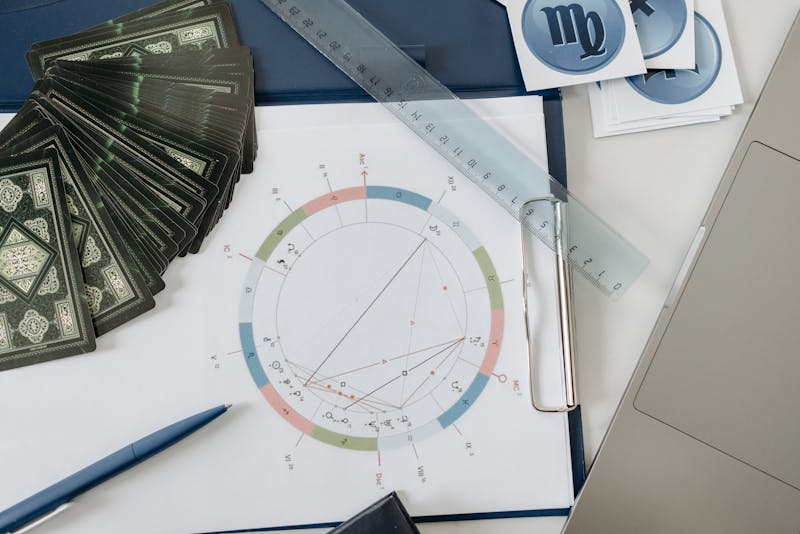
Astrology chart and tarot cards with zodiac symbols
What to Look For
Strong connections between personal planets (Sun, Moon, Mercury, Venus, Mars): These create the day-to-day experience of the relationship. If personal planets connect well, the relationship feels engaging.
Saturn contacts: At least one Saturn aspect to a personal planet suggests the relationship has staying power. Without Saturn, relationships can be exciting but impermanent.
Outer planet contacts (Uranus, Neptune, Pluto to personal planets): These create intensity and transformation. Pluto contacts in particular indicate relationships that change you fundamentally.
Node contacts: When someone's planet conjuncts your North Node, the relationship has a fated quality, as if this person is connected to your soul's evolutionary direction.
Common Misconceptions
"Our signs are incompatible." Sun sign compatibility is real but limited. Two people with "incompatible" Sun signs might have beautifully compatible Moon signs, Venus-Mars chemistry, and supportive Saturn contacts. The chart-to-chart comparison is what matters, not the Sun sign alone.
"We have mostly squares, so it won't work." Squares create growth. Some of the most enduring, transformative relationships are held together by squares. The question isn't whether you have friction, but whether both people are willing to grow through it.
"We need to have matching elements." While shared elements (both fire signs, both water signs) create natural understanding, the most complete relationships often involve some element tension. Fire needs earth for grounding; water needs air for perspective.
Synastry reveals potential, not destiny. Two charts with extraordinary compatibility still require two people willing to show up and do the work. And two charts with significant challenges can produce a remarkable relationship if both people are committed to conscious growth.