
Five of Wands Tarot Card Meaning: Upright, Reversed, Love, Career, and More
Five young men swing wooden wands at each other in what appears to be a chaotic brawl. Wands cross in every direction. Bodies lean in. Arms swing wide. But look closer. Nobody's bleeding. Nobody's falling. Nobody's even trying to land a decisive blow. The five figures are dressed in different colored tunics, each one representing a different personality, a different agenda, a different way of approaching the same problem. The ground beneath them is flat and featureless, offering no tactical advantage to anyone. The sky behind them is clear. This isn't a battle to the death. It's a struggle for position, a competition where everyone's fighting to be heard, to be right, to be the one whose wand rises above the others. It's loud. It's frustrating. And it's not going to end until someone figures out how to channel this chaos into something productive.
This is the Five of Wands, and it marks the first real disruption in the Wands suit's journey. The Ace was pure inspiration. The Two was planning. The Three was expansion. The Four was celebration. Now the Five introduces what every fire eventually encounters: other fires. Other wills. Other egos. Other people who want the same thing you want, or who want something completely different and refuse to get out of your way. Welcome to the arena.
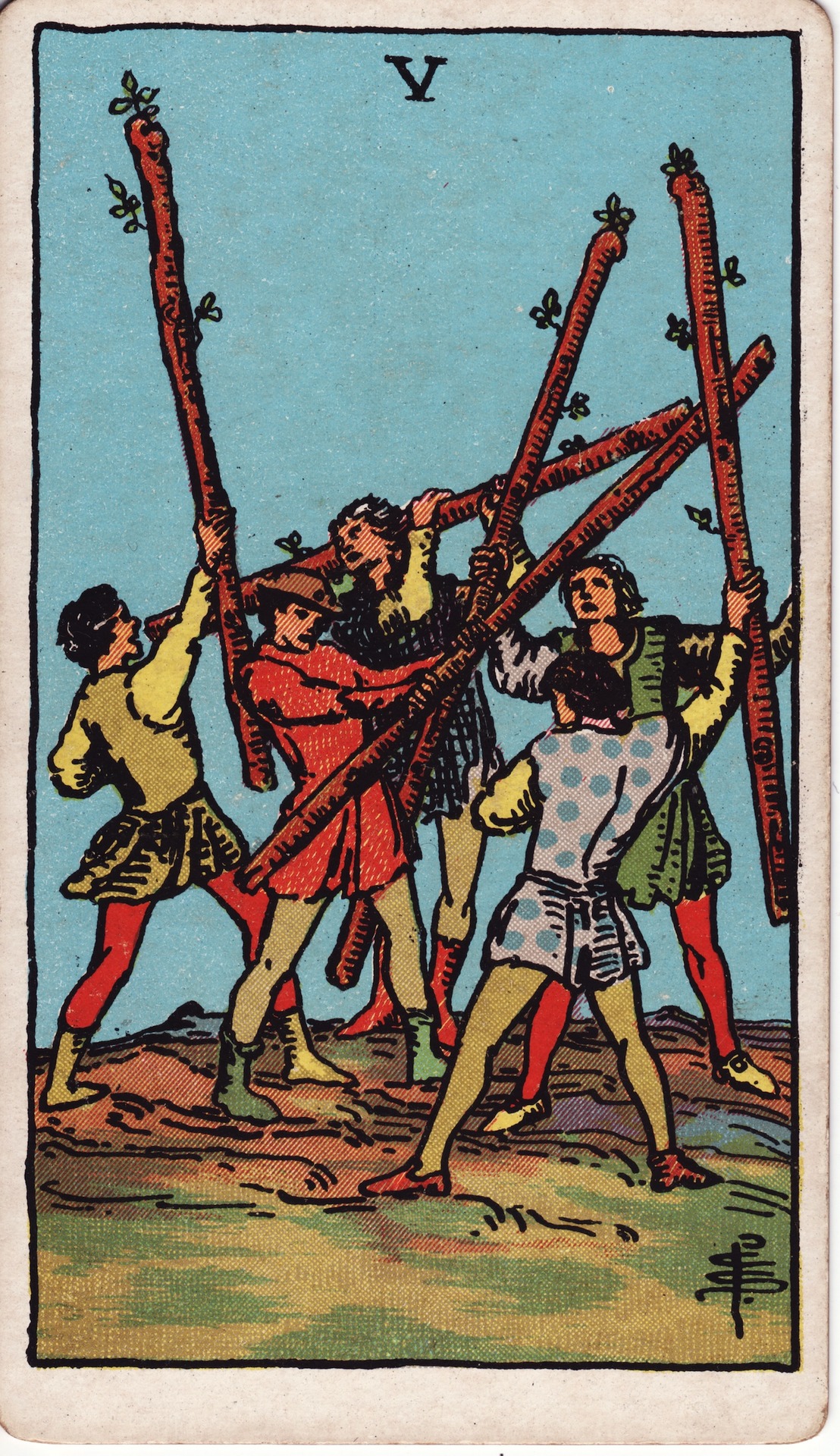
Five Of Wands - Rider-Waite-Smith Tarot
Table of Contents
Key Themes and Symbolism
The Five of Wands captures the energy of creative conflict, competitive struggle, and the friction that arises when multiple strong wills collide.
The five figures. Five different people, five different colored tunics, five different wands swinging in five different directions. The diversity is the point. This isn't a unified army fighting a common enemy. It's five individuals, each pursuing their own agenda, clashing because their paths have converged in the same space. The Five of Wands describes what happens when people with different styles, values, or objectives are forced to share the same arena.
The lack of coordination. Nobody is working together. Nobody is even trying to. Each figure is swinging independently, reacting to the nearest threat rather than pursuing a strategy. This is the hallmark of Five of Wands conflict: it's disorganized, ego-driven, and reactive rather than purposeful. The energy is high but unfocused. There's plenty of fire but no direction.
The wooden wands. Not swords. Not weapons designed to kill. Wands are tools of creative expression, will, and ambition. The conflict in this card isn't truly dangerous. It's uncomfortable, frustrating, and exhausting, but it's not lethal. This is the difference between the Fives of Wands and Swords: Swords can cut deep. Wands bruise. The Five of Wands' struggle is the kind you survive and learn from, not the kind that destroys you.
The flat, featureless ground. No one has the high ground. No one has a fortress or a defensive position. The playing field is literally level. This means the competition is fair, if chaotic. Whatever advantage you gain will come from your own ability, not from your position. The flat ground also suggests that the conflict happens in the open rather than behind closed doors. Everyone can see what's happening. There's no subtlety here.
The clear sky. Unlike darker conflict cards, the Five of Wands' sky is bright and open. The conflict isn't existential or apocalyptic. It's the kind of friction that happens on a clear day when energetic people with competing ideas bump into each other. The clear sky suggests that once the conflict resolves, the conditions remain fundamentally favorable. This storm is temporary.
The number five. Fives in tarot represent disruption, challenge, instability, and the growing pains that occur after the stability of the Fours. Every suit's Five introduces a complication that tests what the preceding cards built. In Wands, that test takes the form of competitive friction: multiple fires competing for the same fuel. The challenge isn't external disaster. It's the internal chaos that arises when ambition meets opposition.

Two muscular men competing in an intense arm wrestling match showcasing the strength and determination at the heart of the Five of Wands
Upright Meaning
When the Five of Wands appears upright, you're in the middle of a struggle, and the struggle has a purpose.
General
The Five of Wands upright is the card of competition, conflict, creative tension, disagreement, and the chaotic energy that arises when multiple strong personalities or agendas collide. It appears when you're facing opposition, whether from other people, competing priorities within your own life, or the friction between your ambitions and the reality of what's required to achieve them.
The crucial insight about the Five of Wands is that its conflict isn't destructive. It's developmental. Athletes get better by competing against worthy opponents. Ideas get sharper by being challenged. Plans get stronger when they survive scrutiny. The Five of Wands' friction is the kind that produces growth, even though it doesn't feel like growth while you're in it. It feels like chaos, frustration, and the maddening experience of being surrounded by people who won't cooperate.
This card often appears during periods of creative ferment: brainstorming sessions where every idea gets challenged, collaborative projects where strong personalities clash, or any situation where the diversity of perspectives is both the problem and the solution. The Five doesn't ask you to eliminate the conflict. It asks you to engage with it productively.
There's also an internal dimension to the Five of Wands. Sometimes the five competing figures represent different parts of yourself: the ambitious part that wants to charge forward, the cautious part that wants to hold back, the creative part that wants to experiment, the practical part that wants to stick with what works. When these inner voices are all shouting at once, the result feels exactly like the card's image: chaotic, uncoordinated, exhausting. The card says: pick a direction. You can't swing every wand at once.
Love
In love readings, the Five of Wands upright indicates friction, disagreements, and the competitive dynamics that can arise in relationships. This isn't the soul-destroying conflict of the Five of Swords. It's the bickering, the petty arguments, the struggle to be right, the clash of egos that happens when two strong-willed people share a life. The arguments might be about small things, but they're persistent, and the cumulative effect is exhausting.
For couples, the Five says you're butting heads more than connecting. The relationship isn't in danger of ending, but the constant friction is wearing both of you down. The conflict often stems from competition within the relationship: who decides where to eat, how to spend the weekend, which way to load the dishwasher. The underlying issue isn't any specific disagreement. It's the power dynamic. Both partners want to feel heard, and neither is yielding enough to let the other speak.
For singles, the Five of Wands can indicate that the dating scene feels like a competitive arena. Too many options, too much noise, too many people trying to stand out, and nobody making a genuine connection because everyone's performing instead of being present. The card can also indicate that you're attracted to people who challenge you, which is exciting but exhausting in equal measure.
Career
In career readings, the Five of Wands upright points to workplace competition, disagreements among colleagues, and the friction that arises in competitive professional environments. You might be competing for a promotion with several qualified candidates. Your team might be arguing about the direction of a project. The office politics might be more intense than usual, with everyone vying for visibility and recognition.
This card doesn't indicate that the competition is unfair or that you should withdraw from it. It indicates that the competition is real and you need to engage with it skillfully. The Five of Wands favors people who can assert themselves without burning bridges, who can advocate for their ideas without dismissing others', and who understand that the goal isn't to eliminate the opposition but to rise above it through the quality of their contribution.
For entrepreneurs, the Five of Wands often represents market competition. Your product or service isn't the only one. Competitors are crowding the same space. The card says: differentiate. Don't fight on their terms. Find the angle that's uniquely yours.
Finances
Financially, the Five of Wands upright warns of competing demands on your resources. Multiple expenses fighting for the same limited funds. Financial decisions that feel like no-win situations because every option requires sacrificing something else. The card doesn't indicate financial crisis. It indicates financial friction, the kind of tension that arises when your money has to do more than it comfortably can.
This card can also indicate financial competition: bidding wars on property, competitive pricing situations, or investment environments where everyone's chasing the same opportunity. The Five says that in competitive financial situations, the advantage goes to the person who's done the most homework and can act decisively when others are still hesitating.
Health
In health readings, the Five of Wands upright can indicate the physical manifestation of stress and conflict. Tension headaches. Muscle tightness from holding your body in a state of readiness. Digestive issues from the anxiety of constant competition. The card says your body is absorbing the friction in your life, and it needs relief.
This card also points to the health benefits of competitive physical activity. The Five of Wands' energy is most naturally expressed through sports, martial arts, competitive fitness, or any physical discipline that channels aggression and competitive drive into structured, healthy outlets. If you've been bottling up your frustration, the Five says: go hit something (safely and consensually, in a gym or a dojo).
The Five can also indicate that you're getting conflicting health advice from different practitioners or sources. Too many opinions, not enough clarity. The solution is to pick one approach, commit to it fully, and evaluate the results before changing course.
Reversed Meaning
When the Five of Wands appears reversed, the conflict is either resolving or being avoided.
General
The Five of Wands reversed describes two very different patterns: the resolution of conflict or the unhealthy avoidance of it.
Conflict resolution is the more positive interpretation. The fighting has died down. The competing parties have found common ground, or at least agreed to stop swinging. The chaos that characterized the upright card is settling into something more manageable. If you've been in the middle of a prolonged struggle, the reversed Five says the worst of it is passing. You can lower your guard.
Conflict avoidance is the shadow side. Instead of engaging with the disagreement, you're pretending it doesn't exist. Instead of competing openly, you're withdrawing from the arena entirely. Instead of asserting your position, you're people-pleasing to avoid friction. The reversed Five in this form says the conflict hasn't resolved. It's been suppressed, and suppressed conflict doesn't disappear. It festers.
There's also an internal version of the reversed Five: the attempt to silence your own competing inner voices by refusing to listen to any of them. The creative tension between different parts of yourself gets resolved not through integration but through shutdown. You stop wanting things because wanting things leads to internal conflict. This is a surrender disguised as peace.
Love
In love, the Five of Wands reversed often indicates that a period of bickering and friction is coming to an end. You and your partner have found a way to communicate that doesn't involve constant combat. The arguments are decreasing. The power struggles are settling. If you've been working on the relationship, the reversed Five validates that the work is paying off.
However, the reversed Five can also indicate a relationship where important disagreements are being swept under the rug rather than addressed. Both partners are avoiding conflict because they're afraid of what honest communication would reveal. The surface feels calm, but the tension hasn't gone anywhere. It's just stopped being expressed, which isn't the same as being resolved.
For singles, the reversed Five can suggest that you're withdrawing from the dating scene to avoid the competitive, chaotic energy it involves. This might be a healthy break, or it might be avoidance of the vulnerability that dating requires.
Career
In career readings, the Five of Wands reversed points to decreasing workplace tension and a more collaborative environment. The competitive phase is easing. People are starting to work together instead of against each other. If you've been in a stressful professional environment, the reversed Five says the pressure is lightening.
This card reversed can also indicate that you're backing down from a professional challenge when you shouldn't be. Withdrawing your proposal because someone criticized it. Not applying for the promotion because you don't want to compete. Letting your ideas go unvoiced because the meeting feels too contentious. The reversed Five asks: is your avoidance of conflict costing you opportunities?
Finances
Financially, the Five of Wands reversed suggests that competing financial pressures are starting to ease. The budget is stabilizing. The bidding war has ended. The financial decisions that felt impossible are becoming clearer as options narrow. The reversed Five in finances is generally a relief: the chaos is resolving.
However, the card reversed can also indicate financial passivity, avoiding financial decisions because they feel too contentious or complicated. Not negotiating your salary because you hate conflict. Not challenging a billing error because the confrontation feels too stressful. The reversed Five says some financial situations require you to fight for your interests.
Health
In health readings, the Five of Wands reversed indicates decreasing physical tension and stress. The body is calming down. The stress-related symptoms are easing. The chronic tension that came from constant competition or conflict is finally releasing.
This card reversed can also signal that you've stopped challenging yourself physically and need to reintroduce some healthy competition or intensity into your fitness routine. Without any friction, the body doesn't grow stronger. The reversed Five says a little constructive stress keeps you sharp.
Card Combinations
The Five of Wands' meaning shifts with its neighbors.
Five of Wands and Strength. A powerful combination that pairs conflict with inner mastery. Strength shows that the way through the Five's chaos isn't brute force but patience, courage, and the willingness to meet aggression with composure. Together, they say: you're in a fight, and you'll win it not by being the loudest or the most aggressive, but by being the most centered. This combination strongly favors diplomatic approaches to conflict and the quiet confidence that disarms opponents without escalating tension.
Five of Wands and The Tower. Conflict escalating to crisis. The Tower amplifies the Five's friction into something genuinely disruptive. Together, they warn that what seems like petty competition or manageable disagreement is about to blow up into something larger. The combination says: address the conflict now, before the Tower's lightning strikes and the small fire becomes a conflagration.
Five of Wands and The Sun. A reassuring combination that places the Five's conflict in the context of ultimate success. The Sun says the current struggle is temporary and the outcome is positive. The competition you're experiencing is part of the process that leads to the Sun's joy and clarity. Together, they say: the fight is real, but so is the victory on the other side of it.
Five of Wands and Four of Wands. The sequential pairing of celebration and conflict. The Four of Wands represents harmony and milestone joy. The Five represents the disruption that follows stability. Together, they describe the universal experience of reaching a peak only to discover new challenges on the other side. The combination normalizes this pattern: every achievement creates new territory, and new territory always involves friction.
Astrological Connections
The Five of Wands corresponds to Saturn in Leo, specifically the first decan of Leo (roughly July 22 through August 1 in the tropical zodiac).
Saturn in Leo is one of astrology's most inherently tense combinations. Saturn is the planet of limitation, discipline, restriction, and hard-won mastery. Leo is the sign of creative self-expression, confidence, generosity, and the need to shine. When you put Saturn's heavy hand on Leo's radiant energy, the result is frustration: the desire to express yourself freely running headfirst into obstacles, restrictions, and the demands of a world that isn't automatically impressed by your talent.
This Saturn-in-Leo tension perfectly captures the Five of Wands' energy. You want to shine. Others want to shine too. The space for recognition feels limited. The competition for attention, resources, and acknowledgment is fierce because Saturn insists there isn't enough to go around, while Leo insists that everyone deserves their moment in the spotlight. The result is the chaotic, everyone-for-themselves energy of the Five of Wands.
Saturn's presence gives the Five its developmental quality. Saturn doesn't create problems for entertainment. It creates problems that teach. The competition the Five describes isn't pointless. It's the process through which you discover what your creative fire is actually made of. The opponent makes you better. The restriction forces innovation. The frustration builds the resilience you'll need for the more difficult challenges ahead.
In your natal chart, Saturn's position describes where your most challenging lessons lie and what kind of mastery you're building over a lifetime. Saturn in fire signs (Leo, Aries, Sagittarius) or in hard aspect to the Sun often correlates with a personal experience of the Five of Wands' tension: the ongoing struggle between the desire to express yourself and the obstacles that stand in the way. The lesson isn't that expression is wrong. It's that expression worth having requires effort, persistence, and the willingness to compete.
Leo transits, particularly when Saturn or Mars pass through Leo, can activate Five of Wands themes in the collective energy: increased competition, creative friction, and the struggle for recognition that characterizes this card.
Reading Tips for the Five of Wands
Normalize the conflict. The Five of Wands' friction is normal, healthy, and temporary. When it appears, help the querent understand that the struggle isn't a sign that something has gone wrong. It's a sign that they're in an arena where growth happens. Competition means they're in the game. Friction means they're moving.
Identify the opponents. Ask who or what the querent is competing with. Sometimes the answer is obvious (a colleague, a rival, a competitor). Sometimes the competition is internal (competing priorities, conflicting desires, different parts of the self pulling in different directions). The advice changes based on whether the conflict is external or internal.
Don't dismiss the frustration. The Five of Wands is genuinely annoying to experience. Constant friction wears people down. Acknowledge that the querent is tired of the fighting, even if the fighting is productive. You can validate their frustration while still helping them see the growth potential in the situation.
Reversed can mean both things. The reversed Five of Wands either means the conflict is resolving or it's being avoided. The surrounding cards and the querent's situation will clarify which interpretation applies. Ask: "Has the fighting stopped because the issue was resolved, or because everyone gave up?"
Connect it to the suit's story. After the celebration of the Four of Wands, the Five is the inevitable challenge that follows success. Every new level brings new obstacles. Placing the Five in this narrative context helps the querent understand that the conflict isn't random. It's the natural next step in their creative development.
Frequently Asked Questions
Is the Five of Wands a yes or no card?
The Five of Wands leans toward "no," or more accurately, "not easily." It indicates obstacles, competition, and friction that stand between you and your desired outcome. The path forward exists, but it requires fighting for your position rather than gliding through. If your question is "will this go smoothly?" the Five says no, there will be challenges. If your question is "is this worth pursuing despite the competition?" the Five says yes, but prepare for a fight. Reversed, the card shifts toward a cautious "yes" as the obstacles begin to clear.
What does the Five of Wands mean in a love reading?
In love, the Five of Wands represents friction, bickering, and the competitive dynamics that arise between partners. This isn't the deep betrayal of the Five of Swords or the heartbreak of the Three of Swords. It's the everyday conflict of two people with their own egos, preferences, and communication styles trying to share a life. The arguments might feel petty, but they add up. The card asks whether you're fighting about the real issue or using small conflicts as proxies for something bigger that neither of you wants to name. For singles, it indicates a competitive dating environment where standing out requires genuine effort.
Is the Five of Wands a bad card?
The Five of Wands isn't a bad card. It's an uncomfortable one. The conflict it describes is the productive kind: the friction that sharpens your skills, clarifies your priorities, and proves what your ambitions are made of. Athletes don't get better by practicing alone. Ideas don't get stronger without being challenged. The Five of Wands says you're in the arena, and the arena is where growth happens. The discomfort is real, but it's temporary, and what comes out the other side is stronger than what went in.
What is the difference between the Five of Wands and the Five of Swords?
The Five of Wands and the Five of Swords both involve conflict, but with fundamentally different stakes and outcomes. The Five of Wands is competitive friction: think sports match, heated debate, creative clash. Nobody gets seriously hurt, and the competition can produce growth. The Five of Swords is destructive conflict: think betrayal, humiliation, winning at someone else's expense. The Five of Wands leaves bruises. The Five of Swords leaves scars. If the Five of Wands is a sparring match, the Five of Swords is a knife fight. The Wands card challenges you to compete. The Swords card warns that the victory may not be worth the cost.
What zodiac sign is the Five of Wands associated with?
The Five of Wands corresponds to Saturn in Leo, specifically the first decan of Leo (approximately July 22 through August 1). Saturn is the planet of limitation, discipline, and hard-won mastery. Leo is the sign of creative self-expression, confidence, and the desire to shine. Together, they produce the Five's distinctive tension between wanting to express yourself and encountering obstacles that restrict that expression. People with Saturn in Leo in their natal chart often experience this card's themes as a lifelong pattern: the ongoing work of building creative confidence in the face of restriction and competition.
For deeper exploration of all 78 cards, visit the Celesian tarot reader. To understand how Saturn and Leo energy express in your personal astrology, explore your Saturn placement and Leo houses with the natal chart calculator. And to continue through the suit of Wands, look back at the Four of Wands, whose celebration the Five now disrupts with competitive friction, and ahead to the Six of Wands, where the battle is won and the struggle transforms into the triumph of public recognition and victory.