
Six of Cups Tarot Card Meaning: Upright, Reversed, Love, Career, and More
In a garden courtyard of an old village, a young boy leans down to offer a cup filled with white flowers to a smaller girl. Six golden cups are arranged around them, each brimming with blooms. The scene is unhurried, gentle, touched with a quality of light that makes everything look the way your happiest childhood memories feel when you close your eyes and visit them. A guard or older figure walks away in the background, leaving the children to their world. The buildings behind them are old and solid, suggesting a family home, a place where generations have lived and loved. Nothing about this scene is urgent, dramatic, or complicated. It's a picture of simple kindness between two people who don't yet know that the world can be anything other than kind.
After the Five of Cups' devastating grief, the Six of Cups arrives like a warm hand on a cold shoulder. The Five stood over spilled cups mourning everything that was lost. The Six looks backward in time to a moment when the cups were full, the garden was blooming, and love was given freely without conditions or calculations. This isn't escape. It's medicine. The Six of Cups understands that sometimes, when the present is painful and the future feels uncertain, the most healing thing you can do is remember a time when the world felt safe, when love was simple, and when a cup of flowers was the most generous gift imaginable.
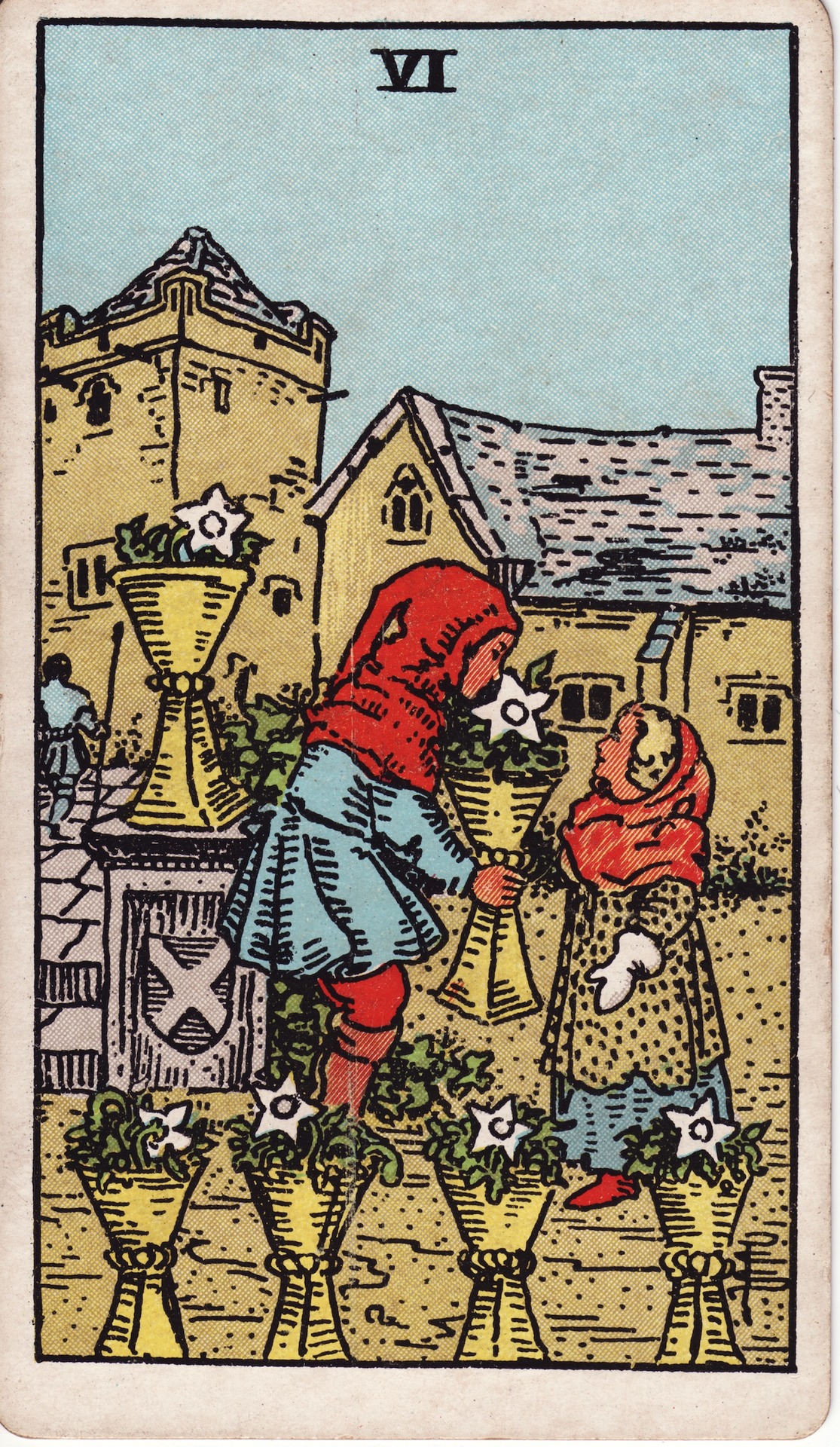
Six Of Cups - Rider-Waite-Smith Tarot
Table of Contents
Key Themes and Symbolism
The Six of Cups paints a scene of emotional innocence and the tender power of memory. Every detail reinforces the card's themes of nostalgia, generosity, and return.
The two children. Children appear rarely in the tarot, and their presence here is deliberate. Children represent innocence, the state of being before the world teaches you to guard your heart. The older child offering the cup to the younger one embodies generosity without expectation, the kind of giving that happens naturally before we learn to keep score. This isn't a transaction. It's a gift, pure and simple, given because giving feels good and because the person receiving it will be happy. The children remind us that we were all capable of this once, and that the capacity hasn't disappeared. It's just been buried under years of learning to protect ourselves.
The cups filled with flowers. Unlike most Cups cards where the cups hold water (emotion), these cups hold flowers (beauty, growth, natural abundance). The flowers transform the cups from vessels of feeling into vessels of offering. They're gifts, arrangements of beauty prepared with care and presented with love. Each cup is a small act of kindness made tangible, a gesture that says: I thought of you. I made this for you. I want you to have something beautiful.
The old village. The buildings in the background are old, established, rooted. They suggest ancestral homes, family history, the places where you grew up and that shaped who you became. The village isn't grand or luxurious. It's comfortable, familiar, the kind of place where everyone knows each other and the streets are safe enough for children to play unsupervised. The setting connects the Six of Cups to home in its deepest sense: not just where you live now but where you came from.
The departing figure. In the background, an adult figure walks away from the scene. This figure is often interpreted as the passage of time, the adult world receding to allow the children their moment of innocent exchange. It can also represent the protective presence of someone who has created the safe space in which this tenderness can happen: a parent, a guardian, someone who built the village and its safety so that children could play in gardens and share flowers without fear.
The six cups. Six is the number of harmony, balance, and the resolution of conflict that the Five created. After the Five's crisis, the Six restores equilibrium. The six cups arranged throughout the scene are all upright, all full, all intact. Nothing has been spilled. Nothing has been broken. The abundance that the Five mourned as lost is here again, expressed through a different time and a different kind of fullness: not the mature emotional abundance of adult relationships but the unguarded, effortless abundance of childhood love.

Vintage family photographs with daisies and an antique key evoking the warmth of cherished memories and the nostalgic pull of the past that defines the Six of Cups
Upright Meaning
When the Six of Cups appears upright, the past is reaching toward you with something warm in its hands.
General
The Six of Cups upright represents nostalgia, childhood memories, innocence, reunion, and the comfort of returning to something familiar. When this card appears, the past is playing a significant role in your present experience. This might mean literally encountering people from your past: an old friend who reaches out, a childhood sweetheart who reappears, a family reunion that stirs feelings you haven't accessed in years. Or it might mean emotionally revisiting the past: remembering who you were before the world complicated you, reconnecting with the simple joys that once came naturally, or finding healing in the memories that still glow with warmth.
The card also represents generosity and kindness, the kind of giving that doesn't calculate returns. The older child offers the cup without conditions, without expecting payment, without holding the gift over the younger child's head. When the Six of Cups appears, you're either receiving this kind of unconditional generosity or being called to practice it. Either way, the card's message is that the purest form of love is the one that gives freely, the one that remembers what kindness felt like before we learned to attach strings to it.
There's a healing dimension here as well. The Six of Cups often appears during periods of emotional recovery, particularly recovery from the kind of pain the Five of Cups represents. The memory of better times isn't denial. It's evidence. It proves that happiness existed before and can exist again. The past isn't just a place you left. It's a resource you can draw from.
Love
In love readings, the Six of Cups is one of the sweetest, most tender cards in the deck. It represents love in its most innocent form: playful, generous, uncomplicated by the power dynamics and defense mechanisms that adult relationships so often develop. If you're in a relationship, the Six of Cups suggests a period of returning to what made you fall in love in the first place. The in-jokes. The shared memories. The quality of attention you gave each other when everything was new. This card asks you to stop being partners who manage a household and start being the two people who couldn't stop talking on that first date.
For singles, the Six of Cups frequently indicates the return of someone from your past. An ex who reaches out. A childhood crush who reappears. A friend from years ago whose renewed presence sparks something unexpected. The card doesn't promise that this reconnection will lead to lasting romance. It says the past is offering something, and it's worth at least looking at what's being offered.
This card can also represent the love between family members, particularly the bond between parents and children. If family is on your mind, the Six of Cups affirms that those bonds are strong, nourishing, and worth investing in.
Career
The Six of Cups in career readings can indicate a return to a previous job, industry, or professional role. A former employer might reach out. A career path you abandoned years ago might become relevant again. A skill you developed earlier in life, something you thought was behind you, might be exactly what's needed now. The card encourages you to see your entire professional history as an asset, not just your most recent experience.
This card can also suggest that finding professional fulfillment requires reconnecting with what you loved doing before career pressures and practical concerns redirected you. What did you want to be when you grew up? What activities made you lose track of time as a child? The Six of Cups says those early impulses contain real information about where your professional heart belongs.
Finances
Financially, the Six of Cups represents gifts, inheritances, or financial support that comes from family or past connections. Money from parents or grandparents. An inheritance from a relative. Financial help from an old friend. The card's financial energy is generous and familial rather than transactional. Money flows because of love and history rather than because of contracts and obligations.
This card can also suggest returning to financial habits that worked for you in the past. Maybe the budgeting system you used years ago was more effective than your current approach. Maybe the simple financial principles you learned as a child (spend less than you earn, save a little every month) are wiser than the complicated strategies you've been chasing.
Health
In health readings, the Six of Cups upright represents the healing power of emotional comfort, family support, and the activities that made you feel good as a child. If your health has been suffering, consider reconnecting with physical activities you enjoyed when you were young, before exercise became a chore and movement became a prescription. What did your body love to do when it was free to play rather than obligated to perform?
The card can also indicate health issues connected to childhood: childhood illnesses that have long-term effects, health patterns established in early life, or the healing of childhood emotional wounds that have been manifesting physically in adulthood.
Reversed Meaning
When the Six of Cups appears reversed, the past has become a trap rather than a resource.
General
The Six of Cups reversed represents being stuck in the past, refusing to grow up, unhealthy nostalgia that prevents present engagement, or the painful realization that you can't go back to the way things were. The warm glow of the upright card has become a prison of idealization, where the past is remembered as perfect and the present can never compete.
This reversal can also indicate childhood trauma or unresolved issues from early life that are affecting your current functioning. Instead of the innocent garden scene, the reversed Six points to a childhood that wasn't safe, a past that holds pain rather than comfort, or memories that need processing rather than revisiting. If this resonates, the card is asking you to address the past honestly rather than either idealizing it or running from it.
In another expression, the reversed Six can represent the refusal to accept adult responsibilities. The inner child has taken over, and while inner children are wonderful for play, creativity, and emotional authenticity, they aren't equipped to navigate adult challenges. The card asks: are you using nostalgia as medicine, or as an escape?
Love
In love readings, the Six of Cups reversed can indicate an inability to move on from a past relationship. You're comparing every new person to an ex. You're idealizing a relationship that ended for valid reasons. You're living in the memory of what love was rather than engaging with what love could be now. The reversed Six asks you to let the past be the past so the present has room to become something real.
This reversal can also indicate a past relationship returning in an unhealthy way. The ex who shows up isn't bringing flowers. They're bringing old patterns, unresolved conflicts, and the same dynamics that ended things the first time. Not every reunion is a gift. Some are tests of whether you've learned enough to not repeat the same mistakes.
Career
The Six of Cups reversed in career readings suggests professional stagnation caused by clinging to outdated approaches, old roles, or past successes that no longer apply. The industry has moved on, but you're still operating from a playbook that expired years ago. The skills that made you successful at twenty-five might not be what you need at forty. The reversed Six asks you to honor your professional past without being imprisoned by it.
Finances
Financially, the Six of Cups reversed warns against financial dependency, particularly on family or past sources of support that aren't sustainable. Living off an inheritance without building your own income. Relying on parents well into adulthood without developing financial independence. The card reversed says: the financial safety net of the past was a gift. Don't mistake it for a permanent structure.
Health
In health readings, the Six of Cups reversed can point to childhood health issues resurfacing, or to health habits from the past that are no longer serving you. The comfort foods from childhood are comforting but undermining your adult health. The sedentary habits of your upbringing are patterns that need breaking. The reversed Six asks you to distinguish between past habits that genuinely nourish you and past habits you've kept only because they're familiar.
Card Combinations
The Six of Cups' nostalgic energy interacts meaningfully with other cards.
Six of Cups + The Lovers. A powerful romantic combination suggesting a soul-level connection rooted in shared history. The Lovers brings the dimension of choice and alignment while the Six brings the dimension of history and shared memory. Together, they often indicate a relationship that feels like coming home, a connection with someone who may have been in your life before, whether literally (a childhood friend turned romantic partner) or in a more spiritual sense (a soul connection that transcends a single lifetime).
Six of Cups + Five of Cups. Grief and nostalgia side by side. The Five's mourning of what's been lost meets the Six's tender remembrance of what once was. This combination often appears when someone is processing a significant loss and finding comfort in memories. The message: the pain is real, and so is the beauty that came before it. Both can coexist.
Six of Cups + The World. A cycle completing through return. The World represents completion, integration, and the ending of a major phase. Paired with the Six of Cups, it suggests that the way forward involves a return to something from the past, a full circle back to your origins that allows you to integrate who you were with who you've become. Coming home, but as a different person.
Six of Cups + Four of Cups. A subtle pairing. The Four's apathy meets the Six's nostalgia, suggesting that the dissatisfaction you're feeling might be healed by reconnecting with something from your past rather than chasing something new. The cure for boredom might not be novelty. It might be remembering what used to make you come alive.
Astrological Connections
The Six of Cups is associated with Sun in Scorpio in the Golden Dawn system, a combination that sounds contradictory but reveals the card's depth.
The Sun represents vitality, identity, warmth, and the conscious self. In Scorpio, the Sun illuminates the sign of depth, intensity, transformation, and the hidden realms of memory and the unconscious. Sun in Scorpio doesn't skim surfaces. It dives deep, and what it finds in those depths it brings back into the light. Applied to the Six of Cups, Sun in Scorpio explains why this card's nostalgia isn't shallow or sentimental. It reaches into the deepest layers of memory and emotional history, pulling up experiences that shaped who you are at your core.
Scorpio's connection to death, rebirth, and transformation adds complexity to the Six of Cups' apparently simple imagery. The children in the garden aren't just cute. They represent a version of you that existed before loss, before betrayal, before the kind of Scorpionic experiences that fundamentally alter a person. The Six of Cups doesn't pretend those experiences didn't happen. It reaches past them, through them, to find the original template: the person you were before the world changed you, and the qualities you carried then that you still carry now, even if they're buried deep.
The Sun's warmth in this placement also explains the card's emotional tone. Despite Scorpio's intensity, the Six of Cups feels gentle and warm. That's the Sun's doing, taking Scorpio's depth and illuminating it with golden light, turning what could be a dark dive into the past into a tender, healing remembrance.
If you have strong Scorpio placements in your natal chart, the Six of Cups may resonate as a card about the way deep memories shape your emotional landscape. When the Sun transits Scorpio each autumn, the Six of Cups' themes often surface: thoughts of family, childhood, people you haven't seen in years, and the particular kind of emotional depth that comes from remembering who you were at the beginning.
Reading Tips for the Six of Cups
Consider whether the past is a resource or a refuge. The Six of Cups' relationship with the past can be healthy (drawing strength from good memories, reconnecting with what matters) or unhealthy (hiding in nostalgia, refusing to engage with the present). The surrounding cards and the querent's situation will determine which interpretation applies. A person in recovery from grief might genuinely need the Six's comfort. A person chronically avoiding adult responsibilities might need its reversal.
Watch for literal appearances of past people. The Six of Cups frequently predicts the reappearance of someone from the querent's past. An old friend, a former colleague, a childhood companion, an ex-partner. When this card appears, ask: who from your past has been on your mind lately? The answer often reveals what the card is pointing toward.
Don't overlook the generosity theme. The card's nostalgic dimension gets the most attention, but the act of giving is equally central. The older child offers the cup freely, without conditions. This card often appears when unconditional generosity, either given or received, is the reading's central message.
Read the card's emotional temperature. The Six of Cups feels different from most other cards. It's soft, warm, quietly beautiful. That emotional temperature is part of the reading. Whatever the Six of Cups is pointing toward, it carries that quality of gentleness. The experience it describes isn't dramatic or intense. It's tender, like a hand on your cheek from someone who's known you your whole life.
Frequently Asked Questions
Does the Six of Cups mean an ex is coming back?
It can, and this is one of the card's most well-known associations. The Six of Cups frequently appears when someone from the past is about to re-enter your life, and in love readings, that person is often a former romantic partner. However, the card doesn't guarantee that this return will lead to a renewed relationship. It says the past is reaching toward you. Whether you accept what's being offered, and whether that offering is genuinely good for you now, requires the discernment that the surrounding cards and your own wisdom provide.
What does the Six of Cups mean as feelings?
When the Six of Cups represents someone's feelings, it indicates warm, tender, nostalgic affection. This person associates you with comfort, safety, and the feeling of home. Their feelings are gentle rather than passionate, rooted in history and familiarity rather than in new, exciting chemistry. They feel about you the way you feel about your favorite childhood memory: soft, warm, full of an ache that's more sweet than painful. If this person knew you in the past, their feelings are colored by everything you shared. If they didn't, they feel an inexplicable sense of familiarity with you, as if they've known you longer than they actually have.
Is the Six of Cups a yes or no card?
The Six of Cups is a gentle yes, especially for questions about reconnecting with people from your past, revisiting previous decisions, returning to familiar places, or any situation where the past plays a meaningful role in the future. The yes comes with warmth and softness rather than urgency. It says "yes, this is worth exploring" rather than "yes, rush in immediately." For questions about entirely new ventures with no connection to your history, the Six of Cups is more neutral, neither yes nor no. Try the Celesian tarot reader for additional cards that clarify the Six's answer.
Is the Six of Cups about childhood trauma?
In its upright position, the Six of Cups is usually about positive childhood memories and the comfort they provide. In its reversed position, however, the card can point to unresolved childhood issues, painful early experiences, or patterns established in childhood that are creating problems in adult life. The reversed Six of Cups doesn't necessarily indicate severe trauma, but it does suggest that something from early life needs to be examined, processed, and integrated rather than idealized or suppressed.
What should I do when the Six of Cups appears?
Remember. Let yourself be pulled gently backward, not to escape the present but to draw strength from the past. Call the friend you haven't spoken to in years. Look through old photographs. Visit the place where you grew up. Cook the meal your grandmother used to make. Let yourself feel the tenderness that comes with remembering, and then bring that tenderness forward into your current life. The Six of Cups doesn't want you to live in the past. It wants you to bring the best of the past, the innocence, the generosity, the simple joy of giving someone a cup full of flowers, into the present, where you need it most.
The Six of Cups is the tarot's lullaby, a card that rocks you gently and reminds you of a time when the world was smaller, kinder, and full of flowers. It comes after grief to say: you've known happiness before, and you'll know it again. The garden still exists. The cups are still full. The child who gave and received love so easily is still inside you, waiting to be remembered. For a deeper exploration of all 78 cards, visit the Celesian tarot reader. To understand how Sun in Scorpio illuminates the depths of memory and emotion in your personal astrology, explore your natal placements with the natal chart calculator. And to continue through the suit of Cups, look back at the Five of Cups, whose grief the Six now soothes with the balm of memory, and ahead to the Seven of Cups, where the emotional journey enters dreamier territory as imagination, fantasy, and the dizzying array of possibilities challenge you to distinguish what you truly want from what merely glitters.