The Hierophant Tarot Card Meaning: Upright, Reversed, Love, Career, and More
A robed figure sits on a stone throne between two grey pillars inside a grand cathedral. He wears a triple crown and three-layered vestment, each layer representing a different world: the conscious, the subconscious, and the superconscious. In his left hand he holds a triple cross, a papal staff that signifies his authority over the three realms. His right hand is raised in a gesture of benediction, two fingers pointing skyward and two curled inward, a sign that bridges the visible and the hidden. At his feet, two acolytes kneel, their robes decorated with roses and lilies. Between the pillars, the stone floor is cold and deliberate. There's no wilderness here, no untamed landscape. Everything is built, consecrated, and intentional.
This is The Hierophant, card five of the Major Arcana, and he is the keeper of established wisdom. If The High Priestess guards the mysteries that can only be felt, The Hierophant guards the mysteries that have been codified, taught, and passed down through generations. He's the bridge between divine knowledge and human understanding, the teacher who translates revelation into doctrine, intuition into tradition, and spiritual experience into institutions that can carry that experience across centuries.
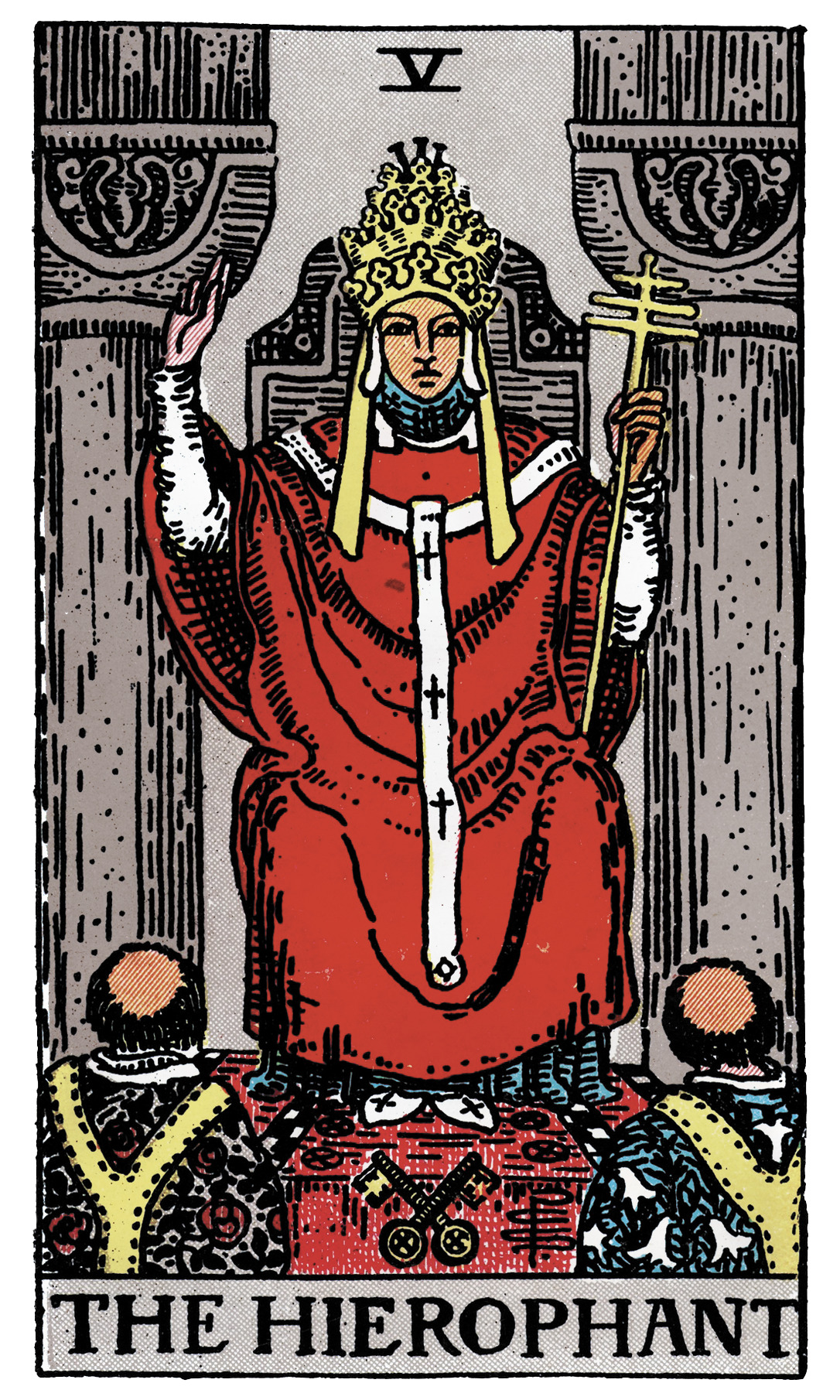
The Hierophant - Rider-Waite-Smith Tarot
Table of Contents
Key Themes and Symbolism
The Rider-Waite-Smith Hierophant is one of the most formally composed cards in the deck. Everything about its imagery communicates order, ceremony, and the weight of inherited knowledge.
The triple crown. Sometimes called the papal tiara, this three-tiered crown represents mastery over three domains: the physical world, the intellectual world, and the spiritual world. The Hierophant's authority isn't limited to earthly matters. He speaks with the voice of something larger than any single human institution. The crown also connects to the triple nature of consciousness that his vestments represent. He understands all three levels, and his teaching integrates them.
The triple cross (papal staff). Held in the left hand (the receptive side), the triple cross echoes the crown's three tiers. Where The Emperor holds a scepter and orb symbolizing dominion over the material world, The Hierophant holds a staff that symbolizes dominion over the spiritual world. His authority comes not from armies or wealth but from knowledge, tradition, and the trust placed in him by those who seek guidance.
The two pillars. Like The High Priestess, The Hierophant sits between two pillars. But where The High Priestess's pillars are marked with mystery (B and J, black and white, representing raw duality), The Hierophant's pillars are plain grey stone, structural and institutional. They represent the established order within which The Hierophant operates. His role isn't to explore the unknown. It's to bring the unknown into known structures that others can access.
The raised hand (benediction). The Hierophant's right hand gesture is deliberate: two fingers point up, two curl down. This is the gesture of blessing and teaching, the sign that what's above can be communicated to what's below. It's the same "as above, so below" principle that The Magician embodies, but formalized into ritual. The Magician channels divine energy through personal will. The Hierophant channels it through ceremony and instruction.
The two acolytes. The kneeling figures represent students, initiates, or followers. They've come to The Hierophant not to find their own path but to learn the path that's already been established. Their robes are decorated with roses (passion, devotion) and lilies (purity, spiritual aspiration), the same symbols at The Magician's feet but here worn by the students rather than growing freely. The energy has been formalized, made into something that can be transmitted from teacher to student.
The crossed keys. At The Hierophant's feet lie two crossed keys, one gold and one silver. These are the keys to heaven, the keys to the kingdom, the keys that unlock sacred knowledge. Gold represents the sun, conscious understanding, and the intellect. Silver represents the moon, subconscious knowledge, and intuition. The Hierophant holds access to both paths of knowing, but he dispenses that access through established channels. You don't just grab the keys. You earn them through study, devotion, and submission to the learning process.
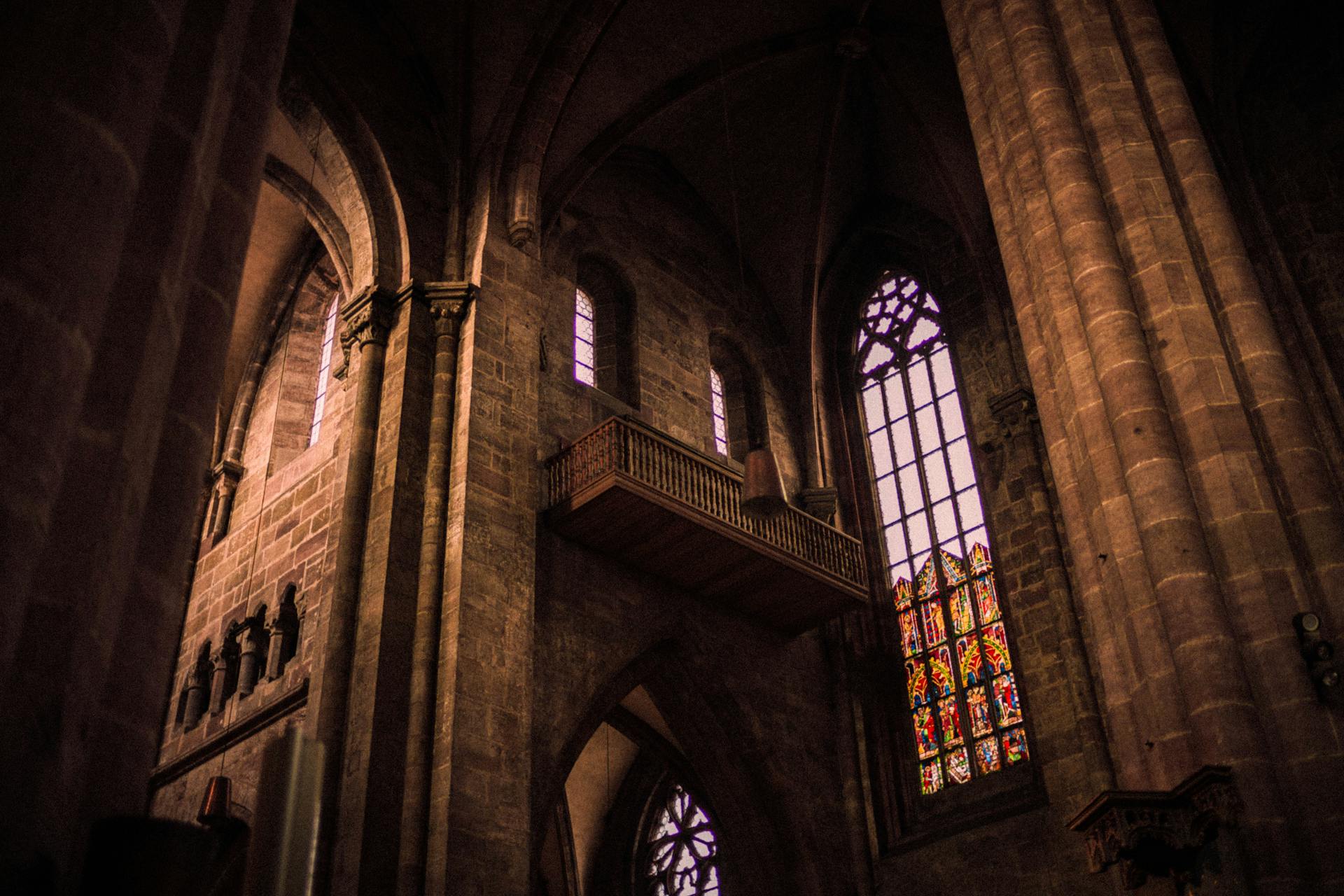
The stone throne and floor. Unlike The Empress's outdoor garden or The Fool's windswept cliff, The Hierophant sits inside a building. The stone floor, the constructed pillars, the enclosed space: these all communicate that his power operates within institutions. Churches, universities, professional organizations, lineages of teaching: these are The Hierophant's domain. He doesn't work in the wild. He works in the built environment of human knowledge systems.
The number five. Five sits at the midpoint of the first ten numbers and represents the human being (five fingers, five senses, five points of the body's pentagram). After the abstract principles of the first four cards (potential, will, intuition, creation, structure), five brings the spiritual into direct contact with human experience. The Hierophant is where divine knowledge becomes accessible to ordinary people through teaching, ritual, and tradition.

Ancient Greek temple columns standing against a cloudy sky representing enduring tradition
Upright Meaning
When The Hierophant appears upright, he's calling you toward established wisdom.
General
The Hierophant upright is the card of tradition, conventional wisdom, spiritual teaching, and working within established systems. He appears when the path forward isn't through innovation or rebellion but through learning from those who've walked it before you. There's a teacher, a tradition, or an institution that has something valuable to offer you right now, and The Hierophant says: pay attention to it.
This card represents the understanding that not everything needs to be discovered from scratch. Thousands of years of human experience have produced wisdom about how to live, how to love, how to navigate difficulty, and how to find meaning. You don't have to reinvent the wheel. Sometimes the most powerful thing you can do is sit down, study, and learn from someone who's already done the work.
The Hierophant also speaks to conformity, but not in the dismissive way the word is usually used. Conformity, in The Hierophant's sense, means recognizing that some rules and traditions exist because they work. Social contracts, ethical guidelines, professional standards, spiritual practices: these are structures that allow communities to function and individuals to develop within a supported framework. The Hierophant asks: before you reject tradition, have you understood what it's actually offering?
There's a mentorship dimension here too. The Hierophant often appears when a teacher, counselor, advisor, or spiritual guide plays an important role in your life. This person has knowledge born from experience and study, and they're willing to share it. Your job isn't to challenge them at every turn. It's to receive what they're teaching, integrate it, and eventually develop your own authority through that foundation.
The deeper message of The Hierophant is about the relationship between individual experience and collective wisdom. The Fool began the Major Arcana journey alone. The Magician acted from individual will. The High Priestess accessed personal intuition. The Empress created from individual abundance. The Emperor built individual authority. Now, with The Hierophant, the journey encounters something larger: the accumulated knowledge of everyone who's come before. You are not the first person to face this situation, and the wisdom of others is a resource, not a constraint.
Love
In love readings, The Hierophant upright points toward commitment, shared values, and traditional relationship milestones. This is the card of marriage, formal commitment, and partnerships that are recognized and supported by your community and family. If you've been dating someone and wondering where it's headed, The Hierophant suggests it's moving toward something traditional and substantial.
If you're single, The Hierophant indicates meeting someone through conventional channels: a friend's introduction, a religious or community gathering, a professional context, or a dating approach that's more structured than spontaneous. This person is likely to value tradition, stability, and shared moral or spiritual principles. They aren't the exciting wild card. They're the person your parents would approve of, and there's more substance to that than cynics admit.
The Hierophant in love also addresses shared belief systems. For a relationship to work long-term, partners need compatible values, not identical opinions, but a shared framework for making decisions about how to live. The Hierophant asks: do you and your partner agree on the things that actually matter? Religion, family, ethics, how to raise children, what constitutes a good life? Surface-level chemistry fades. Shared values endure.
There's also a dimension of learning within the relationship. The Hierophant suggests that you and your partner have something to teach each other. Maybe one person brings spiritual depth and the other brings practical wisdom. Maybe one has relationship experience the other lacks. The partnership itself becomes a kind of school, and both people grow through the exchange.
Career
In career readings, The Hierophant upright strongly favors established institutions, conventional career paths, and learning from mentors. This isn't the card of the startup founder or the freelancer. It's the card of the person who joins a reputable organization, learns its systems, earns their credentials, and builds authority through demonstrated competence within recognized structures.
The Hierophant encourages professional development: going back to school, getting a certification, joining a professional association, or apprenticing under someone who knows more than you do. The investment in formal learning will pay off. The credential matters. The mentorship matters. Don't try to shortcut the process.
If you're already established in your career, The Hierophant may indicate a shift toward teaching, training, or mentoring others. You've accumulated knowledge that's worth passing down. Sharing it doesn't diminish your authority. It deepens it.
This card also favors careers in education, religion, counseling, law, medicine, and any field where established bodies of knowledge are central. If you're drawn to work that involves preserving, teaching, or applying traditional wisdom, The Hierophant confirms that direction.
Finances
Financially, The Hierophant supports conventional, time-tested approaches to money. Traditional savings accounts, established investment vehicles, financial advisors with proper credentials, and institutions with long track records. This isn't the card for speculative bets or novel financial instruments. It's the card for the approach your financial advisor would recommend: diversified, patient, disciplined.
The Hierophant also connects to financial institutions themselves: banks, insurance companies, government programs, retirement funds. If you need to navigate an established system to secure your financial well-being, now is a good time. The bureaucracy might be frustrating, but working within it will produce results.
This card can also indicate that seeking financial advice from an experienced mentor or counselor will be particularly valuable right now. Don't just Google your financial questions. Talk to someone who's spent their career understanding these systems.
Health
In health readings, The Hierophant upright encourages you to follow established medical advice and work within conventional healthcare systems. If your doctor has recommended a treatment plan, follow it. If you need to see a specialist, see one. This isn't the time for self-diagnosis or experimental approaches. The wisdom of evidence-based medicine is your best resource.
The Hierophant connects to the throat, neck, and thyroid (through his Taurus association), so these areas may need attention. He also connects to the concept of holistic well-being understood through tradition: practices like yoga, meditation, traditional Chinese medicine, or Ayurveda that have centuries of accumulated wisdom behind them. The key is that these are established practices with lineages of teaching, not random wellness trends.
Mental and spiritual health are particularly relevant with The Hierophant. If you've been searching for meaning, purpose, or a sense of belonging, this card suggests that an established spiritual community or practice might provide what you need. Sometimes the answer isn't to forge your own spiritual path alone. Sometimes it's to join others who are walking together.
Reversed Meaning
When The Hierophant appears reversed, the relationship between individual and institution becomes dysfunctional.
General
The Hierophant reversed speaks to three primary patterns: oppressive conformity, necessary rebellion, or a personal crisis of faith.
The oppressive conformity pattern is the most common interpretation. When The Hierophant's energy inverts, tradition becomes dogma, teaching becomes indoctrination, and institutions become prisons. Someone, whether it's a religious leader, a boss, a family patriarch, or a cultural norm, is using the weight of "the way things are done" to suppress individuality, questions, and growth. The rules exist to serve the institution, not the people within it. If you feel suffocated by expectations that don't serve your authentic development, the reversed Hierophant validates that feeling.
The necessary rebellion pattern is the positive side of the reversal. Sometimes you've outgrown the tradition that shaped you. The school has taught you everything it can, and now continuing to follow its rules holds you back. The reversed Hierophant can signal that it's time to leave the institution, reject the conventional approach, and find your own path. This isn't rebellion for its own sake. It's the natural graduation that happens when a student surpasses the curriculum.
The crisis of faith pattern touches the deepest level. The reversed Hierophant can indicate that your foundational beliefs are crumbling. The religion that sustained you no longer makes sense. The career path you followed because "that's what you do" feels meaningless. The relationship structure everyone told you to want doesn't match who you actually are. This is deeply disorienting, but it's also the beginning of genuine spiritual maturity: the moment when inherited beliefs are replaced by tested ones.
Love
In love, The Hierophant reversed can indicate an unconventional relationship that doesn't follow traditional scripts. You might be drawn to a partner your family disapproves of, or you might be questioning whether marriage is right for you, or you might be exploring relationship structures that don't fit the conventional mold. The reversed Hierophant says that what works for your parents, your culture, or your social circle might not work for you, and that's okay.
This card reversed can also reveal a relationship trapped in empty ritual. You go through the motions: date nights, holiday traditions, the expected milestones. But the living connection underneath has withered. The form of the relationship is maintained while the substance has drained away. The reversed Hierophant asks whether you're in a real relationship or just performing one.
For singles, the reversed Hierophant may suggest that conventional dating approaches aren't working because you're not a conventional person. Stop trying to meet someone the way you're "supposed to" and start meeting people in ways that actually align with who you are.
There's also a power dynamic to watch for. The reversed Hierophant in love can indicate a partner who uses moral authority, guilt, or appeals to tradition to control the relationship. "A good wife would..." or "In my family, we always..." These phrases weaponize tradition to suppress your authentic needs.
Career
In career readings, The Hierophant reversed suggests that conventional career paths are stifling your growth. The organization's hierarchy, its bureaucracy, its insistence on doing things the way they've always been done: these structures are holding you back rather than supporting you. If you've been a loyal soldier in an institution that doesn't reward your contributions or value your ideas, the reversed Hierophant says it might be time to leave.
This card reversed also favors unconventional career paths: entrepreneurship, freelancing, self-taught expertise, and careers that don't require traditional credentials. If you've been told you can't succeed without a specific degree or certification, the reversed Hierophant challenges that assumption. In the age of information, formal gatekeeping is less powerful than it used to be.
However, the reversed Hierophant in career can also warn against rejecting all guidance and structure. There's a difference between outgrowing a specific institution and believing you have nothing to learn from anyone. Make sure your rejection of conventional career advice comes from genuine wisdom and not from ego or avoidance of discipline.
Finances
Financially, The Hierophant reversed warns about blind faith in financial institutions or advisors. The bank's recommended product might serve their interests more than yours. The financial advisor's strategy might be conventional to the point of mediocrity. The "safe" investment everyone recommends might not actually be safe for your specific situation.
This card reversed encourages financial independence and self-education. Learn to manage your own money. Question the conventional wisdom about retirement planning, home ownership, and debt management. Not because tradition is always wrong, but because tradition can become a substitute for thinking.
The reversed Hierophant can also indicate financial problems caused by excessive conformity: spending to keep up with social expectations, maintaining a lifestyle that looks right but feels crushing, or staying in a job you hate because it pays what you're "supposed to" earn.
Health
In health readings, The Hierophant reversed can indicate dissatisfaction with conventional medicine or a situation where the medical establishment isn't meeting your needs. You might feel that your symptoms are being dismissed, that your treatment is too rigid, or that alternative approaches deserve consideration.
Be careful with this energy, though. The reversed Hierophant's rejection of institutional wisdom can tip into dangerous territory if it leads to ignoring legitimate medical advice or substituting unproven treatments for evidence-based care. The goal is informed discernment, not blanket rejection of expertise.
This card reversed can also point to spiritual or mental health challenges that arise from losing faith in your belief system. The existential crisis of the reversed Hierophant can manifest physically: insomnia, anxiety, digestive issues, and the general malaise that comes from living without a sense of meaning. If conventional religion or philosophy no longer works, the reversed Hierophant says you need to find something that does, not abandon the search entirely.
Card Combinations
The Hierophant's meaning transforms with the cards around him.
The Hierophant and The High Priestess. The most revealing pairing. The High Priestess represents inner, intuitive, personal spiritual knowledge. The Hierophant represents outer, institutional, transmitted spiritual knowledge. Together, they ask: how does your inner knowing relate to the traditions you follow? Are they in harmony or in conflict? This combination often appears when you need to integrate personal intuition with established teaching, honoring both without sacrificing either.
The Hierophant and The Devil. A powerful tension between spiritual authority and material bondage. Together, these cards can reveal how religious or institutional structures become mechanisms of control, using guilt, shame, or fear to keep people compliant rather than genuinely spiritually nourished. This combination can also indicate addiction to conformity: staying in systems you know are harmful because leaving feels too frightening. The pairing asks: is your devotion to this institution genuine faith or just a cage you've mistaken for a sanctuary?
The Hierophant and The Tower. Institutional collapse. The Hierophant builds and maintains structures of belief and tradition. The Tower destroys what's become corrupt or outlived its purpose. Together, they suggest that an established system in your life, a church, a school, a company, a belief system, is about to undergo radical disruption. What feels like destruction is actually renovation. The institution needs to break before it can be rebuilt in a form that actually serves its purpose.
The Hierophant and The Lovers. A fascinating combination because The Lovers directly follows The Hierophant in the Major Arcana. The Hierophant teaches through tradition; The Lovers demand a personal choice. Together, they often appear in readings about marriage or commitment decisions that involve both social/religious expectations and genuine personal desire. The question becomes: are you choosing this path because it's right for you, or because you were taught to choose it?
Astrological Connections
The Hierophant is associated with the zodiac sign Taurus and its ruling planet Venus.
This might seem surprising at first. Taurus is known for earthiness, sensuality, and material enjoyment, qualities that seem distant from the spiritual formality of The Hierophant. But the connection runs deeper than surface appearances.
Taurus is the fixed earth sign: stable, persistent, and concerned with establishing lasting value. The Hierophant embodies these qualities in the spiritual realm. He builds lasting spiritual structures. He preserves valuable knowledge across generations. He values what endures over what's novel. Taurus doesn't chase trends. Neither does The Hierophant. Both are concerned with what's been tested by time and proven to work.
Venus, Taurus's ruling planet, governs not just romantic love but also values, aesthetics, and the principle of harmonious relationship. The Hierophant's Venus connection shows in his role as the arbiter of values within a community. He defines what the group holds sacred, what's considered beautiful and worthy, and how relationships should be structured. Venus creates bonds between people. The Hierophant formalizes those bonds through ceremony, ritual, and shared belief.
The throat connection is significant. Taurus rules the throat, and The Hierophant is fundamentally a communicator of sacred knowledge. His power flows through the spoken word: sermons, teachings, blessings, and the oral transmission of wisdom from teacher to student. When you see The Hierophant, words matter. What's being said, what's being taught, and whether the message aligns with genuine truth are all central concerns.
In your natal chart, strong Taurus placements (Sun, Moon, or Ascendant in Taurus, or Venus prominently placed) often correlate with Hierophant energy: a deep respect for tradition, an appreciation for established practices, and a natural ability to transmit knowledge and values to others. The 9th house (higher education, philosophy, and religion) is particularly Hierophant-relevant, regardless of what sign it falls in.
The element of Earth grounds The Hierophant's spiritual authority in practical reality. His teachings aren't abstract philosophy floating in the ether. They're applied wisdom meant to be lived. The Hierophant's Earth nature insists that spirituality that doesn't improve actual life isn't real spirituality. It's just theory.
Reading Tips for The Hierophant
Identify the institution. When The Hierophant appears, there's always an institution, tradition, or established system at play. It might be a religion, a university, a company, a family tradition, a professional standard, or even a cultural norm. Identify what it is, because the card's meaning depends entirely on your relationship with that specific institution.
He often represents a specific person. The Hierophant frequently stands for a teacher, mentor, counselor, therapist, spiritual advisor, priest, or any authority figure whose role is to transmit established knowledge. When this card appears, consider who in your life fills that role and what they're trying to teach you.
Don't automatically resist him. Modern culture celebrates rebellion and individual expression, which can create a knee-jerk reaction against The Hierophant's message. But rebellion without wisdom is just noise. Before you reject what The Hierophant offers, make sure you understand what he's actually teaching. You can't meaningfully reject a tradition you've never genuinely engaged with.
Context determines whether conformity is healthy or suffocating. The same Hierophant energy that feels like wise guidance in one reading can feel like oppressive control in another. The card isn't inherently positive or negative. It's a mirror for your relationship with authority, tradition, and belonging. If you're someone who always conforms, The Hierophant might be asking you to question. If you're someone who always rebels, he might be asking you to learn.
He pairs with The High Priestess for completeness. The Hierophant represents the outer path: learning from teachers, following traditions, participating in institutions. The High Priestess represents the inner path: trusting intuition, seeking direct experience, listening to the silence. A full spiritual life requires both. If The Hierophant appears alone, ask whether you've been neglecting the inner path. If The High Priestess appears alone, ask whether you've been neglecting the outer one.
Frequently Asked Questions
Is The Hierophant a yes or no card?
The Hierophant is generally a "yes," particularly for questions about following established paths, seeking guidance, committing to traditional structures, or pursuing formal education. It's a "yes" that says: the conventional approach will work here. Follow the process. Trust the system. The answer is already known; you just need to learn it from someone who already knows. If your question is about whether to break from tradition or do something unconventional, The Hierophant leans toward "no" or "not yet." Learn the rules before you break them.
What does The Hierophant mean in a love reading?
In love, The Hierophant represents commitment, shared values, and relationships that follow conventional milestones: meeting the family, getting engaged, formal commitment, marriage. He points to a partner who values tradition, stability, and shared moral or spiritual principles. This card encourages you to consider whether your values genuinely align with your partner's, because long-term compatibility depends on that alignment more than chemistry. Reversed, The Hierophant in love indicates unconventional relationships or a need to break free from relationship expectations that don't serve your authentic self.
What is the difference between The Hierophant and The High Priestess?
Both cards deal with spiritual knowledge, but through entirely different channels. The High Priestess accesses wisdom through personal intuition, silence, and direct inner experience. She knows without being taught. The Hierophant accesses wisdom through study, tradition, and institutional transmission. He knows because he was taught by those who came before. The High Priestess works alone in the dark. The Hierophant works publicly in a built structure. She represents the mystical path. He represents the religious or philosophical path. Neither is superior. They're complementary ways of accessing truth.
Does The Hierophant always mean religion?
No. While The Hierophant is strongly associated with religious institutions, his energy extends to any established system of knowledge and authority: universities, professional organizations, corporate hierarchies, cultural traditions, schools of thought, and even family customs. Anywhere that accumulated wisdom is preserved and transmitted through formal structures, The Hierophant is present. A secular reading of The Hierophant might focus on mentorship, professional credentials, institutional loyalty, or the decision to work within an established system versus forging your own path.
What zodiac sign is The Hierophant associated with?
The Hierophant is associated with Taurus, the fixed earth sign ruled by Venus. This connects The Hierophant to themes of stability, persistence, material reality, and the establishment of lasting value. Taurus rules the throat, linking The Hierophant to the voice, speech, and the oral transmission of sacred knowledge. People with strong Taurus placements in their natal chart often resonate with The Hierophant's energy: they value tradition, appreciate established practices, and possess a natural gift for teaching and preserving knowledge that endures.
For deeper exploration of all 78 cards, visit the Celesian tarot reader. To understand how The Hierophant's Taurus energy connects to your personal astrology, check your Venus and Taurus placements with the natal chart calculator. And to follow The Fool's Journey, read about The Emperor, whose personal authority The Hierophant now places within a larger institutional framework, and The Lovers, whose personal choice The Hierophant's teaching prepares you to make.