
The 1st House in Astrology: Self, Identity, and First Impressions
The 1st house is where your chart begins, and in a real sense, where you begin. It rules the body you arrived in, the face you show before saying a word, the energy that walks into a room ahead of you. The Ascendant, also called the rising sign, marks the cusp of this house and forms one of the four most important angles in any birth chart. Everything that follows in your life, every house, planet, and aspect, gets filtered through the lens this house sets up.
Most beginners learn that the 1st house is about appearance and the rising sign, then stop there. The deeper read is that the 1st house describes the self at its most undefended layer. Not who you've become through work or trauma or marriage, but who you were before any of that happened. The part that's still you when everything else gets stripped away.
If you've ever felt that people meet you and form an instant impression that may or may not match who you are inside, the 1st house is usually involved. Here's how to read it well.
What You'll Learn
What Does the 1st House Represent?
The 1st house is the most angular house in the chart. Classical astrology called it the House of Life, a name that captures its territory more accurately than the modern label of "house of self." It rules your physical body, your vitality, your temperament, and the orientation you bring to every new situation. Where the 2nd house handles what you have, the 1st handles who's there to have it.
Traditionally the 1st house belongs to Aries and is ruled by Mars, the planet of action and assertion. That association tells you most of what you need to know about the house's flavor. The 1st house is where you push out into the world, where you stake a claim on existence, where you announce that you're here and not anyone else. It's the planet of initiation paired with the house of beginnings.
The 1st house also rules your overall constitution. Classical doctors and astrologers read the rising sign and any planets in the 1st as indicators of physical health, energy patterns, and the temperament that would shape someone's life. A Mars in the 1st suggests a different baseline metabolism than a Saturn in the 1st, and both produce predictable patterns across the body and the personality.
The deeper level of the 1st house is what we might call life direction. The angle of the Ascendant points to a specific zodiacal degree, and that degree describes the trajectory you're set on from the moment of birth. Two people born within minutes of each other in different locations have different Ascendants, and they tend to move through the world differently as a result. The 1st house is where that trajectory becomes visible.
The Ascendant and the 1st House Cusp
The Ascendant is the exact degree of the zodiac that was rising over the eastern horizon at the moment of your birth. It marks the cusp of the 1st house and is one of the four angles, along with the Imum Coeli, the Descendant, and the Midheaven. These four points form the structural backbone of every natal chart.
Because the Earth rotates once every 24 hours, the entire zodiac passes over the eastern horizon in a single day. This means your Ascendant is highly sensitive to birth time. Even a 10-minute error can shift the Ascendant by a degree or more, and a four-minute error can shift it to a different decan. For 1st house reading, accurate birth time matters more than for any other part of the chart.
The sign on your Ascendant becomes your rising sign, and the ruler of that sign, called the chart ruler, becomes one of the most important planets in your entire chart. Where that ruler sits by sign, house, and aspect describes how your whole life unfolds. A chart with a Libra rising has Venus as the chart ruler, and Venus's placement tells you where the life is most likely to find expression. The chart ruler guide covers the technique in depth.
The first few degrees of the 1st house are considered especially potent. Planets near the Ascendant, within about 8 degrees of the cusp, are described as conjunct the Ascendant and exert strong influence over the personality and appearance. A Sun within 5 degrees of the Ascendant produces what's called a rising Sun, and the personality often carries a Leo-like quality regardless of the actual sign placement.

A person facing themselves in a mirror representing the self-image dimension of the 1st house
The Sign on Your 1st House Cusp
The sign on the cusp of your 1st house, your rising sign, describes how you enter situations, how you appear to others, and the basic energy you carry into the world. Pull up your natal chart and find your Ascendant.
Aries rising: You enter rooms with a forward push. There's typically something direct about your bearing, sometimes a quick stride or sharp features. You start things easily and may struggle with patience for slow processes. Mars rules your chart, so its placement matters greatly.
Taurus rising: You move steadily and tend to occupy space comfortably. Your physical presence often carries weight, even if your build is slim. You don't rush, and you don't like being rushed. Venus rules your chart, and her placement shapes the texture of your life.
Gemini rising: Lighter and quicker in movement. Speech tends to come fast, and your hands often move when you talk. You may seem younger than your age into late life. Mercury rules your chart, and his placement describes how your mind operates.
Cancer rising: A softer, more receptive presence. People often feel safe enough around you to share things they don't share elsewhere. The face may be round or expressive, and the Moon rules your chart, making lunar transits especially noticeable.
Leo rising: A presence that takes up room without trying. Often noticeable hair or a distinctive feature that gets remembered. You enter with warmth and a sense of occasion. The Sun rules your chart, so its placement is central.
Virgo rising: Composed, attentive, often well-groomed. You scan situations on entry and tend toward an alert quality. People may underestimate how much you're seeing. Mercury rules your chart, and his placement shapes how you process the world.
Libra rising: Pleasant first impression. Often symmetrical features and a tendency toward balance in bearing and dress. You consider how you're being received more than most. Venus rules your chart, and her placement shapes what brings you joy.
Scorpio rising: Intense presence even when quiet. Eyes often described as penetrating. People sense depth before you've said anything. Mars and Pluto co-rule your chart in modern practice, and both placements matter.
Sagittarius rising: An open, often optimistic bearing. You may move with a slight tilt forward or have a tendency toward larger gestures. Travel and learning often shape the life early. Jupiter rules your chart, and his placement describes where your fortune lands.
Capricorn rising: A reserved, often serious presence. You may seem older than your age until midlife, when the pattern reverses. People sense competence before you've earned it. Saturn rules your chart, and his placement shapes the structure of your life.
Aquarius rising: Something distinctive about your appearance or bearing. People may struggle to place you in a familiar category. You enter situations slightly removed, observing. Saturn and Uranus co-rule your chart in modern practice.
Pisces rising: Soft, dreamy quality to the presence. Eyes often described as expressive or watery. You absorb the energy of a room on entering and may need to discharge it afterward. Jupiter and Neptune co-rule your chart.
The rising sign appearance guide covers the physical markers in more depth, and the chart ruler guide shows how to read your ruling planet's placement.
Planets in the 1st House: What Each One Means
When a planet sits in your 1st house natally, that planet's energy fuses with your identity. The closer to the Ascendant, the stronger the effect.
Sun in the 1st house: Your identity is your purpose. You tend to lead, take initiative, and orient your life around being recognized for who you are rather than what you do. People often describe you using Sun sign language even when their other observations are off.
Moon in the 1st house: Your emotional state shows on your face. You may appear different from week to week as your inner weather changes. Caretaking instincts run high, and you may have an unusually intuitive feel for what others are carrying.
Mercury in the 1st house: You're identified with your mind and your speech. People often remember what you said more than what you wore. You think quickly, talk often, and may seem younger than your age. Communication is central to who you are.
Venus in the 1st house: Venus on the Ascendant is one of the more fortunate placements for first impressions. You're typically considered attractive, charming, or pleasant on first meeting. Aesthetics matter to your identity, and you often dress or present with care.
Mars in the 1st house: Strong physical energy and a direct presence. You may have a noticeable physicality, athletic build, or an edge to your bearing. People often pick up on your strength of will quickly. The risk is coming on stronger than intended.
Jupiter in the 1st house: A generous, expansive presence. You often appear taller or larger than average, or carry yourself as if you do. Opportunities tend to find you, and your bearing draws people in. The risk is overconfidence or taking up more space than the situation calls for.
Saturn in the 1st house: A reserved, often serious bearing. You may have appeared older than your age in childhood and felt the pressure of responsibility early. By midlife, the pattern often reverses, and you begin to feel younger and lighter than your years.
Uranus in the 1st house: Something distinctive about your appearance, manner, or path through life. You may resist being categorized. People often describe you as unusual, original, or hard to place. Sudden changes in identity or appearance happen more easily than average.
Neptune in the 1st house: A dreamy, sometimes elusive presence. People may project onto you whatever they need to see. Personal boundaries can feel thin, and you may need to consciously distinguish yourself from the emotional environment around you.
Pluto in the 1st house: An intense, transformative presence. You tend to undergo total identity shifts over the course of life, sometimes more than once. People sense your power before you do, and learning to hold it without dominating is part of the work.
Chiron in the 1st house: A wound around identity itself. You may have felt early on that something about you was different or unwelcome. Healing often comes through eventually claiming the part of yourself you were told to hide.

A solitary figure walking a sunlit forest path representing the life direction set by the 1st house
The 1st House and Your Body
The 1st house rules the physical body in the most literal sense. Classical astrology used it as the primary indicator of constitution, vitality, and lifelong health patterns. The sign on the Ascendant describes the body's general type, and planets in the 1st house describe specific physical signatures.
Mars in the 1st often produces athletic builds, scars, or a tendency to push the body hard. Saturn in the 1st often produces lean builds, slower physical development, and a need to manage energy carefully. Jupiter in the 1st often produces larger frames, generous proportions, or a tendency to gain weight in midlife. Venus in the 1st often produces graceful features, attractive coloring, or a tendency toward physical pleasure as a baseline orientation.
The 1st house also describes how you inhabit your body. Some people live in their bodies fully and notice every signal. Others spend most of their time in their heads and only register the body when something goes wrong. The 1st house signature, along with the 6th house, describes which mode you default to.
Health themes in the 1st house tend to involve the head and face specifically, since Aries rules the head in medical astrology. Headaches, sinus issues, eye strain, dental work, and head injuries often connect to 1st house factors. Heavy 1st house placements in cardinal signs frequently produce people who collect head injuries or have sensitive facial features.
The 1st House and First Impressions
The 1st house describes the impression you make before you've done or said anything. This impression isn't your full self, but it's usually accurate to one layer of you, and it determines what comes next in most social situations.
The Ascendant sign sets the basic flavor of the impression. The chart ruler's placement determines whether the impression reads as charming, intimidating, mysterious, or warm. Planets within 8 degrees of the Ascendant strongly modify the read. A Saturn near the Ascendant adds gravity to a Leo rising. A Venus near the Ascendant softens a Scorpio rising.
People often discover that their rising sign matches how strangers describe them more than how close friends describe them. The 1st house is what you broadcast to people who haven't yet seen the other layers. Close friends know the Moon and the inner planets. Strangers and acquaintances see the rising sign.
The 1st house also influences who's attracted to you and who's not. People with strong placements in the sign of your Descendant, opposite your Ascendant, often feel drawn to you instantly because you embody what they're looking for in partnership. The descendant sign guide covers this attraction dynamic in detail.
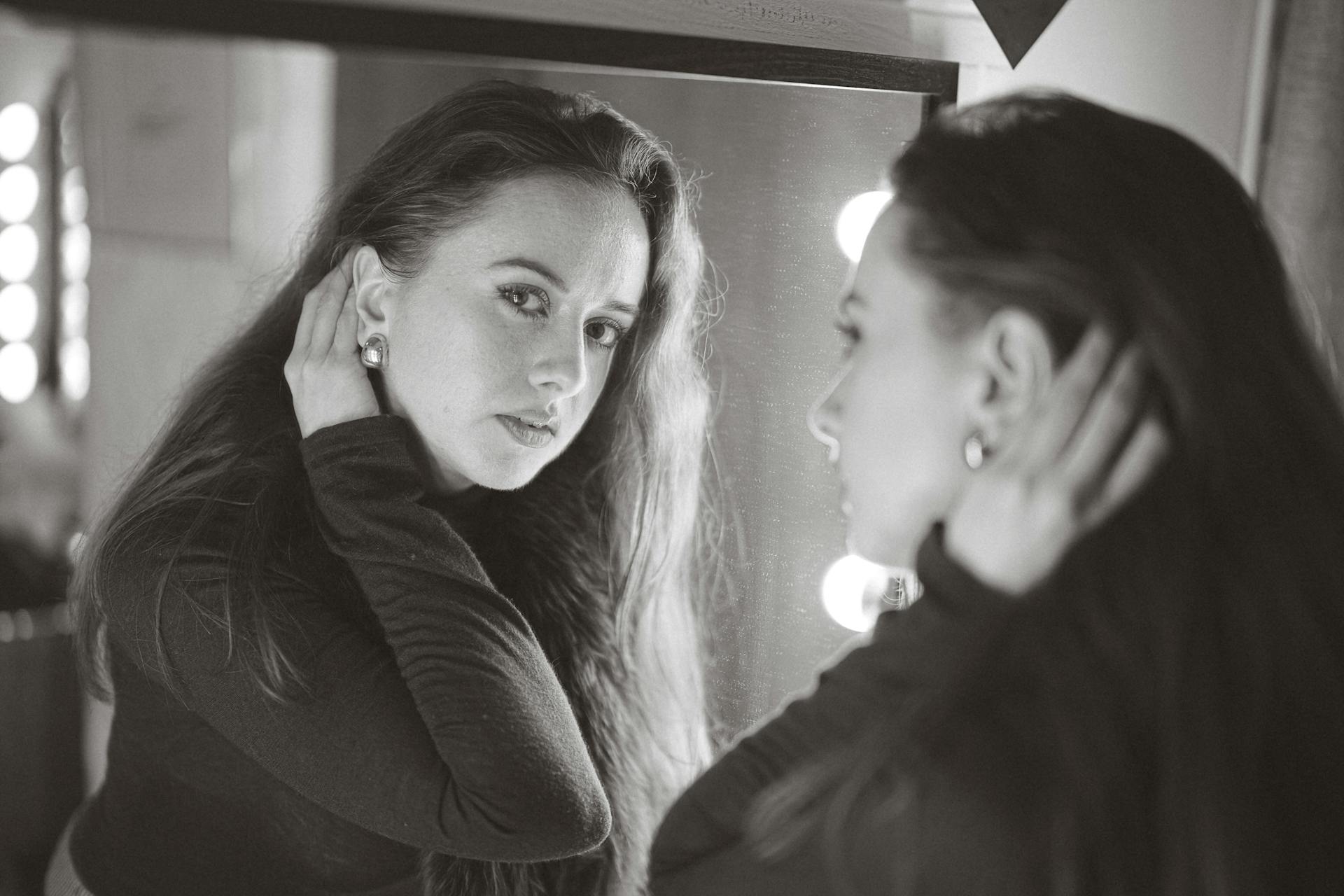
A woman quietly studying her reflection representing the first-impression presence of the 1st house
Transits Through the 1st House
Every planet eventually transits your 1st house. When slow planets pass through, identity themes come into focus and major personal changes often follow.
Jupiter transiting the 1st house (about 1 year): A traditionally fortunate transit for personal growth, confidence, and opportunity. You often feel larger than usual, both literally and figuratively. New directions open up, weight can fluctuate, and the year tends to mark a fresh chapter. The risk is overextension.
Saturn transiting the 1st house (about 2.5 years): A serious period of identity restructuring. You often feel heavier, slower, or more weighed down by responsibility. By the end of the transit, the self that emerges is more solid, more honest, and more authoritative. Body weight, posture, and physical habits often shift permanently.
Uranus transiting the 1st house (about 7 years): Sudden and sometimes radical identity shifts. You may change your appearance dramatically, leave a long-held role, or rebuild your life around a new direction. The transit doesn't ask permission. The work is letting the new self emerge rather than clinging to the old one.
Neptune transiting the 1st house (about 14 years): A long, dissolving transit through identity. You may lose track of who you are in conventional terms and gain access to a more spiritual or imaginative version of yourself. Boundaries soften, sensitivities increase, and ordinary self-definition becomes harder to maintain.
Pluto transiting the 1st house (varies, often 12 to 30 years): Total transformation of the self. Some people experience this transit as a long death and rebirth of identity. Others find their entire life pattern restructured. Power, control, and the deeper roots of who you are all come up for renegotiation. The person who emerges at the other end is rarely the same one who started.
When outer planets transit the 1st house, you're rarely the same person you were before. The renovation usually leaves you with a truer self than the one that went in.
How to Work With Your 1st House
The 1st house responds to deliberate engagement with how you show up. A few practical approaches:
Know your rising sign and chart ruler. The starting point of all 1st house work. The chart ruler guide covers how to find and read yours, and the rising sign appearance guide covers the physical signatures.
Tend the body. The 1st house gets stronger when you treat the body as something to care for rather than something to push through. Sleep, food, movement, posture. Small consistent care does more 1st house work than dramatic interventions.
Let your appearance reflect you. Many people dress against their rising sign, often because they were told their natural style was wrong. Letting the 1st house signature show in how you dress, move, and present often produces an immediate sense of relief and rightness.
Notice the gap between how you see yourself and how others see you. This gap is the 1st house at work. Sometimes the gap signals a misalignment worth closing. Other times it signals that the people around you are simply seeing your Ascendant rather than your full chart.
Pull up your natal chart and find your 1st house. Read the sign on the cusp, the chart ruler's placement, and any planets you find there as a portrait of who you actually are at the entry layer. If you're considering a major identity shift, the chart often shows whether the timing is right. And if a question about who you are, who you're becoming, or who you've been hiding is sitting heavy, a tarot pull often surfaces the next honest step.
Frequently Asked Questions
What is the difference between the 1st house and the rising sign?
The rising sign is the zodiac sign on the cusp of the 1st house. The 1st house is the broader territory the sign rules, including any planets that sit there and the chart ruler's placement elsewhere in the chart. The rising sign is one piece of 1st house reading. Full 1st house analysis includes the chart ruler and any planets in the house.
Is the 1st house good or bad?
The 1st house is one of the four angular houses and is considered one of the most powerful and generally favorable houses in any chart. Most planets there function strongly, especially benefics like Venus and Jupiter. Even challenging placements in the 1st often produce strong, capable people, though they may carry an early sense of being different or marked.
What does an empty 1st house mean?
An empty 1st house means no natal planets sit there, but the rising sign and chart ruler still describe your identity, body, and entry into the world. An empty 1st doesn't mean a weak self. It often means identity flows from the chart ruler's placement elsewhere rather than from concentrated 1st house energy.
How do I know my rising sign?
You need your exact birth time and location to determine your rising sign. The Ascendant changes about every two hours, so even small errors in birth time can shift the result. A precise calculation through the natal chart tool gives the accurate Ascendant. If your birth time is unknown, techniques exist to estimate it, but they're imperfect.
What's the difference between the 1st house and the 7th house?
The 1st house rules you. The 7th house rules your significant others, partnerships, and what you project onto people closest to you. The two houses sit on the same axis and form a single relationship between self and other. People often marry someone with strong placements in their 7th house sign, which is the opposite of their Ascendant.
Does the 1st house describe my whole personality?
No. The 1st house describes the entry layer, the version of you that arrives before context fills in. Your full personality requires reading the Sun, the Moon, Mercury, and the other personal planets, plus the houses they occupy. The 1st house is the doorway. The rest of the chart is the rooms inside.
Pull up your natal chart and find your 1st house. Note your rising sign, your chart ruler's placement, and any planets sitting close to the Ascendant. Then notice what people seem to see when they first meet you and whether it matches who you actually are. The 1st house gets stronger the moment you stop hiding what's on the entry layer and start letting it through. If you're partnered and want to see how your Ascendant interacts with theirs, the compatibility tool surfaces the practical attraction dynamics. And if a question about identity, direction, or a self you've been postponing is sitting heavy, a tarot pull often surfaces the next honest step.