
Your Descendant Sign in Astrology: What the 7th House Cusp Reveals About Your Relationships
The Descendant is the most overlooked angle in your birth chart, and it might be the most important one for understanding your love life. While most people know their rising sign (the Ascendant), far fewer know the sign sitting directly opposite it. That opposite point is the Descendant, the cusp of your 7th house, and it describes the qualities you're unconsciously drawn to in partners, the traits you project onto other people, and the kind of relationship dynamic that feels like home to you, even when it shouldn't.
Your Ascendant is who you are when you walk into a room. Your Descendant is who you're looking for once you get there. It's the missing piece you keep trying to find in other people, the qualities you've pushed into your shadow because they don't fit the identity you've built around your rising sign. Understanding this axis doesn't just explain your relationship patterns; it explains why you keep choosing the same kind of person, why certain dynamics feel magnetically compelling, and what you actually need from partnership versus what you think you need.
If you've ever wondered why you're consistently attracted to a specific type of person, even when it doesn't make logical sense, your Descendant sign holds the answer.
What You'll Learn
What Is the Descendant in Astrology?
The Descendant (abbreviated DC) is one of the four angles in your birth chart. It sits at the western horizon, the point where the sun was setting at the moment you were born. In chart terms, it's the cusp of the 7th house, which governs committed partnerships, marriage, open enemies, and one-on-one relationships of all kinds.
The four angles of the chart are the Ascendant (1st house cusp), the IC or Imum Coeli (4th house cusp), the Descendant (7th house cusp), and the Midheaven (10th house cusp). These four points form the structural skeleton of your chart, and they're some of the most sensitive, powerful degrees in your entire horoscope.
The Descendant specifically rules the area of "the other." It describes what you seek in a committed partner, how you approach one-on-one relationships, and the qualities that feel complementary to your own personality. Where the Ascendant is about self-presentation and identity, the Descendant is about what you look for across the table.
In traditional astrology, the 7th house was also the house of "open enemies," people who oppose you directly and publicly. This makes sense when you consider that the Descendant represents qualities you've externalized. Sometimes you fall in love with those qualities in another person, and sometimes you clash with them. The Descendant governs both dynamics.
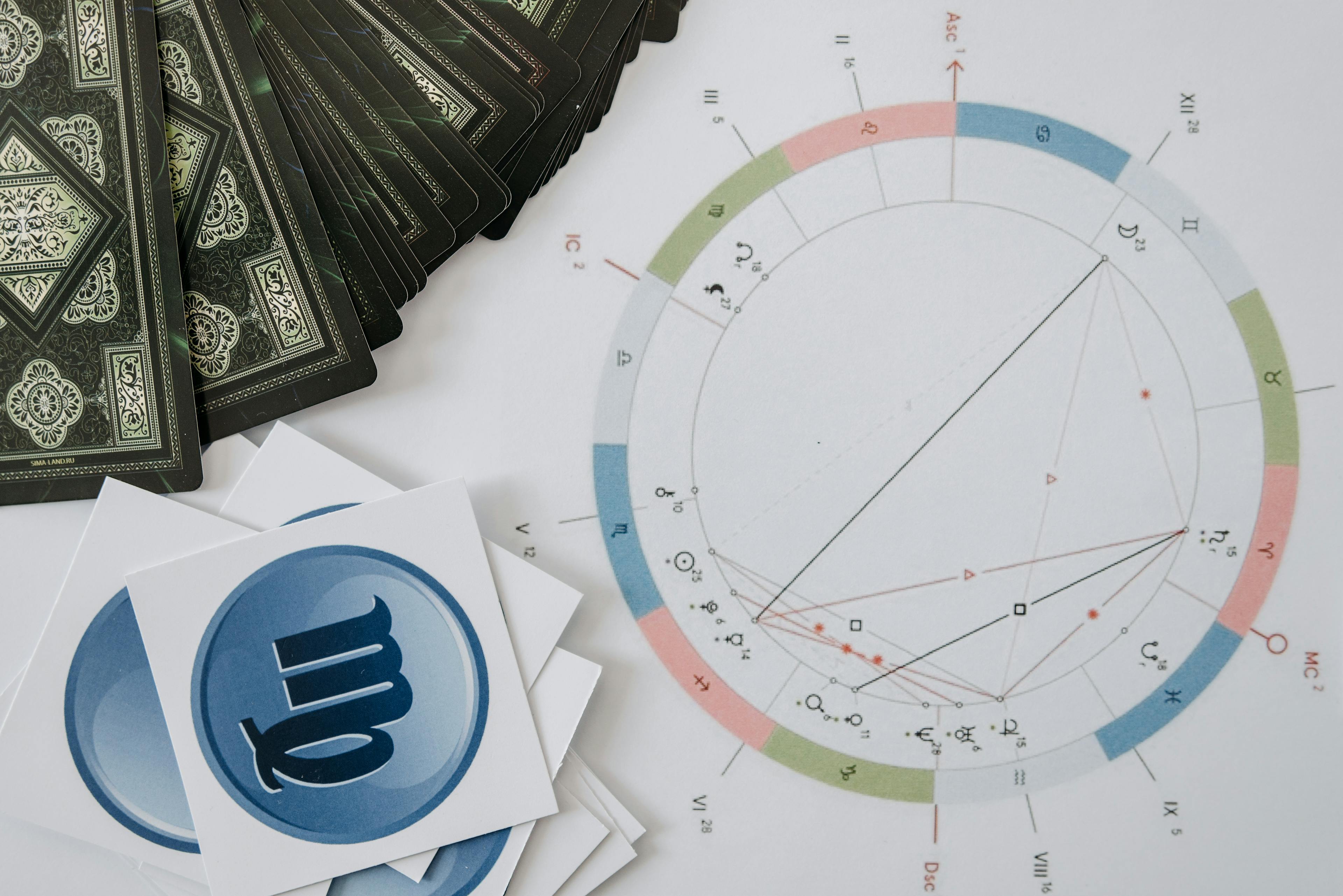
Zodiac wheel chart with astrological symbols highlighting the axis between self and partnerships
The Ascendant-Descendant Axis: Your Identity Mirror
The Ascendant and Descendant always sit in opposite signs. If your Ascendant is in Aries, your Descendant is in Libra. If your Ascendant is in Cancer, your Descendant is in Capricorn. This opposition isn't accidental. It's a polarity, and understanding it is the key to understanding your relationship patterns.
Your Ascendant represents the qualities you identify with, the traits you developed early in life as your way of navigating the world. Your Descendant represents the qualities you've pushed to the other side of that equation, the traits you might admire, envy, or even dislike in others precisely because they're underdeveloped in yourself.
Carl Jung called this dynamic "projection." The qualities in your Descendant sign don't disappear just because you don't consciously identify with them. They show up in the people you attract. If you're an Aries rising (independent, self-starting, competitive), you'll naturally gravitate toward Libra Descendant qualities in partners: diplomacy, grace, compromise, aesthetic sensibility. Not because you lack those traits entirely, but because they're sitting in your relational blind spot.
This is why the Ascendant-Descendant axis is sometimes called the "relationship axis" or the "identity mirror." The people you're drawn to are reflecting back qualities that belong to you but that you've outsourced. The healthiest relationships happen when you start integrating your Descendant qualities yourself, so you're choosing partners out of genuine compatibility rather than unconscious need.
The tricky part is that shadow projection can create intense attraction. Meeting someone who embodies your Descendant sign can feel electric, like they complete you. And in a sense they do, temporarily. But the long-term work of any relationship involves reclaiming those projected qualities so the partnership is between two whole people rather than two halves.
How to Find Your Descendant Sign
Finding your Descendant is simple if you know your rising sign. The Descendant is always the sign directly opposite your Ascendant:
You need your birth time to calculate your Ascendant accurately. Without it, you can't determine either angle. If you know your birth time, pull up your natal chart and look for the sign on the 7th house cusp. That's your Descendant.
The degree of your Descendant matters too. Planets that sit close to this degree (within about 5 degrees on either side) are conjunct your Descendant and have a powerful influence on your relationship experience. More on that below.
What Each Descendant Sign Means for Relationships
Aries Descendant (Libra Rising)
You're drawn to bold, assertive, independent people. Partners who take initiative, speak their mind, and aren't afraid of conflict feel exciting to you. As a Libra rising, you lead with diplomacy and harmony, so you're attracted to the directness you hold back in yourself. The challenge is finding someone whose assertiveness doesn't tip into aggression, and learning to stand your own ground rather than outsourcing confrontation to your partner.
Taurus Descendant (Scorpio Rising)
You seek stability, sensuality, and consistency in partners. Scorpio risings live in emotional intensity, so you're drawn to people who feel grounded and calm, someone who can anchor your inner turbulence. You want a partner who values loyalty, physical comfort, and long-term security. The challenge is that you can mistake possessiveness for devotion, or find yourself bored by the very steadiness that attracted you.
Gemini Descendant (Sagittarius Rising)
You're attracted to people who are witty, curious, communicative, and mentally versatile. As a Sagittarius rising, you think in big-picture terms, so you need a partner who can handle the details, keep conversation flowing, and bring intellectual variety into the relationship. The challenge is finding depth beneath the charm; you may attract people who are scattered or non-committal.

Couple silhouetted against a sunset horizon representing the astrological partnership axis
Cancer Descendant (Capricorn Rising)
You're drawn to nurturing, emotionally available, domestic partners. Capricorn risings project competence, self-sufficiency, and ambition, so you seek people who soften your edges and create emotional safety. You want someone who makes you feel at home. The challenge is allowing yourself to be vulnerable and need someone, because your rising sign's instinct is to appear self-contained.
Leo Descendant (Aquarius Rising)
You seek warm, generous, expressive, and confident partners. As an Aquarius rising, you lead with detachment and intellectual independence, so you're attracted to people who are openly passionate, creative, and comfortable being the center of attention. The challenge is balancing your need for personal freedom with a Leo partner's need for devotion and admiration.
Virgo Descendant (Pisces Rising)
You're drawn to practical, detail-oriented, and helpful partners. Pisces risings live in a world of feeling, intuition, and imagination, so you need someone who brings order, routine, and grounded service into the relationship. You want a partner who notices what needs fixing and quietly handles it. The challenge is not being overly critical of partners or attracting people who are more focused on your flaws than your strengths.
Libra Descendant (Aries Rising)
You seek graceful, diplomatic, aesthetically aware, and partnership-oriented people. Aries risings are independent and action-driven, so you're attracted to the people who bring beauty, balance, and cooperation into your life. You want someone who's willing to compromise. The challenge is not losing patience with indecisiveness, and recognizing that your partner's desire for harmony isn't weakness.
Scorpio Descendant (Taurus Rising)
You're drawn to intense, transformative, emotionally deep partners. As a Taurus rising, you project stability and calm, but your relationships tend to be anything but calm. You attract people who push you into emotional depth, who want to merge and transform rather than coast. The challenge is handling the intensity without shutting down, and not confusing drama with passion.
Sagittarius Descendant (Gemini Rising)
You seek adventurous, philosophical, freedom-loving partners. Gemini risings are curious and mentally agile, so you're attracted to people who bring big-picture meaning, travel, and expansive vision into the relationship. You want a partner who makes life feel like an adventure. The challenge is building commitment with someone who values freedom as much as you do.
Capricorn Descendant (Cancer Rising)
You're drawn to ambitious, responsible, structured partners. Cancer risings lead with emotional sensitivity and nurturing, so you seek people who provide structure, direction, and material security. You want someone who has their life together and takes long-term goals seriously. The challenge is not turning your partner into a parent figure, and maintaining emotional warmth within a practical partnership.
Aquarius Descendant (Leo Rising)
You seek unconventional, intellectually stimulating, independent partners. Leo risings are warm, creative, and crave recognition, so you're attracted to people who are different, who challenge norms, and who won't just be an adoring audience. You want a partner who surprises you. The challenge is that Aquarian detachment can feel cold to your Leo warmth, and you may struggle with partners who won't prioritize the relationship above their causes.
Pisces Descendant (Virgo Rising)
You're drawn to compassionate, intuitive, creative, and spiritually attuned partners. Virgo risings are analytical and practical, so you seek people who bring magic, empathy, and emotional depth into your life. You want someone who sees beyond the surface and connects with you on a soul level. The challenge is not rescuing partners or attracting people whose boundaries are as porous as their empathy.

Reflective surface with soft light symbolizing the mirror-like quality of the Descendant axis in astrology
Planets Conjunct the Descendant
When a planet sits close to your Descendant (within about 5 degrees), it colors your entire relationship experience. That planet becomes a dominant force in your partnerships, and you'll attract people who embody its energy.
Sun conjunct the Descendant. Your identity is deeply tied to relationships. You come alive through partnership and may feel incomplete without one. You attract confident, authoritative partners.
Moon conjunct the Descendant. Emotional connection is non-negotiable. You need a partner who meets you on a feeling level, and you attract nurturing, emotionally expressive people. Your moods are deeply affected by your relationship's health.
Mercury conjunct the Descendant. Communication is the foundation of your relationships. You need to talk, process, and connect intellectually with your partner. You attract witty, verbal, and mentally agile people.
Venus conjunct the Descendant. This is one of the strongest placements for romantic attraction. You attract love easily and value beauty, harmony, and pleasure in partnership. Relationships tend to come naturally to you.
Mars conjunct the Descendant. Your relationships are passionate and sometimes combative. You attract assertive, energetic, and competitive partners. Conflict is a feature of your partnerships, not a bug; the key is channeling it productively.
Jupiter conjunct the Descendant. You attract generous, optimistic, and growth-oriented partners. Relationships expand your world. You may marry someone from a different culture or background, or find that partnership brings you luck and opportunity.
Saturn conjunct the Descendant. Relationships feel serious and sometimes heavy. You attract older, more mature, or more reserved partners. Commitment comes with real responsibility, and your partnerships improve with age and effort.
The Descendant in Synastry and Compatibility
In synastry (chart comparison between two people), the Descendant plays a significant role. When someone's personal planets (Sun, Moon, Mercury, Venus, or Mars) land on your Descendant, you feel an immediate pull toward them. It's one of the strongest indicators of attraction in chart comparison.
If your partner's Sun conjuncts your Descendant, they embody the qualities you're looking for in a partner almost exactly. It can feel like they were custom-built for you. If their Venus lands on your Descendant, the romantic attraction is intense and mutual. If their Saturn lands there, the relationship has a serious, committed, sometimes challenging quality from the start.
The Descendant also matters in composite charts. The composite Descendant shows how the relationship itself relates to the outside world and how the partnership is perceived by others.
When checking compatibility, don't just look at Sun sign matches. Check whether your partner's planets activate your Descendant axis. A relationship with strong Descendant contacts often feels fated, like you were supposed to meet this person. Whether that fate leads to a love story or a lesson depends on the planets involved and how consciously both people engage with the dynamic.
Descendant vs. Venus Sign: What's the Difference?
People often confuse the Descendant with Venus in the birth chart, and while both relate to love and relationships, they describe different things.
Your Venus sign describes what you find beautiful, pleasurable, and attractive. It's your love style, how you flirt, what turns you on, and how you express affection. Venus is about desire and values.
Your Descendant sign describes what you need in a committed partner and the dynamic that defines your serious relationships. It's less about attraction and more about the long-term relationship pattern.
You might have Venus in Sagittarius (attracted to adventurous, free-spirited people) but a Capricorn Descendant (you commit to structured, ambitious partners). The initial spark comes from Venus, but the person you actually build a life with looks more like your Descendant.
Think of Venus as your dating profile and the Descendant as your marriage contract. They can align, but they often don't, and understanding the difference helps explain why the people you're attracted to aren't always the people you end up with.

Couple holding hands under a starry night sky representing soulmate connections and astrological partnership
How to Work With Your Descendant Sign
The Descendant isn't just a description of what you attract. It's an invitation to grow. The qualities in your Descendant sign are qualities you're meant to develop within yourself, not just find in someone else.
Step 1: Identify the pattern. Look back at your significant relationships. Do your partners share common traits? Those traits probably align with your Descendant sign. Recognition is the first step toward conscious choice.
Step 2: Own the projection. The qualities you admire most in partners, and the ones that frustrate you most, are reflections of your own undeveloped potential. If you have a Scorpio Descendant and keep attracting intense, controlling partners, ask yourself where you're avoiding your own depth and power.
Step 3: Integrate, don't abandon. The goal isn't to stop being your Ascendant sign and become your Descendant sign. It's to expand your range so you can embody both. An Aries rising with a Libra Descendant doesn't need to stop being direct and bold; they need to add diplomacy and consideration to their toolkit.
Step 4: Choose consciously. Once you've integrated your Descendant qualities, you stop choosing partners out of unconscious need and start choosing them out of genuine compatibility. The attraction still exists, but it's no longer desperate. It's complementary.
The Ascendant-Descendant axis is a lifelong balancing act. You'll swing between the two poles throughout your life, sometimes leaning too far into your Ascendant identity, sometimes losing yourself in your Descendant partnerships. The sweet spot is the middle, where you can be fully yourself and fully present in a relationship at the same time.
Frequently Asked Questions
Is your Descendant sign the same as your 7th house sign?
Yes. The Descendant is the cusp of your 7th house, so whatever sign falls on that cusp is both your Descendant sign and your 7th house sign. They're two names for the same thing. The Descendant specifically refers to the degree and sign of the cusp itself, while the 7th house includes the entire area that follows.
Can your Descendant sign predict who you'll marry?
Your Descendant sign describes the qualities you seek in a committed partner, not a specific person. You might marry someone whose Sun, Moon, or rising sign matches your Descendant sign, but that's not guaranteed. It's more about the dynamic and the traits than any one zodiac placement. Check your compatibility for a fuller picture of how two charts interact.
What if I don't relate to my Descendant sign at all?
That's actually common, especially if you haven't been in many relationships yet. The Descendant describes unconscious patterns, so its influence often becomes clearer in hindsight. Look at the people you've been closest to (not just romantic partners but close friends and even rivals) and you'll likely spot the pattern.
How is the Descendant different from the 7th house ruler?
The Descendant is the sign on the 7th house cusp. The 7th house ruler is the planet that rules that sign. Both matter, but they describe different things. The Descendant sign shows the qualities you seek; the 7th house ruler shows where and how those relationship themes play out based on its house placement and aspects in your chart.
Do you need your birth time to find your Descendant?
Yes. The Descendant depends on your Ascendant, which changes signs roughly every two hours. Without an accurate birth time, you can't determine either angle reliably. If you don't know your birth time, try requesting your birth certificate from the hospital or vital records office where you were born; many include the time.
Your Descendant sign is one of the most revealing and least discussed points in your chart. It holds the blueprint for your relationship patterns, your unconscious attractions, and the growth edge where partnership pushes you to become more than you are alone. Pull up your natal chart to find your Descendant, check your compatibility to see how your axis interacts with someone else's, or draw a tarot card for insight into what your current relationships are teaching you. The person sitting across from you is always a mirror. Your Descendant tells you what's being reflected.