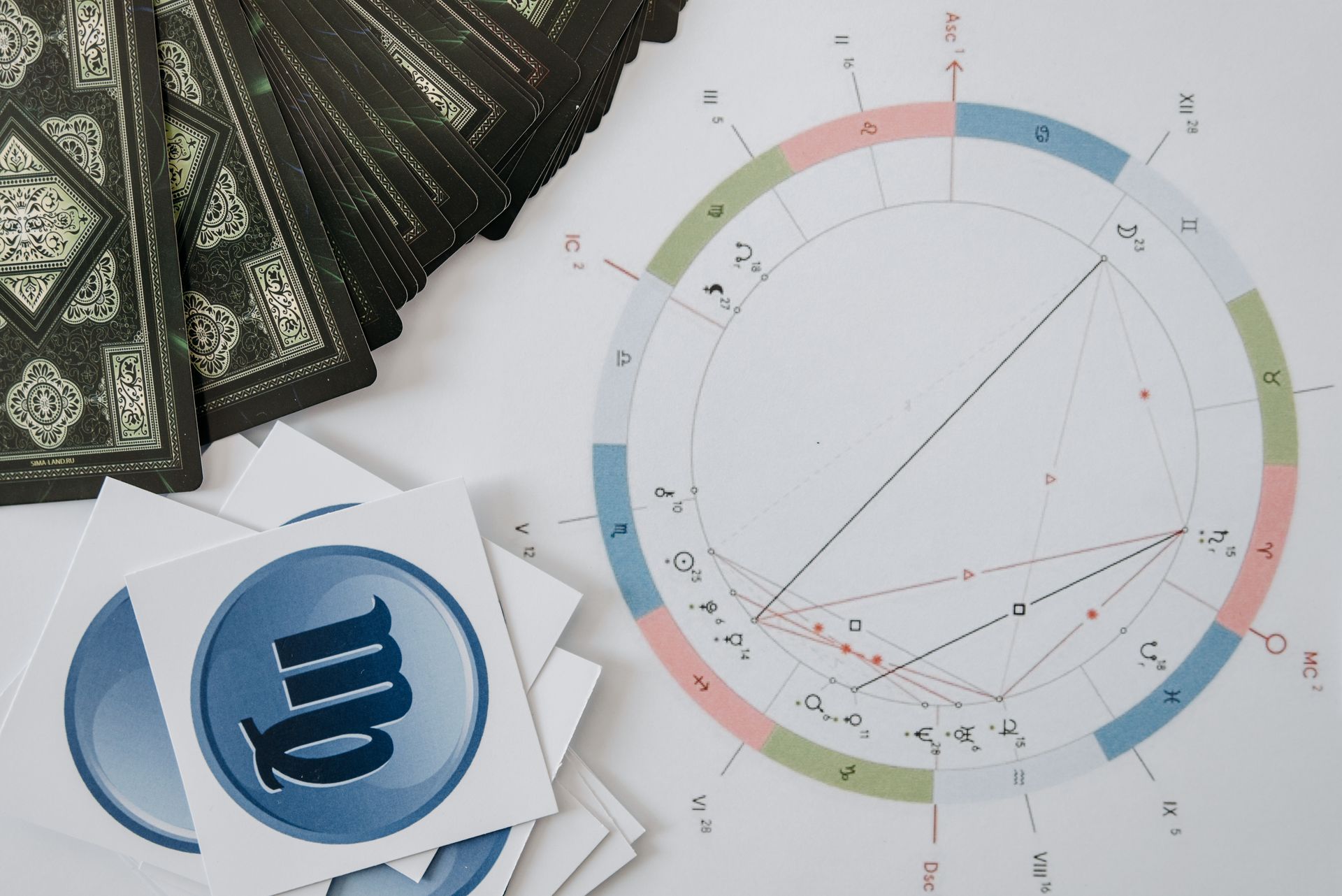
Astrology Symbols Explained: Every Planet, Sign, and Aspect Glyph
Astrology symbols are the shorthand astrologers use to pack a whole birth chart onto a single wheel. There are four main groups to learn: the ten planet glyphs (like the Sun's circle with a dot), the twelve zodiac sign glyphs (like Aries' ram horns), the aspect symbols that show how planets connect (like the triangle for a trine), and the four element and house markers that tie it all together. Once you can read those four groups, a chart stops looking like static and starts reading like a sentence.
Every glyph is built from the same three shapes, and that's the secret that makes them easy to memorize. The circle stands for spirit or eternity, the crescent stands for the soul or receptivity, and the cross stands for matter and the physical world. Almost every planet symbol is just those three pieces stacked in a different order. Learn the logic once and you'll never need to brute-force a flashcard again. Below you'll find every symbol you'll meet on a standard chart, what it means, and how to start reading them together.
What You'll Learn
The Three Building Blocks of Every Glyph
Before you memorize anything, learn the three shapes that build almost every astrology symbol. The circle represents spirit, the divine, and infinite potential. The crescent (a half-moon shape) represents the soul, the mind, and receptivity. The cross represents matter, the body, and physical reality. That's it. Nearly every planet glyph is a combination of these three.
Watch how it works. The Sun is a circle with a dot, pure spirit. The Moon is a crescent, pure soul. Mercury is a crescent on top of a circle on top of a cross, mind over spirit over matter, which fits the planet of thought perfectly. Venus is a circle over a cross, spirit rising above matter, the planet of love and values. Mars is a cross (or arrow) leaving a circle, energy pushing out into the world. Once you see the grammar, the symbols decode themselves.
This is why astrologers rarely write out planet names on a chart. The glyphs are faster to read and they carry meaning in their structure. When you learn the parts of a natal chart, you're really learning to read this visual language, and the building-block trick turns hours of rote memorization into a single afternoon.
A glowing golden zodiac wheel showing the twelve signs and their astrology glyphs
The Ten Planet Symbols
The planets are the actors in your chart, the what of any placement. In astrology, "planet" is a loose term that includes the Sun and Moon (technically luminaries) plus the eight bodies from Mercury out to Pluto. Here's every glyph and the core meaning it carries.
Sun is a circle with a central dot, your core identity, ego, and life force. Moon is a crescent, your emotions, instincts, and inner world. Mercury is a crescent above a circle above a cross, the mind, communication, and how you think. Venus is a circle above a cross, love, beauty, money, and what you value. Mars is a circle with an arrow pointing up and out, drive, anger, desire, and action.
Jupiter looks like a stylized number four or a crescent attached to a cross, expansion, luck, and growth. Saturn looks like a lowercase h with a cross, or a cross above a crescent, the inverse of Jupiter, representing structure, limits, and discipline. Uranus is often a capital H with a circle hanging below (honoring discoverer William Herschel), sudden change and rebellion. Neptune is a trident, dreams, illusion, and spirituality. Pluto appears either as a PL monogram or a circle resting in a crescent above a cross, power, death, and transformation.
If you want to find where each of these sits in your own chart, the fastest route is to generate your free natal chart and match the glyphs you see against this list. To go deeper on what each planet actually does, the guide to the planets in your chart shows how each one changes strength depending on the sign it lands in.
A clean view of the planets of the solar system against deep space
The Twelve Zodiac Sign Symbols
If planets are the actors, the zodiac signs are the costumes, the how. Each sign glyph is a pictograph that hints at the sign's nature, and most of them are surprisingly literal once you know what you're looking at.
Aries is two curved lines like a ram's horns. Taurus is a circle with horns on top, a bull's head. Gemini is the Roman numeral two, the twins, or a pair of pillars. Cancer is two curled shapes like a crab's claws or two nestled spirals. Leo is a loop with a curving tail, the lion's mane and tail. Virgo is an M with an inward loop, often read as the maiden.
Libra is a horizontal line with a half-circle resting on it, the scales of balance, or a setting sun on the horizon. Scorpio is an M with an outward arrow tail, the scorpion's stinger. Sagittarius is an arrow pointing up and away, the archer's arrow. Capricorn is a hard-to-draw shape blending a goat's horns and a fish's tail, the sea-goat. Aquarius is two parallel wavy lines, representing waves of water or electricity. Pisces is two crescents joined by a line, two fish swimming in opposite directions.
Notice that Scorpio and Virgo both start with an M shape; the difference is the tail. Virgo's loops inward (modest, contained), while Scorpio's shoots outward with a sting (intense, penetrating). Small visual cues like that carry real meaning. Each sign also belongs to one of the four astrology elements, which adds another layer to how its glyph behaves in a chart.
A field of bright constellations and stars filling a dark night sky
The Major Aspect Symbols
Aspects are the relationships between planets, the geometric angles they form across the chart. These are the lines you see crisscrossing the center of a wheel, and each has its own symbol. Aspects are where a chart goes from a list of placements to an actual story, because they show which parts of you cooperate and which parts fight.
Conjunction is a circle with a small line, written as two planets at zero degrees apart, energies fused together. Sextile is a six-pointed asterisk or star, sixty degrees apart, easy opportunity and talent. Square is a literal square, ninety degrees apart, tension, friction, and motivation. Trine is a triangle, one hundred twenty degrees apart, natural flow and ease. Opposition is a line with a circle at each end, one hundred eighty degrees apart, balance, projection, and pull.
The shapes carry a rough emotional charge. The triangle (trine) and star (sextile) are the "soft" or flowing aspects that feel good and come naturally. The square and opposition are the "hard" aspects that create challenge, though hard aspects are often what drive growth and achievement. A conjunction is neutral; it intensifies whatever the two planets want. To see how these angles shape a personality, the deep dive on birth chart aspects walks through each one with real examples, and the guide to aspect patterns shows what happens when several aspects link into a single shape.
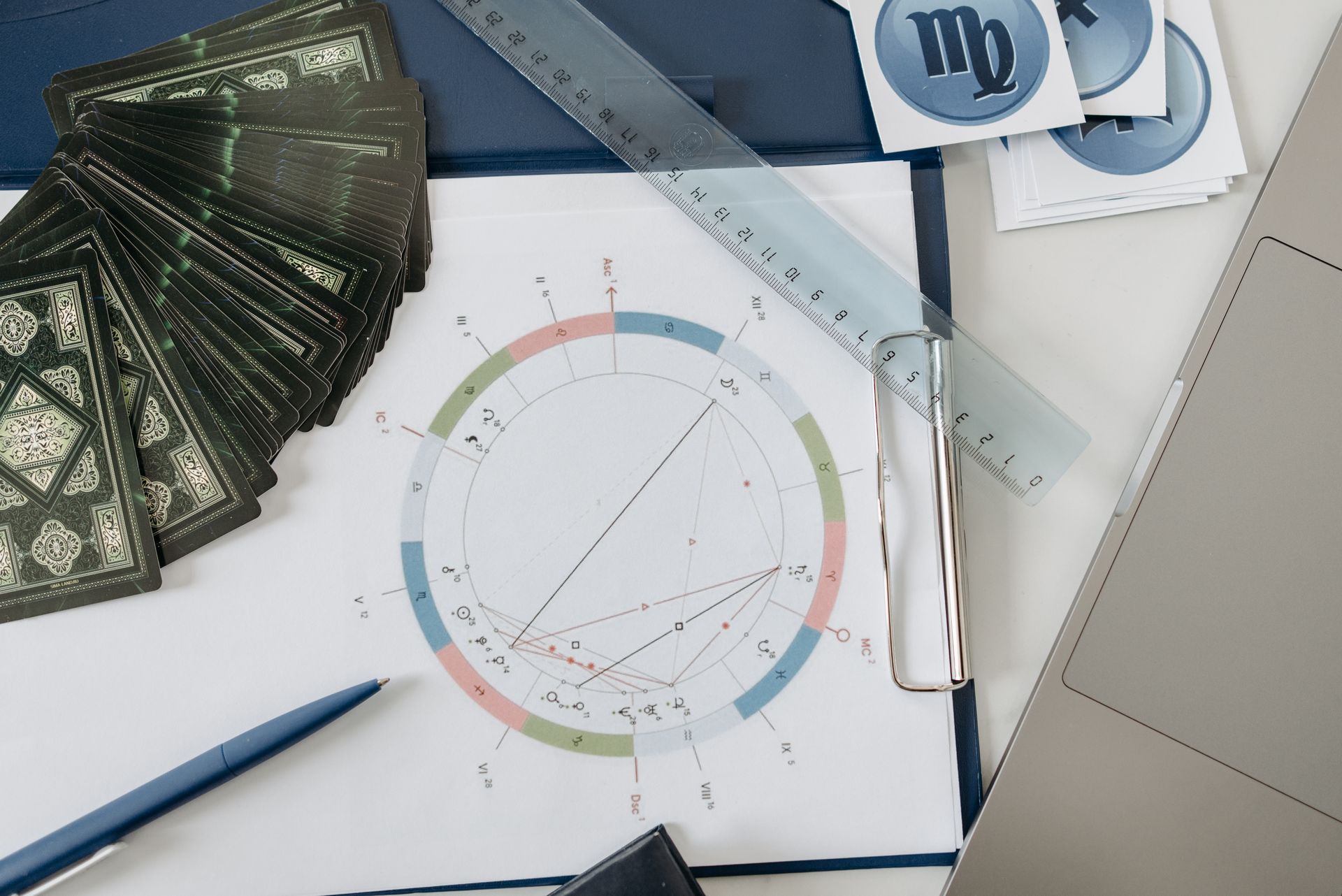
A detailed astrology birth chart wheel with colored aspect lines crossing the center
Element, Modality, and Node Symbols
A few more symbols round out a standard chart, and they're worth knowing even though they show up less often than planets and aspects. These markers group the signs and flag special points that many readers find the most personal parts of their chart.
The four elements are sometimes marked with classic alchemical triangles. Fire is an upward triangle, air is an upward triangle with a horizontal line through it, water is a downward triangle, and earth is a downward triangle with a line through it. You'll see these in books more than on software charts, but recognizing them helps when you read older or hand-drawn material. The three modalities, cardinal, fixed, and mutable, are usually written as words rather than glyphs.
The lunar nodes get their own symbols and matter a lot for life-purpose work. The North Node looks like a horseshoe or upside-down U (sometimes called the head of the dragon), pointing to where your soul is growing. The South Node is the same shape flipped (the tail of the dragon), showing comfortable past-life patterns. You'll also meet the Ascendant (AC) and Midheaven (MC), which are labeled with letters rather than glyphs but anchor the whole chart. The lunar nodes guide explains why so many astrologers read them first.
A sweeping Milky Way arching over a dark, star-filled horizon
How to Read the Symbols Together on a Chart
Now you put it together, and the order is always the same: planet, then sign, then house, then aspect. A placement reads like a sentence. The planet is the noun (what energy), the sign is the adjective (how it expresses), the house is the setting (where in life), and the aspect is the verb connecting it to the rest of you.
Say you see the Venus glyph (circle over cross) sitting next to the Scorpio glyph (M with a sting) in the section marked house seven, with a triangle line running to your Moon. You'd read that as "Venus in Scorpio in the seventh house, trine the Moon," which translates to: your way of loving (Venus) is intense and all-or-nothing (Scorpio), it shows up most in committed partnerships (seventh house), and it flows easily with your emotional needs (trine the Moon). That's a full, rich statement pulled from four little symbols.
Start by finding your Sun, Moon, and Ascendant glyphs first, since those three are your big three and form the backbone of any reading. Then work outward planet by planet, naming the sign and house for each. Don't try to memorize everything at once. Keep this page open beside your free natal chart and decode one placement at a time. Within a few sessions the glyphs will read as fast as letters, and the chart that once looked like a coded mystery will simply read like you.
Frequently Asked Questions
What do the symbols in astrology mean?
Astrology symbols, called glyphs, are shorthand for the planets, zodiac signs, and aspects in a chart. Planet glyphs show which energy is active, sign glyphs show how it expresses, and aspect glyphs show how planets relate. Nearly all of them are built from three shapes: a circle (spirit), a crescent (soul), and a cross (matter).
How do I memorize astrology glyphs?
Learn the three building blocks first: circle, crescent, and cross. Most planet symbols are just those shapes stacked in different orders, so you can reason out the meaning instead of memorizing blindly. For zodiac signs, treat each glyph as a tiny picture of its symbol, like Aries' ram horns or Leo's lion tail.
What are the symbols that look like an M in astrology?
Two zodiac signs use an M shape. Virgo is an M with a loop curling inward, suggesting modesty and containment. Scorpio is an M with an arrow or stinger shooting outward, suggesting intensity and a sting. The tail is the only difference, so always check where the final stroke points.
What do the triangle and square symbols mean in a chart?
The triangle is a trine, an easy, flowing aspect between planets one hundred twenty degrees apart. The square is a tense, challenging aspect ninety degrees apart that creates friction and drive. Triangles feel like talents you were born with, while squares feel like problems that push you to grow.
Do I need to know the symbols to read my birth chart?
It helps a lot, but you don't have to start there. Most online chart tools let you hover over a glyph to see its name, so you can read your chart while you learn. Knowing the symbols just makes you faster and lets you read printed charts, older books, and other people's charts at a glance.
Astrology symbols look intimidating for about a day, then they click and never un-click. Learn the three shapes, match the planet and sign glyphs to this list, and read each placement as planet plus sign plus house plus aspect. To put it into practice right now, pull up your free natal chart and start decoding your big three, or run a compatibility report and watch the same symbols tell the story of how two charts fit together.