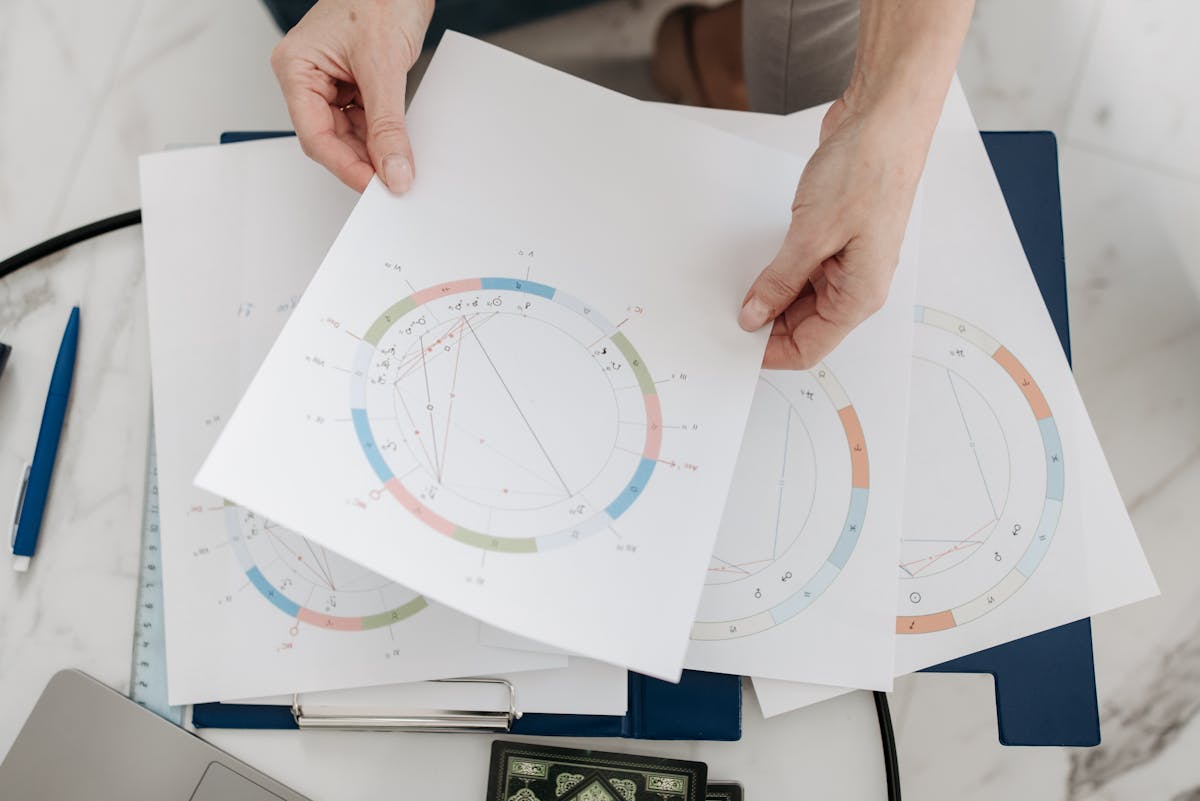
Understanding Your Natal Chart: A Beginner's Guide
A natal chart, also called a birth chart, is a map of where every planet was positioned at the exact moment you were born, as seen from your birthplace. It's the foundation of Western astrology, and learning to read one is the single most valuable skill you can develop if you're interested in understanding yourself through the stars.
What You Need
To calculate an accurate natal chart, you need three things: your date of birth, your time of birth (as precise as possible), and your place of birth. The date gives you your planetary positions. The time gives you your Ascendant (rising sign) and house placements. The location adjusts everything for your specific spot on Earth.
If you don't know your exact birth time, you can still get meaningful information from the planetary signs alone, but you'll miss the houses and the Ascendant, which are arguably the most personal parts of the chart.
Zodiac signs on a historic astronomical ceiling
The Three Layers
Think of a natal chart as having three layers:
Planets are the actors. Each planet represents a different drive, need, or function in your psyche. The Sun is your core identity. The Moon is your emotional nature. Mercury is how you think and communicate. Venus is how you love. Mars is how you assert yourself. The outer planets (Jupiter through Pluto) represent broader generational and transformative forces.
Signs are the style. When we say "Venus in Scorpio," we mean the planet of love is expressing itself through Scorpio's lens of intensity, depth, and transformation. Every planet operates through the filter of whatever sign it occupies.
Houses are the stage. The twelve houses divide your chart into twelve life domains: self, money, communication, home, creativity, health, partnership, transformation, philosophy, career, community, and the unconscious. A planet's house placement tells you where in your life its energy plays out most strongly.
The Big Three
Most people know their Sun sign. But in astrology, three placements matter far more than any single one:
Your Sun sign is your core identity, your ego, your conscious self-expression. It's who you are when you're being most authentically yourself.
Your Moon sign is your emotional nature, your instincts, your inner life. It's who you are when no one is watching. Many people relate more strongly to their Moon sign than their Sun sign.
Your Rising sign (Ascendant) is the sign that was coming over the eastern horizon at your moment of birth. It's the mask you wear, the first impression you make, and the lens through which you experience the entire chart. It also determines your house system, making it arguably the most structurally important point in the chart.
Aspects: How Planets Talk to Each Other
Planets don't operate in isolation. They form geometric relationships called aspects, measured in degrees of angular separation. The five major aspects are:
Squares and oppositions are often called "hard" aspects, but they're not bad. They're the aspects that generate the most growth, the most drive, and the most memorable life experiences. A chart full of trines might be comfortable but stagnant; a chart with meaningful squares is where the interesting work happens.
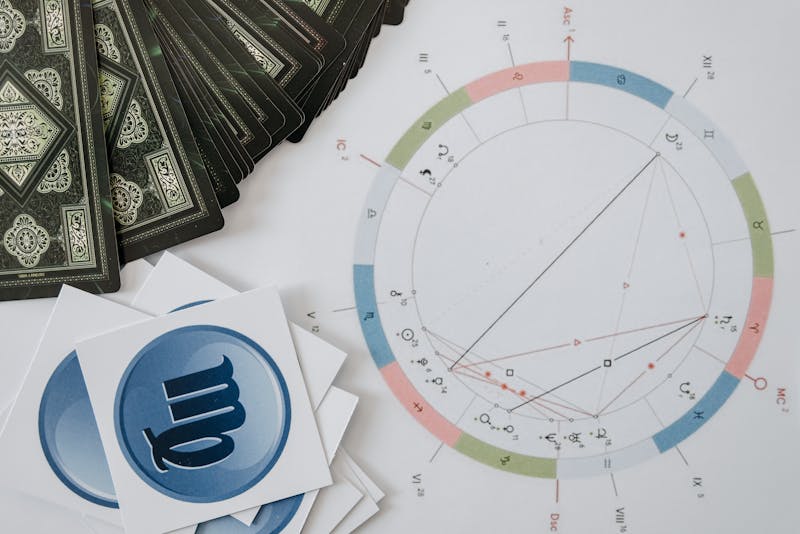
Astrology chart with tarot cards and zodiac symbols
Reading Your Chart
Start with the Big Three. Then look at where Venus and Mars fall, since those govern your love life and your drive. Note any planets in the 1st house (strongly personal), the 10th house (career and public life), and the 7th house (partnerships).
Pay attention to clusters: if several planets occupy the same sign or house, that area of life is particularly emphasized for you. Pay attention to planets with tight aspects (small orbs), as these represent the strongest connections in your chart.
Finally, remember that a natal chart is not a sentence. It's a map of potential. The same aspect that creates struggle in one person's life becomes the fuel for extraordinary achievement in another's. Astrology doesn't tell you what will happen. It tells you what you're working with.