How to Find Your Dominant Planet in Astrology (And What It Reveals About You)
Your dominant planet is the planet that holds the most power in your birth chart. It's not your Sun sign ruler, and it's not necessarily the planet you'd expect. Dominant planet analysis looks at the full chart, weighing house placement, sign rulership, aspects, and angular position to determine which single celestial body exerts the strongest pull on your personality, motivations, and life patterns. If your natal chart is an orchestra, your dominant planet is the loudest instrument in the mix.
Most people know their Sun, Moon, and Rising signs. That trio describes your core identity, emotional nature, and outward persona. But your dominant planet cuts across all three of those layers. It colors everything. Two people can share the same Big Three and feel completely different because one has a dominant Saturn shaping every decision through caution and discipline, while the other has a dominant Jupiter turning every setback into an opportunity.
Finding your dominant planet takes more than glancing at a single placement. It requires looking at several factors and scoring them against each other. Here's exactly how to do it, what each dominant planet means, and how to use this information to understand yourself better.
What You'll Learn
What Makes a Planet Dominant?
A dominant planet isn't determined by a single factor. It's the planet that accumulates the most influence across multiple dimensions of the chart. Think of it like evaluating an employee's impact on a company: you wouldn't just look at their title, you'd look at how many teams they work with, how central their role is, and how much their decisions affect the organization as a whole.
In astrological terms, a planet gains dominance through four main channels:
Sign rulership. A planet that rules the sign on the Ascendant, the Sun's sign, or the Moon's sign automatically carries extra weight. If you're a Scorpio Rising, Mars (and Pluto, depending on your tradition) has a built-in advantage because it governs the lens through which you experience the world.
House placement. Planets sitting in angular houses (the 1st, 4th, 7th, and 10th) are louder than planets tucked away in cadent houses. An angular planet acts directly on the most visible areas of life: self, home, relationships, and career.
Aspects. The more aspects a planet makes to other planets, the more connected it is to the chart's network. A planet that aspects five or six other bodies is involved in almost everything that happens in your life. A planet with no major aspects is isolated, operating on its own frequency.
Dignity. A planet in its own sign or exaltation is operating from a position of strength. Saturn in Capricorn or Venus in Taurus isn't just present; it's at full power. Planetary dignities amplify a planet's ability to express itself clearly.
No single factor makes a planet dominant on its own. A planet in the 1st house with no aspects and no rulership ties is prominent but not necessarily dominant. A planet ruling the Ascendant from a cadent house with three strong aspects might be. The dominant planet is the one that wins the overall scorecard.

Planets aligned in space illustrating the concept of celestial hierarchy and planetary strength in a natal chart
How to Calculate Your Dominant Planet Step by Step
You'll need your complete birth chart with accurate house placements, which means you need your birth time. Without a birth time, you can't determine house positions or the Ascendant, and both are critical for this analysis. Pull up your natal chart and work through the following scoring system.
Step 1: Identify the Rulers of Key Placements
Find the planet that rules each of these signs in your chart:
Use traditional rulerships for the most consistent results. That means Mars rules Scorpio (not Pluto), Saturn rules Aquarius (not Uranus), and Jupiter rules Pisces (not Neptune). You can note the modern rulers as secondary influences, but the traditional system produces cleaner dominance scores.
If the same planet rules multiple placements, it stacks. Mercury ruling both your Ascendant (Virgo Rising) and your Sun (Gemini Sun) would score 5 points from rulership alone.
Step 2: Score House Placement
Look at where each planet sits:
Angular houses (1st, 4th, 7th, 10th) get the highest scores because planets there act most directly on visible life areas. The 1st and 10th are especially powerful because they're conjunct the Ascendant and Midheaven, the two most personal angles in the chart.
Step 3: Count Major Aspects
For each planet, count its major aspects (conjunction, sextile, square, trine, opposition) to other planets. Use standard orbs: roughly 8 degrees for the Sun and Moon, 6 degrees for other planets.
Conjunctions to the Sun, Moon, or Ascendant degree count double since those are the chart's most personal points.
Step 4: Check Dignity
A planet in its own sign operates with authority. Mars in Aries doesn't need permission to act. Venus in Libra instinctively knows how to connect. That inherent comfort amplifies the planet's influence across the chart.
Step 5: Add It Up
Tally the scores for all seven traditional planets (Sun, Moon, Mercury, Venus, Mars, Jupiter, Saturn). If you want to include Uranus, Neptune, and Pluto, score them using only house placement and aspects since they don't have traditional rulership dignities.
The planet with the highest score is your dominant planet. The second highest is your sub-dominant, and together they describe the primary energetic signature of your chart.
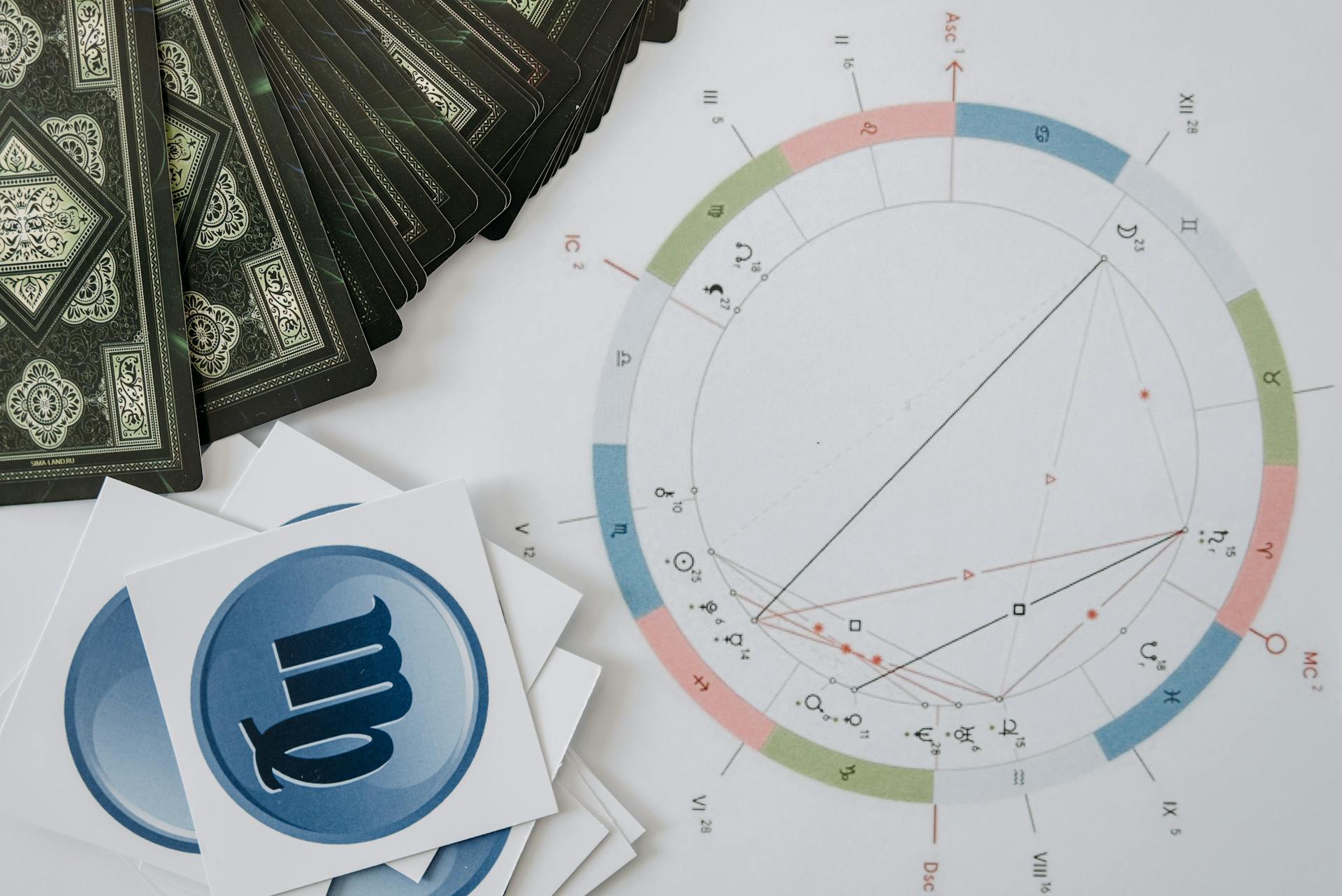
A zodiac wheel chart with astrological symbols representing the full natal chart used for determining planetary dominance
Does Ruling the Ascendant, Sun, or Moon Make a Planet Dominant?
Ruling important placements gives a planet a strong head start, but it doesn't guarantee dominance. Your chart ruler (the planet ruling the Ascendant sign) is always significant because it governs your physical body, appearance, and approach to life. But chart ruler and dominant planet aren't the same thing.
Consider someone with Libra Rising. Venus rules the Ascendant, so it gets those initial rulership points. But if Venus sits in the 12th house with only one aspect, while Mars sits in the 1st house in Aries with five aspects and rules the Sun sign, Mars will outscore Venus decisively. The chart ruler is Venus, but the dominant planet is Mars.
This distinction matters because people often over-identify with their chart ruler without considering the broader picture. Your chart ruler describes how you initiate and how others first perceive you. Your dominant planet describes the force that drives the most activity across all areas of your life.
That said, when the chart ruler also has strong house placement, multiple aspects, and dignity, it becomes the dominant planet too. When one planet wins on multiple scoring dimensions, its dominance is obvious and its influence is especially concentrated.
Why Angular Houses Matter So Much
The 12 houses aren't created equal. Angular houses (1st, 4th, 7th, 10th) represent the four most active areas of life: your identity, your roots, your partnerships, and your public role. Planets in these houses don't just influence you internally; they act in ways that are visible to others and that generate external events.
A planet in the 1st house is woven into your identity. People see it when they look at you. Mars in the 1st makes you physically dynamic and assertive without trying. Saturn in the 1st makes you appear serious, composed, and older than your years. The 1st house planet becomes part of how you move through the world.
The 10th house planet shapes your career, reputation, and public image. The 7th house planet defines your approach to partnerships and how you attract others. The 4th house planet influences your home environment, family dynamics, and emotional foundations.
Cadent houses (3rd, 6th, 9th, 12th) are the quietest positions. Planets there work behind the scenes. They influence your mental processes, daily habits, beliefs, and subconscious patterns, but they don't announce themselves the way angular planets do. A dominant planet almost always has angular placement or at minimum aspects to an angular planet.
Aspects: The Wiring That Connects Everything
Aspects determine how connected a planet is to the rest of the chart. A planet with many aspects is like a hub in a network: information flows through it constantly, and it touches nearly every part of your experience.
The type of aspect matters less than the count for dominance calculations. A planet with three squares and two oppositions is just as connected as one with three trines and two sextiles. The squares and oppositions create tension and challenges, while the trines and sextiles create flow and ease, but both make the planet active.
An unaspected planet is a special case. It has no major connections to other planets, so it operates independently, often in an extreme or unpredictable way. Unaspected planets can be very noticeable in a person's behavior precisely because they're unregulated by the rest of the chart, but they don't score well for dominance because they lack integration.
Conjunctions deserve extra attention. When two planets are conjunct, they merge their energies and function as a unit. If your dominant planet candidate is conjunct the Sun or Moon, that conjunction dramatically increases its influence because it's blended with a luminary, one of the chart's two most personal points.

Interconnected points of light against a cosmic background symbolizing planetary aspects and connections in an astrological chart
What Each Dominant Planet Means for Your Personality
Once you've identified your dominant planet, here's what it reveals about the core force driving your life.
Sun Dominant
You're naturally oriented toward self-expression, leadership, and recognition. You need to be seen and acknowledged for who you are. Your identity isn't something you discover quietly; it's something you broadcast. Sun-dominant people often gravitate toward creative fields, leadership positions, or any role where personal visibility is part of the job. The risk is ego inflation or tying your self-worth too closely to external validation.
Moon Dominant
Emotions drive everything. You process the world through feeling before logic, and your mood shapes your experience more than external circumstances do. Moon-dominant people are deeply intuitive, nurturing, and attuned to the emotional states of everyone around them. You absorb atmosphere like a sponge. The risk is emotional overwhelm, mood dependency, or difficulty separating your feelings from other people's. Your Moon sign describes the specific flavor of this emotional dominance.
Mercury Dominant
Your mind never stops. Communication, analysis, learning, and information processing are your primary modes of engaging with the world. Mercury-dominant people talk fast, read constantly, and can hold multiple threads of thought simultaneously. You're the person who needs to understand how things work before you can relax about them. The risk is overthinking, nervous energy, or difficulty sitting with ambiguity. Your Mercury sign shapes whether this mental energy expresses as meticulous analysis, quick wit, or broad intellectual curiosity.
Venus Dominant
Relationships, beauty, comfort, and harmony aren't just preferences; they're necessities. Venus-dominant people organize their lives around connection and pleasure. You have a refined aesthetic sense, strong social instincts, and an ability to make others feel valued. Conflict is genuinely painful, not just uncomfortable. The risk is people-pleasing, avoidance of necessary confrontation, or overvaluing comfort at the expense of growth. Your Venus sign determines the specific style.
Mars Dominant
Action is your default state. You're driven, competitive, direct, and physically energetic. Mars-dominant people don't wait for permission or consensus; they move and adjust later. You're at your best when you have a clear goal and a clear obstacle. Stagnation is intolerable. The risk is impulsiveness, aggression, or burning through relationships and projects because the pace you set is unsustainable for everyone else. Your Mars sign defines how this drive expresses.
Jupiter Dominant
Expansion, optimism, and meaning-seeking define your approach to life. Jupiter-dominant people think big, take risks, and genuinely believe that things tend to work out. You're drawn to philosophy, travel, education, and any experience that broadens your understanding. Generosity comes naturally, and you often inspire others through sheer enthusiasm. The risk is overextension, promising more than you can deliver, or skipping the details in pursuit of the big picture. Your Jupiter sign colors the domains where this expansion focuses.
Saturn Dominant
Responsibility, structure, and long-term planning aren't burdens for you; they're how you make sense of the world. Saturn-dominant people are disciplined, realistic, and often wise beyond their years. You build things that last. Authority and competence matter to you, and you're willing to put in the work that others avoid. The risk is excessive rigidity, pessimism, or defining yourself entirely through achievement and productivity. Your Saturn sign reveals the specific area where discipline and structure concentrate. Saturn-dominant people often experience their Saturn return as a period of confirmation rather than crisis, because they've already been living Saturn's values.

An astrological chart with zodiac symbols and planetary glyphs representing the analysis of dominant planetary energies
Outer Planet Dominance (Uranus, Neptune, Pluto)
If an outer planet scores highest through house placement and aspects, its influence operates differently than a personal planet's. Outer planets are generational, so their sign placement is shared by everyone born within the same few years. Their dominance shows up through house position and aspects to personal planets.
Uranus dominant: You're unconventional, independent, and resistant to any system that tries to contain you. Innovation and disruption come naturally.
Neptune dominant: You're highly imaginative, empathic, and spiritually attuned. Boundaries between self and other are porous, which is both a gift and a vulnerability.
Pluto dominant: Intensity, transformation, and psychological depth define your experience. You're drawn to power dynamics, hidden truths, and experiences that fundamentally change you. Black Moon Lilith in your chart may amplify these themes.
Can You Have More Than One Dominant Planet?
Yes. Many charts have two planets that score within a point or two of each other, creating a co-dominance. When that happens, both planets share the driver's seat, and their interaction defines your personality more than either one alone.
Co-dominant planets can create a productive partnership or an internal tug-of-war depending on their nature. Venus and Jupiter co-dominant makes for someone who's generous, sociable, and pleasure-seeking in a way that's both warm and excessive. Mars and Saturn co-dominant creates someone who's simultaneously driven to act and determined to plan, producing either disciplined ambition or frustrating stop-start patterns.
If three or more planets score similarly, you don't have a clear dominant planet, which is itself meaningful. It suggests a more distributed chart where no single force overshadows the others. These charts produce versatile, complex people who express different planetary energies depending on the situation.
Dominant Planet vs Chart Ruler: What's the Difference?
People confuse these terms constantly, so here's the clear distinction.
Chart ruler: The planet that rules the sign on the Ascendant. Period. If you have Leo Rising, your chart ruler is the Sun. If you have Pisces Rising, your chart ruler is Jupiter (traditional) or Neptune (modern). The chart ruler is determined by a single factor: the Ascendant sign.
Dominant planet: The planet that accumulates the most influence across all dimensions of the chart, including rulership, house placement, aspects, and dignity. It's determined by scoring the entire chart, not just one placement.
Your chart ruler is always important because it governs the Ascendant, and the Ascendant is your interface with the world. But your chart ruler might be weak by house and aspects while another planet dominates through angular placement and a web of aspects. In that case, your chart ruler sets the tone of your personality's surface expression, but your dominant planet drives the deeper patterns.
When the chart ruler is also the dominant planet, the personality is especially coherent. The way you present yourself and the force driving your life are the same planet, and people tend to experience you as particularly authentic or "what you see is what you get."
Frequently Asked Questions
How do I find my dominant planet without doing the math?
Several free online calculators, including the one at Astro-Seek, will calculate your dominant planet automatically. You'll need your exact birth time, date, and location. The calculator scores each planet across multiple factors and displays them ranked. For a deeper understanding, pull up your natal chart and work through the manual scoring system described above, because the process teaches you more about your chart than the result alone.
Is my dominant planet the same as my strongest planet?
They're essentially the same concept described with different words. "Dominant planet" and "strongest planet" both refer to the planet with the most overall influence in the chart. Some astrologers distinguish between "dominant" (most active/visible) and "strongest" (best dignified), but in common usage, they're interchangeable. The scoring method above captures both activity and strength.
Can my dominant planet change over time?
Your natal dominant planet never changes because it's based on your birth chart, which is fixed. However, transits and progressions can temporarily activate other planets, making them feel more dominant during certain life periods. During your Saturn return, Saturn's themes dominate your experience regardless of whether Saturn is your natal dominant planet. These activations are temporary; your natal dominant planet remains the baseline.
What if my dominant planet is in detriment or fall?
A dominant planet in detriment or fall is still dominant; it just operates with more friction. Mars dominant in Libra still drives you to act, but the actions are filtered through Libra's need for balance, fairness, and others' approval. The planet's core nature doesn't disappear; it's just harder to express cleanly. Think of it as a powerful engine running on the wrong fuel. It still produces the most energy in the chart, but it's not running at peak efficiency.
Does the dominant planet affect compatibility?
It's not the primary factor, but it adds context. Two people with the same dominant planet often understand each other's core drives intuitively. Two people with conflicting dominant planets (say, Venus-dominant and Saturn-dominant) may struggle because their fundamental orientations toward life differ: one prioritizes connection and pleasure, the other prioritizes structure and achievement. For a thorough compatibility analysis, explore synastry and composite charts, which account for far more than dominant planet alone.
Your dominant planet is the thread that runs through everything you do. It's the reason certain patterns keep appearing in your life, why certain environments energize you while others drain you, and why some people immediately feel like your tribe while others feel like they're speaking a different language. It doesn't override the rest of your chart. Your Moon sign still governs your emotions, your Rising sign still shapes first impressions, and your house placements still direct planetary energy into specific life areas. But your dominant planet is the volume knob that's turned up highest, and once you know which one it is, a lot of things about yourself start making more sense.