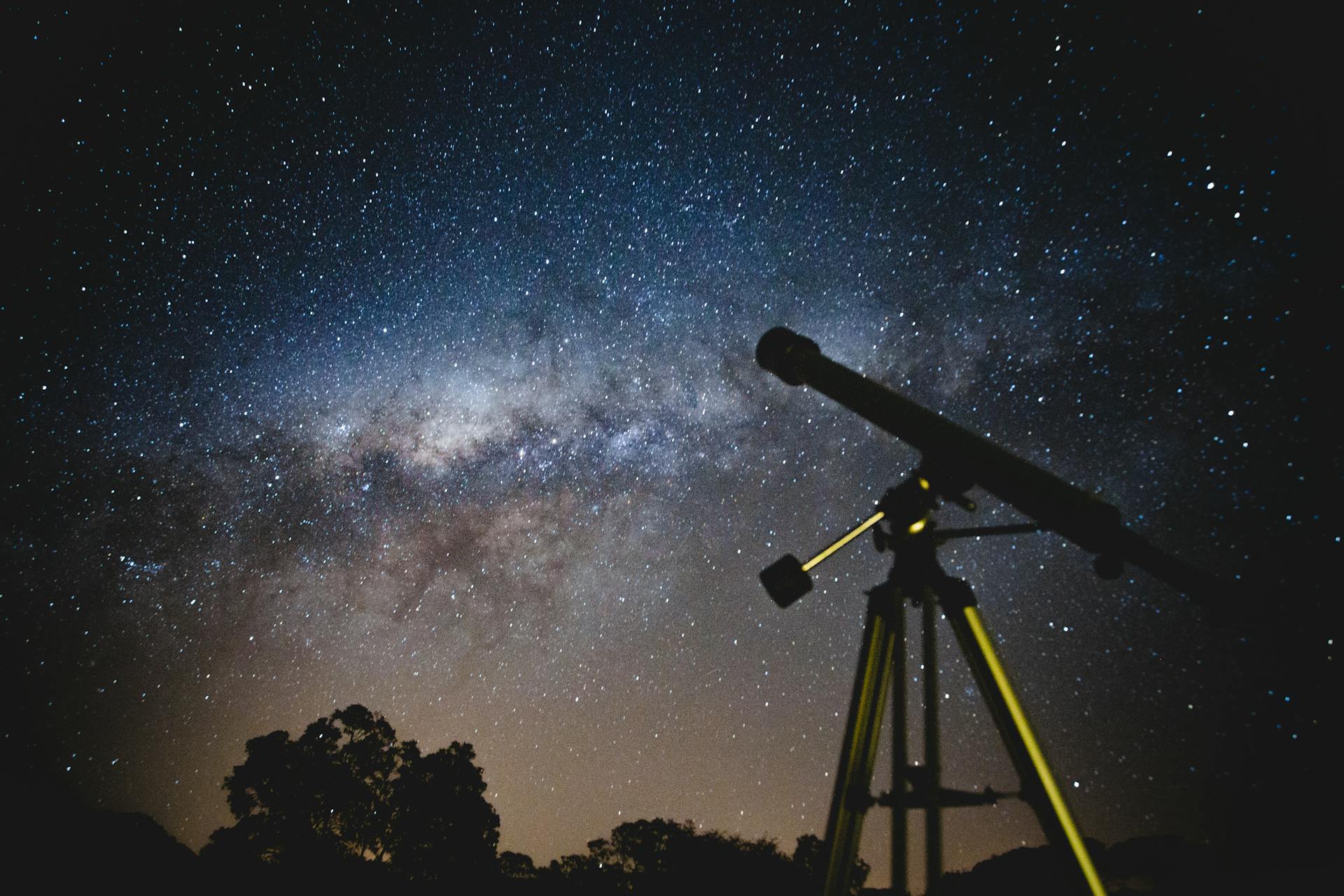
Astrology vs Astronomy: How They Differ, Where They Overlap, and Why Both Matter
For most of human history, the person who tracked the planets and the person who interpreted their meaning were the same individual. The Babylonian priest who recorded the movements of Jupiter across the night sky also believed those movements foretold the fate of kings. The Renaissance scholar who calculated planetary orbits with mathematical precision also cast horoscopes for the Pope. Astrology and astronomy weren't two disciplines. They were one, a single practice of watching the sky and drawing meaning from what it revealed.
That changed roughly three hundred years ago, and today the two fields occupy different worlds. Astronomy is a natural science, one of the most rigorous and well-funded on Earth. Astrology is a symbolic interpretive system that most scientists dismiss but roughly 30% of Americans still find meaningful. They share a vocabulary (planets, signs, conjunctions, transits), a subject matter (the sky), and a lineage stretching back thousands of years. But they ask fundamentally different questions about the same celestial objects.
Understanding the difference isn't just an exercise in definitions. If you practice astrology, knowing what astronomy actually does (and doesn't claim) sharpens your own practice. If you're skeptical of astrology, understanding what it actually claims (and doesn't claim) gives your skepticism a more honest target. And if you're somewhere in between, this is the article that helps you hold both without confusion.
What You'll Learn
What Astronomy Actually Is
Astronomy is the scientific study of everything beyond Earth's atmosphere. Stars, planets, moons, asteroids, comets, galaxies, nebulae, black holes, dark matter, the cosmic microwave background radiation left over from the first moments of the universe. If it exists in space, astronomy studies it.
The discipline operates through the scientific method: observation, hypothesis, experimentation (or observation-based testing), and peer review. Astronomers use telescopes, spectroscopy, radio waves, gravitational wave detectors, and space probes to gather data. They build mathematical models to explain what they observe and make predictions that can be tested against future observations.
Astronomy doesn't ask whether the position of Mars affects your love life. It asks what Mars is made of, how it formed, whether its subsurface harbors liquid water, and what its orbital mechanics can tell us about the formation of the solar system. The questions are physical, measurable, and testable.
Modern astronomy branches into several subfields: astrophysics (the physics of celestial objects), cosmology (the origin and evolution of the universe), planetary science (the study of planets and moons), stellar astronomy (the life cycles of stars), and astrometry (the precise measurement of celestial positions and movements). Each branch uses mathematical frameworks and empirical evidence as its foundation.
What astronomy doesn't do, and this is important for understanding the comparison, is assign meaning. Astronomy can tell you that Jupiter is in conjunction with Saturn at a specific date and time. It won't tell you what that means for your career or relationships. The data is the destination. What you do with the data philosophically, spiritually, or personally is outside astronomy's scope.
What Astrology Actually Is
Astrology is a symbolic system that interprets the positions and movements of celestial bodies as meaningful for human experience. It's built on the premise that the arrangement of the sky at any given moment, particularly the moment of a person's birth, corresponds to patterns in personality, events, and development.
The key word is "corresponds." Most modern astrologers don't claim that planets physically cause events on Earth the way the Moon's gravity causes tides. The more sophisticated position is that the cosmos and human experience are part of an interconnected system where celestial patterns reflect, rather than dictate, what's happening below. The ancient Hermetic axiom "as above, so below" captures this idea: the macrocosm and the microcosm mirror each other.
Astrology uses a specific technical framework. A natal chart maps the positions of the Sun, Moon, and planets at the exact moment and location of someone's birth. The chart is divided into twelve houses, each governing a different area of life. The planets occupy zodiac signs, which color how their energy expresses. The angular relationships between planets (called aspects) create dynamics of harmony or tension. Transits, the current movements of planets relative to the birth chart, indicate timing for different kinds of experiences.
This framework produces interpretations that are personal, nuanced, and, crucially, not falsifiable in the way scientific hypotheses are. You can't set up a controlled experiment to prove that having Venus in Pisces makes someone romantically idealistic, because "romantically idealistic" isn't a measurable variable with a universal definition. This is the core reason astronomy and astrology parted ways: astronomy moved toward what could be measured and tested, while astrology remained in the territory of meaning and interpretation.
That doesn't make astrology useless. It makes it a different kind of tool. Psychology isn't physics either, and philosophy isn't chemistry. Different domains of human experience require different frameworks for understanding.
The Shared History of Astrology and Astronomy
The split between astrology and astronomy is recent. For roughly four thousand years, they were inseparable.
Mesopotamia (circa 2000 BCE). The earliest systematic sky-watching comes from Babylonian civilization. Priests tracked planetary movements on clay tablets, recording the positions of Venus, Jupiter, Mars, Saturn, and Mercury with remarkable precision. Their purpose was explicitly astrological: they believed celestial events presaged the fortunes of the king and the state. These same observations, however, produced the first accurate astronomical records. The Babylonians identified the ecliptic (the Sun's apparent path), cataloged star positions, and developed mathematical methods for predicting lunar eclipses.
Ancient Greece (circa 400 BCE to 200 CE). Greek thinkers inherited Babylonian data and added geometry. Hipparchus calculated the length of the solar year to within six minutes of the modern value. Ptolemy wrote both the Almagest (the most influential astronomical text for the next 1,400 years) and the Tetrabiblos (the most influential astrological text for the same period). To Ptolemy, these weren't contradictory projects. Understanding the positions of the planets and understanding their significance were two halves of the same inquiry. For a deeper look at astrology's ancient development, the history of astrology traces this lineage in detail.
The Islamic Golden Age (circa 800 to 1200 CE). Arab scholars preserved and advanced both disciplines. Al-Biruni (973 to 1048) was among the first to distinguish between the two, treating astronomy as the more rigorous pursuit while acknowledging astrology's cultural significance. Islamic astronomers refined the astrolabe (a device for measuring celestial positions used by both astronomers and astrologers), built observatories, and produced star catalogs that improved on Greek data.
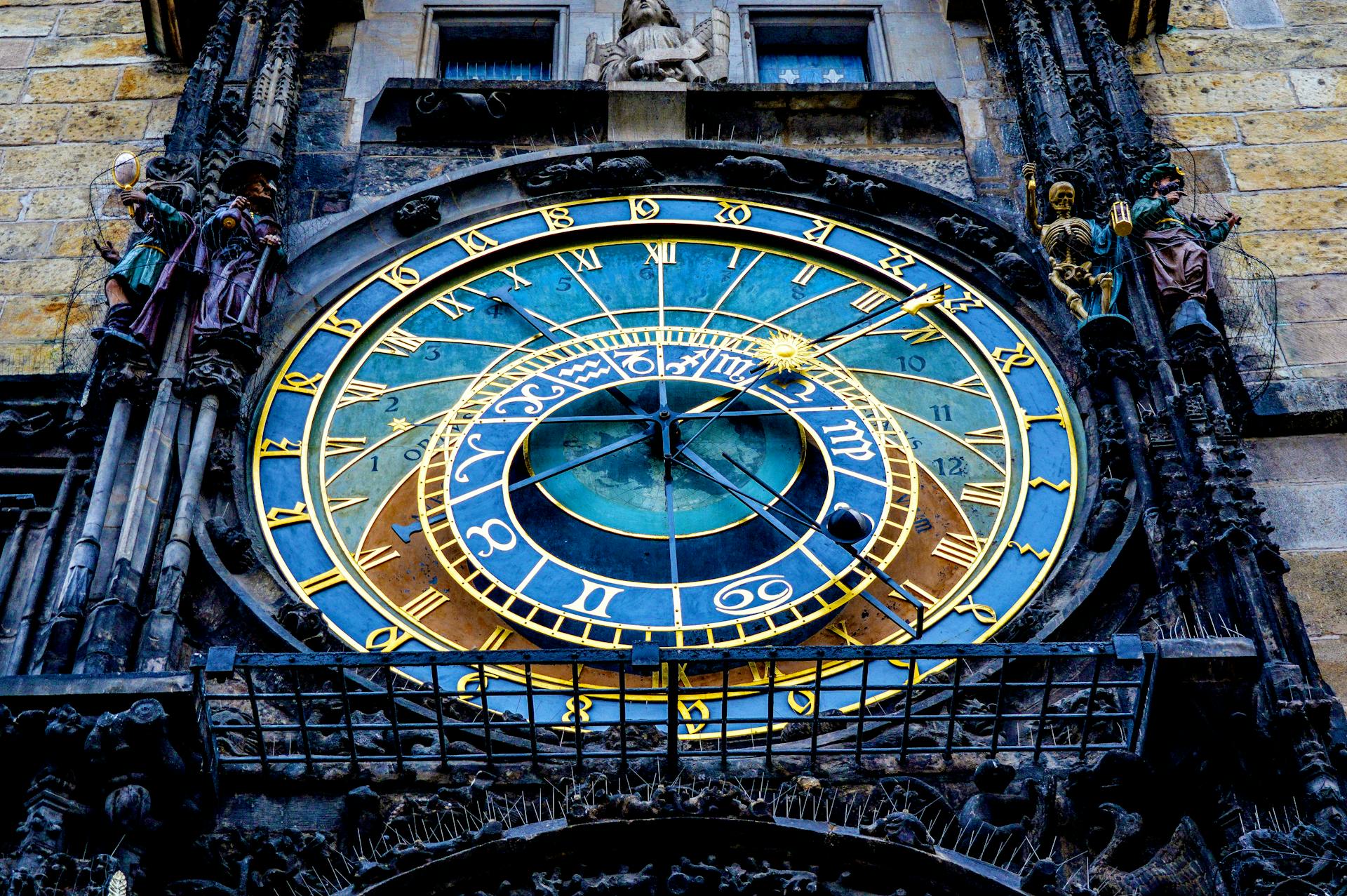
The medieval Prague Astronomical Clock, a symbol of time and the centuries-long union of astronomy and astrology
Medieval and Renaissance Europe (circa 1200 to 1600 CE). University curricula included both astronomy and astrology as standard subjects. Tycho Brahe, whose meticulous observations laid the groundwork for Kepler's laws of planetary motion, was also a practicing astrologer who cast horoscopes for the Danish court. Kepler himself, the man who discovered that planets move in ellipses rather than perfect circles, practiced astrology throughout his life and wrote astrological almanacs to supplement his income. Galileo cast horoscopes. So did most astronomers of the era. The two practices were woven together not because people were less intelligent but because the intellectual framework of the time didn't require separation.
When and Why They Split
The divorce between astrology and astronomy happened gradually over the 17th and 18th centuries, driven by three developments.
The Scientific Revolution. Newton's Principia Mathematica (1687) established that planetary motion could be explained entirely by the law of universal gravitation. For the first time, celestial mechanics had a physical explanation that didn't require interpretive meaning. The planets moved because of gravitational forces, not because of divine will or symbolic purpose. This didn't disprove astrology directly, but it gave astronomy a self-contained framework that no longer needed astrology's interpretive layer.
The Enlightenment. The broader cultural movement toward empiricism, reason, and testability pushed astrology out of intellectual respectability. If something couldn't be tested, measured, and replicated, it wasn't knowledge in the Enlightenment sense. Astronomy met this standard. Astrology didn't. By the late 1700s, most European universities had dropped astrology from their curricula while expanding astronomy departments.
Institutional professionalization. As astronomy became a formalized academic discipline with its own journals, observatories, and professional standards, astronomers had incentive to distance themselves from astrology. Astrology was increasingly associated with folk superstition and almanac horoscopes, and professional astronomers didn't want the association. The split was partly intellectual and partly social: a young discipline establishing its credibility by separating from an older practice that the intellectual establishment had decided to reject.
It's worth noting that the split was a Western European phenomenon with a specific historical context. In India, Vedic astrology (Jyotish) has maintained institutional legitimacy and remains closely tied to astronomical observation. In China, traditional astrology never experienced the same sharp separation from sky-watching. The idea that astrology and astronomy must be at war is itself a product of a particular cultural moment, not a universal truth.
Key Differences Between Astrology and Astronomy
Despite their shared origin, the two fields now differ in nearly every dimension.
Method. Astronomy uses the scientific method: testable hypotheses, controlled observations, peer review, mathematical modeling, and the principle that any claim must be potentially falsifiable. Astrology uses symbolic interpretation: chart reading, pattern recognition, archetypal analysis, and the principle that celestial patterns correspond to human experience in ways that are meaningful rather than mechanistic.
Claims. Astronomy makes physical claims about the universe: the age of the Sun, the composition of Saturn's rings, the distance to the nearest galaxy. These claims can be verified or disproven by anyone with the right instruments. Astrology makes interpretive claims about correspondence: a person born with Mars in Aries tends toward directness and assertiveness, a Saturn return at age 29 often coincides with a period of significant restructuring. These claims can be evaluated through personal experience but not through controlled experiment in the same way.
Tools. Astronomers use telescopes, spectrometers, radio arrays, space probes, gravitational wave detectors, and supercomputers. Astrologers use ephemerides (tables of planetary positions, which are produced by astronomical calculation), chart calculation software, and interpretive frameworks passed down through thousands of years of tradition.
Validation. Astronomy validates through prediction and observation. If the model predicts a solar eclipse at 2:47 PM on a specific date, and the eclipse occurs at 2:47 PM, the model is validated. Astrology validates through resonance and pattern. If a chart reading accurately describes your personality and pinpoints the timing of major life events, the system feels validated. But "feels validated" isn't the same standard as "experimentally validated," which is the crux of the scientific objection.
Scope. Astronomy is concerned with the physical universe at every scale, from subatomic particles in stellar cores to the large-scale structure of the observable universe. Astrology is concerned with human experience: personality, relationships, life timing, psychological development, and, in mundane astrology, the fate of nations and collective events.
Status. Astronomy is universally recognized as a natural science and is taught in every university on Earth. Astrology is not recognized as a science by any major scientific institution and is classified by most academics as a pseudoscience. Astrologers dispute this classification, arguing that astrology isn't attempting to be a science and shouldn't be judged by scientific criteria any more than poetry should be judged by the standards of biology.
Where They Still Overlap
Despite three centuries of separation, the two fields aren't as isolated from each other as either side sometimes claims.
Shared vocabulary. Both fields use the same names for celestial objects, the same zodiac constellations (though with different technical meanings, more on this below), and similar terminology for celestial events. A conjunction in astronomy (two objects appearing close together in the sky) means the same thing observationally as a conjunction in astrology, though the astrologer adds an interpretive layer about what the conjunction signifies.
Astronomical data powers astrology. Every astrological chart is built on astronomical calculations. The ephemeris that astrologers consult to find planetary positions is produced by astronomical computation. When you generate a natal chart using the natal chart calculator, the software is performing astronomical math to determine where each planet was positioned at your birth. Astrology couldn't function without astronomy's precision.
Eclipses and lunations. Both astronomers and astrologers track eclipses, new moons, and full moons. An astronomer studies a solar eclipse to learn about the Sun's corona. An astrologer studies the same eclipse to assess its impact on collective events and individual charts. They're observing the same phenomenon through different lenses.
Historical astronomy was built by astrologers. Many of the fundamental observations that modern astronomy rests on were made by people whose primary motivation was astrological. The precision of Babylonian planetary records, Ptolemy's mathematical models, Brahe's observational data, all were driven partly or entirely by the desire to cast better horoscopes. Astronomy owes a genuine debt to astrology as the cultural motivation that funded centuries of sky-watching.
Growing public interest fuels both. The surge of popular interest in astrology over the past decade has coincided with increased public engagement with astronomy. People who start checking their horoscope often develop a curiosity about the physical sky. People who buy a telescope often encounter astrological concepts as they learn constellation names and planetary lore. The two fields, whatever their professional relationship, still feed each other at the popular level.
The Precession Problem: Tropical vs Sidereal
The single most common point of confusion in the astrology-astronomy comparison involves the zodiac, and understanding it properly requires knowing something that both fields acknowledge but handle differently.
The Earth's axis wobbles over a roughly 26,000-year cycle called axial precession. This wobble means that the position of the Sun against the background constellations on any given date slowly shifts over centuries. Two thousand years ago, when the Western zodiac was formalized, the Sun was in the constellation Aries during late March. Today, because of precession, the Sun is actually in the constellation Pisces during that same period.
This is the basis for the most common criticism of astrology: "Your sign is wrong! The constellations have moved!" But this criticism misunderstands what Western astrology actually measures.
Western (tropical) astrology defines the zodiac by the seasons, not the stars. The sign of Aries begins at the vernal equinox, the moment when day and night are equal and spring begins in the Northern Hemisphere. Taurus follows. Then Gemini, and so on through the cycle. These signs are tied to the Earth-Sun relationship, not to the background constellations. The constellation of Aries could be anywhere in the sky and the tropical sign of Aries would still begin at the equinox.
Sidereal astrology, practiced primarily in the Vedic (Indian) tradition, does define the zodiac by the actual positions of the constellations. Sidereal astrologers account for precession, which means a Vedic chart will typically show signs that are about 23 degrees (roughly one sign) offset from a tropical chart. Both systems produce functional interpretations. They're just measuring different things.
Astronomers are technically correct that the constellations no longer align with the tropical signs. Astrologers are technically correct that tropical astrology never claimed to measure constellations in the first place. The argument persists because both sides are talking past each other, each pointing to a fact that's true but irrelevant to the other's framework.
The house systems article explores how different calculation methods affect chart interpretation, a parallel reminder that even within astrology, the question "what exactly are we measuring?" has multiple valid answers.
Can You Practice Both?
Yes, and many people do.
There's no intellectual contradiction in studying the physical properties of Jupiter through a telescope and also interpreting Jupiter's transit through your seventh house as a period of relationship expansion. The two activities operate in different domains. One describes what Jupiter physically is. The other uses Jupiter as a symbol within an interpretive system. You don't need to believe that the physical planet is beaming relationship energy at your apartment to find the symbolic framework useful.
The contradiction only arises when you conflate the two, when you claim that astrology is a science (it's not, by the standard definition) or that astronomy disproves astrology (it doesn't, because astrology's claims aren't scientific claims). Keep them in their proper lanes and they coexist without friction.
Many amateur astronomers enjoy astrology as a complementary lens on the sky they observe. Many astrologers deepen their practice by understanding the astronomical reality of the celestial bodies they interpret. Knowing that Saturn's rings are made of ice and rock doesn't diminish the astrological symbolism of Saturn as the planet of structure, discipline, and time. If anything, it enriches it: a planet literally encircled by organized layers of frozen material is a fitting symbol for the principle of crystallized form.
The most productive relationship between the two isn't opposition. It's division of labor. Astronomy answers "what is the sky?" Astrology asks "what does the sky mean?" Both questions are worth asking. Neither answer substitutes for the other.
Frequently Asked Questions
Is astrology considered a science?
No. Astrology is not recognized as a science by any major scientific institution, including NASA, the American Astronomical Society, or the National Science Foundation. The primary reason is that astrological claims are generally not falsifiable in the way scientific hypotheses must be. A scientific claim needs to be specific enough that an experiment could prove it wrong. Astrological interpretations, because they involve symbolic and often subjective language, resist this kind of testing. This doesn't mean astrology is worthless. It means it operates outside the scientific framework. Many practitioners frame astrology as a symbolic language, a philosophical system, or a form of applied psychology rather than claiming scientific status.
Did astrology used to be considered a real science?
Before the Scientific Revolution, the modern concept of "science" as distinct from other forms of knowledge didn't exist in the way we understand it today. Astrology was part of the standard intellectual curriculum in medieval European universities and was practiced by figures we now celebrate as foundational scientists: Kepler, Galileo, Brahe, and Newton (who studied alchemy, a similarly now-rejected practice). The word "scientist" wasn't even coined until 1833. Astrology wasn't "considered a science" in the modern sense because the category didn't exist. It was considered a legitimate form of knowledge within the intellectual framework of its time.
Why do astronomers dislike astrology?
Not all do, but many professional astronomers view astrology as a misuse of astronomical data that confuses the public about what astronomy actually studies. The frustration is partly about brand protection: astronomers worry that public conflation of the two fields undermines the credibility of astronomical research. It's also partly philosophical: scientists trained in empiricism tend to reject interpretive systems that can't be tested experimentally. The intensity of the objection varies. Some astronomers actively campaign against astrology. Others are indifferent. A few quietly practice it. The official position of major astronomical organizations is that astrology is not science, but individual astronomers hold a range of personal views.
Can astrology predict the future?
Astrology doesn't predict specific events the way astronomy predicts eclipses with split-second accuracy. What astrology does is identify periods when certain themes, energies, and challenges are more likely to surface based on planetary transits and chart progressions. An astrologer might say that your upcoming Saturn return will bring a period of restructuring in your late twenties. They won't say you'll get fired on March 15th. The distinction matters: astrology works in themes and timing windows, not specific events. Whether you consider this "prediction" depends on how loosely you're willing to define the word.
What's the difference between a zodiac sign and a constellation?
In astronomy, a constellation is a defined area of the sky containing a pattern of stars. The International Astronomical Union recognizes 88 constellations with precise boundaries. The twelve zodiac constellations are the ones that lie along the ecliptic, the Sun's apparent path through the sky. They vary enormously in size. In tropical astrology, a zodiac sign is a 30-degree segment of the ecliptic, starting from the vernal equinox point. All twelve signs are exactly 30 degrees each, regardless of the size of the corresponding constellation. The signs are geometrically defined divisions of the seasonal cycle. The constellations are irregularly shaped star groupings. They share names but measure different things.
Astrology and astronomy are siblings who grew up together and chose different paths. One became a scientist. The other became something harder to categorize: part philosopher, part psychologist, part storyteller, part keeper of an ancient tradition that refuses to disappear despite three centuries of dismissal. You don't have to choose between them. Understanding the physical sky deepens your appreciation for the symbolic system built upon it, and the symbolic system gives you a reason to look up in the first place. To start exploring what the sky looked like at the moment you were born, generate your chart with the natal chart calculator. For the astrological perspective on how celestial movements shape your experience right now, explore planetary transits. And if you're curious about the ancient roots that connect both traditions, the history of astrology traces the full lineage from Babylonian sky-watchers to the modern practice.