Eclipse Season in Astrology: What Solar and Lunar Eclipses Mean for You
Twice a year, sometimes three times, the sky does something it doesn't do during ordinary new and full moons. The Sun, Moon, and Earth line up so precisely that one body blocks the light of another. For a few hours, the normal rhythm of day and night stutters. Shadows fall where they shouldn't. Light appears where it normally doesn't. And in astrology, the events that unfold during these windows carry a weight that regular lunations can't match.
Eclipse season isn't subtle. It's the period when the universe stops asking nicely and starts rearranging the furniture whether you've agreed to the renovation or not. Relationships that were limping along suddenly end. Opportunities that weren't on your radar materialize from nowhere. Truths you've been avoiding land on your doorstep and refuse to leave. The changes that eclipses trigger tend to feel fated, not because some cosmic force is controlling your life, but because eclipses accelerate processes that were already building beneath the surface.
If you've ever had a month where everything shifted at once and you couldn't explain why, check the eclipse calendar. There's a good chance one landed on a sensitive point in your chart.
What You'll Learn
What Makes an Eclipse Different From a Regular New or Full Moon
Every month brings a new moon and a full moon. These are routine lunations, the Moon's steady rhythm as it orbits Earth. New moons are planting times: set intentions, start projects, begin. Full moons are harvest times: see results, gain clarity, release what's finished. You've probably worked with this cycle already, especially if you follow planetary transits.
Eclipses happen when this ordinary cycle gets supercharged.
During a regular new moon, the Moon sits between the Earth and Sun, but it's slightly above or below the Sun's path, so no blocking occurs. During a solar eclipse, the alignment is precise enough that the Moon actually obscures the Sun. During a regular full moon, the Moon reflects sunlight from the opposite side of the sky. During a lunar eclipse, the Earth slides between the Sun and Moon, casting its shadow across the lunar surface.
The difference isn't just visual. In astrological terms, eclipses carry roughly five to ten times the energetic weight of a standard lunation. What a regular new moon might unfold over weeks, a solar eclipse can trigger in days. What a full moon might gently illuminate, a lunar eclipse can expose with the intensity of a floodlight turned on in a dark room.
Eclipses also have a longer reach. The effects of a regular new or full moon dissipate within about two weeks. Eclipse effects can ripple through the following six months, sometimes longer. The events that begin during an eclipse often don't fully resolve until the next eclipse in the same sign, which could be six months or even years away.
Solar Eclipses vs. Lunar Eclipses
Solar eclipses and lunar eclipses operate differently, and understanding the distinction helps you anticipate what each one brings.
Solar eclipses occur during new moons when the Moon passes directly between the Earth and Sun. From our perspective, the Moon covers the Sun, temporarily blocking its light. In astrology, this represents a powerful new beginning, but not the gentle, intention-setting kind of beginning you associate with a normal new moon. Solar eclipse beginnings are often abrupt, unexpected, and impossible to ignore. A door opens that you didn't know existed. A chapter starts before you've finished the last one. Something enters your life that reshapes the landscape.
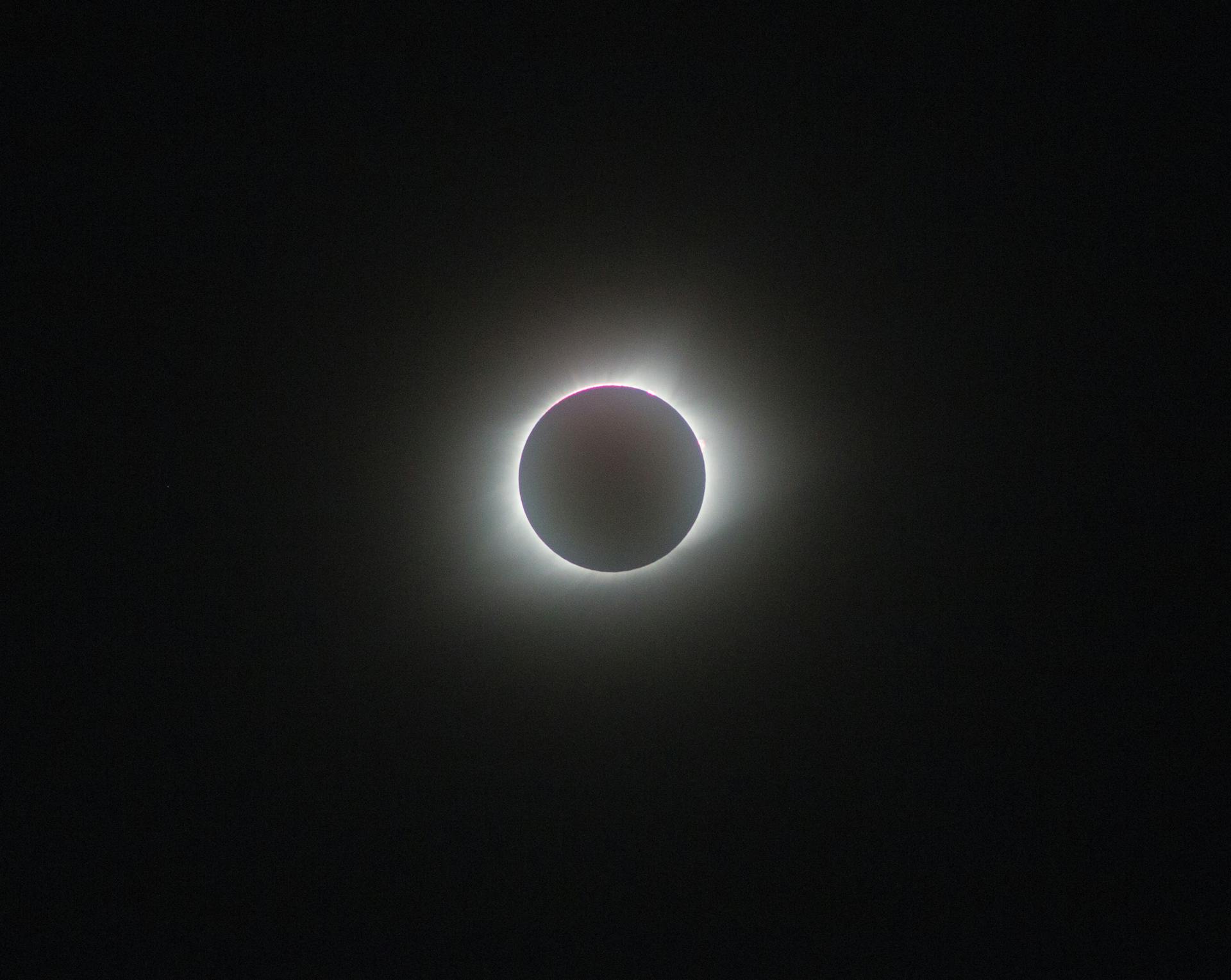
Solar eclipses come in three varieties: total (the Moon fully covers the Sun), annular (the Moon covers the Sun's center but a ring of light remains visible around the edges), and partial (the Moon covers only part of the Sun). Total solar eclipses carry the most concentrated energy. Annular eclipses are close behind. Partial eclipses are the gentlest of the three, though "gentle" is relative when you're talking about eclipses.
Lunar eclipses occur during full moons when the Earth passes between the Sun and Moon, casting Earth's shadow across the Moon's face. This is the classic "blood moon" effect, where the Moon turns red or copper during totality. In astrology, lunar eclipses represent culminations, revelations, and endings. Something that's been building comes to a head. A secret surfaces. A situation that's been running on borrowed time finally reaches its conclusion.
Lunar eclipses tend to be more emotional than solar eclipses because they involve the full moon, which already heightens feelings. During a lunar eclipse, emotions that you've been managing or ignoring can overwhelm their containers. The revelation isn't just intellectual. You feel it in your body.
The two types work together in pairs. During a typical eclipse season, you'll get one solar and one lunar eclipse about two weeks apart. The solar eclipse opens a new door; the lunar eclipse closes an old one. Or the lunar eclipse reveals a truth that the solar eclipse then forces you to act on. The paired nature means eclipse seasons are periods of simultaneous beginning and ending, which is why they feel so disorienting. You're building and dismantling at the same time.
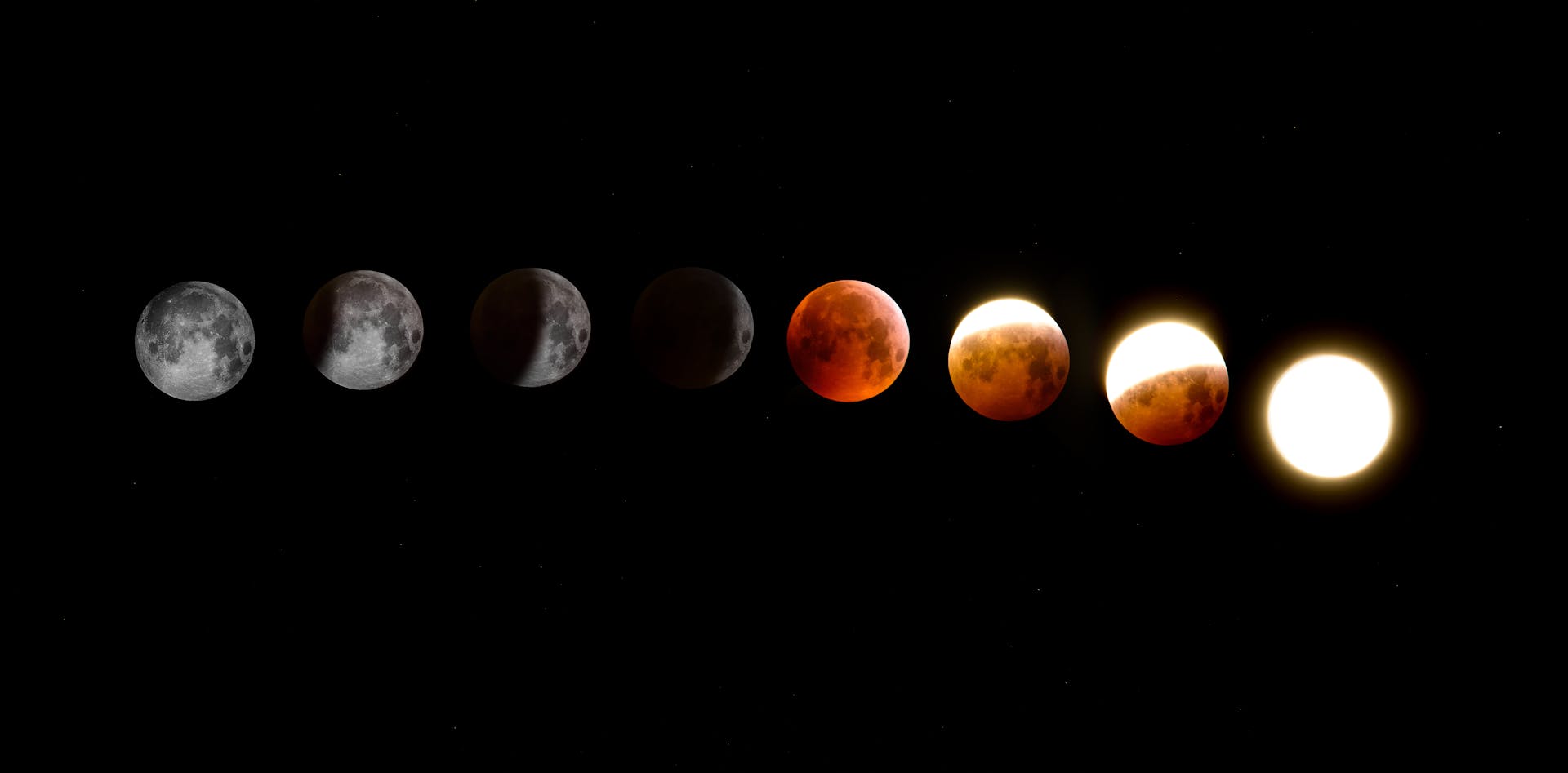
A stunning sequence of moon phases during a lunar eclipse showing the transition from full moon to the red-copper totality
The Lunar Nodes and Why They Matter
You can't understand eclipses without understanding the lunar nodes, because eclipses only happen when the Sun and Moon are near them.
The lunar nodes are the two points where the Moon's orbit crosses the ecliptic, the Sun's apparent path through the sky. The North Node marks where the Moon crosses from south to north. The South Node marks where it crosses from north to south. These points aren't physical bodies. They're mathematical intersections, but they carry enormous astrological significance.
In a natal chart, the North Node represents your soul's growth direction, the qualities and experiences you're meant to develop in this lifetime. The South Node represents your comfort zone, the skills and patterns you've already mastered (possibly across lifetimes, if you follow that framework) that now need to be released or evolved.
Eclipses happen exclusively when the new or full moon falls close to the nodal axis. This is why eclipses feel fated: they're tied to the same points in the sky that astrology associates with destiny, karma, and life purpose. An eclipse isn't just a powerful lunation. It's a powerful lunation that's aligned with the axis of your personal evolution.
The nodes move backward through the zodiac, spending roughly 18 months in each pair of signs. This means eclipses occur in the same pair of signs for about a year and a half before shifting. When eclipses fall in signs that are active in your chart (on your Sun, Moon, Ascendant, or other personal points), that 18-month window tends to be a period of accelerated, sometimes uncomfortable, growth.
How Eclipse Cycles Work
Eclipses follow patterns that repeat over long time scales. Understanding these patterns gives you context for the changes they bring.
Eclipse seasons occur roughly every six months, each lasting about 34 to 38 days. During this window, two or occasionally three eclipses will occur. Eclipse seasons happen when the Sun moves close enough to the lunar nodes for an eclipse alignment to be possible.
The Saros cycle is the most famous eclipse pattern. It spans 18 years, 11 days, and 8 hours. Eclipses within the same Saros series share similar characteristics and tend to echo each other's themes. If something significant happened in your life during an eclipse 18 or 19 years ago, the current eclipse in the same Saros series may revisit that theme from a new angle.
The Metonic cycle covers 19 years. After 19 years, eclipses return to nearly the same degree of the zodiac. This means the eclipses of your late teens often rhyme with the eclipses of your late thirties. The themes resurface, but you've changed, so you meet them differently.
Nodal return cycles repeat every 18.6 years. When the lunar nodes return to the signs they occupied at your birth (your nodal return), the eclipses during that period hit especially close to home. Your first nodal return at around age 18-19 and your second at around 37-38 are often marked by significant life redirections.
The practical takeaway: eclipses aren't random. They follow patterns that connect to your personal timeline. When an eclipse activates a sensitive point in your chart, it's not just that one eclipse working on you. It's a link in a chain that stretches back years and will continue forward for years to come.
What to Do (and Not Do) During Eclipse Season
Eclipse energy is potent but volatile. Working with it effectively means understanding what it favors and what it doesn't.
What to do:
Let things happen. Eclipses bring changes that are already overdue. Resisting them creates more friction than accepting them. If a relationship ends during an eclipse, it was already ending. If an opportunity appears, it's because you've been preparing for it, consciously or not. The most productive response to eclipse energy is openness. Pay attention to what's shifting and ask yourself what it's trying to show you.
Observe more than you act. Eclipse periods are better for receiving information than for launching initiatives. The revelations that come during eclipses are valuable, but the emotional intensity of the moment can distort your judgment. Take notes. Process what's happening. Make major decisions after the eclipse dust settles, not during the peak of the energy.
Journal. Eclipse seasons generate insights at an unusual rate. Capture them. You'll want to review your notes months later when the next eclipse in the same sign activates related themes.
Rest more than usual. Eclipse energy is physically draining for many people. Fatigue, vivid dreams, disrupted sleep, headaches, and emotional sensitivity are all common during eclipse windows. Your body is processing change on a cellular level. Give it the rest it needs.
What to avoid:
Starting major new ventures on the day of an eclipse. This is one of the most widely agreed-upon guidelines in mundane astrology. Eclipses are associated with instability and unpredictability. Projects launched under an eclipse tend to take unexpected turns. If electional astrology matters to you, wait at least a week after the eclipse to sign contracts, launch businesses, or make binding commitments.
Manifesting or doing intention-setting rituals during eclipses. This surprises people who treat every new moon as a manifesting opportunity. Eclipse new moons are different. The energy is too wild and unpredictable to direct with intention work. Instead of trying to steer the eclipse, let the eclipse show you what it has in mind. You can set intentions at the regular new moon that follows.
Forcing outcomes. If something isn't working during an eclipse, pushing harder won't fix it. Eclipse energy has its own agenda. Your job isn't to control it. It's to stay present, stay flexible, and trust that the disruption is clearing space for something better aligned with your path.
How to Read Eclipses in Your Birth Chart
To understand how a specific eclipse affects you personally, you need three pieces of information: the eclipse's sign and degree, the house it falls in your chart, and any aspects it makes to your natal planets.
Step one: Find the eclipse's position. Every eclipse occurs at a specific degree of a specific zodiac sign. Eclipse tables published by astronomy organizations provide exact dates and degrees. Astrology sites translate these into chart-readable formats.
Step two: Locate that degree in your chart. Pull up your natal chart and find which house contains the eclipse degree. That house tells you the area of life that the eclipse will activate. If the eclipse falls at 15 degrees of Virgo, look for where 15 degrees Virgo falls in your chart.
Step three: Check for conjunctions. If the eclipse lands within 3 to 5 degrees of one of your natal planets, angles (Ascendant, Midheaven, IC, Descendant), or nodes, the effect intensifies dramatically. An eclipse conjunct your natal Sun can trigger a major identity shift. An eclipse conjunct your natal Venus can reshape your relationships. An eclipse conjunct your Midheaven can redirect your career.
Step four: Consider the sign axis. Eclipses activate an entire axis, not just one sign. If a solar eclipse falls in Virgo, the opposing sign Pisces is also engaged. Your natal planets in either sign will feel the eclipse's energy, with the conjunction being the most intense and the opposition close behind.
Step five: Look back at previous eclipses in the same signs. What was happening in your life the last time eclipses fell in this sign pair? The current eclipse is continuing a story that started then. Recognizing the thread helps you understand the chapter you're in.
Eclipse Effects by House
The house where an eclipse falls tells you which area of life is being activated. Here's a brief guide to eclipses through each house.
1st House. Identity, appearance, personal direction. Eclipses here can trigger dramatic shifts in how you present yourself to the world or how you see yourself. New hair, new style, new life direction. You're being reborn in some visible way.
2nd House. Money, possessions, self-worth. Financial changes, shifts in income, or a deeper reckoning with what you value. You might gain or lose a resource in a way that forces you to redefine what security means.
3rd House. Communication, siblings, local community, learning. A message arrives that changes things. A conversation you can't take back. A new course of study that reshapes your thinking. Sibling relationships may transform.
4th House. Home, family, roots, emotional foundation. Moving, renovating, changes in family dynamics. Eclipses here often coincide with leaving one home and building another, literally or emotionally.
5th House. Creativity, romance, children, self-expression. A new creative project takes on a life of its own. A romantic connection begins or ends. Pregnancy or developments with children. Your relationship to joy itself shifts.
6th House. Daily routines, health, work habits, service. A health diagnosis that changes your routine. A new job or a significant shift in your work environment. The daily structures of your life get reorganized.
7th House. Partnerships, marriage, contracts, open enemies. Relationship beginnings and endings. Business partnerships forming or dissolving. Eclipses here tend to be among the most personally felt because they directly involve the people closest to you.
8th House. Shared resources, intimacy, transformation, debt, inheritance. Financial entanglements shift. Deep psychological material surfaces. Taxes, loans, or inheritance matters reach turning points. The power dynamics in your intimate relationships change.
9th House. Higher education, travel, beliefs, publishing, legal matters. A trip that changes your perspective. A legal matter reaching resolution. A shift in your belief system. An opportunity to teach or publish.
10th House. Career, reputation, public standing, legacy. One of the most visible eclipse positions. Career changes, promotions, public recognition, or public reckoning. What the world sees when it looks at you is being redefined.
11th House. Friendships, community, hopes, collective goals. Friend groups shift. Your vision for the future changes. Involvement with organizations or social causes takes a new direction. The people you surround yourself with may change significantly.
12th House. The unconscious, hidden matters, spirituality, isolation. The most internal and least visible eclipse position. Dreams become vivid and meaningful. Hidden information comes to light. A period of spiritual deepening or necessary retreat from the world.
Frequently Asked Questions
How long do eclipse effects last?
Eclipse effects typically unfold over six months, from one eclipse to the next eclipse in related signs. However, the most intense period is the two weeks surrounding the eclipse itself. Some astrologers extend the influence window to a full year, especially for eclipses that closely conjunct natal planets. The Saros cycle (18 years) also suggests that eclipse themes can echo across decades. As a practical guideline, expect the most noticeable shifts in the month surrounding the eclipse, with subtler developments continuing for six months afterward.
Can I manifest during an eclipse?
Most traditional and modern astrologers advise against deliberate manifesting or intention-setting during eclipses. The energy is too unpredictable and too powerful to direct with personal intention. Eclipses operate on a larger scale than individual willpower. Instead of trying to tell the eclipse what you want, allow the eclipse to reveal what's already in motion. Save your intention-setting for the regular new moon that follows the eclipse, when the energy stabilizes enough for focused personal work.
What if an eclipse falls on my birthday?
An eclipse near your birthday (within a few days) means the eclipse is conjunct your natal Sun. This is one of the most personally significant eclipse contacts possible. It typically marks a year of major life changes, identity shifts, and accelerated personal evolution. The house the eclipse falls in and the type of eclipse (solar or lunar) shape the specifics, but the general theme is transformation of self. Think of it as your entire solar return year being supercharged. Changes initiated during this period tend to be lasting.
Are solar eclipses more powerful than lunar eclipses?
Neither is universally more powerful, but they operate differently. Solar eclipses tend to create more external, visible changes: new beginnings, new opportunities, new chapters. Lunar eclipses tend to generate more internal, emotional shifts: realizations, emotional releases, endings of patterns that no longer serve you. Which feels more powerful depends on what's happening in your chart and life. An eclipse that closely conjuncts a personal planet will feel significant regardless of whether it's solar or lunar.
Do eclipses affect everyone the same way?
No. While eclipses influence the collective (they're associated with major world events, political shifts, and cultural turning points), their personal impact depends entirely on your birth chart. An eclipse at 15 degrees Virgo will be life-changing for someone with their Sun, Moon, or Ascendant near that degree, and barely noticeable for someone with no planets in mutable signs. The closer the eclipse falls to a sensitive point in your chart, the more directly you'll feel its effects. To check your personal exposure, run your natal chart and compare it against current eclipse degrees.
Eclipse seasons can feel chaotic, but they're not random. They follow patterns you can track, anticipate, and learn from. The changes they bring are almost always changes that needed to happen, even when they don't feel that way in the moment. To understand how the current eclipse axis interacts with your personal placements, explore your chart with the natal chart calculator. And for deeper context on the karmic axis that eclipses activate, read about the lunar nodes and their role in your soul's evolution.