
How to Build a Daily Tarot Practice: Card Pulls, Journaling, and Rituals That Stick
The single fastest way to learn tarot isn't memorizing card meanings from a book. It isn't watching someone else read on YouTube. It isn't buying a prettier deck. It's pulling one card every day, sitting with it, and paying attention to how it shows up in your actual life before the sun sets.
A daily tarot practice turns 78 abstract symbols into a living vocabulary. After a month, you'll recognize the Three of Swords not as "heartbreak" from a keyword list but as that Tuesday when your friend canceled plans and you realized you were more hurt than you expected. After three months, you won't need to look up the Seven of Pentacles because you'll remember the week you pulled it and spent every day wondering whether the project you'd been working on was actually going anywhere. After a year, the cards won't feel like cards anymore. They'll feel like a language you speak, one that describes the inner landscape of human experience with a precision that ordinary words can't match.
This isn't about developing psychic abilities or believing in anything supernatural. Daily tarot practice works because it forces a few minutes of focused self-reflection into your routine, and that reflection, practiced consistently, changes how you understand yourself and the situations you're navigating.
What You'll Learn
Why a Daily Practice Matters More Than Occasional Readings
Most people encounter tarot through big readings. A Celtic Cross spread during a life crisis. A love reading when a relationship feels uncertain. A career spread at a crossroads. These are valuable, but they're also infrequent. You might do a major spread once a month, or once a season, or only when something dramatic forces you to look for guidance.
Daily practice fills the gaps between those big moments, and it's in the gaps where the real learning happens.
Here's why consistency matters more than intensity.
You learn the cards through experience, not memorization. A book tells you the Four of Pentacles means holding on too tightly. Your daily practice shows you the Four of Pentacles on the morning you refuse to delegate a task at work because nobody else will do it right. One teaches you a definition. The other teaches you a feeling. The feeling is what you'll remember in your next reading.
You develop pattern recognition. After a few weeks of daily pulls, you'll start noticing which cards appear frequently and which you almost never see. You'll notice that Cups dominate your pulls during emotional weeks and Swords show up when you're overthinking. These patterns teach you about both the cards and yourself simultaneously.
You build the muscle of interpretation. Reading tarot is a skill that improves with repetition, exactly like playing an instrument or speaking a language. One big reading per month gives you twelve practice sessions per year. One daily pull gives you 365. The person who practices daily will outread the person who only does occasional spreads, every single time.
You create a feedback loop. When you pull a card in the morning and review it at night, you're testing interpretations against reality in real time. Did the Two of Wands actually manifest as a decision about the future? Did the Ace of Cups actually show up as an emotional opening? This immediate feedback accelerates learning in a way that big, infrequent readings can't replicate.
You make space for reflection. The most underrated benefit of daily tarot isn't divinatory. It's psychological. Pulling a card forces you to pause, even if only for sixty seconds, and consider what's happening in your inner life. Most people go through entire days without checking in with themselves. The daily pull interrupts that autopilot.
How to Pull a Daily Tarot Card
The mechanics are simple. The consistency is the challenge.
Step 1: Shuffle. Hold your deck and shuffle however feels natural. Overhand, riffle, pile shuffling, spreading the cards out on a table and mixing them with your hands. There's no correct technique. Shuffle until the deck feels ready. Most people find that 30 seconds to a minute of shuffling is enough to randomize the cards and settle their mind.
Step 2: Set a focus. You don't need a formal question, but having some kind of orientation helps. "What should I pay attention to today?" is the most common daily pull question, and it works perfectly. More on questions in the next section.
Step 3: Draw. Pull from the top of the deck. Or cut the deck and pull from the middle. Or fan the cards and let your hand drift to one. The method doesn't change the outcome. Pick a method and use it consistently so the ritual becomes automatic.
Step 4: Look at the card. Before reaching for a book or app, spend at least 30 seconds just looking at the image. What do you notice first? What's the figure doing? What's the color palette? What feeling does the image create in your body? These initial impressions are the foundation of intuitive reading, and they'll become more accurate over time.
Step 5: Interpret. Combine your visual impression with whatever you know about the card's traditional meaning. If you're still learning, glance at a reference. But always start with your own impression before checking. You're training your intuition, and it needs room to practice.
Step 6: Carry it with you. Let the card's message sit in the back of your mind throughout the day. You're not obsessing over it. You're just watching for moments where the card's energy appears in your experience.
Step 7: Review. At the end of the day, or the next morning, think about whether and how the card showed up. This step is what transforms a pull from a parlor trick into a practice.
The Best Questions to Ask in a Daily Pull
The question you ask shapes the reading you get. Here are questions that work well for daily practice, organized by what you're trying to accomplish.
For general guidance:
These open-ended questions let the card set the agenda rather than limiting it to a specific topic. They're the best starting point for beginners.
For self-awareness:
These questions use the daily pull as a mirror. They're more confrontational than general guidance questions and tend to produce cards that are uncomfortable but illuminating.
For intention-setting:
These questions point toward action and attitude rather than prediction. They're excellent for people who want their tarot practice to be practical rather than mystical.
For learning the cards:
This approach works especially well when you're new and want to focus on card knowledge rather than interpretation accuracy.
Questions to avoid in daily practice:
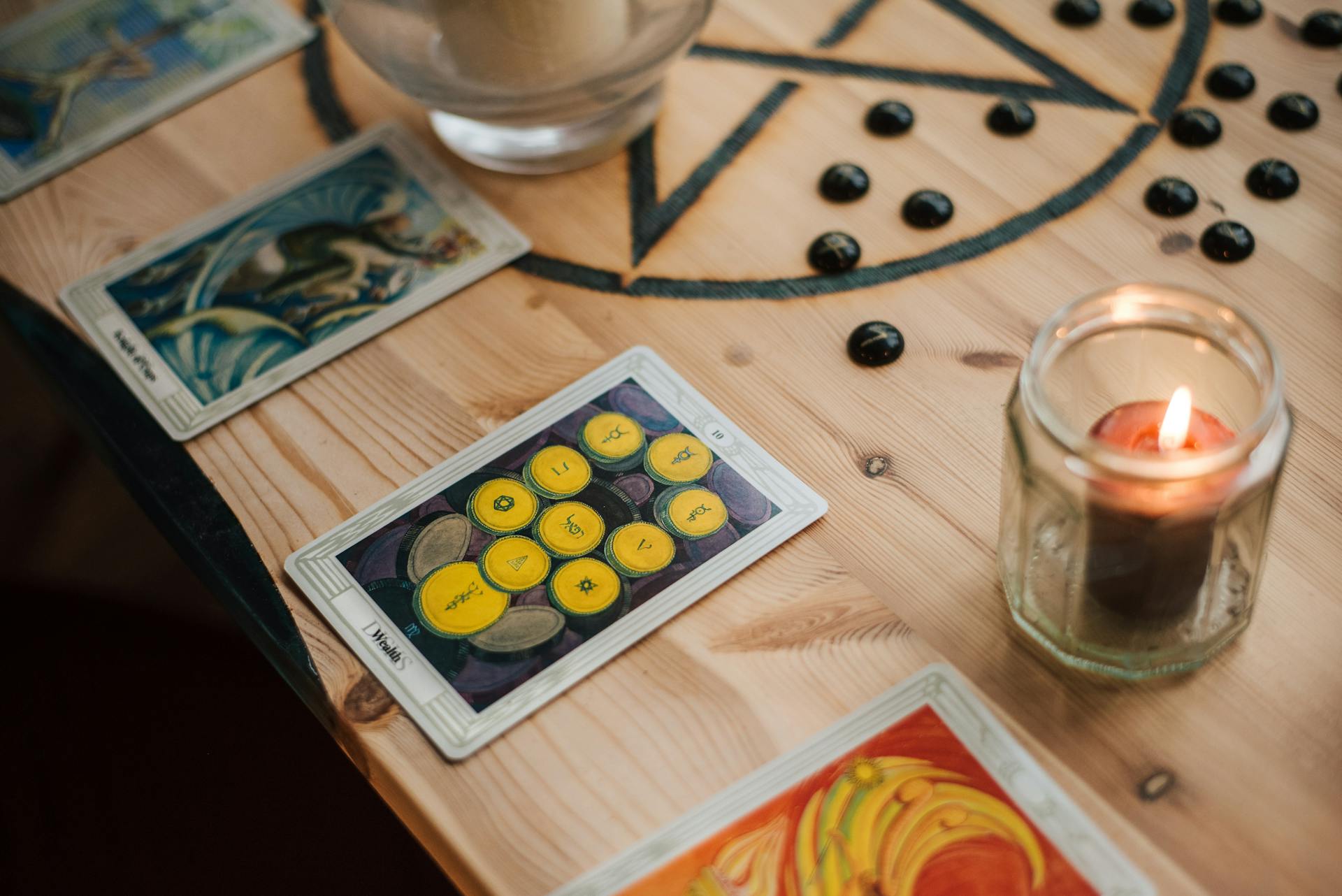
Tarot cards and a glowing candle on a wooden table creating an intimate space for daily card study and reflection
How to Journal Your Daily Tarot Pulls
Journaling is what turns daily pulls from a nice habit into a powerful self-development tool. Without a written record, you'll forget most of your daily pulls within a week. With one, you build a personal tarot textbook that's written in your own experience.
Here's a journaling format that takes five minutes or less.
Date and card. Write the date and which card you pulled. If you're using reversals, note the orientation.
First impression. One or two sentences about what you noticed or felt when you first saw the card. Don't censor yourself. "This card makes me anxious" is as valid as "I noticed the figure looking away from the cups." Your gut reaction is data.
Traditional meaning. A brief note about what the card conventionally means. This is optional once you've been practicing for a while and know the meanings, but useful in the early months. For reference, the beginner's guide to reading tarot cards covers the foundational meanings.
How it might apply today. One or two sentences connecting the card's energy to something you're currently navigating. If you have no idea how it applies, write that. "I have no idea what the Eight of Pentacles has to do with my day" is fine. You might understand by evening.
Evening review (optional but valuable). Return to the entry at the end of the day and add a note about how the card actually showed up. This is where the real learning happens. Sometimes the connection will be obvious. Sometimes it'll be subtle. Sometimes you genuinely won't see it. All three outcomes are normal.
Over time, your tarot journal becomes an incredibly rich document. You'll be able to flip back three months and see exactly what was happening the last time you pulled the Tower. You'll notice that the Queen of Swords appears every time you need to set a boundary. You'll discover which cards you never pull and start wondering what that absence means.
Some people use a dedicated notebook. Others use a notes app. Others keep a spreadsheet. The medium doesn't matter. The consistency does. Pick a format that's easy enough that you'll actually use it at 7 AM when you're barely awake and haven't had coffee yet.
Morning vs. Evening Pulls: Finding Your Rhythm
There's genuine disagreement in the tarot community about the best time of day for a daily pull. Both approaches work. Here's how they differ so you can choose.
Morning pulls set a tone for the day. You draw a card before the day has started, which means you're reading proactively. The card becomes a lens through which you view whatever happens next. If you pull the Five of Wands in the morning, you'll be watching for conflict, competition, and creative tension throughout the day. This forewarning can help you navigate challenging situations with more awareness.
The downside of morning pulls is that you're interpreting without context. You have to project the card's meaning forward into a day that hasn't happened yet, which requires more imagination and can sometimes lead to overthinking. ("I pulled the Tower. Is something terrible going to happen today?")
Evening pulls reflect on the day that was. You draw a card after the day's events, which means you're reading retrospectively. The card becomes a summary, revealing the theme or lesson of the day you just lived. If you pull the Five of Wands in the evening, you can look back and identify exactly where the conflict and creative tension showed up.
The downside of evening pulls is that you lose the proactive quality. The card isn't guiding you through the day. It's commenting on it afterward. This can feel less interactive, especially for people who want their daily practice to influence their behavior.
The hybrid approach is the best of both worlds if you're willing to check in twice. Pull in the morning. Carry the card's message through your day. Journal briefly in the evening about how it manifested. This creates the complete feedback loop: prediction, experience, and reflection.
If you can only choose one, morning pulls are generally better for building interpretive skill because they challenge you to apply card meanings in real time. Evening pulls are better for processing and emotional awareness because they help you make sense of what already happened.
Building a Daily Tarot Ritual That Lasts
The biggest challenge with daily tarot practice isn't learning the cards. It's showing up. Here's how to build a practice that survives the inevitable loss of initial enthusiasm.
Attach it to an existing habit. The most reliable way to establish a new daily practice is to piggyback it onto something you already do without thinking. Pull your card right after you pour your coffee. Do it while your morning tea steeps. Pull it as part of your existing evening wind-down routine. The existing habit acts as a trigger, which means you don't have to remember to do the tarot pull. You just do it automatically because it's attached to something you already do.
Keep the deck accessible. If your deck lives in a box on a high shelf in the closet, you won't pull from it daily. Keep it on your nightstand, your desk, your kitchen counter, wherever you'll see it during your chosen pull time. Friction kills habits. Remove the friction.
Set a time boundary. Your daily practice doesn't need to take twenty minutes. Five minutes works. Three minutes works. Sixty seconds of looking at a card and noting a quick thought works. The shorter the minimum commitment, the more likely you'll do it on days when you're tired, busy, or not in the mood. You can always spend longer when inspiration strikes, but the daily minimum should be so low that "I don't have time" is never a valid excuse.
Don't require perfection. You'll miss days. Everyone does. The practice isn't ruined because you skipped Tuesday. Just pick it up again on Wednesday. What kills a daily practice isn't missing one day. It's the story you tell yourself after missing one day ("I already broke the streak, so what's the point?"). The point is the next pull, regardless of what happened yesterday.
Track your streak lightly. Some people find it motivating to note how many consecutive days they've pulled a card. If that works for you, do it. If it creates pressure that makes the practice feel like an obligation rather than a gift, drop it. The goal is a sustainable relationship with your deck, not a perfect attendance record.
Use the same deck. If you have multiple decks, pick one for daily practice and stick with it. Consistency with a single deck builds the personal connection and visual familiarity that accelerates learning. You can use other decks for bigger readings or specific questions, but your daily deck should be the one you know best. If you haven't found your deck yet, the introduction to tarot covers how to choose one that fits your style.
Cleanse periodically. A daily practice means your deck gets heavy use. Cleanse and charge your cards on a regular schedule, whether that's weekly, at each new moon, or whenever the cards start feeling muddy. Regular cleansing maintains the clarity of your readings and reinforces the ritual quality of your practice.
What to Do When You Keep Pulling the Same Card
It will happen. You'll pull the Seven of Cups three days in a row, or the Queen of Pentacles will appear every other day for two weeks, or the Ace of Swords will stalk you for a month. Repeated cards are one of the most interesting features of daily practice, and they're worth paying attention to.
First, check the practical explanation. Are you shuffling thoroughly? If you're doing a quick overhand shuffle and pulling from the top every day, the same cards can end up in rotation simply because they aren't moving far from their previous position in the deck. Try a more thorough shuffle: multiple riffle shuffles, or spreading the cards face-down on a table and mixing them with both hands for 30 seconds.
If the card keeps showing up after thorough shuffling, it's a message. A card that repeats is a theme that hasn't been fully addressed. The Seven of Cups appearing three days in a row suggests that the message about choices, fantasies, or scattered desires hasn't landed yet. The card will keep showing up until you genuinely engage with what it's telling you.
Sit with the repeated card more deeply. Pull out a tarot reference and read everything about the card. Look at the image with fresh eyes. Journal specifically about this card: What is it saying that I haven't heard? What am I avoiding that this card keeps pointing to? What would change if I took its message seriously?
Track the repetition in your journal. Note how many times the card appeared, across what timeframe, and what was happening in your life during that period. When the card finally stops appearing, note what shifted. These records become some of the most valuable entries in your entire tarot journal because they document the conversation between you and your deck in real time.
Consider the card's relationship to your natal chart. Some cards have astrological correspondences that connect to placements in your birth chart. If you keep pulling the Empress and Venus is prominent in your natal chart, the repetition might indicate an activated Venus theme in your current life. The astrology-tarot connection adds a layer of meaning that pure card interpretation can miss.
Expanding Beyond Single Cards
Once your single-card daily practice feels solid (usually after one to three months of consistency), you can expand without abandoning the simplicity that makes daily practice sustainable.
Two-card daily pull. Add a second card for a cause-and-effect, challenge-and-advice, or conscious-and-unconscious pairing. This introduces the skill of reading cards in relationship to each other, which is the core skill of spread reading. Keep it to two cards to maintain the daily practice's quick, accessible quality.
Weekly spread. Add a three-card spread at the start of each week alongside your daily single pulls. The weekly spread provides a broader context that your daily cards can reference and expand on. Monday's weekly spread might show a theme of patience, and Wednesday's daily pull of the Seven of Pentacles suddenly has a richer context.
Monthly check-in. At the new moon or the first of each month, do a slightly larger spread (five cards or a modified Celtic Cross) to set the month's themes. Your daily pulls then become conversations within that larger framework.
Card study days. Once a week, instead of a random pull, deliberately select a card you want to study. Spend your journaling time going deeper into its symbolism, correspondences, and personal associations. This fills gaps in your card knowledge that random pulls might not cover.
Seasonal review. Every three months, read back through your journal. Count which cards appeared most often. Note which suits dominated. Look for patterns in timing, mood, and life events. This macro-level review reveals things that the daily micro-level can't: long arcs of development, recurring themes across months, and your evolving relationship with specific cards.
The key principle for expansion: add layers slowly and only when the foundation feels solid. A daily practice that grows organically over months is more sustainable than an ambitious practice that burns you out in two weeks.
Frequently Asked Questions
How long does it take to learn tarot through daily practice?
Most people who pull a daily card and journal about it develop working fluency with the Major Arcana within two to three months. The full 78-card deck, including the Minor Arcana and court cards, typically takes six months to a year of daily practice to feel genuinely comfortable with. "Comfortable" means you can look at any card and immediately have an intuitive response before needing a reference. Mastery, the ability to weave multiple cards into nuanced, layered narratives, is an ongoing process that deepens over years. But basic confidence with the deck happens faster than most beginners expect, provided the practice is daily and includes journaling.
Should I use reversals in my daily practice?
If you're a beginner, start without reversals. The upright meanings of 78 cards are already a substantial amount to learn, and adding reversed interpretations doubles the complexity before you've built a foundation. Once you feel solid with upright meanings (usually after three to six months of daily practice), you can introduce reversals. When you do, let reversed cards emerge naturally during your shuffles rather than deliberately flipping cards. Some experienced readers never use reversals and produce excellent readings. It's a stylistic choice, not a requirement. The beginner's guide to reading tarot discusses both approaches.
What if I don't understand the card I pulled?
This happens regularly, especially in the first few months. When a card makes no sense to you, do three things. First, write down what you see in the image and any feelings it creates, even if you can't articulate why. Second, look up the card's traditional meaning and see if anything clicks. Third, carry the card's image in your mind through the day and check back in the evening. Often, a card that was opaque at 7 AM makes perfect sense by 9 PM because the day provided the context you were missing. If it still doesn't make sense after a full day, note that in your journal and move on. Some cards only reveal their message days or weeks later, in hindsight.
Can I pull more than one card per day?
You can, but resist the temptation to pull additional cards because you didn't like the first one. That's not expanding your practice. It's avoiding a message. If you genuinely want a multi-card daily practice, commit to a specific number (two or three) and pull them all at once, rather than pulling one, disliking it, and pulling another as a "clarifier." The discipline of sitting with a single card you didn't want is one of the most valuable aspects of daily practice. It builds the ability to receive difficult messages with openness rather than deflection.
Do I need a special deck for daily practice?
No. Any standard 78-card tarot deck works. Some people prefer to designate one deck as their "daily deck" and keep others for bigger readings, but this is a preference, not a requirement. The most important quality in a daily practice deck is that you like looking at it. You'll see these images every single day. Choose a deck whose art style, color palette, and imagery resonate with you enough to hold your attention across hundreds of pulls. If you're still exploring decks, visit the Celesian tarot reader to interact with card meanings digitally and find which visual language speaks to you.
Is daily tarot practice a form of divination or self-help?
It can be either or both, depending on your approach. If you view the daily pull as a message from the universe, spirit, or your higher self about what's coming or what needs attention, it functions as divination. If you view it as a prompt for self-reflection, like pulling a random journaling question each morning, it functions as a psychological self-development tool. Many practitioners hold both perspectives simultaneously without contradiction. The cards don't care which framework you use. They work either way because the core mechanism is the same: a symbolic image prompts you to reflect on your inner state and life situation in a way that you wouldn't have done unprompted. Whether you attribute the reflection to intuition, synchronicity, or focused attention, the practical benefit of increased self-awareness is identical.
A daily tarot practice is the simplest commitment you can make to learning the cards, and it's the most effective one. One card. A few minutes. Every day. The sophistication develops naturally over time, not because you force it, but because daily contact with the deck builds a relationship that no amount of weekend study sessions can replicate. Start tomorrow morning. Pull one card. Look at it. Write one sentence about what you see. Then go live your day and notice what the card was trying to tell you. That's the whole practice. Everything else is refinement. For your first pull, try the Celesian tarot reader to explore any card's full meaning. To understand the astrological currents shaping your daily experience, check your natal chart and read about planetary transits that might be influencing which cards appear in your daily practice.