The Planets in Astrology: What Each of the 10 Planets Means
The planets in astrology are the actors in your birth chart. If the zodiac signs describe how energy expresses itself and the houses describe where it plays out, the planets are the what, the actual drives and functions of your psyche. The Sun is your core identity, the Moon your emotions, Mercury your mind, Venus your love nature, Mars your drive, and so on through the rest of the chart. Learn the planets and you've learned the vocabulary that everything else in astrology builds on.
Astrology counts ten planets, even though two of them, the Sun and Moon, are technically a star and a satellite. Astrologers call all ten "planets" out of long tradition, and they group them into personal planets, social planets, and outer planets based on how fast they move and how personal their influence feels. This guide walks through all ten one by one, explains what each governs, and shows how to start reading them in your own chart. If you're brand new to the whole system, our guide to understanding your natal chart gives you the bigger picture first.
What You'll Learn
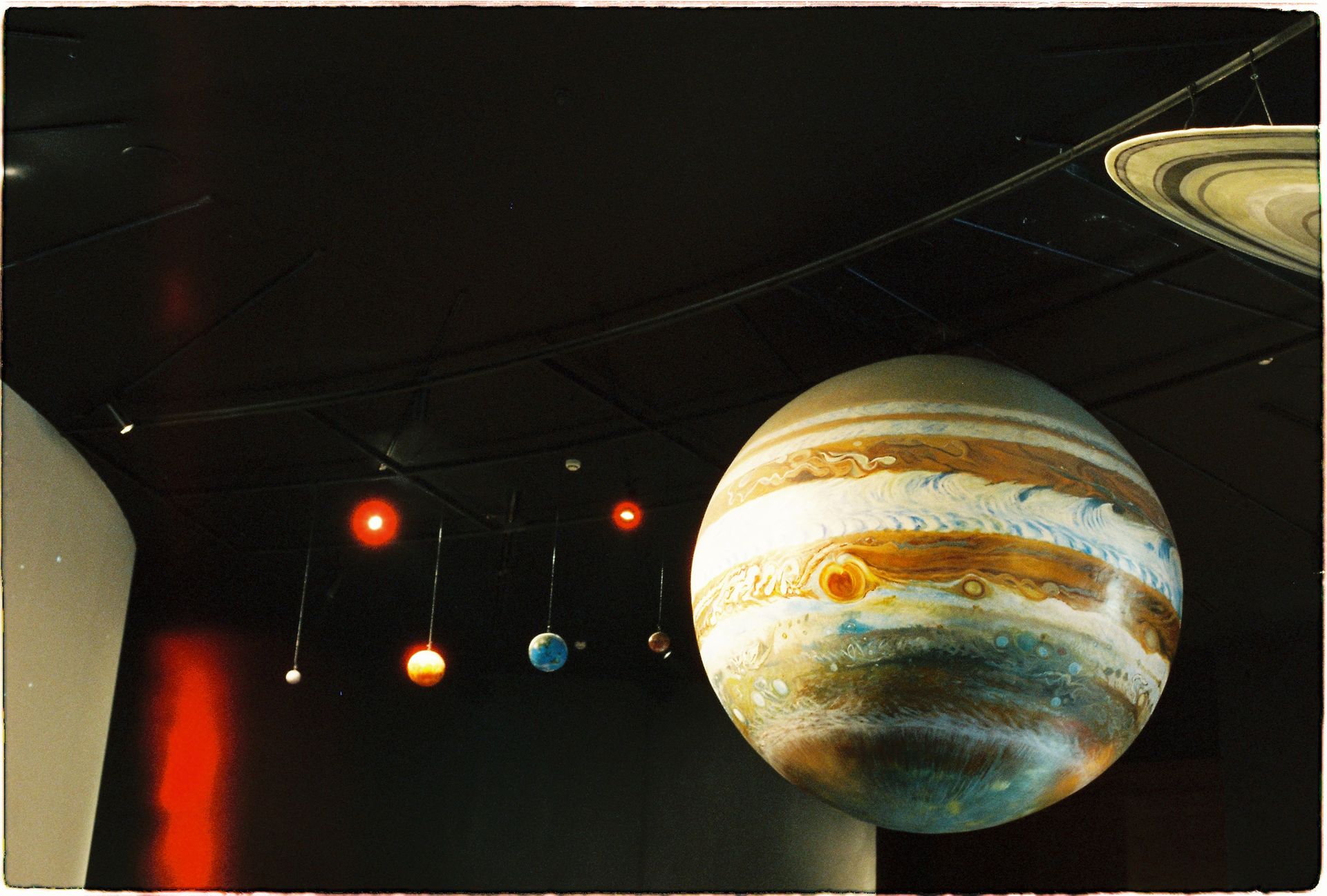
A row of planets against the dark backdrop of space, representing the planets in astrology and their meanings
What are the planets in astrology?
The planets in astrology are ten celestial bodies that each represent a specific function of human life and personality. They're the moving parts of your chart, and their positions at the exact moment you were born form the blueprint astrologers read. Each planet answers a different question. The Sun asks who you are at your core, Venus asks what you love, Saturn asks where you face limits and lessons.
Astrologers sort the ten into three tiers based on orbital speed, because speed maps neatly onto how personally you feel a planet's influence. The personal planets (Sun, Moon, Mercury, Venus, Mars) move quickly and shape your individual personality. The social planets (Jupiter and Saturn) move slower and shape how you engage with the wider world. The outer planets (Uranus, Neptune, Pluto) crawl through the zodiac over decades and color whole generations more than single individuals. Knowing which tier a planet belongs to tells you how much of your unique self it describes.
The personal planets
The personal planets are the five fastest-moving bodies, and they do most of the heavy lifting when it comes to your individual character. These are the placements people usually mean when they talk about "my chart," and together with your rising sign they form the foundation of who you are.
The Sun is your core identity, ego, and the conscious self you're growing into. It's the single most important point in the chart, which is why your Sun sign is the one most people know. The Sun describes your vitality, your sense of purpose, and the kind of person you're here to become. Wherever your Sun sits is where you shine and where you want to be seen. Curious which traits yours carries? Find out with our guide to the Sun and Moon sign combinations.
The Moon rules your emotions, instincts, and inner world. Where the Sun is who you're becoming, the Moon is how you feel right now, your gut reactions, your needs, and what makes you feel safe. It governs your relationship with comfort, home, and the people who nurture you. Many astrologers consider the Moon just as important as the Sun, since it runs your emotional life. Learn yours in our breakdown of moon sign meanings through the zodiac.
Mercury is the mind. It governs how you think, speak, learn, and process information, plus how you handle short trips and everyday communication. Your Mercury sign shapes whether you're a quick talker or a careful one, a big-picture thinker or a detail person. When Mercury appears to move backward, we get the famous Mercury retrograde periods that scramble communication and tech.

A clear night sky scattered with bright stars above a dark horizon
Venus rules love, beauty, pleasure, and values. It describes what you find attractive, how you show affection, and what you consider worth having, including money and material comfort. Your Venus sign is one of the first places to look in any compatibility reading because it reveals your romantic style and what makes you feel cherished. See how yours pairs with a partner's in our Venus sign compatibility guide.
Mars is drive, action, and desire. It governs your energy, your ambition, how you pursue what you want, and how you handle anger and conflict. Mars is the planet of doing, the part of you that takes initiative and fights for things. It also describes physical and sexual energy, which is why it matters so much in chemistry between two people. Our Mars sign compatibility guide digs into that side of it.
The social planets
Jupiter and Saturn sit between the personal and outer planets. They move slowly enough to share a sign with people born a year or two on either side of you, so their influence feels less personal, yet fast enough that they still mark your individual path through society, growth, and responsibility.
Jupiter is the planet of expansion, luck, and growth. It governs optimism, abundance, higher learning, travel, and your search for meaning and belief. Wherever Jupiter sits in your chart shows where life tends to open up for you, where you find opportunity, and where you're inclined to overdo it, because Jupiter expands everything it touches, including excess. It spends about a year in each sign and returns to its birth position roughly every twelve years, an event you can read about in our Jupiter return guide.
Saturn is the planet of structure, discipline, limits, and time. If Jupiter says yes, Saturn says not yet. It governs responsibility, hard work, maturity, and the lessons you learn the slow way. Saturn often gets a bad reputation, but it's the planet that builds lasting achievement through patience and effort. Its most talked-about cycle, the Saturn return near ages 29 and 58, marks the major growing-up moments of adult life.
The Moon glowing against a deep black sky
The outer planets
Uranus, Neptune, and Pluto are the slowest movers, taking anywhere from seven to twenty years to cross a single sign. Because of that, everyone born within years of you shares the same sign for these planets, so they describe generational themes more than personal quirks. Where they land by house, and the aspects they make to your faster planets, is where they get personal for you.
Uranus is the planet of sudden change, rebellion, and awakening. It governs innovation, freedom, technology, and the lightning-bolt insights that break old patterns. Uranus disrupts whatever it touches, often through unexpected events that force growth. Its placement by house shows where you crave independence and where life is likely to surprise you. The current Uranus in Gemini transit is shaking up communication and technology for everyone.
Neptune rules dreams, intuition, spirituality, and illusion. It dissolves boundaries, which makes it the planet of imagination, compassion, and transcendence, but also of confusion, escapism, and deception. Neptune is where you connect to something larger than yourself and also where you're prone to wishful thinking. Its current journey through its home sign, covered in our Neptune in Aries guide, reshapes how a whole generation dreams.
Pluto is the planet of transformation, power, and rebirth. It governs the deep, often hidden processes of death and renewal, obsession, and the things that fundamentally change us. Pluto destroys in order to regenerate, so its transits, while intense, tend to leave you profoundly altered. It's currently moving through Aquarius, a shift we cover in Pluto in Aquarius, reshaping power and technology across society.
Which planet rules each zodiac sign?
Every zodiac sign has a ruling planet, the planet most at home in that sign and most expressive of its energy. This rulership is one of the oldest principles in astrology, and it links the ten planets directly to the twelve signs. The Sun rules Leo and the Moon rules Cancer, while the other planets each rule two signs in the traditional system.
Here's the classic breakdown: Mars rules Aries (and traditionally Scorpio), Venus rules Taurus and Libra, Mercury rules Gemini and Virgo, the Moon rules Cancer, the Sun rules Leo, Pluto rules Scorpio in modern astrology, Jupiter rules Sagittarius (and traditionally Pisces), Saturn rules Capricorn (and traditionally Aquarius), Uranus rules Aquarius in modern astrology, and Neptune rules Pisces in modern astrology. Knowing a sign's ruler tells you which planet to study to understand it. Our full planetary rulerships guide lays out both the traditional and modern systems side by side.
A swirling galaxy of color and light in deep space
How to read the planets in your chart
Reading the planets starts with three pieces of information for each one: its sign, its house, and the aspects it makes to other planets. The sign tells you how the planet expresses itself, the house tells you where in your life it operates, and the aspects tell you how it cooperates or clashes with the rest of your chart. Put those three together and you have a sentence. Mars in Aries (how) in the tenth house (where) describes someone who pursues career and status with bold, direct drive.
Start with your personal planets, since they describe you most directly, and read them in order of importance: Sun, Moon, then rising sign, then Mercury, Venus, and Mars. The combination of your Sun, Moon, and rising is so central that astrologers call it the big three, and it's the fastest way to get a real feel for a chart. Once you're comfortable there, move out to Jupiter and Saturn, and finally to the outer planets by house.
Don't try to memorize every combination at once. Pick one planet, find it in your chart, note its sign and house, and read just that. Then add the next. Astrology clicks when you build it piece by piece rather than swallowing it whole. The aspects between planets, the angles they form, are where the real nuance lives, and our guide to birth chart aspects shows you how to read those once the basics feel solid.

A telescope pointed at a star-filled night sky
Frequently asked questions
How many planets are there in astrology?
Astrology uses ten planets: the Sun, Moon, Mercury, Venus, Mars, Jupiter, Saturn, Uranus, Neptune, and Pluto. The Sun and Moon are technically a star and a moon, but astrology has counted them as planets for thousands of years. Some astrologers also include asteroids like Chiron and Ceres.
What are the most important planets in a birth chart?
The Sun, Moon, and rising sign matter most, since they form the core of your personality. After those, the personal planets Mercury, Venus, and Mars shape your mind, love nature, and drive. The slower planets describe broader life themes and generational influences rather than your individual character.
What's the difference between personal and outer planets?
Personal planets (Sun, Moon, Mercury, Venus, Mars) move quickly and shape your individual personality. Outer planets (Uranus, Neptune, Pluto) move slowly, taking up to twenty years per sign, so they describe themes shared by an entire generation. Outer planets feel personal mainly through the house they occupy and the aspects they form.
Why is Pluto still a planet in astrology?
Astrology kept Pluto as a planet even after astronomers reclassified it as a dwarf planet in 2006. Astrology isn't bound by astronomical definitions, since it reads celestial bodies as symbolic forces rather than physical objects. Pluto's meaning, transformation and rebirth, remains central to chart interpretation.
The ten planets are the working vocabulary of astrology, and once you know what each one governs, the signs and houses snap into focus around them. Start with your personal planets, learn their signs and houses, and build outward from there. Ready to see all ten mapped out for your exact birth moment? Generate your free natal chart and meet the planets that shape your story.