Death Tarot Card Meaning: Upright, Reversed, Love, Career, and More
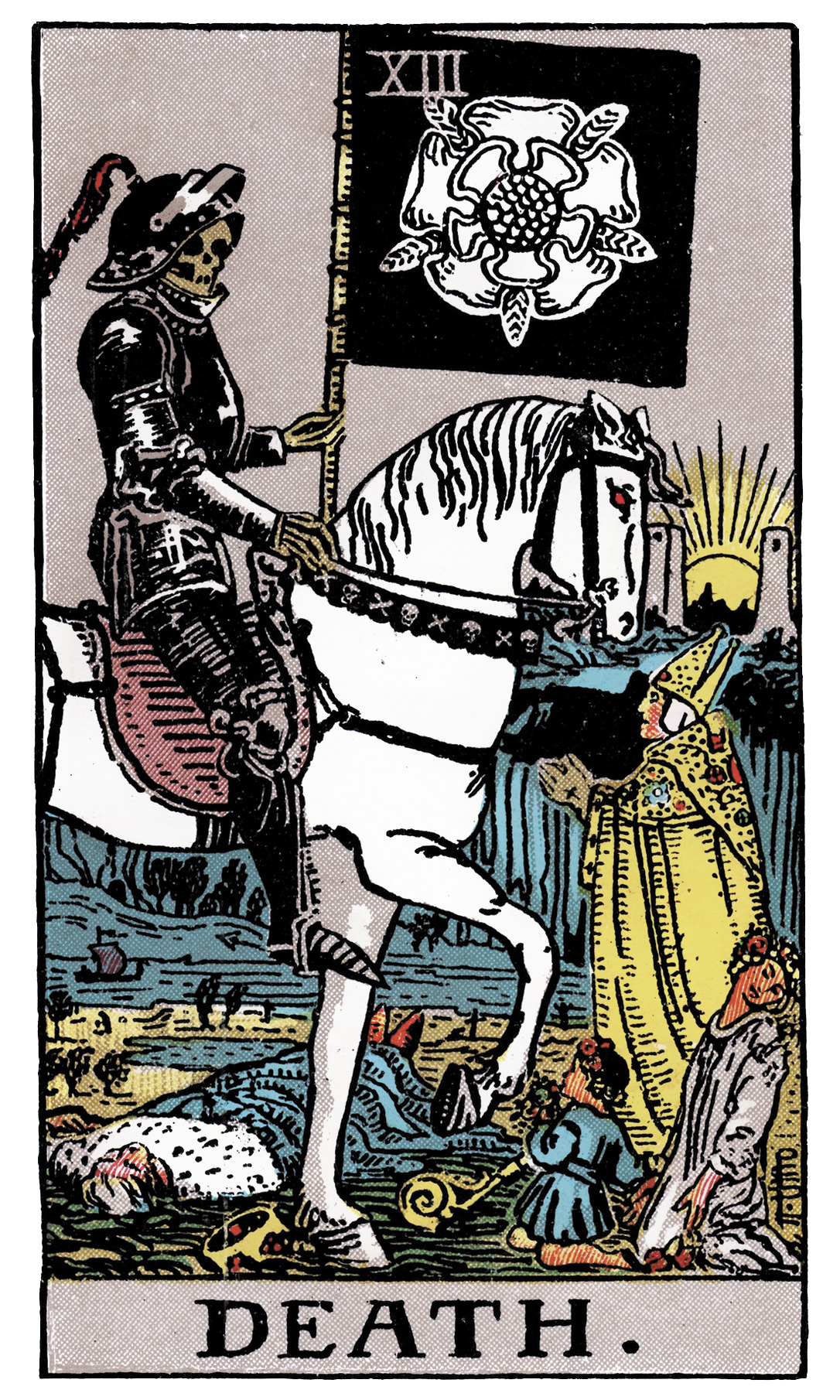
A skeleton in black armor rides a white horse across a landscape of devastation and renewal. In his left hand he carries a black flag bearing a white rose, a five-petaled flower that represents beauty, purity, and the promise of new life emerging from decay. Before him, a king lies fallen on the ground, his crown tumbled beside him. A bishop in ceremonial robes stands with hands clasped in prayer, facing the rider directly. A young woman turns away, her eyes downcast. And a small child holds out a bouquet of flowers toward the skeletal figure, too innocent to fear what the adults can't face. In the background, a river flows between two towers, and on the horizon, the sun is either rising or setting, balanced between the land of the living and whatever comes next.
This is Death, card thirteen of the Major Arcana, and it's the card that everyone fears and almost everyone misunderstands. Death in the tarot almost never means physical death. What it means is something that can feel just as total, just as irrevocable, and ultimately just as necessary: the end of something that has run its course and the clearing of ground for what comes next. If The Hanged Man asked you to surrender voluntarily, Death is what happens when the surrender is complete. The old form dissolves. The identity you've been carrying falls away. And in the space where it used to stand, something new, something you couldn't have planned or predicted, begins to take root.
Death - Rider-Waite-Smith Tarot
Table of Contents
Key Themes and Symbolism
The Rider-Waite-Smith Death card is one of the most carefully composed images in the entire deck. Every figure, every detail, every color tells part of a story about transformation that spares no one and favors no one.
The skeleton. Death is depicted as a skeleton, stripped of all flesh, all identity, all distinguishing features. This is deliberate. Death doesn't have a face because death doesn't have a personality. It's not cruel or kind, not angry or compassionate. It's impersonal, the way gravity is impersonal. It affects everyone equally: kings and children, priests and common people. The skeleton also represents what remains after everything unnecessary has been stripped away. When the flesh of your old identity falls off, what's left? Bone. Structure. The essential framework that existed before the identity was built and will persist after it dissolves.
The black armor. The armor tells you that Death is invincible. You can't fight transformation. You can't negotiate with it, bribe it, or argue it into retreat. The armor is black, the color of the void, of mystery, of the unknown space that exists between what was and what will be. Black absorbs all light, all color, all distinction. Death's armor absorbs everything you throw at it: your resistance, your bargaining, your anger, your grief. None of it changes the outcome. The transformation comes regardless.
The white horse. White represents purity, and the white horse communicates that Death's purpose is purification, not punishment. The horse moves forward with steady, unstoppable momentum. It doesn't gallop in panic or charge in aggression. It walks. Death's pace is measured and inevitable. There's no rush because there's no escape. The white horse has appeared in mythology across cultures as the mount of transformative figures, from the biblical Four Horsemen to the Norse god Odin's eight-legged Sleipnir. The horse carries the rider toward you whether you're ready or not.
The black flag with the white rose. This is the card's most hopeful symbol, and it's easy to miss while your attention is on the skeleton. The rose is white for purity and has five petals, connecting it to the five senses and the five elements. A rose growing on a black flag means: beauty emerges from darkness. Life persists through death. The promise of renewal is woven into the fabric of ending itself. The flag is Death's standard, his announcement of what he brings, and what he brings isn't just destruction. It's the seed of what comes after.
The fallen king. The king on the ground represents worldly power, authority, and status. His crown has tumbled off. Death doesn't respect hierarchies. The wealth, influence, and social position you've accumulated can't protect you from the transformation this card brings. The king's fall is the tarot's reminder that everything built in the material world is temporary. This isn't pessimistic. It's liberating. If everything is temporary, then the structures you've outgrown can't imprison you forever. They'll fall, and you'll be free to build something new.
The bishop. The religious figure stands facing Death with his hands in prayer. He represents faith, spiritual institutions, and the human attempt to make peace with mortality through belief. Unlike the king, who's already fallen, the bishop is still standing, suggesting that spiritual understanding provides a framework for meeting transformation without being destroyed by it. He doesn't run. He prays. He faces what's coming with the only tool he has: trust in something beyond the visible.
The young woman. She turns away, unable to look. She represents the part of every person that can't bear to witness the ending, that would rather not see, not know, not face the reality that something is over. Her reaction is human and universal. Denial is the most natural first response to transformation. You turn away. You pretend it isn't happening. But Death doesn't require your attention to do its work. It operates whether you watch or not.
The child. The child holds flowers out to Death with no fear at all. Children haven't learned to be afraid of change because they haven't yet built the rigid identities that change threatens. The child represents innocence, openness, and the capacity to meet transformation without the resistance that makes it painful. The child's offering of flowers mirrors the rose on Death's flag: beauty given freely to the force that most adults flee from.
The river and the towers. In the background, a river flows between two towers. The river is the divide between the known and the unknown, the past and the future, life and whatever comes after. The two towers mark the gateway, the threshold that Death carries you through. The river represents the flow of time, consciousness, and emotion that continues regardless of what individual forms appear and disappear on its banks.
The sun on the horizon. The sun sits between the towers, neither clearly rising nor setting. This ambiguity is intentional. Is this dawn or dusk? Is this an ending or a beginning? The answer, of course, is both. Every sunset is followed by a sunrise. Every ending contains the beginning it makes possible. The sun on Death's horizon is the card's promise: something will follow this transformation, and it will be illuminated.
The number thirteen. Thirteen has been considered unlucky across many cultures, and this superstition amplifies the fear people feel when this card appears. But thirteen is actually the number of transformation: one (new beginning) combined with three (creative expression), producing a new creation through fundamental change. There are thirteen lunar cycles in a year, connecting the number to the moon's cycle of death and rebirth, waning to dark to waxing again.

Dramatic sunrise with vibrant orange and blue hues painting the sky representing new beginnings emerging from endings
Upright Meaning
When Death appears upright, something is ending, and something is beginning. The two are the same event.
General
Death upright is the card of transformation, endings, profound change, and the necessary destruction of old forms so new ones can emerge. It appears when a chapter of your life is closing, not gently fading, but definitively ending. The relationship is over. The career chapter has concluded. The belief system you've been operating from no longer fits. The person you were is becoming someone else. Death says: let it happen.
The transformation Death brings isn't optional. This separates Death from The Hanged Man, who offers voluntary surrender, and from The Tower, which brings sudden, violent disruption. Death's transformation is more like the changing of seasons: inexorable, natural, and ultimately life-serving, even when it doesn't feel that way while you're in it. You don't choose autumn. Autumn comes. The leaves fall because their time is over, and their falling feeds the soil for spring.
One of Death's most important teachings is that resistance to transformation causes more suffering than the transformation itself. The ending isn't what hurts most. The clinging is what hurts most. The white-knuckled grip on what's already gone, the refusal to accept that the chapter has closed, the insistence that things go back to how they were: this is where the real pain lives. Death's message isn't "prepare for suffering." It's "stop suffering by letting go of what's already dead."
Death also carries a deep promise: what comes after will be better than what you're losing, because it will be aligned with who you're becoming rather than who you used to be. The old form served you when you were the person who needed it. You're not that person anymore. The new form, the one Death is clearing space for, will serve the person you're growing into. You can't see it yet because it hasn't been built. But Death's sunrise says: trust the process.
Love
In love readings, Death upright signals a profound transformation in your romantic life. This can mean the end of a relationship, but it just as often means the death of a dynamic within a relationship that needed to die. The codependency ends. The avoidance pattern ends. The version of the relationship where you both pretended everything was fine while everything wasn't: that version dies, and what replaces it is either a healthier partnership or the recognition that the partnership can't become what you both need.
If Death indicates the end of a relationship, it's saying this ending is necessary and ultimately kind, even though it doesn't feel kind right now. The relationship has completed its purpose. You both got what you came for, and what you came for might have been as much about learning what doesn't work as about finding what does. The grief is real, but so is the freedom on the other side of it.
For singles, Death often signals the end of a pattern that's been blocking love. The type you always go for, the wall you always build, the story you tell yourself about why love doesn't work for you: Death is ending that pattern. What opens up once the old pattern dies is space for something genuinely new. Not a repeat of the past with a different face, but an entirely different kind of connection.
Death in love can also indicate a relationship transforming so deeply that it feels like a death and rebirth. Couples who survive a crisis, an affair, a betrayal, a loss, and rebuild from the wreckage often describe the new relationship as completely different from the old one, even though it involves the same two people. That's Death's work. The old relationship dies. A new one, built on harder truths and deeper understanding, takes its place.
Career
In career readings, Death upright indicates the end of a professional chapter and the beginning of a new one. A job ending. A career change becoming unavoidable. A business closing or fundamentally restructuring. The professional identity you've been carrying, "I'm a lawyer," "I'm a manager," "I'm the person who does this particular thing," is dissolving, and what replaces it will require you to become someone you haven't been before.
This card often appears when people have been ignoring career dissatisfaction for too long. You've known for months or years that this role doesn't fit anymore, but you've stayed because the familiar discomfort felt safer than the unknown. Death says: the familiar discomfort is ending now, with or without your cooperation. The question isn't whether to change. It's whether you'll participate in the change or be dragged through it.
Death in career can also represent a fundamental shift in your industry, company, or professional landscape. The way things have always been done is ending. The role you've been trained for is transforming beyond recognition. The skills that got you here won't get you where you need to go next. Death says: adapt. The professional identity that's dying served its time. Build a new one.
Finances
Financially, Death upright can indicate the end of a financial chapter: the loss of an income source, the depletion of savings, the end of financial arrangements that have been supporting you, or the collapse of an investment. The financial structure you've been relying on is changing fundamentally.
This sounds frightening, and it can be. But Death's financial message isn't despair. It's transformation. The financial loss creates the pressure to build something new, something better suited to your current life. People who lose a comfortable salary and are forced to start their own business sometimes look back and realize the loss was the best thing that could have happened. The Death card doesn't promise that journey will be comfortable. It promises that the destination will be worth the loss.
Death can also signal the death of unhealthy financial habits. The spending pattern that's been slowly draining you finally reaches a breaking point. The debt that's been accumulating finally demands attention. The financial denial you've been practicing collapses under the weight of reality. These are painful moments, but they're also the moments where genuine financial transformation becomes possible.
Health
In health readings, Death upright very rarely indicates physical death. It's important to state this clearly, because the fear associated with this card can cause unnecessary distress. What Death typically indicates in health is the end of a health phase and the beginning of a new one. A chronic condition entering a new stage. A treatment plan changing. A lifestyle that's been damaging your health finally being abandoned in favor of something better.
Death can signal the kind of health event that forces a complete lifestyle overhaul: a diagnosis that changes how you eat, move, think, and live. These events are frightening, but they're also the catalysts for the kind of deep health transformation that willpower alone couldn't achieve. Sometimes the body has to break before the person will change.
This card also connects to the natural cycles of the body: cellular death and renewal (your body replaces most of its cells over a seven-year period), hormonal transitions (puberty, menopause), and the aging process itself. Death reminds you that the body is always in a process of dying and being reborn at the cellular level. What you call "your body" is actually a continuous process of transformation, not a fixed object.
Reversed Meaning
When Death appears reversed, the transformation that needs to happen is being resisted.
General
Death reversed is one of the most psychologically significant cards in the deck, because it represents the refusal to let something die that's already dead. The relationship that ended months ago but you're still trying to revive. The career that's clearly over but you keep showing up to. The identity you've outgrown but you keep performing. The belief that no longer serves you but you cling to because letting it go would mean admitting you were wrong.
The reversed Death card says: the transformation is happening regardless. Your resistance doesn't prevent the change. It just makes the change more painful and more prolonged. You're spending enormous energy keeping alive something that wants to die, and that energy is being drawn from the new life that's trying to emerge. Every ounce of effort you pour into preserving the dead thing is an ounce you can't invest in the living thing.
The fear driving this resistance is usually fear of the unknown. The dead thing is familiar. It's painful, but it's known. What comes after is unknown, and the unknown feels more dangerous than the known pain. Death reversed says: the unknown is actually where your future lives. The known thing you're clinging to is the real danger, because it's preventing you from reaching what's next.
Death reversed can also indicate a personal transformation that's been incomplete. You started changing but stopped midway. You let go of some things but clutched others. You're caught between who you were and who you're becoming, and the in-between state is more uncomfortable than either endpoint would be. The reversed Death says: finish the transformation. You're halfway through a chrysalis, and there's no going back to being a caterpillar. The only way out is through.
Love
In love, Death reversed warns about relationships that have died but haven't been buried. You're maintaining the form of a partnership that has no life in it. You go through the motions, you share the space, you present the image, but the connection that made it a relationship is gone. The reversed Death says: the kindest thing you can do, for yourself and for your partner, is to acknowledge what's already true. This has ended. Honor the ending instead of dragging its corpse forward.
This card reversed can also indicate the refusal to let go of an ex. Months or years after the breakup, you're still checking their social media, still comparing new people to them, still holding space for a reunion that isn't coming. The reversed Death says: this attachment isn't love anymore. It's habit, and it's blocking the genuine love that's trying to find you.
For couples, Death reversed can point to the avoidance of a necessary conversation that both people know needs to happen. The elephant in the room that everyone pretends isn't there. The issue that would change everything if it were spoken aloud. Reversed Death says: the conversation is scarier in anticipation than in reality. Have it.
Career
In career readings, Death reversed points to professional stagnation caused by fear of change. You hate your job but you won't quit. You know the career path is wrong but you won't pivot. You've been in the same role for years and the growth stopped long ago, but the comfort of familiarity outweighs the discomfort of exploration. The reversed Death says: the comfort is an illusion. What feels like safety is actually a slow decline.
This card reversed also warns about organizational refusal to adapt. A company that won't modernize. A team that won't change processes that obviously aren't working. An industry that's being disrupted but insists on doing things the old way. The reversed Death says: what isn't willing to transform is willing to be destroyed.
Finances
Financially, Death reversed warns about clinging to financial strategies that have stopped working. The investment thesis that made sense five years ago but doesn't match current conditions. The spending habits that reflect who you were, not who you are. The financial relationship (business partnership, joint account, shared expenses) that should have been restructured long ago but keeps limping forward out of inertia.
The reversed Death in finance can also indicate the fear of financial transformation. You know you need to make a big financial change, leave the stable job for the risky opportunity, invest in something new, restructure your debt, but the fear of the transition keeps you locked in place. Reversed Death says: the financial status quo isn't as safe as it feels.
Health
In health readings, Death reversed can indicate resistance to necessary medical treatment or lifestyle changes. You know what the body needs. The doctor has told you. The symptoms have told you. But you won't do it because the change feels too big, too disruptive, too uncomfortable. The reversed Death says: the discomfort of change is temporary. The damage of resistance is cumulative.
This card reversed can also indicate a health issue that's been lingering because the underlying cause hasn't been addressed. You treat the symptoms but you won't address the source. You manage the condition but you won't make the fundamental changes that would resolve it. The reversed Death says the body won't stop sending the message just because you don't like what it's saying.
Card Combinations
Death's meaning intensifies with the cards around it.
Death and The Hanged Man. A sequential pairing (cards twelve and thirteen) representing the most profound transformation arc in the Major Arcana. The Hanged Man surrenders and lets go. Death takes what's been released and transforms it completely. Together, they indicate a full cycle of voluntary release followed by irreversible change. This combination appears during the deepest personal transformations: addiction recovery, leaving a religion, ending a marriage, or any process where who you were before and who you become afterward barely recognize each other.
Death and The Empress. A powerful combination of ending and creation. The Empress is the card of fertility, abundance, and new life. Death is the card of endings and transformation. Together, they indicate a creative rebirth: something must die so something new can be born. This pairing often appears during pregnancy (literal or metaphorical), suggesting that the new creation requires the death of an old way of life. The mother who was becomes the mother who is. The creative vision that existed in potential dies as the actual creation takes its place.
Death and The Tower. Two of the tarot's most feared cards appearing together. Death transforms gradually and inevitably, like the changing of seasons. The Tower destroys suddenly, without warning. Together, they indicate a period of extreme, multi-layered transformation where both the gradual dismantling and the sudden collapse are happening simultaneously. This combination is rare and significant. It marks a period that will be remembered as a before-and-after dividing line in your life.
Death and The Star. One of the most beautiful combinations in the tarot. Death clears the ground. The Star plants seeds of hope in the cleared earth. Together, they say: the worst is over, and what comes next will heal you. The ending that felt like destruction was actually preparation for a period of quiet restoration, renewed faith, and the return of a future you can believe in. If you've been through devastation, this pairing is the tarot's promise that devastation isn't the end of the story.
Astrological Connections
Death is associated with the zodiac sign Scorpio and its ruling planets Mars and Pluto.
Scorpio is the sign of death, rebirth, transformation, and the hidden forces that operate beneath the surface of visible life. Scorpio doesn't do anything halfway. It goes to the deepest, darkest, most intense level of every experience it encounters. Where other signs might adjust or reform, Scorpio destroys and rebuilds from the foundation up. The Death card channels this energy directly: it doesn't suggest minor modifications. It demands total transformation.
Pluto, Scorpio's modern ruler, is the planet of power, destruction, rebirth, and the unconscious forces that reshape civilizations and psyches alike. Pluto's influence is generational and tectonic: it operates on timescales that dwarf individual human concerns. When Pluto moves through a sign (which takes twelve to thirty years), it transforms everything that sign represents. The Death card carries this same quality of deep, slow, unstoppable change. What Death transforms stays transformed. There's no going back.
Mars, Scorpio's traditional ruler, adds the element of drive, energy, and the willingness to cut through what needs to be cut. Mars gives Death its forward momentum, its armor, its horse. Without Mars, Death's transformation might be too passive, too slow, too willing to wait. Mars says: the ending is happening now. Not someday. Now.
The Water element connects Death to the emotional realm. Death's transformation isn't purely physical or intellectual. It transforms how you feel, what you desire, what you fear, and what you love. Water also connects Death to the unconscious mind, the place where transformation does most of its work before the conscious mind catches up. Often, by the time you realize something in your life has died, the death happened weeks or months ago in the deeper layers of your psyche. The conscious realization is just the surface acknowledging what the depths already know.
In your natal chart, strong Scorpio placements (Sun, Moon, or Ascendant in Scorpio) or prominent Pluto aspects often correlate with a life marked by intense transformation cycles. People with these placements tend to experience life as a series of deaths and rebirths rather than a smooth linear progression. They're comfortable with intensity and discomfort in ways that others aren't, because they've been through the fire enough times to know they'll survive it. The 8th house (Scorpio's natural home) governs death, taxes, inheritance, shared resources, and the kind of intimacy that requires you to be psychologically naked. It's the house where transformation is most personal and most unavoidable.
Reading Tips for Death
Start with reassurance. This is the most feared card in the deck, and most of that fear is based on misunderstanding. If a querent pulls Death and goes pale, the first words out of your mouth should be: "This card almost never means physical death. It means transformation." Then explain what kind of transformation the surrounding cards suggest.
Identify what's dying. Every Death reading contains a specific ending. Your job is to identify it. Is it a relationship? A job? A belief system? A self-image? A habit? A life stage? The card doesn't say "everything is ending." It says "this specific thing is ending, and it needs to end so something specific can begin."
Honor the grief. Transformation hurts, even when it's necessary. Don't skip to "but new things are coming!" without first acknowledging that the ending is real and the loss is legitimate. People need to grieve what they're losing before they can embrace what they're gaining. The Death card allows space for both.
The sunrise is always there. No matter how dark the reading feels, the sun on Death's horizon is always present. Remind the querent that this card contains both the ending and the promise of what follows. The destruction is real, but it isn't the whole picture. The whole picture includes the dawn.
Reversed Death is often harder than upright Death. Counterintuitively, resisting Death's transformation typically causes more pain than accepting it. When Death appears reversed, the message is often: "the thing you're afraid of losing is already gone. The only thing your resistance is producing is extended suffering." This can be a difficult message to deliver, but it's also a liberating one.
Frequently Asked Questions
Does the Death card mean someone will die?
In the vast majority of readings, no. The Death card represents metaphorical death: the end of a relationship, a career, a phase of life, a belief system, or an identity. It's about transformation, not mortality. Professional tarot readers almost universally interpret this card as a symbol of necessary change rather than a prediction of physical death. If you pull the Death card, what's "dying" is almost certainly a situation, pattern, or chapter of your life, not a person.
Is the Death card a yes or no card?
Death is a "yes, but" card. Yes, the thing you're asking about is going to happen, but not in the way you're imagining. The situation will transform completely before it resolves, and what you get will be fundamentally different from what you expected when you asked the question. If you're asking whether something will end, Death is a definitive yes. If you're asking whether something new will begin, Death is also a yes, but the new thing requires the old thing to end first.
What does the Death card mean in a love reading?
In love, Death indicates a profound transformation in your romantic life. This can mean the end of a relationship that's completed its purpose, the death of unhealthy dynamics within an existing relationship, or the clearing of old patterns so new love can enter. Death in love isn't inherently negative. Many couples who survive a "death" in their relationship (a crisis, a betrayal, a major life change) report that the relationship that emerged afterward was deeper and more authentic than what came before. For singles, Death often signals that old romantic patterns are finally ending, creating space for genuinely new connections.
What is the difference between Death and The Tower?
Death (card thirteen) and The Tower (card sixteen) both bring major change, but through different mechanisms. Death transforms gradually and inevitably, like the seasons changing. You can usually sense Death's approach before it arrives. The Tower destroys suddenly and without warning, like an earthquake. Death's change is natural and organic. The Tower's change is shocking and disruptive. Death gives you time to grieve and adjust. The Tower doesn't. Both ultimately serve transformation, but the experience of going through them is very different.
What zodiac sign is the Death card associated with?
Death is associated with Scorpio, the fixed water sign ruled by Pluto (and traditionally by Mars). This connects Death to themes of intensity, depth, transformation, power, secrets, and the hidden forces that operate beneath the surface of visible reality. Scorpio's energy isn't gentle. It goes to the absolute depths of every experience and doesn't emerge until the transformation is complete. People with strong Scorpio or Pluto placements in their natal chart often live lives marked by dramatic cycles of ending and rebirth, and they develop a relationship with transformation that most people never reach: not fearless, but experienced enough to trust the process.
For deeper exploration of all 78 cards, visit the Celesian tarot reader. To understand how Death's Scorpio energy connects to your personal astrology, check your Pluto and Scorpio placements with the natal chart calculator. And to follow The Fool's Journey, read about The Hanged Man, whose voluntary surrender initiated the transformation that Death now completes, and Temperance, whose patient alchemy integrates the fragments that Death's fire left behind.