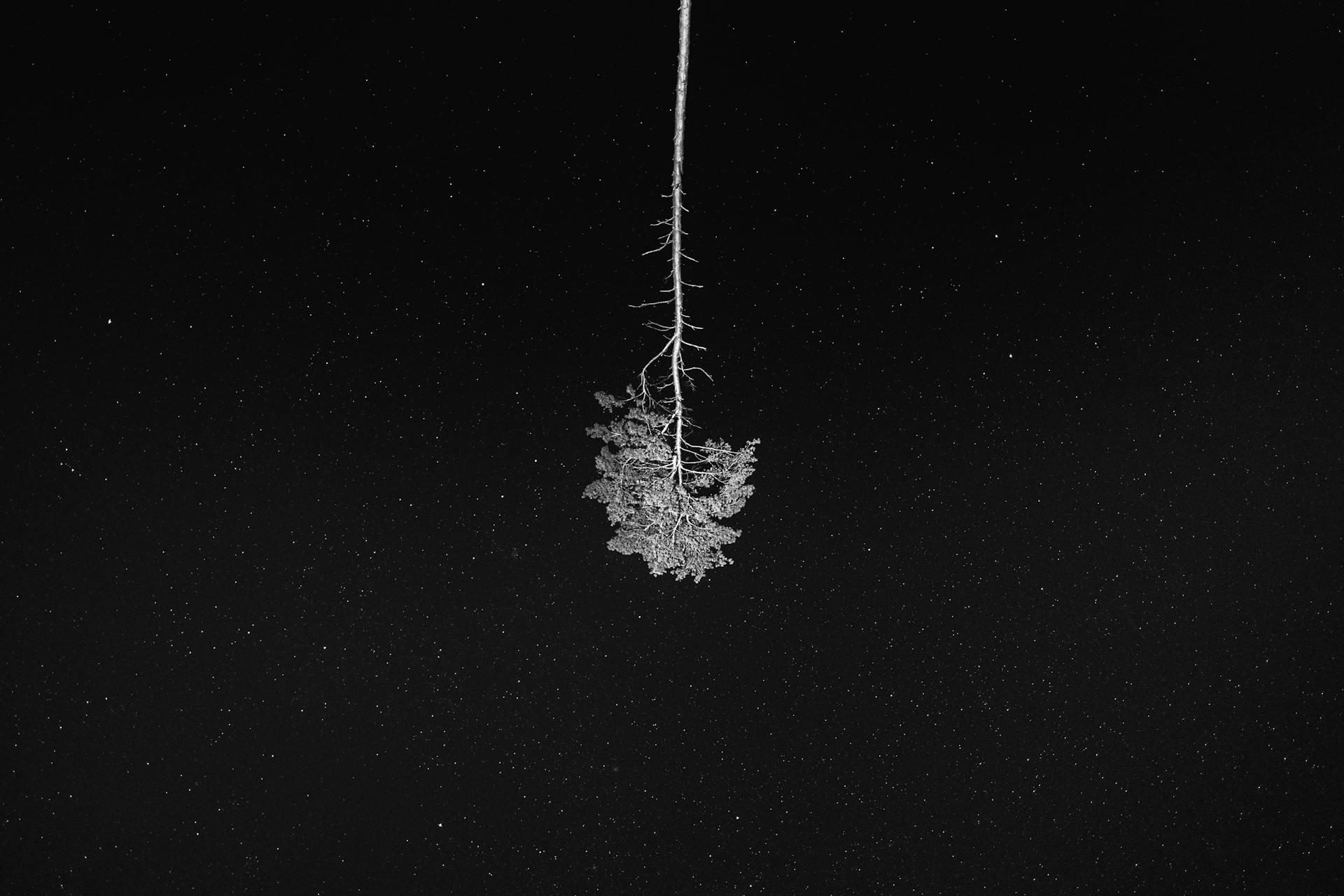
The Hanged Man Tarot Card Meaning: Upright, Reversed, Love, Career, and More
A young man hangs upside down from a living T-shaped tree, suspended by his right foot. His left leg is bent behind his right knee, forming a triangle with his legs. His arms are folded behind his back, hidden from view. His face is calm. Not pained, not strained, not struggling. Calm. A golden halo radiates from his head, the same luminous glow you'd find around the heads of saints in medieval paintings. His blue tunic and red leggings form a deliberate color combination: blue for knowledge and spiritual depth above, red for passion and the material world below. But he's inverted, so the material is above and the spiritual is below. Everything is reversed. Everything is upside down. And the man who should be suffering looks entirely at peace.
This is The Hanged Man, card twelve of the Major Arcana, and he's the most counterintuitive card in the entire deck. Every card before him has been about doing something: manifesting, choosing, building, driving, mastering, seeking, turning, judging. The Hanged Man is about stopping. Not because he's been stopped, not because he's been captured or punished, but because he's chosen to suspend himself. He's discovered something that The Chariot's relentless drive and Justice's careful logic couldn't teach him: sometimes the way forward is to stop moving entirely and see the world from a completely different angle.
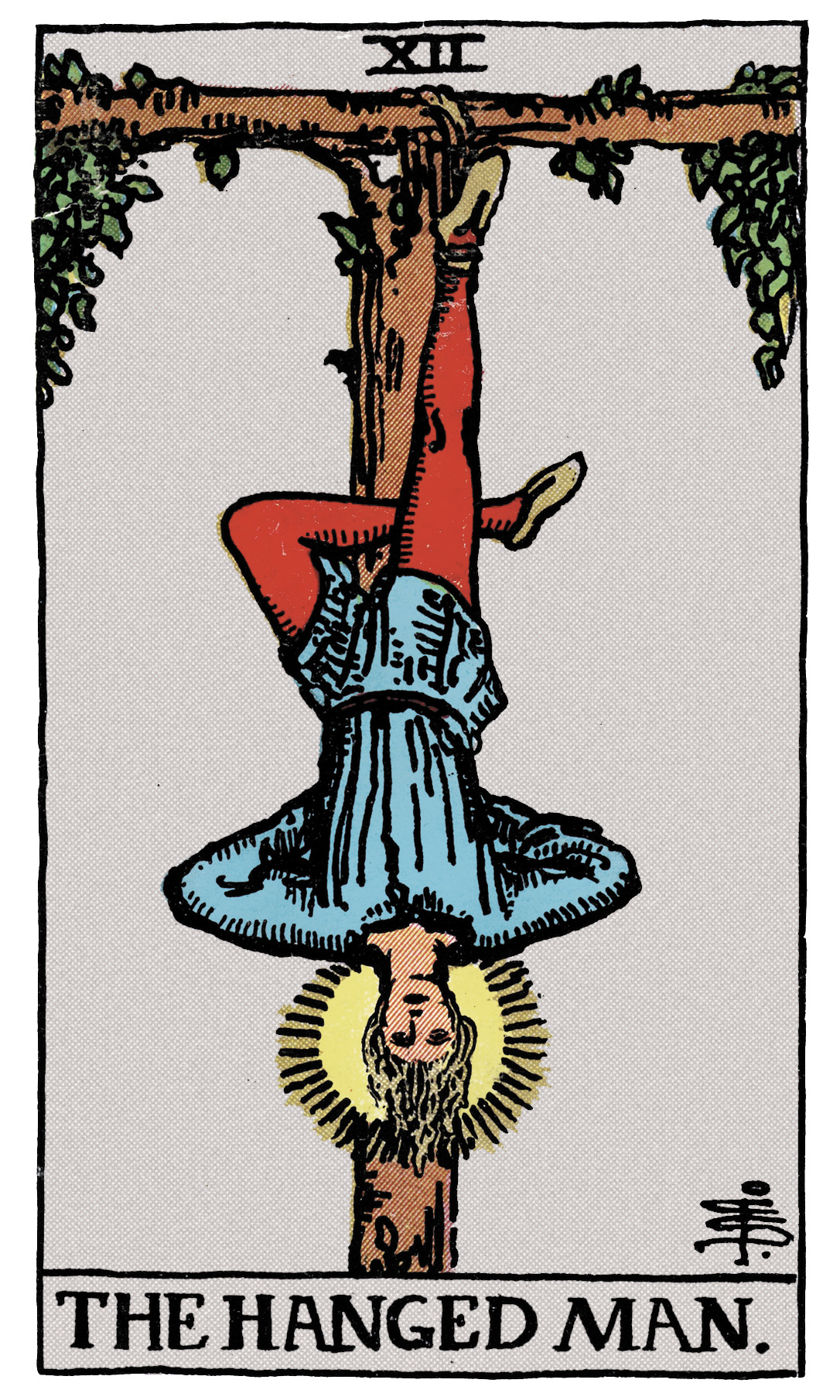
The Hanged Man - Rider-Waite-Smith Tarot
Table of Contents
Key Themes and Symbolism
The Rider-Waite-Smith Hanged Man is one of the most visually striking cards in the deck, and its power comes from the tension between what it shows and what you'd expect. A man hanging upside down should look like a victim. Instead, he looks like a mystic.
The living tree. The Hanged Man is suspended from a T-shaped structure that's unmistakably alive, with leaves sprouting from its horizontal beam. This is often identified as the World Tree, the axis mundi that connects heaven, earth, and the underworld in numerous mythological traditions. The tree is alive because The Hanged Man's sacrifice isn't death. It's a living sacrifice, a conscious choice to offer something, time, comfort, control, in exchange for something more valuable: understanding. The tree's T-shape also forms a tau cross, one of the oldest symbols of sacrifice and redemption.
The inverted position. Everything about The Hanged Man is reversed. His head is where his feet should be. His spiritual colors (blue) are below where material colors (red) sit above. He sees the world from an angle that nobody else shares. This inversion is the card's essential teaching: some truths can only be perceived when you reverse your usual way of looking. The assumptions you carry, the beliefs you hold, the logic you trust, these all produce a particular view of reality. The Hanged Man says: what if that view is incomplete? What if turning it upside down reveals something you couldn't see from the normal position?
The golden halo. This is enlightenment, literally. The golden light surrounding The Hanged Man's head indicates that the inverted perspective isn't confusion or delirium. It's illumination. He's found something valuable in the suspension. The halo tells you that this isn't punishment. It's revelation. The light that comes from letting go of the need to control, to act, to push forward at all costs, that light is genuine wisdom.
The triangle formed by the legs. The right leg hangs straight, the left crosses behind it at the knee, forming a clear triangle shape. The triangle has been a symbol of spiritual aspiration and the integration of mind, body, and spirit across cultures for millennia. In The Hanged Man's case, the downward-pointing triangle created by his legs represents the descent of spiritual energy into matter, the willingness to bring higher understanding down into physical experience, even when that experience involves discomfort.
The hidden arms. The Hanged Man's arms are behind his back, but whether they're bound or simply folded is deliberately ambiguous. This ambiguity matters. If his arms are bound, he's been forced into this position by external circumstances. If they're folded by choice, he's surrendered voluntarily. The card works both ways because sometimes life forces a pause upon you (illness, job loss, heartbreak) and sometimes you choose the pause yourself (sabbatical, meditation retreat, deliberate stepping back from a situation). Either way, the wisdom available is the same. The Hanged Man doesn't care how you got here. He cares what you see now that you've stopped.
The calm expression. This is the detail that transforms the entire card from something frightening to something profound. The Hanged Man isn't suffering. He's serene. His face carries the quiet contentment of someone who's discovered that the thing they feared, the loss of control, the abandonment of forward momentum, the vulnerability of suspension, is actually a doorway rather than a dead end. The peace in his expression tells you that surrender, real surrender, doesn't feel like defeat. It feels like relief.
The colors. Blue (the tunic) represents the mind, wisdom, and spiritual knowledge. Red (the leggings) represents the physical body, passion, and material life. In the upright position, the blue would be above and the red below, the normal hierarchy of spirit over matter. But The Hanged Man is inverted, placing the physical above and the spiritual below. This reversal suggests a reordering of priorities. The things you thought mattered most (material success, external achievement, visible progress) are now secondary. The things you undervalued (inner peace, spiritual understanding, the willingness to be still) are now primary.
The number twelve. Twelve is the number of completion through sacrifice: twelve months in a year, twelve zodiac signs, twelve hours on a clock face, twelve apostles. After eleven cards of building and deciding, twelve introduces the principle that sometimes you must give something up to receive something greater. The number twelve also reduces to three (1+2=3), the number of creative synthesis. The Hanged Man's sacrifice generates new understanding, new possibilities, new creative energy that couldn't exist without the letting go.

Serene autumn landscape with trees reflecting on a tranquil lake surface creating a mirrored effect that inverts the world
Upright Meaning
When The Hanged Man appears upright, he's asking you to stop trying so hard and let a different kind of wisdom arrive.
General
The Hanged Man upright is the card of surrender, suspension, letting go, and the radical shift in perspective that comes from pausing when every instinct says to push. He appears when you've been approaching a situation from every angle you know, when you've tried harder, worked smarter, planned more carefully, and the breakthrough still hasn't come. The Hanged Man says: the problem isn't your effort. It's your orientation. You're looking at this from the wrong direction, and more effort from the same direction will produce more of the same frustration.
The surrender The Hanged Man asks for isn't giving up. It's giving over. There's a critical distinction. Giving up means abandoning hope and walking away. Giving over means releasing your grip on how things should look and trusting that a pause, a reversal, a willingness to see differently, will reveal what force couldn't find. The Hanged Man has tried pushing, and pushing didn't work. So he stopped pushing, and what he needed appeared on its own.
This card often arrives during periods of waiting that feel purposeless but aren't. A job application you're waiting to hear back about. A relationship that's in limbo. A creative project that's stuck in a phase where nothing seems to happen. The Hanged Man says: the waiting is the work. Something is developing in the stillness that your activity would actually prevent. Like a photograph developing in a darkroom, certain things only emerge in the absence of light and motion.
The deeper teaching of The Hanged Man is about the relationship between control and wisdom. Most of the Major Arcana's earlier cards teach you to take control: of your will (The Magician), your emotions (Strength), your direction (The Chariot), your decisions (Justice). The Hanged Man teaches that wisdom also requires the ability to release control, to admit you don't know, to let the situation reveal itself rather than forcing it to match your expectations. The most powerful people aren't the ones who control everything. They're the ones who know when to control and when to surrender.
Love
In love readings, The Hanged Man upright often signals a relationship in a state of pause, and that pause is exactly what's needed. Things aren't moving forward. You're not getting the commitment, the clarity, or the progression you want. But The Hanged Man says the stagnation has a purpose you can't see yet. Something is shifting beneath the surface. A perspective is forming that will change how you see the entire relationship. Don't force the conversation. Don't issue ultimatums. Wait. Watch. Let the new understanding emerge on its own.
If you're single, The Hanged Man suggests stepping back from active dating and letting romance find you rather than hunting for it. This isn't passive resignation. It's the strategic recognition that sometimes trying too hard to find love creates exactly the kind of desperate energy that repels it. The person who's at peace with being alone is often more attractive than the person who's urgently searching. Let your life be interesting and full on its own terms, and connection will arrive when you've stopped white-knuckling the search.
The Hanged Man in love also points to the need for a new perspective on what you want from a relationship. Maybe the qualities you've been prioritizing aren't the ones that would actually make you happy. Maybe the person you keep overlooking has something the "ideal" candidate doesn't. The Hanged Man invites you to flip your romantic expectations upside down and see what they look like from a completely different angle.
For those in challenging relationships, The Hanged Man encourages seeing your partner's perspective with genuine openness. Not the performative "I hear you" that still holds onto its own rightness, but the real thing: the willingness to genuinely consider that they might see something you've been missing.
Career
In career readings, The Hanged Man upright indicates a period where professional progress has stalled, and the correct response is patience rather than panic. The promotion isn't coming yet. The business isn't growing yet. The career change hasn't materialized yet. The "yet" is important. The Hanged Man doesn't say "never." He says "not through the approach you've been using."
This card suggests that the career breakthrough you're looking for requires a fundamentally different perspective. You might need to reconsider your entire professional approach: the industry you're in, the way you measure success, the assumptions you carry about what your career should look like. The Hanged Man in career often appears for people who are so committed to a specific vision of professional success that they can't see the better opportunity sitting right beside it.
The Hanged Man also supports sabbaticals, career breaks, and periods of professional reflection. If you can afford to step back from work for a while, this card says the time away will be more productive than grinding through. The insights that come from distance are often more valuable than the incremental progress that comes from endurance.
For entrepreneurs and creatives, The Hanged Man is particularly relevant. Creative breakthroughs almost never come from working harder. They come from stepping away, doing something unrelated, and letting the subconscious mind solve the problem your conscious mind couldn't crack. If your project is stuck, The Hanged Man says: go do something else. The answer will find you when you stop looking for it.
Finances
Financially, The Hanged Man counsels patience and a willingness to reconsider your relationship with money. If investments aren't performing, the impulse to sell or restructure may be premature. If income has stalled, the impulse to make drastic financial changes may create more problems than it solves. The Hanged Man says: hold. Wait. The financial picture will clarify, but not on your timeline.
This card can also indicate a period of voluntary financial sacrifice that serves a larger purpose. Taking a pay cut to change careers. Investing in education that won't pay off for years. Living simply to save for something that matters more than current comfort. The Hanged Man's financial message is that short-term sacrifice for long-term gain is wise, provided the sacrifice is deliberate and the goal is genuine.
The deeper financial teaching of The Hanged Man is about redefining what wealth means to you. If you've been chasing financial goals that someone else defined, if your spending reflects other people's values rather than your own, the Hanged Man invites you to flip your financial priorities upside down. What would your financial life look like if you optimized for peace rather than accumulation? For freedom rather than status? The answer might surprise you.
Health
In health readings, The Hanged Man upright strongly emphasizes the healing power of rest and the danger of pushing through. If you're sick, stop working. If you're recovering, stop rushing. If you're dealing with chronic issues, stop pretending that willpower can substitute for genuine rest. The body has its own timeline for healing, and that timeline doesn't accelerate because you're impatient with it.
The Hanged Man connects to the feet and the lymphatic system through various traditional associations. More broadly, he connects to any health situation where the body is asking you to slow down and you're refusing. The headaches that come from grinding through exhaustion. The injuries that come from training without adequate recovery. The flare-ups that come from ignoring the body's signals because you have "too much to do."
This card also supports alternative and holistic approaches to health: acupuncture, meditation, yoga, float tanks, and any practice that involves surrendering the body's usual orientation and allowing a different kind of healing to occur. The Hanged Man's health philosophy is that the body knows how to heal itself if you get out of its way. Your job is to create the conditions, rest, nutrition, calm, and then trust the process.
Mental health is deeply relevant with this card. The Hanged Man often appears during depression, and his message isn't to push through it. It's to listen to it. Depression sometimes carries information that productive activity drowns out. What is the stillness trying to tell you? What has the pause revealed about your life that you couldn't see while you were busy? This isn't to romanticize depression. It's to suggest that the perspective shift The Hanged Man offers sometimes arrives through difficult emotional states, and the wisdom inside them is worth attending to.
Reversed Meaning
When The Hanged Man appears reversed, the suspension has become stuck, or you're resisting the pause you need.
General
The Hanged Man reversed speaks to three primary patterns: stalling, resistance to necessary surrender, or sacrifice without purpose.
The stalling pattern is the most common. What was supposed to be a productive pause has become indefinite paralysis. You stopped moving to gain perspective, but you never started again. The Hanged Man's gift of patience has curdled into procrastination. The strategic pause has become avoidance. You're not suspended for insight anymore. You're just stuck, and "I'm waiting for clarity" has become the excuse you use to avoid making decisions that scare you.
The resistance pattern shows up when you know you need to let go but you won't. The situation clearly calls for surrender, a relationship you need to release, a job you need to leave, a belief you need to outgrow, but you keep gripping. You keep pushing. You keep trying to make something work through sheer force of will, even though the evidence keeps telling you that force isn't the answer. The reversed Hanged Man says: what you're resisting isn't failure. It's transformation. And transformation requires releasing what no longer serves you.
The purposeless sacrifice pattern is the most painful. You've been giving things up, making sacrifices, enduring discomfort, but without any clear reason or result. You're suffering, but the suffering isn't producing wisdom. It's just producing more suffering. The reversed Hanged Man asks: is this sacrifice serving something, or are you just punishing yourself? Not all pain is meaningful. Not all waiting is productive. If you've been suspended long enough to gain the perspective and you still haven't gained it, the reversed Hanged Man says it's time to cut yourself down and move on.
Love
In love, The Hanged Man reversed warns about relationships in permanent limbo. The "defining the relationship" conversation never happens. The commitment never arrives. One person waits indefinitely while the other keeps things vague. If you've been in a romantic holding pattern for longer than you can justify, the reversed Hanged Man says the pause has served its purpose and now it's time for either commitment or release. Continuing to hang without resolution isn't patience. It's self-abandonment.
This card reversed can also indicate that you're sacrificing too much for a relationship without receiving anything in return. You've given up friends, hobbies, career opportunities, or parts of your identity to accommodate a partner, and the sacrifice hasn't been reciprocated or even acknowledged. The reversed Hanged Man says: sacrifice that isn't valued by the person it's made for isn't devotion. It's self-erasure.
For singles, the reversed Hanged Man may indicate that you've been "on pause" from dating for too long. The healing period is over. The self-reflection has been done. Now you're using the Hanged Man's pause as a shelter from the vulnerability that dating requires. It's time to start moving again.
Career
In career readings, The Hanged Man reversed points to professional paralysis. You've been thinking about changing careers, starting the project, making the move, for months or years, and you're still thinking. The reflection phase has exceeded its usefulness. At some point, thinking about what to do must give way to actually doing something, even if the action is imperfect.
This card reversed can also indicate that you're making professional sacrifices that aren't leading anywhere. Working for free with the promise of future payment. Taking on extra responsibility without recognition. Enduring a toxic work environment because you believe things will eventually improve. The reversed Hanged Man says: evaluate whether this sacrifice is actually building toward something, or whether you're just being exploited by people who benefit from your willingness to endure.
Finances
Financially, The Hanged Man reversed warns against indefinite financial stalling. If you've been "waiting for the right time" to invest, save, negotiate, or make a financial change, the reversed Hanged Man says the right time has already passed. The perfect moment doesn't exist. Make the financial decision you've been postponing.
This card reversed can also indicate financial martyrdom: living in unnecessary deprivation because you believe sacrifice is inherently virtuous. Frugality has its place, but frugality that prevents you from enjoying anything isn't discipline. It's fear dressed in virtue's clothing.
Health
In health readings, The Hanged Man reversed can indicate that rest has become lethargy. The healing pause has become stagnation. You've been "taking it easy" for so long that your body has lost its momentum. Getting moving again, gently, slowly, respectfully, is now more therapeutic than more rest.
This card reversed can also point to the futility of waiting for a health issue to resolve on its own when active treatment is needed. If you've been hoping symptoms will disappear without medical attention, the reversed Hanged Man says the passive approach has failed. Seek help. The body has been speaking, and it's time to respond with action rather than patience.
Card Combinations
The Hanged Man's meaning transforms with the cards around him.
The Hanged Man and Death. A sequential pairing (cards twelve and thirteen) that represents the tarot's deepest teaching about transformation. The Hanged Man surrenders. Death transforms what's been surrendered. Together, they indicate a complete release and rebirth process: you let go of something, and in letting go, you create space for something entirely new to be born. This combination often appears during the most significant transitions in a person's life, the kind where who you were before and who you become afterward are barely recognizable as the same person.
The Hanged Man and The Hermit. Two cards of withdrawal, but with different purposes. The Hermit withdraws to think, to analyze, to understand through deliberate mental effort. The Hanged Man withdraws to stop thinking, to surrender the analytical mind, to understand through non-effort. Together, they represent a period where both kinds of inner work are happening: active reflection and passive reception, thinking and being. This combination is powerful for people in deep spiritual or psychological transformation.
The Hanged Man and The Tower. A striking contrast between voluntary and involuntary disruption. The Hanged Man suspends himself by choice. The Tower destroys without asking permission. Together, they suggest that the surrender you won't do voluntarily (The Hanged Man) will be forced upon you dramatically (The Tower). This combination is the tarot's way of saying: you can do this the easy way or the hard way. Let go now, or life will rip it away from you later.
The Hanged Man and The Star. A gentle, healing combination. The Hanged Man's surrender creates an opening, and The Star's hope and renewal pour into it. Together, they indicate that the period of suspension is ending and what follows is a phase of quiet healing, renewed faith, and the return of inspiration that seemed lost during the pause. If you've been in a difficult holding pattern, this pairing says light is returning.
Astrological Connections
The Hanged Man is associated with the planet Neptune and, through Neptune, the zodiac sign Pisces.
Neptune is the planet of dissolution, spirituality, dreams, illusion, and the transcendence of ordinary reality. It dissolves boundaries, and that's exactly what The Hanged Man does: he dissolves the boundary between action and stillness, between sacrifice and gain, between the ordinary way of seeing and the inverted perspective that reveals hidden truth. Neptune's influence explains why The Hanged Man's experience feels more like a dream than a hardship. The suspension dissolves normal orientation and replaces it with something more fluid, more ambiguous, and ultimately more revelatory.
Neptune's connection to water and the ocean reinforces The Hanged Man's themes of surrender. Water doesn't push or force. It flows, adapts, and eventually wears down anything that resists it. The Hanged Man teaches this same oceanic patience: the power of non-resistance, the strength of yielding, the wisdom of letting the current carry you when swimming against it has proven futile.
The shadow side of Neptune, illusion and self-deception, is also present in The Hanged Man. The surrender this card asks for can be genuine spiritual growth, or it can be an excuse for passivity, martyrdom, and the refusal to engage with reality. Neptune doesn't distinguish between authentic transcendence and escapism. That discernment falls to you. When The Hanged Man appears, the question is always: is this surrender purposeful or am I just avoiding something?
Pisces, Neptune's domicile sign, is the final sign of the zodiac, the sign of dissolution, compassion, and the return to the cosmic ocean from which all individual existence emerged. Pisces energy at its best is selfless, intuitive, and deeply connected to the suffering and joy of all living things. The Hanged Man channels this energy through his willingness to sacrifice personal comfort for greater understanding. His hanging isn't self-punishment. It's the Piscean recognition that some things matter more than comfort.
In your natal chart, strong Neptune or Pisces placements (Neptune in angular houses, Sun or Moon in Pisces, or Neptune aspecting personal planets) often correlate with Hanged Man energy: a natural capacity for surrender, a comfort with ambiguity, and an intuitive understanding that not everything needs to be controlled, analyzed, or resolved. The 12th house, Pisces's natural home, is particularly relevant: it governs the unconscious, hidden matters, self-undoing, and the kind of solitary spiritual work that The Hanged Man embodies.
The element of Water gives The Hanged Man his fluid, adaptable quality. Water doesn't resist. It accommodates. It takes the shape of whatever contains it, and in doing so, it gains access to places that rigid materials can't reach. The Hanged Man's Water element means his approach to obstacles isn't to smash through them (Fire), outthink them (Air), or outlast them (Earth). It's to flow around them, beneath them, through the cracks that force and logic missed.
Reading Tips for The Hanged Man
Don't assume it's negative. The name sounds ominous, but The Hanged Man is one of the most spiritually positive cards in the deck. He's not being punished. He chose this. The suspension is productive, even when it doesn't feel that way. If a querent pulls The Hanged Man and looks frightened, the first job is to reassure them that this card is about wisdom, not suffering.
Identify what needs to be surrendered. Every Hanged Man reading contains something the querent is holding onto that they need to release. A belief. An expectation. A plan. A relationship dynamic. A self-image. A need for control. Your job is to help identify what that thing is, because The Hanged Man's entire benefit depends on the letting go that precedes the insight.
The pause has a purpose, but it's not infinite. The Hanged Man supports strategic suspension, not permanent paralysis. If the pause has been going on for months and no new perspective has emerged, the card's lesson may have been missed. Sometimes The Hanged Man's message is: "let go and wait." But sometimes, especially reversed, the message is: "you've waited long enough. Move."
It's the tarot's meditation card. If there's ever a card that says "meditate," it's The Hanged Man. The still, inverted, receptive, surrendered quality of this card maps perfectly onto the meditative experience. When The Hanged Man appears, literal meditation, not just metaphorical surrender, is strongly recommended.
Notice what you can see from here. The Hanged Man's gift is the inverted perspective. In every reading, ask: what does the situation look like from upside down? What assumptions have you been making that might not be true? What would change if you reversed your usual way of approaching this problem? The answer to that question is usually The Hanged Man's specific message for the reading.
Frequently Asked Questions
Is The Hanged Man a yes or no card?
The Hanged Man is a "not now" or a "wait." It's neither a definitive yes nor a definitive no. Instead, it says the timing isn't right for action, or that the question itself needs to be reconsidered before an answer becomes possible. If you're asking whether to do something, The Hanged Man says: pause. If you're asking whether something will happen, The Hanged Man says: eventually, but not on the timeline you're imagining. The card encourages patience and the willingness to let the answer emerge rather than forcing it.
What does The Hanged Man mean in a love reading?
In love, The Hanged Man indicates a relationship in a state of pause, waiting, or deliberate suspension. For singles, it suggests that stepping back from active pursuit of romance and focusing on self-development will be more productive than intense dating. For couples, it can indicate a period where the relationship needs space and patience rather than action and decisions. The Hanged Man in love asks you to see your partner or your romantic life from a completely different perspective, one that might reveal something important that your usual viewpoint has been missing.
Is The Hanged Man a bad card?
No. Despite its name, The Hanged Man is one of the most spiritually meaningful and ultimately positive cards in the Major Arcana. The figure on the card isn't suffering or being punished. He's voluntarily suspended and visibly at peace, indicated by the golden halo around his head. The card represents the wisdom that comes from surrender, patience, and the willingness to see things differently. It can indicate frustrating delays, but those delays typically serve a purpose that becomes clear in retrospect.
What is the difference between The Hanged Man and Death?
The Hanged Man (card twelve) and Death (card thirteen) are neighbors in the Major Arcana and represent two phases of the same transformative process. The Hanged Man is the surrender, the letting go, the willingness to release what no longer serves you. Death is the actual transformation, the ending that makes room for something new. Think of The Hanged Man as the decision to release your grip and Death as the moment when what you released actually falls away. One precedes the other, and together they represent the tarot's most powerful statement about the necessity of endings for new beginnings.
What planet is The Hanged Man associated with?
The Hanged Man is associated with the planet Neptune, which governs spirituality, dreams, dissolution, intuition, and the transcendence of ordinary reality. Neptune's influence gives The Hanged Man his dreamlike quality, his comfort with ambiguity, and his ability to find wisdom in states of surrender rather than action. People with strong Neptune or Pisces placements in their natal chart often resonate with The Hanged Man's energy: they're naturally comfortable with uncertainty, possess deep intuitive gifts, and understand that some of life's most important truths can't be grasped through effort alone but must be received through stillness and openness.
For deeper exploration of all 78 cards, visit the Celesian tarot reader. To understand how The Hanged Man's Neptune energy connects to your personal astrology, check your Neptune and Pisces placements with the natal chart calculator. And to follow The Fool's Journey, read about Justice, whose rational evaluation The Hanged Man now complements with intuitive surrender, and Death, whose transformative power completes the release that The Hanged Man began.