
The Hermit Tarot Card Meaning: Upright, Reversed, Love, Career, and More
An old man stands alone at the top of a snow-covered mountain. His grey robe blends into the cold landscape, as though he's been here so long he's become part of the terrain. In his right hand he holds a lantern, and inside the lantern glows a six-pointed star, a hexagram made of light. In his left hand he grips a tall staff, the kind you'd lean on after a long climb. His head is slightly bowed, not in defeat but in contemplation, as though he's listening to something only silence can say. There's no path behind him and none ahead. He's not traveling. He's arrived. And the light he holds isn't for finding his way. It's for showing others theirs.
This is The Hermit, card nine of the Major Arcana, and he represents the most difficult journey in the entire deck: the journey inward. If Strength taught you to face your inner nature with compassion and courage, The Hermit takes that self-knowledge deeper. He withdraws from the noise, the opinions, the endless distractions of social life, and he climbs. He goes somewhere no one else can follow, because the truth he's looking for can't be found in conversation, in books, or in the approval of others. It can only be found in the raw encounter between a person and their own soul.
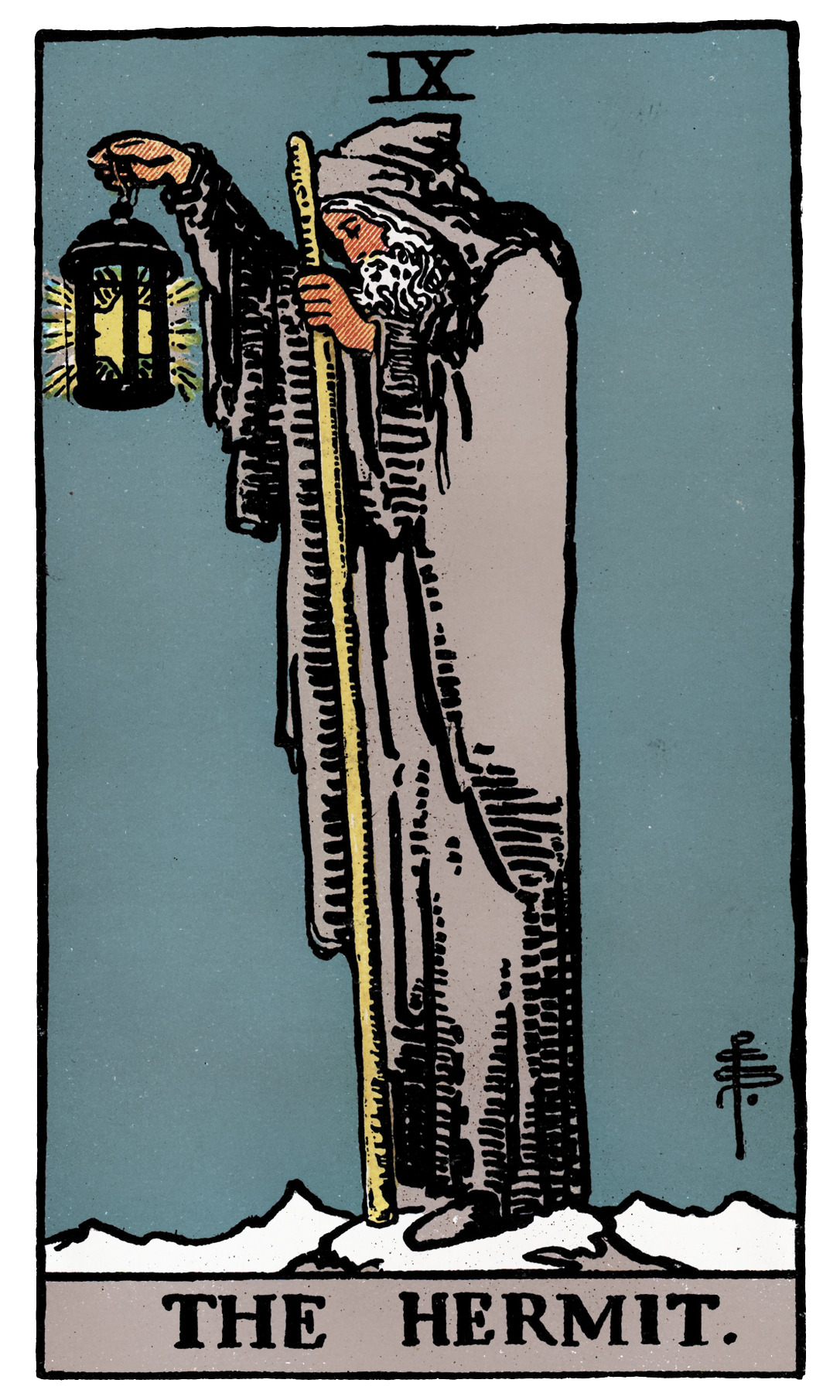
The Hermit - Rider-Waite-Smith Tarot
Table of Contents
Key Themes and Symbolism
The Rider-Waite-Smith Hermit is one of the most visually restrained cards in the Major Arcana. There's no dramatic scenery, no vivid color, no action. The simplicity is the point. Everything unnecessary has been stripped away, and what remains is essence.
The old man. The Hermit is the first card in the Major Arcana to depict someone who is clearly aged. The Magician is young and active. The Emperor is mature but vigorous. The Hermit is old, and his age is his qualification. He's not old in the sense of being depleted. He's old in the sense of having lived long enough to know what matters and what doesn't. Youth asks "what can I get?" Maturity asks "what can I build?" The Hermit asks "what is actually true?" That question requires years of living to even formulate properly.
The lantern. This is the card's central symbol, and it communicates everything about The Hermit's purpose. The lantern holds light, but it's a small, contained light. It doesn't illuminate the whole mountain. It illuminates the next few steps. The Hermit doesn't claim to see the entire truth of existence. He sees enough to keep walking, and he offers that light to anyone who comes looking. The lantern also represents the inner light of consciousness, the awareness that each person carries but most people ignore because the noise of daily life drowns it out.
The six-pointed star (Star of David / Seal of Solomon). Inside the lantern, the light takes the form of a hexagram, the symbol of the union of opposites: fire and water, above and below, the masculine and the feminine, spirit and matter. This star is wisdom itself, the understanding that apparent opposites are actually interdependent. The Hermit's light isn't ordinary knowledge. It's the kind of wisdom that comes from integrating what seems contradictory. It's the reward for sitting with paradox long enough to see that it was never really a paradox at all.
The staff. The Hermit's walking stick represents the journey that brought him here. Unlike The Magician's wand (which channels power) or The Emperor's scepter (which commands authority), The Hermit's staff is humble and functional. It helped him climb. It steadies him on uncertain ground. It's the tool of the pilgrim, not the ruler. The staff also represents the authority of personal experience. The Hermit doesn't need a throne or a title. His authority comes from having walked the path himself.
The mountaintop. Mountains in tarot represent achievement, spiritual elevation, and the perspective that comes from rising above the ordinary vantage point. The Hermit stands at the peak, meaning he's already done the work of climbing. The mountain isn't his destination. It's his lookout point. From here, he can see patterns and connections that are invisible to people in the valley. But the climb was hard, and it was solitary. No one carried him.
The grey robe. Grey is the color of neutrality, of the space between black and white, of wisdom that has moved beyond simple binaries. The Hermit doesn't see the world in terms of good and evil, right and wrong. He sees it in terms of what's true, and truth is almost always more complicated than any binary allows. The grey robe also signals humility. There's no red for passion, no gold for wealth, no white for purity. Just grey, the color of someone who has nothing to prove.
The snow. The mountain is cold and bare. There's no lush landscape here, no flowing river, no wheat growing at his feet. The Hermit's environment is deliberately stripped of comfort and distraction. This isn't a punishment. It's a choice. The Hermit knows that comfort and distraction are the enemies of truth. You can't hear the quiet voice inside if you're surrounded by noise. You can't see clearly if the landscape is cluttered with pleasant things to look at.
The number nine. Nine is the last single digit, the number of completion, wisdom earned through experience, and the threshold before a new cycle begins. After nine comes ten (the Wheel of Fortune), which resets everything. Nine represents the fullest development of individual consciousness before it encounters the impersonal forces of fate. The Hermit is the wisest the individual can become on their own, the peak of personal development before the wheel turns and the journey becomes something larger than the self.
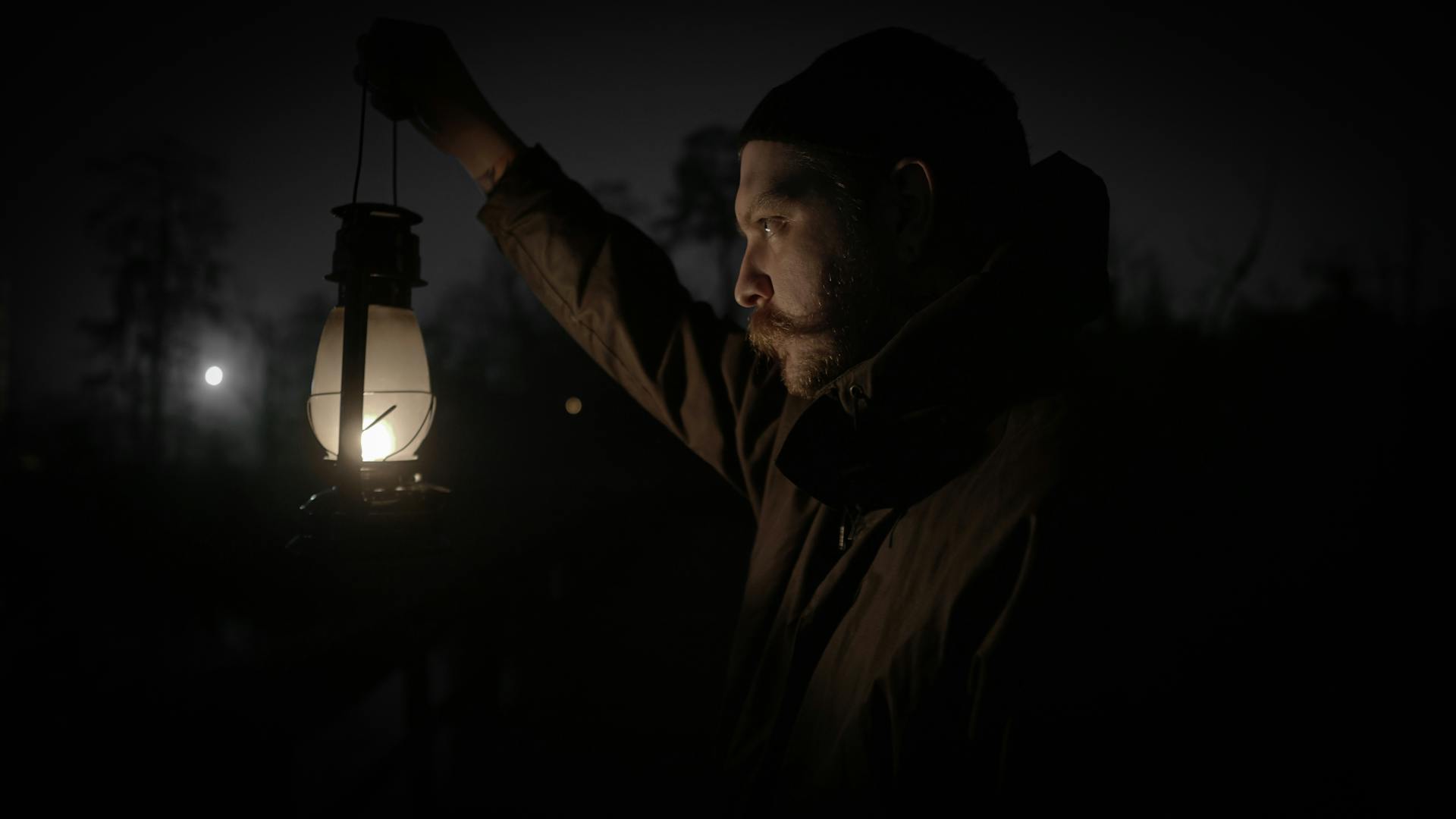
A man with a lantern explores the outdoors during a dark night representing The Hermit's solitary quest for truth
Upright Meaning
When The Hermit appears upright, he's calling you away from the crowd and into your own knowing.
General
The Hermit upright is the card of solitude, introspection, inner guidance, and the deliberate withdrawal from external noise to find internal truth. He appears when the answers you need aren't available from other people, when the advice you've been collecting contradicts itself, when every opinion you hear sounds plausible but none of them settle the restless feeling in your chest that says "this isn't it." The Hermit says: stop asking everyone else. Go quiet. Listen to yourself.
This isn't the same as isolation. The Hermit doesn't flee from people because he fears them. He steps away because he needs space to think without interference. There's a critical difference between running from connection and choosing solitude to deepen your understanding. The Hermit has done the social thing. He's listened to the teachers (The Hierophant), made the choices (The Lovers), driven forward with determination (The Chariot), and mastered his inner nature (Strength). Now he needs to process all of it. He needs to figure out what it means, what's truly his, and what he absorbed from other people without questioning it.
The Hermit also represents the search for a deeper purpose. Surface-level goals, career success, social approval, material comfort, have been achieved or at least understood. Now the question becomes: what's the point of all this? Why am I here? What's my actual purpose, not the one I inherited from my family or culture, but the one that's genuinely mine? These questions can't be answered at parties or in meetings. They require the kind of silence that most people actively avoid.
There's a mentorship dimension to The Hermit as well. He stands on the mountaintop with his lantern held out, which means he's willing to guide those who seek him. But you have to climb the mountain yourself. The Hermit doesn't come down to recruit followers. He doesn't knock on doors. If you want what he's offering, you have to do the work of reaching him. This is the principle of every genuine spiritual teacher: the teaching is available, but the student must be ready and willing to receive it.
When The Hermit appears in a reading, the immediate practical message is usually: you need time alone. Cancel some plans. Take a walk by yourself. Turn off your phone. Sit somewhere quiet and let your thoughts settle like sediment in a glass of water. What becomes clear when everything stops moving? That clarity is what The Hermit is pointing you toward.
Love
In love readings, The Hermit upright often indicates a period of being single by choice, or a need for space within an existing relationship. This isn't a rejection of love. It's the recognition that you can't offer your best self to a partner if you don't know who that self is. The Hermit in love says: before you can truly be with someone, you need to be with yourself.
If you're single, The Hermit suggests that this isn't the time to pursue new connections aggressively. Instead, it's a period for understanding what you actually want from a relationship, not what you think you should want, not what looks good from the outside, but what genuinely nourishes your soul. The Hermit's solitude isn't loneliness. It's the fertile ground where self-knowledge grows, and self-knowledge is the foundation of every healthy relationship.
If you're in a partnership, The Hermit can indicate that one or both partners needs space, not as a punishment or a sign of trouble, but as a healthy part of individual growth within the relationship. Couples who allow each other solitude often find that the time apart deepens the connection rather than threatening it. You come back to each other with something new: a clearer sense of self, a renewed appreciation, and the perspective that only distance can provide.
The Hermit in love can also point to a relationship with a significant age gap, or a connection with someone who carries considerable life experience and wisdom. This person may not be the most exciting or flashy partner, but they bring depth, stability, and a kind of insight that only comes from having lived a full life.
The caution with The Hermit in love is that solitude can become avoidance. If you're using "I need space" as a way to avoid vulnerability, The Hermit's energy has curdled into something unhealthy. Genuine Hermit solitude has a purpose: self-discovery. Avoidant isolation has a different purpose: protection from intimacy. Know the difference.
Career
In career readings, The Hermit upright encourages stepping back from the hustle to reassess your professional direction. You might be at a point where the career you've been building no longer feels meaningful, or where the next step isn't obvious despite years of experience. The Hermit says: don't force the next move. Take time to think about what you actually want your work to be.
This card favors careers that involve depth, research, analysis, consulting, writing, teaching, counseling, and any role where deep expertise matters more than social networking. The Hermit isn't the team player in the open office. He's the specialist who works best with focused, uninterrupted concentration. If your work environment demands constant collaboration and you're struggling, The Hermit validates your need for a quieter working style.
The Hermit also supports academic and spiritual pursuits. If you're considering going back to school, studying something deeply, or pursuing a path that society might see as impractical (philosophy, theology, the arts), The Hermit says the pursuit of knowledge for its own sake has value that transcends market demand.
If you're in a leadership position, The Hermit suggests leading by example and wisdom rather than by charisma or force. The Hermit leader doesn't give rousing speeches. They give thoughtful guidance to individuals who seek it. Their authority comes from demonstrated competence and insight, not from title or personality.
Finances
Financially, The Hermit encourages a period of careful review and reflection rather than action. Before making significant financial decisions, take time to understand your true financial picture. Look at the numbers honestly. Examine your spending patterns for what they reveal about your values. Are you spending money in ways that align with who you actually are, or in ways that serve an image you're trying to project?
The Hermit doesn't promise sudden wealth, and he doesn't suggest aggressive financial moves. He favors frugality, simplicity, and the recognition that many of the things money buys aren't actually necessary for a good life. If you've been chasing financial goals that were never really yours, goals inherited from parents, peers, or culture, The Hermit invites you to question whether more money would actually solve what feels missing.
This card can also indicate financial wisdom gained through experience. If you've been through financial difficulty and learned from it, The Hermit represents the hard-won knowledge that now guides your decisions. The mistakes of the past become the wisdom of the present.
Health
In health readings, The Hermit upright emphasizes the healing power of rest, solitude, and mental quiet. If you've been pushing through illness or managing chronic conditions while maintaining a demanding schedule, The Hermit says: stop. Your body needs stillness to heal. Your mind needs silence to process what the body is telling you.
The Hermit connects to the digestive system and the intestines through his Virgo association. Gut health, dietary sensitivity, and the connection between stress and digestive function may be particularly relevant. The gut is sometimes called the "second brain," and The Hermit's emphasis on inner wisdom resonates with the idea that your body's intelligence deserves as much attention as your mind's.
This card strongly supports practices that cultivate stillness and body awareness: meditation, mindfulness, yoga, walking in nature, and any activity that slows you down enough to feel what's actually happening inside. The Hermit's health advice is counter-cultural in a world that glorifies productivity: sometimes the most healing thing you can do is nothing.
Mental health is especially relevant with this card. The Hermit can indicate that therapy, journaling, or other forms of inner exploration will be particularly beneficial right now. The issues you're dealing with aren't going to be solved by staying busy. They need to be examined, understood, and processed, and that requires the kind of focused introspection The Hermit embodies.
Reversed Meaning
When The Hermit appears reversed, the relationship between solitude and wisdom breaks down.
General
The Hermit reversed speaks to three primary patterns: isolation that's become unhealthy, avoidance disguised as introspection, or a refusal to listen to your own inner wisdom.
The unhealthy isolation pattern is the most commonly experienced. What began as a legitimate need for space has become withdrawal from life. You've been alone too long. The solitude that was supposed to be a temporary retreat has become a permanent hiding place. You're not finding answers in the silence anymore. You're just avoiding the questions. When The Hermit reverses, the mountaintop becomes a prison, and the lantern's light turns inward so intensely that you can't see anything outside yourself.
The avoidance pattern is subtler. You tell yourself you're "figuring things out," but what you're actually doing is avoiding the scary parts of life: relationships that demand vulnerability, career moves that involve risk, conversations that require honesty. The Hermit reversed calls this out. True introspection leads to action. If your solitude isn't eventually producing clarity that you act on, it's not wisdom-seeking. It's hiding.
The third pattern involves ignoring your inner guidance. You've done the inner work. You've heard the quiet voice. You know what you need to do. But you're refusing to listen because what it's saying is inconvenient or frightening. The reversed Hermit can indicate someone who possesses genuine self-knowledge but won't apply it, who understands their own patterns perfectly but keeps repeating them anyway. Knowing the truth and living the truth are different things, and the reversed Hermit highlights the gap.
Love
In love, The Hermit reversed warns about emotional withdrawal that's damaging relationships. If you're in a partnership, you may have retreated so far into yourself that your partner feels shut out. There's a difference between needing occasional space and building a wall. The reversed Hermit indicates the wall.
This card reversed can also indicate loneliness that's been reframed as independence. You tell yourself and others that you're choosing to be alone, that you prefer your own company, that you don't need anyone. But underneath the narrative, there's a longing for connection that you won't admit to because admitting it feels like weakness. The reversed Hermit says: wanting love isn't weakness. Refusing to want it because you're afraid of rejection is the real vulnerability you haven't faced yet.
For those in relationships, The Hermit reversed can signal that one partner has become emotionally unavailable. They're physically present but internally absent, lost in their own world, their own projects, their own thoughts, with no room left for genuine intimacy. The relationship exists on paper but not in practice.
The reversed Hermit in love can also indicate being so self-focused that you've become blind to your partner's needs. Introspection without empathy creates a kind of enlightened selfishness: you understand yourself perfectly but have stopped trying to understand anyone else.
Career
In career readings, The Hermit reversed points to professional paralysis caused by overthinking. You've analyzed every option. You've weighed every possibility. And you still haven't moved. The reversed Hermit says the analysis phase is over. You know enough to act. The perfection you're waiting for, the absolute certainty that you're making the right move, doesn't exist. Make the decision and adjust as you go.
This card reversed can also indicate isolation from professional networks and opportunities. If you've been working alone for too long, you might be missing collaborations, job openings, or perspectives that would significantly benefit your career. The Hermit's solitude has its season, but refusing to emerge from it when the season's over is a form of self-sabotage.
There's also a dimension of refusing to share your expertise. The upright Hermit holds his lantern out for others. The reversed Hermit turns it inward. If you have knowledge that could help others but you're hoarding it, whether from fear of exposure, imposter syndrome, or simple unwillingness to engage, the reversed Hermit asks you to reconsider.
Finances
Financially, The Hermit reversed warns about two extremes: excessive frugality that's become deprivation, or financial decisions being avoided through analysis paralysis. You might be so focused on saving that you've stopped investing in your own well-being. Or you might be so afraid of making a wrong financial move that you've made no move at all, letting inflation and inaction erode your position.
This card reversed can also indicate that you're ignoring financial guidance, either your own earned wisdom or the advice of qualified professionals. You know what you should be doing with your money. You've known for a while. The reversed Hermit asks: why aren't you doing it?
Health
In health readings, The Hermit reversed can signal the physical consequences of excessive isolation: depression, lethargy, the decline that comes from disengaging from social life and physical activity. Humans are social creatures, and prolonged isolation affects the body as much as the mind. Immune function decreases. Inflammation increases. Sleep quality deteriorates. The reversed Hermit says that while solitude has its healing properties, too much of it becomes its own disease.
This card reversed can also indicate obsessive health anxiety, the kind where you research every symptom endlessly, convinced something is wrong, unable to trust medical reassurance. The inner focus that's healthy in moderation becomes destructive when it spirals into rumination. If your introspection about health has become a source of anxiety rather than clarity, the reversed Hermit suggests it's time to get out of your head and back into your life.
Card Combinations
The Hermit's meaning deepens with the cards around him.
The Hermit and Strength. A natural sequential pairing (cards eight and nine). Strength teaches you to face your inner nature with compassion. The Hermit takes that self-awareness and deepens it through contemplation. Together, they represent a person who has both the courage to look at themselves honestly and the patience to sit with what they find. This combination often appears during periods of profound personal growth, the kind that happens not through dramatic events but through sustained, quiet inner work.
The Hermit and The High Priestess. The two great introverts of the Major Arcana. The High Priestess receives wisdom through intuition and the subconscious. The Hermit seeks wisdom through deliberate introspection and experience. Together, they indicate a period of deep inner knowing, a time when both your intuitive hits and your rational self-examination are pointing in the same direction. Trust what's coming through. The convergence of these two sources of wisdom produces clarity that's hard to doubt.
The Hermit and The Wheel of Fortune. An interesting pair because they sit next to each other in the Major Arcana (nine and ten). The Hermit represents the pinnacle of individual wisdom. The Wheel of Fortune represents the impersonal forces of fate and change that no amount of personal wisdom can control. Together, they suggest that you've done all the inner work you can and now external circumstances are about to shift. The wisdom you've gathered in solitude is about to be tested by the turning of the wheel. You're as prepared as you can be. What happens next is bigger than you.
The Hermit and The Sun. A beautiful contrast between withdrawal and radiance. The Hermit retreats into darkness to find inner light. The Sun shines outward with external joy and vitality. Together, they indicate that a period of solitude and introspection is about to yield tangible, visible results. The insights gained in the dark are ready to come into the light. The depression lifts. The clarity arrives. What you discovered about yourself during the quiet period now becomes the foundation for a more joyful, authentic life.
Astrological Connections
The Hermit is associated with the zodiac sign Virgo and its ruling planet Mercury.
This association makes more sense than it initially appears. Virgo is often reduced to stereotypes about cleanliness and perfectionism, but at its core, Virgo is the sign of discernment, service, and the methodical pursuit of understanding. Virgo doesn't accept things at face value. It examines, analyzes, separates the useful from the useless, and refines what remains until only the essential survives. The Hermit embodies this process applied to the self: he's examined his own life with Virgo's meticulous eye and kept only what's true.
Mercury, Virgo's ruling planet, governs the mind, communication, and the processing of information. But Mercury in Virgo operates differently than Mercury in Gemini (which rules The Lovers). Gemini's Mercury is quick, social, and interested in variety. Virgo's Mercury is slow, methodical, and interested in depth. The Hermit's Mercury connection shows in his analytical approach to wisdom: he doesn't just feel his way to truth (that's The High Priestess). He thinks his way there, carefully and systematically, testing each insight against experience before accepting it.
The harvest connection is significant. Virgo is the sign of the harvest, the time when the crops planted in spring are finally gathered. The Hermit, as card nine, sits near the end of the first cycle of the Major Arcana, and he represents the harvest of self-knowledge. Everything that came before, the experiences of cards zero through eight, has produced wisdom that The Hermit now gathers and distills. The harvest isn't grain. It's understanding.
Virgo's association with health and healing reinforces The Hermit's connection to mind-body awareness. Virgo understands that physical health and mental clarity are inseparable, that what you eat, how you rest, and how you manage stress directly affect your ability to think clearly and perceive truth. The Hermit's mountaintop retreat isn't just spiritual discipline. It's also a health practice: removing yourself from toxicity so your whole system can recalibrate.
In your natal chart, strong Virgo placements (Sun, Moon, or Ascendant in Virgo, or Mercury in Virgo) often correlate with Hermit energy: a natural inclination toward analysis, a need for solitude to process experience, and a gift for seeing details that others miss. The 6th house (daily routines, health, and service) is particularly relevant to The Hermit's themes, as it's where the practical, body-level wisdom that Virgo specializes in takes shape.
The element of Earth gives The Hermit's wisdom a practical quality. His insights aren't abstract philosophy. They're grounded, applicable, and relevant to actual life. The Hermit doesn't contemplate the meaning of existence for entertainment. He does it so he can live better, make better choices, and help others do the same. His Earth element ensures that the journey inward eventually produces outward results.
Reading Tips for The Hermit
Distinguish solitude from isolation. When The Hermit appears, the first question is whether the solitude in the reading is healthy or harmful. Healthy Hermit energy has a purpose: self-discovery, rest, perspective-gaining. Unhealthy Hermit energy has no destination: it's just withdrawal from life driven by fear, depression, or avoidance. The context of the reading and the surrounding cards will tell you which one you're dealing with.
He's usually saying "slow down." In a culture that prizes speed, productivity, and constant connection, The Hermit's message is radical: stop. Think. Be quiet. If the querent is juggling seventeen responsibilities and asking why they feel lost, The Hermit's answer is obvious. You can't hear yourself think when you never stop making noise.
Look for what's being avoided. The Hermit often appears when someone is overdue for a reckoning with themselves. There's a truth they've been outrunning, a pattern they've been ignoring, a question they've been drowning out with activity. The Hermit says the avoidance strategy has reached its limit. The truth you've been running from is patient, and it's still there waiting.
He frequently indicates a mentor. The Hermit can represent a teacher, therapist, spiritual guide, or wise elder whose guidance would be valuable right now. This person won't come looking for you. You have to seek them out. And the guidance they offer won't be easy or comfortable. It will be true, and true things often sting before they heal.
Timing matters with this card. The Hermit isn't a permanent state. He's a season. Like winter, which looks barren but prepares the ground for spring, The Hermit's withdrawal period prepares you for a new phase of engagement with life. If the card appears, you're either entering this season, in the middle of it, or being told you've stayed in it too long. Context determines which.
Frequently Asked Questions
Is The Hermit a yes or no card?
The Hermit is generally a "not yet" rather than a clear yes or no. It suggests that you don't have enough information to make this decision right now, not because the information doesn't exist, but because you haven't done the inner work to access it. The Hermit says: pause. Reflect. Let the answer emerge from genuine understanding rather than impulse or anxiety. If the question is about timing, The Hermit indicates delays, but productive ones. The delay gives you time to gain clarity. If you're asking whether to take action, The Hermit says: not until you've thought it through properly.
What does The Hermit mean in a love reading?
In love, The Hermit most often indicates a period of being happily or purposefully single, a time to understand yourself before committing to someone else. It can also suggest that an existing relationship needs more space and less intensity, that one or both partners would benefit from time alone to process their feelings and needs. The Hermit in love isn't a rejection of partnership. It's the recognition that the best partnerships are between two people who know themselves well. If you haven't done that work yet, The Hermit says: do it now, and the love that follows will be built on something real.
Does The Hermit mean I should be alone?
Not necessarily forever, but probably right now. The Hermit indicates a temporary withdrawal, not a permanent state. Think of it as a retreat: you step away from normal life to gain perspective, insight, and rest, and then you return with something valuable to offer. The key word is "temporary." If the solitude has a purpose (self-discovery, healing, creative focus), The Hermit approves. If it has become a way to avoid life, The Hermit reversed warns that the retreat has overstayed its usefulness.
What is the difference between The Hermit and The High Priestess?
Both cards deal with inner knowing, but through different processes. The High Priestess receives wisdom passively through intuition, dreams, and the subconscious. She sits still and knowledge comes to her. The Hermit seeks wisdom actively through deliberate introspection, study, and the methodical examination of experience. He climbs a mountain to find it. The High Priestess knows without knowing how she knows. The Hermit knows because he's carefully traced each insight back to its source. She's the moon. He's the lantern: smaller but more focused and more portable.
What zodiac sign is The Hermit associated with?
The Hermit is associated with Virgo, the mutable earth sign ruled by Mercury. This connects The Hermit to themes of analysis, discernment, service, and the methodical pursuit of understanding. Virgo's harvest energy gives The Hermit his quality of gathering wisdom from experience and distilling it into something useful and applicable. People with strong Virgo or Mercury-in-Virgo placements in their natal chart often resonate deeply with The Hermit's energy: they need solitude to process, they find truth through careful analysis, and they value depth and precision over breadth and speed.
For deeper exploration of all 78 cards, visit the Celesian tarot reader. To understand how The Hermit's Virgo energy connects to your personal astrology, check your Mercury and Virgo placements with the natal chart calculator. And to follow The Fool's Journey, read about Strength, whose compassionate self-mastery The Hermit now deepens through contemplation, and the Wheel of Fortune, whose impersonal forces of change await The Hermit at the bottom of the mountain.