Knight of Swords Tarot Card Meaning: Upright, Reversed, Love, Career, and More
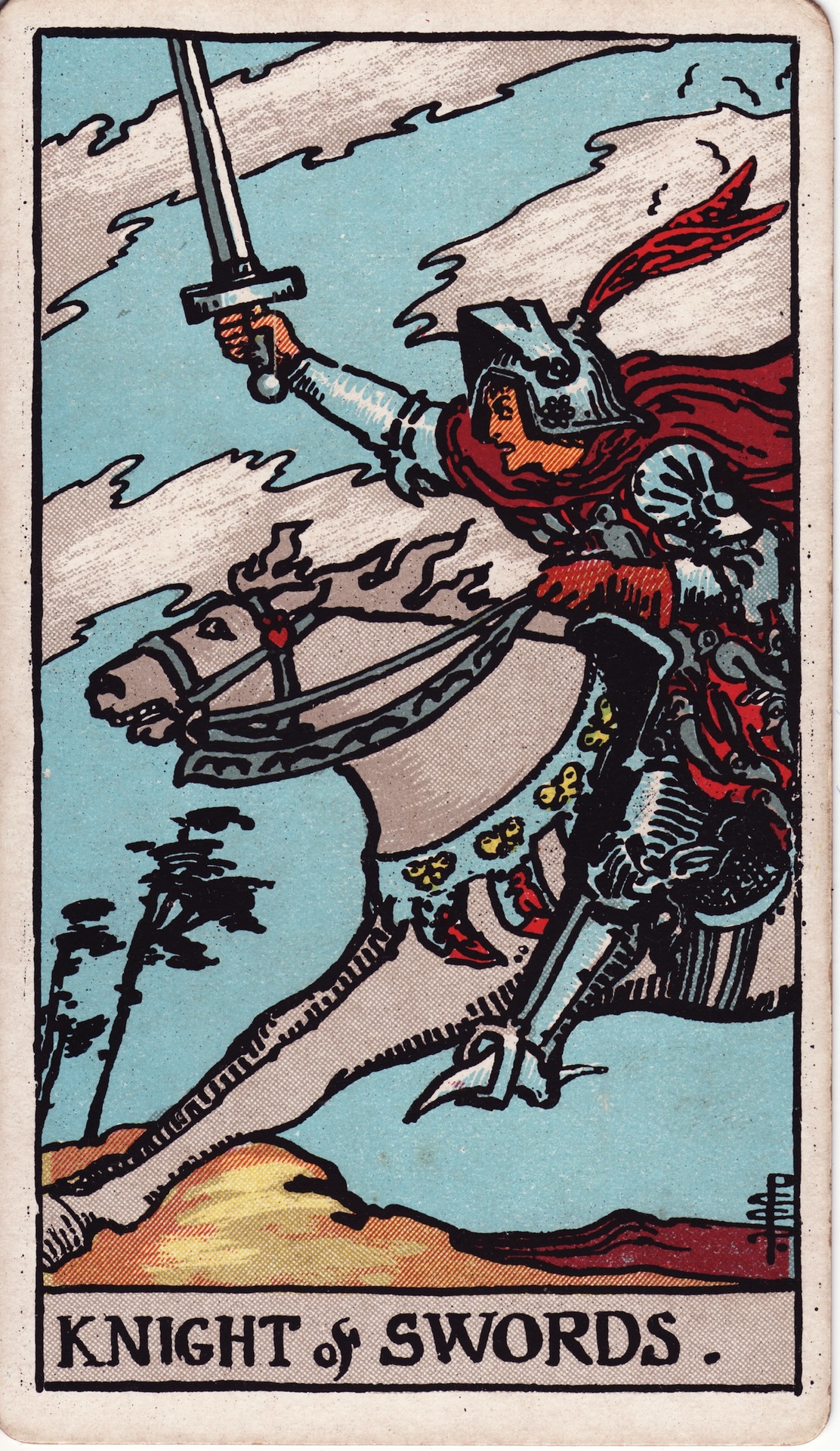
A knight in full armor rides a white horse at full gallop, his sword raised high and thrust forward as if slicing through the air itself. The horse's legs are airborne, its body stretched long and low, mane and tail streaming behind in a wind that bends the trees in the background nearly horizontal. Clouds tear across a stormy sky in ragged, fast-moving streaks. The knight's red cape flies behind him, caught in the same fierce wind that drives everything in the scene. Birds wheel and scatter in the churning atmosphere. The ground below is rough and hilly, but the knight doesn't slow for the terrain. He doesn't slow for anything. His visor is up, his eyes fixed forward on whatever he's charging toward, and every line of the composition conveys a single message: this figure has made his decision, and nothing between here and the destination is going to stop him.
Knight of Swords - Rider-Waite-Smith Tarot
The Page of Swords stood on the hilltop, sword at the ready, scanning every direction with the alert but unfocused curiosity of someone who's just discovered the power of the mind. The Knight of Swords is what happens when that curiosity locks onto a target. The scanning stops. The deliberation ends. The sword that the Page held vertically, testing its weight, is now thrust forward in a charge. Where the Page asks questions, the Knight delivers answers, sometimes before anyone asked for them and sometimes before the Knight has fully considered whether the answers are right. This is the Swords suit's energy at peak velocity: intellect combined with action, thought fused with movement, the mind weaponized and aimed at a single point.
Table of Contents
Key Themes and Symbolism
The Knight of Swords is the tarot's portrait of the mind in motion, no longer contemplating possibilities but committed to a course of action with the full force of intellectual conviction behind it.
The charging horse. The horse represents the raw energy that carries the knight's ideas into the world. Unlike the Knight of Cups, whose horse walks calmly, or the Knight of Pentacles, whose horse stands still, the Knight of Swords' horse is at full gallop. The animal is white, suggesting clarity of purpose and mental purity, but the speed is so extreme that the horse's hooves have left the ground entirely. This is intellect that's become untethered from the practical constraints that slower minds navigate. The speed is both the Knight's greatest asset and greatest liability: it gets him where he's going faster than anyone else, but it also means he can't change direction easily and may not see the obstacles in his path until he's already crashing through them.
The raised sword. The sword is held high and thrust forward, not defensively positioned or experimentally gripped like the Page's weapon. This is a sword being used, actively cutting through resistance, opposition, and ambiguity. The Knight has committed to a position, an argument, a plan, or a belief, and the raised sword represents his willingness to fight for it. In its highest expression, this is the courage to speak truth when silence would be safer. In its shadow expression, this is the aggression of someone who's confused intellectual certainty with being right.
The storm. The sky behind the Knight is the most turbulent in the Swords suit. Clouds don't just drift; they tear. Trees don't just sway; they bend nearly to the ground. The wind that the Page of Swords stood in has intensified into something closer to a gale. Storms in tarot represent conflict, turmoil, and the kind of disruption that clears the air. The Knight rides directly into the storm rather than seeking shelter, which tells you everything about his character: he doesn't avoid difficulty. He charges at it. Sometimes this is heroic. Sometimes it's reckless. The storm doesn't care which one it is.
The birds. Birds scatter through the churning sky, representing thoughts and communications that have been disrupted by the Knight's passage. Where the Page watched birds from a distance, the Knight is riding through them. Ideas aren't being observed anymore. They're being activated, scattered, rearranged. The Knight's charge through the intellectual landscape doesn't leave things as they were. He creates upheaval in the realm of ideas, which can be revolutionary or destructive depending on whether the ideas he's scattering needed to be disrupted.
The armor. Full armor distinguishes the Knight from the Page, who wore only a tunic. The Knight is protected, prepared for conflict, and equipped to survive opposition. The armor decorated with butterflies and birds suggests that this warrior's nature is fundamentally intellectual and communicative, even while his behavior is aggressive and martial. He fights with words, arguments, strategies, and ideas. The armor means he's hardened himself for the battle of wits, which is both a strength, he can take hits without being derailed, and a limitation, the armor that protects him also prevents vulnerability, empathy, and the openness that human connection requires.
The Knight as court card. Knights in the tarot represent action, movement, pursuit, and the dynamic expression of their suit's energy. Where Pages are students, Knights are warriors. Where Queens internalize their suit's power, Knights externalize it. The Knight of Wands charges toward adventure. The Knight of Cups rides toward love. The Knight of Pentacles moves methodically toward material goals. The Knight of Swords charges toward truth, or at least toward what he believes is truth, and he does so with a velocity that no other knight matches. He is the fastest court card in the deck, the most decisive, and the most likely to arrive before anyone was ready for him.
Upright Meaning
When the Knight of Swords appears upright, you're encountering the energy of swift decisive action, intellectual courage, direct communication, and the willingness to cut through confusion and opposition without hesitation.
General
The Knight of Swords upright signals that a period of rapid forward movement has arrived or is about to arrive. Something that was stalled is about to accelerate. A decision that was languishing in deliberation is about to be made. A truth that was being avoided is about to be spoken. The Knight doesn't ease into things. He bursts through the door. When this card appears, expect the pace of your situation to increase dramatically and expect that increase to be driven by mental clarity, determination, and the refusal to tolerate ambiguity any longer.
This card often appears when you've been overthinking a situation and the time for thinking has ended. The Knight of Swords says: you already know what you need to do. Stop circling the issue and do it. The analysis is complete. The research is sufficient. The information you have is enough. What's missing isn't more data; it's the willingness to act on the data you already have. The Knight has that willingness in abundance, and his appearance in your reading suggests that you either have it too or need to find it immediately.
The shadow side of the upright Knight is that speed isn't the same as wisdom. Acting quickly on a correct assessment produces results. Acting quickly on an incorrect assessment produces damage. The Knight of Swords doesn't always check whether his assessment is correct before he charges. He trusts his mind, which is usually sharp, but sharpness and accuracy aren't identical qualities. A brilliant person who's wrong is more dangerous than a slow person who's right, because the brilliant person will implement their wrong answer faster, more thoroughly, and with more conviction.
When this card represents a person in your life, expect someone who's intelligent, direct, verbally quick, argumentative, ambitious, and impatient with anyone who can't keep up. This person speaks before thinking, commits before consulting, and moves faster than the people around them are comfortable with. They're exciting and exhausting in roughly equal measure. They get things done, but they may leave interpersonal wreckage in their wake because they prioritized the objective over the feelings of the people involved.
Love
In love readings, the Knight of Swords upright often signals a period of direct, honest communication in your romantic life. If you've been tiptoeing around a topic with your partner, this card says the tiptoeing is over. The conversation is going to happen, probably soon, and probably with more intensity than a gentle discussion. The Knight doesn't do gentle. He does clear, pointed, and sometimes uncomfortably direct.
For singles, the Knight of Swords can indicate someone entering your life who's intellectually stimulating, verbally sharp, and moves fast. This person won't send three ambiguous texts over two weeks. They'll tell you exactly what they want and when they want it. Whether that directness is attractive or overwhelming depends on your temperament, but the Knight of Swords as a romantic figure is never boring and never unclear about their intentions.
The caution in love readings is that the Knight of Swords can prioritize being right over being kind. In relationships, the need to win every argument is more destructive than losing occasionally. If this card describes your own behavior, it's asking whether you've been treating your partner like an adversary rather than an ally. Intellectual combat is invigorating between equals who enjoy it. It's devastating when one person uses their verbal skill to dominate rather than connect.
Career
The Knight of Swords is one of the strongest career cards in the Minor Arcana when it appears upright. It signals ambitious forward movement, rapid professional advancement, and the willingness to pursue your goals with single-minded focus. If you've been considering a bold professional move, a career change, a direct conversation with your boss, or a competitive bid for a position, the Knight says: go. Move fast. The window is open and hesitation will close it.
This card often appears when you need to assert yourself professionally, when being diplomatic and patient hasn't produced results and the situation calls for direct, forceful action instead. The Knight of Swords in a career reading is the executive who makes the unpopular decision because it's the right one, the entrepreneur who launches before the business plan is perfect because the market opportunity won't wait, the employee who speaks up in the meeting instead of waiting for the right moment that never comes.
The workplace warning: the Knight's speed and directness can create enemies. Not everyone appreciates having their ideas challenged publicly or their pace accelerated involuntarily. Professional success achieved by running over colleagues tends to be unstable. The Knight of Swords is most effective when his directness is paired with enough political awareness to know when to charge and when to ride alongside.
Finances
Financially, the Knight of Swords upright suggests quick, decisive action regarding money. This might mean making a fast investment decision, cutting losses on something that's been underperforming, or taking a financial opportunity that requires immediate commitment. The Knight doesn't agonize over spreadsheets for months. He assesses, decides, and acts.
The financial caution is the same as the general one: speed is valuable only when the underlying assessment is sound. Rushing into investments, signing contracts without reading them thoroughly, or making major financial commitments under time pressure can produce regret. The Knight of Swords advises decisiveness, not recklessness. Know the difference. Make sure the speed of your action matches the quality of your analysis.
Health
In health readings, the Knight of Swords often indicates sudden developments, fast-moving conditions, or the need to take quick action regarding a health concern. If you've been putting off a medical appointment or test, this card says stop procrastinating and deal with it now. The Knight cuts through avoidance the way his sword cuts through air: directly and without negotiation.
This card can also suggest that mental health is the primary concern. The Knight of Swords' mind never stops moving, never stops analyzing, never stops running ahead to the next problem. The health implication is anxiety, insomnia, mental exhaustion, or the physical consequences of a mind that won't let the body rest. If this resonates, the Knight isn't telling you to think more. He's telling you that the same decisive energy you apply to external problems needs to be turned inward: decide to rest, decide to slow down, and implement that decision with the same force you apply to everything else.
Reversed Meaning
When the Knight of Swords appears reversed, the charge has gone wrong. The speed becomes recklessness. The directness becomes cruelty. The intellectual confidence becomes arrogance. The decisive action becomes impulsive destruction.
General
The Knight of Swords reversed is the mind moving so fast that it's lost control of its own direction. Where the upright Knight charges toward a clear target, the reversed Knight charges blindly, propelled by momentum rather than purpose. He's still fast, still sharp, still formidable, but his speed is doing damage instead of producing results because he hasn't taken the time to make sure he's aimed at the right thing.
This reversal often appears when you've been making decisions too quickly, speaking before thinking, committing to plans before examining them, or acting on anger or frustration rather than genuine conviction. The reversed Knight is the email you sent in the heat of the moment and regretted immediately. He's the argument you escalated when de-escalation would have served you better. He's the bridge you burned because you mistook impulsiveness for courage.
The reversed Knight can also indicate a failure to act, the opposite problem. Sometimes the horse rears and the knight falls off. The same mind that's capable of brilliant, decisive action can become paralyzed when it turns its analytical power inward. The reversed Knight of Swords can represent someone who thinks so fast and sees so many potential outcomes that they can't commit to any of them. The analysis becomes paralysis. The sword that should be swung stays raised, indefinitely, because every potential target seems wrong.
When this card represents a person, expect someone who's intellectually aggressive, verbally cutting, impatient to the point of cruelty, or so scattered that their brilliance produces chaos instead of results. This person argues for sport, dismisses other people's ideas reflexively, and uses their verbal skill as a weapon rather than a tool. They may be charming in short bursts, but sustained contact reveals that their speed comes at the expense of depth and their sharpness comes at the expense of kindness.
Love
In love readings, the Knight of Swords reversed often signals destructive communication patterns. Arguments that have become habitual rather than productive. A partner who uses words to wound rather than to connect. The pattern of saying the most cutting thing possible during a conflict because you can, because you're quick enough to find the verbal kill shot, even when you know the damage it causes.
For singles, this reversal warns against rushing into relationships based on intellectual chemistry alone. The reversed Knight is attracted to the person who can match his verbal sparring, but matching someone blow for blow in an argument isn't intimacy. It's combat. If your dating pattern involves intense initial attraction followed by escalating conflict, the reversed Knight of Swords is asking you to examine whether you're seeking a partner or an opponent.
This card can also indicate that someone in your romantic life is being dishonest or manipulative. The Knight of Swords' mental agility, when reversed, can become cunning rather than clever. If someone's story keeps changing, if their words don't match their actions, or if you feel intellectually outmaneuvered rather than genuinely understood, the reversed Knight suggests you're dealing with someone who's using their intelligence to control rather than to connect.
Career
The Knight of Swords reversed in career readings warns against professional recklessness. You may be moving too fast, cutting too many corners, alienating too many colleagues, or pursuing a career path with more aggression than strategy. Ambition is a fuel. The reversed Knight has too much fuel and not enough steering.
This reversal can indicate workplace conflict that's become toxic, where the exchange of ideas has deteriorated into the exchange of personal attacks. It can also point to a professional decision you made impulsively that's producing negative consequences. The project you launched without adequate planning. The confrontation with your boss that was satisfying in the moment but damaging to your position. The career change you committed to before you had a viable plan.
In some readings, the reversed Knight of Swords signals that someone in your professional environment is undermining you through gossip, manipulation, or aggressive politicking. This person is smart, strategic, and not operating in good faith. The reversed Knight warns you to protect yourself from their maneuvering, not by matching their aggression (which feeds the cycle) but by being more deliberate and strategic than they expect.
Finances
Financially, the reversed Knight of Swords is a strong warning against impulsive financial decisions. This is not the time to make fast moves with money. The reversed Knight represents the investor who panics and sells at the bottom, the gambler who doubles down to recoup losses, or the person who makes a major purchase during an emotional state and regrets it when clarity returns.
If you've already made a hasty financial commitment, this card suggests pausing to assess the damage and develop a recovery plan rather than making another fast move to compensate. The instinct to act quickly to fix a financial mistake often produces a second mistake. The reversed Knight's lesson is that financial recovery requires the patience the original mistake lacked.
Health
In health readings, the reversed Knight of Swords can indicate mental health challenges related to aggression, anxiety, or the inability to slow down. The mind that won't stop racing, the thoughts that attack rather than inform, the internal dialogue that's become relentlessly critical. This reversal points toward burnout, stress-related conditions, or health issues that stem from refusing to listen to your body's signals because your mind insists there's no time to rest.
The reversed Knight can also suggest that you're approaching a health issue with too much aggression. Not every health challenge requires a military campaign. Sometimes healing means surrender rather than fight, acceptance rather than resistance, patience rather than the urgent demand for immediate results.
Card Combinations
The Knight of Swords' meaning shifts significantly depending on which cards appear alongside him.
Knight of Swords + The Chariot. Unstoppable forward momentum. The Chariot's disciplined willpower combined with the Knight's intellectual speed creates a force that's both fast and controlled. This pairing appears when you're about to achieve something through sheer determination and mental focus. The combination suggests not just speed but direction, not just force but mastery of that force. Whatever you're charging toward, this pair says you'll reach it, and the arrival will feel like victory rather than accident.
Knight of Swords + The High Priestess. A powerful tension between action and intuition. The Knight wants to charge forward; the High Priestess says wait and listen to what you can't yet see. Together, they suggest that the situation requires both: the courage to act and the wisdom to know when. If you've been all action, the High Priestess asks you to pause. If you've been all contemplation, the Knight says the time for waiting has passed. The combination is asking you to integrate intellect with intuition rather than choosing one at the expense of the other.
Knight of Swords + Five of Swords. Conflict without resolution. This pairing warns that the Knight's aggressive charge is heading toward a battle that nobody truly wins. The Five of Swords represents the hollow victory, winning the argument but losing the relationship, proving your point but destroying the trust. If you see these cards together, reconsider whether the fight you're about to pick is worth what it will cost. The Knight's instinct is to charge. The Five of Swords says this particular charge ends badly for everyone involved.
Knight of Swords + The Star. Hope after a period of aggressive striving. The Star's gentle, healing energy tempers the Knight's intensity and suggests that the way forward isn't more force but more faith. This combination often appears when someone who's been fighting hard needs to learn that some goals are achieved through openness and receptivity rather than intellectual combat. The Knight got you to the clearing. The Star says: put down the sword and receive what's waiting for you.
Astrological Connections
The Knight of Swords is associated with the mutable air portion of the zodiac, specifically the transition from Taurus to Gemini, though different tarot traditions assign slightly different ranges. The most common association links the Knight of Swords to the last decan of Taurus and the first two decans of Gemini, roughly May 11 through June 10.
This astrological placement illuminates the Knight's nature perfectly. Gemini is ruled by Mercury, the planet of communication, intellect, speed, and the transmission of ideas. Mercury is the fastest planet in the solar system, orbiting the Sun in just 88 days, and the Knight of Swords embodies that speed in every dimension of his character. He thinks fast, speaks fast, moves fast, and processes information faster than the people around him can follow.
The Gemini influence also explains the Knight's relationship with duality and communication. Gemini is the sign of the twins, the communicator, the translator between different worlds and perspectives. The Knight of Swords at his best is a brilliant communicator who can cut through confusion and articulate what others are struggling to express. At his worst, he's the debater who argues both sides so skillfully that nobody knows what he actually believes, including himself.
The Taurus influence at the beginning of the Knight's range adds an element of stubborn determination to the Gemini speed. Once this Knight has locked onto a target, he brings Taurus' fixed-earth persistence to the charge. He doesn't just have fast ideas. He commits to them with a tenacity that can be either admirable or alarming depending on whether the idea deserves that level of commitment.
Mercury's influence on this card means that Mercury retrograde periods can be particularly significant for people who strongly identify with the Knight of Swords energy. When Mercury retrogrades, the Knight is forced to slow down, re-examine, and potentially discover that some of his fastest decisions were also his least considered. For more on how Mercury shapes communication and thought patterns, explore your natal Mercury placement with the natal chart calculator.
Reading Tips for the Knight of Swords
Timing matters. The Knight of Swords is one of the strongest timing indicators in the tarot. When he appears, events are about to accelerate. Whatever you're asking about isn't going to develop slowly. Expect fast movement, rapid communication, and situations that evolve more quickly than you might be comfortable with. If your question is "when will this happen?", the Knight of Swords answers: soon, and probably sooner than you think.
Check surrounding cards for direction. The Knight of Swords is energy and speed, but the surrounding cards tell you whether that speed is aimed productively. Positive cards nearby (The Sun, Ace of Wands, Six of Wands) suggest the charge leads somewhere good. Challenging cards nearby (The Tower, Five of Swords, Ten of Swords) suggest the Knight's speed is heading toward a crash. Don't read the Knight in isolation. He's the velocity. The surrounding cards are the destination.
Distinguish between courage and recklessness. This is the central interpretive challenge with the Knight of Swords. He looks the same whether he's being heroically brave or catastrophically reckless, because the behavior is identical in both cases: a full-speed charge toward whatever he's decided matters. The difference is whether the underlying assessment is sound. Ask the querent what they're charging toward and whether they've genuinely thought it through, or whether the excitement of the charge has replaced the quality of the thinking.
The Knight as person vs. the Knight as energy. Court cards can represent actual people or qualities being activated in the querent's life. When the Knight of Swords represents a person, look for someone who's between 20 and 35, intellectually sharp, verbally direct, professionally ambitious, and potentially impatient or aggressive. When the card represents energy rather than a person, it indicates that the querent is in Knight of Swords mode: thinking fast, acting decisively, and potentially moving too fast for their own good. Context and surrounding cards clarify which interpretation applies.
Watch for the speed trap. The Knight of Swords' greatest temptation is to confuse movement with progress. Not everything that moves fast is going somewhere useful. Sometimes the Knight is charging toward an objective. Sometimes he's running from something he doesn't want to face, and the speed is avoidance dressed up as ambition. If the reading's other cards suggest unresolved emotional issues (cards from the Cups suit, the Moon, the reversed High Priestess), the Knight's intellectual charge may be compensating for emotional work he's refusing to do.
Frequently Asked Questions
What does the Knight of Swords mean as feelings?
As feelings, the Knight of Swords represents intense mental attraction, the excitement of intellectual connection, and the desire to pursue someone or something with focused determination. This isn't the warm, tender feeling of the Cups suit. It's the sharp thrill of meeting someone who makes your mind come alive, someone you want to debate, challenge, impress, and engage with at the level of ideas. In existing relationships, the Knight of Swords as feelings can indicate frustration that's about to become confrontation, the feeling that something needs to be said and the growing inability to hold it back any longer. The emotional register is high energy, low patience: whatever the person is feeling, they're feeling it urgently and they're ready to act on it.
Is the Knight of Swords a yes or no card?
The Knight of Swords is generally a yes in yes-or-no readings, and it's an emphatic, fast-moving yes. This card's energy is forward motion and decisive action, which suggests that whatever you're asking about is going to happen, and probably quickly. The caveat is that the Knight doesn't promise the outcome will be comfortable or that you've fully thought through the consequences. It's a "yes, and brace yourself for the speed of it" rather than a peaceful, reassuring yes. Reversed, the Knight shifts toward "not yet" or "yes, but you'll regret the way you went about it," suggesting that the impulse is there but the execution needs more thought.
What does the Knight of Swords mean for reconciliation?
For reconciliation, the Knight of Swords suggests that if reconnection happens, it will happen fast and directly. This isn't the slow, gradual rebuilding of trust. It's the phone call or conversation where everything gets said at once, the clearing of the air through honest, possibly blunt communication. The Knight of Swords favors reconciliation through truth-telling rather than diplomacy. If both people can handle directness and value intellectual honesty over emotional comfort, this card suggests the reconciliation has a chance. If the original conflict was caused by someone being too aggressive or verbally cutting, the Knight of Swords may indicate that the same pattern is about to repeat unless the underlying dynamic changes.
How is the Knight of Swords different from the Knight of Wands?
Both Knights are fast and action-oriented, but their fuel sources are completely different. The Knight of Wands is driven by passion, enthusiasm, adventure, and the fire of creative inspiration. He charges because he's excited. The Knight of Swords is driven by intellect, conviction, ambition, and the force of mental certainty. He charges because he's decided. The Knight of Wands doesn't always know where he's going, but he's having a great time getting there. The Knight of Swords knows exactly where he's going and doesn't care whether the journey is enjoyable. Wands is fire energy externalized. Swords is air energy weaponized. In relationships, the Knight of Wands brings passion. The Knight of Swords brings stimulation. Both can be thrilling. Both can be exhausting. The burnout just feels different.
What should I do when the Knight of Swords appears in a reading?
When the Knight of Swords appears, prepare for speed. Whatever your situation, it's about to accelerate. The practical advice depends on the position and surrounding cards, but the universal message is: be ready to move, think clearly under pressure, and communicate directly. If you've been procrastinating on a decision, the Knight says decide now. If you've been avoiding a difficult conversation, the Knight says have it. If you've been researching endlessly instead of acting, the Knight says the research phase is over. The one thing the Knight of Swords never advises is waiting. He advises smart, focused, decisive action, and he advises it now.
The Knight of Swords is the tarot's reminder that the mind is a weapon, and like any weapon, it's only as good or as dangerous as the person wielding it. Aimed precisely and swung with discipline, the Knight's sword cuts through confusion, dishonesty, and stagnation. Swung wildly or aimed carelessly, it cuts through relationships, trust, and the fragile structures that human connection depends on. The Knight doesn't care which outcome you produce. He cares that you move, that you commit, that you stop standing on the hilltop scanning the horizon and actually ride toward something. The choice of what to ride toward, the decision of when speed serves you and when it destroys you, that's yours to make. The Knight provides the velocity. You provide the direction. For a broader exploration of all 78 cards, visit the Celesian tarot reader. To understand how Mercury and Gemini shape your communication style, your intellectual velocity, and your relationship with the cutting, charging energy the Knight embodies, explore your natal placements with the natal chart calculator. And to continue through the Swords court, look back at the Page of Swords, whose curiosity and alertness were the seed of everything the Knight has become, and ahead to the Queen of Swords, where the Knight's raw intellectual force matures into the sharpest, most disciplined clarity in the entire deck.