
Five of Swords Tarot Card Meaning: Upright, Reversed, Love, Career, and More
A man stands in the foreground holding three swords, two in his arms and one in his hand, with a look on his face that hovers somewhere between satisfaction and contempt. Behind him, two other figures walk away, shoulders slumped, defeated. One of them has his face in his hands. Two more swords lie on the ground between the victor and the vanquished, abandoned like things no longer worth carrying. The sky above is turbulent, streaked with jagged clouds that suggest the aftermath of a storm rather than clear resolution. The water behind the figures is choppy and unsettled. Nothing about this scene looks like a genuine victory. It looks like the moment after a fight that nobody actually won, the moment when the person left standing realizes that being the last one holding the weapons doesn't mean the same thing as being right.
The Four of Swords was rest, the sacred pause after mental exhaustion. The Five of Swords is what happens when the mind re-enters conflict without having fully learned the lesson that rest was trying to teach. This card is the tarot's most unflinching portrait of Pyrrhic victory, the kind of winning that costs so much it barely qualifies as winning at all. The man with the swords has the weapons. He has the battlefield. What he doesn't have are the people who were standing beside him five minutes ago, and the card forces you to ask whether any argument, any competition, any power struggle is worth the relationships it destroys.
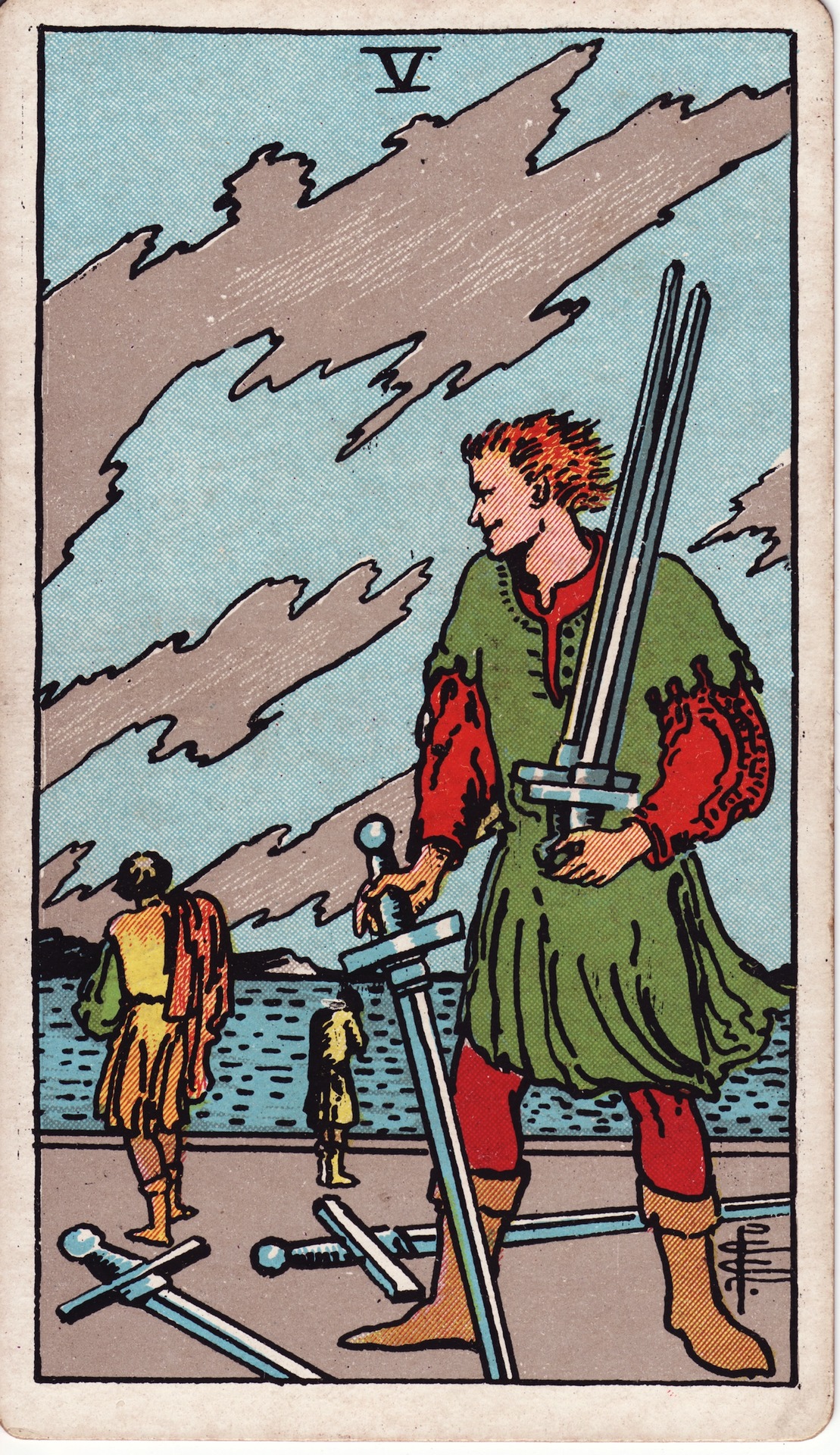
Five Of Swords - Rider-Waite-Smith Tarot
Table of Contents
Key Themes and Symbolism
The Five of Swords operates at the intersection of intellect and ego, and every element of its imagery reinforces the emptiness of victory achieved through domination rather than genuine strength.
The three collected swords. The central figure holds three swords, more than he needs, more than he can comfortably carry. He's not just defending himself. He's hoarding the weapons of others. This detail reveals the nature of the victory: it was achieved not by being right, but by being more aggressive, more willing to fight dirty, or more determined to dominate. The extra swords represent the power, voice, or agency he's stripped from the people behind him. In practical terms, this is the person who wins an argument by talking over everyone, the colleague who gets the promotion by undermining competitors, the partner who wins every fight because the other person has simply stopped trying.
The two retreating figures. The people walking away aren't just losers. They're people who've decided that engaging further isn't worth it. One has his face covered, a gesture of grief or shame. They've been diminished by the encounter, stripped of something, their dignity, their confidence, their willingness to participate. Their departure is the real cost of the victory. The swordsman is left alone on the battlefield with his prizes, and nobody is there to witness the triumph because everyone who mattered has left.
The turbulent sky. The clouds in the Five of Swords are jagged and restless, suggesting conflict that hasn't truly resolved. Compare this to the clear skies in more harmonious cards. The atmosphere tells you that even though the fight appears to be over, the underlying tension hasn't dissipated. The weather is a warning: the conflict will return in some form because the root cause hasn't been addressed, only suppressed through force.
The choppy water. Water in the tarot represents emotions, and the unsettled water behind the figures shows the emotional damage this conflict has caused. Nothing is calm. Nothing has been processed. The emotional aftermath is still churning, and it won't settle until the real issues, the ones underneath the surface argument, are acknowledged and dealt with honestly.
The number five. Fives in the tarot are disruption cards across every suit. The Five of Wands is competition. The Five of Cups is loss. The Five of Pentacles is material hardship. Here in Swords, the disruption is mental and interpersonal: conflict that fractures relationships and leaves the mind in a state of aggressive defensiveness rather than clarity. Fives sit at the midpoint of each suit's journey, representing the growing pains that occur when early confidence meets real-world friction.
The smirk. The central figure's expression is critical to the card's meaning. He doesn't look relieved. He doesn't look righteous. He looks smug. This is self-satisfaction born from domination, and the card invites you to examine every situation in your life where you might be wearing that expression, where you've prioritized being right over being kind, or winning over maintaining the relationship.
Upright Meaning
When the Five of Swords appears upright, it signals conflict, defeat, or a victory that came at too high a price. The card doesn't always mean you're the person holding the swords. You might be one of the retreating figures. In either case, the message is the same: this fight isn't producing anything worth having.
General
The Five of Swords upright asks a brutally direct question: is this battle worth fighting? In many cases, the answer is no. The card appears when you're engaged in or recovering from a conflict where the stakes feel high but the actual prize is hollow. You might win the argument, get the last word, prove your point beyond any doubt, and still lose the person, the opportunity, or the self-respect that mattered more than being right.
This isn't a card about healthy disagreement. Healthy conflict involves both parties working toward understanding, even when it's uncomfortable. The Five of Swords describes conflict that's become about dominance: who's smarter, who's louder, who can cut deeper with words. It's the weaponization of intellect, and the Swords suit, which governs the mind and communication, is showing you what happens when mental sharpness is used to wound rather than to understand.
Sometimes the Five of Swords indicates that you're on the losing end of a conflict with someone who won't fight fair. Manipulation, deceit, intimidation, gaslighting, these are all in the card's vocabulary. If this resonates, the message isn't to fight harder. It's to walk away. The retreating figures in the card aren't cowards. They're the ones who recognized that staying in a rigged game costs more than leaving.
Love and Relationships
In a love reading, the Five of Swords upright is a serious warning. It points to a relationship dynamic built on power rather than partnership, where arguments are about winning rather than understanding, and where one or both partners use words as weapons. This isn't the occasional heated disagreement that every couple experiences. This is a pattern, a dynamic where conflict has become the relationship's default mode.
If you're in a relationship, the card asks you to examine who holds the swords. Are you the one dominating every argument, dismissing your partner's feelings as illogical, using your verbal agility to shut down conversations you don't want to have? Or are you the retreating figure, giving up your voice to avoid another fight, losing yourself incrementally because engagement costs more than silence?
For singles, the Five of Swords can indicate attraction to combative dynamics or a recent conflict that's left you guarded and defensive. It sometimes appears when someone is carrying bitterness from a past relationship into their dating life, unconsciously recreating the fight they never finished.
Career and Finances
In career readings, the Five of Swords often describes workplace conflicts driven by ambition, ego, or office politics. Someone is willing to step on others to advance. Projects get sabotaged. Credit gets stolen. The environment is competitive in the worst sense, where success is measured by other people's failure rather than collective achievement.
If you're the person climbing over others, the card warns that the professional relationships you're burning won't regenerate. The promotion you win through manipulation comes with a reputation that limits your future options. If you're being stepped on, the card suggests that the environment itself is toxic and that strategic retreat, finding a different team, department, or organization, may be wiser than continuing to fight on someone else's terms.
Financially, the Five of Swords can indicate losses from conflicts, bad deals, or situations where someone took advantage of you. Legal disputes, dishonest transactions, and financial arguments within partnerships all fall under this card's domain. The message is usually to cut your losses rather than pouring more resources into a fight that's already cost too much.
Health
In health readings, the Five of Swords points to the physical toll of sustained mental conflict. Chronic stress from unresolved arguments, workplace tension, or adversarial relationships manifests in the body: headaches, insomnia, muscle tension, digestive problems, compromised immune function. The card connects the mind-body link directly, showing that the battles you're fighting mentally are creating casualties in your physical health.
It can also indicate a combative attitude toward illness or treatment, the person who fights their diagnosis rather than working with it, or who approaches recovery as a competition rather than a process. Sometimes surrender to what your body is telling you is more productive than fighting it.
Reversed Meaning
The Five of Swords reversed shifts the energy from active conflict toward its aftermath: reconciliation, regret, the desire to make peace, or in some cases, the lingering effects of a battle that ended badly.
General
Reversed, the Five of Swords most commonly indicates that a conflict is ending and the desire for reconciliation is emerging. The weapons are being put down. The people who walked away might be willing to come back if genuine accountability is offered. The card in this position represents the moment when the cost of the fight finally becomes clear and both sides realize that continuing serves no one.

A dramatic image exploring duality and introspection with two figures in deep contemplation evoking the internal conflict of the Five of Swords reversed
This isn't automatic forgiveness. The Five of Swords reversed requires honesty about what happened and who was responsible. It's the apology that actually names what it's apologizing for, not "I'm sorry you felt that way" but "I'm sorry I prioritized being right over being kind." The reversal opens the door to repair, but someone has to walk through it with genuine humility.
In some readings, the Five of Swords reversed indicates lingering shame or regret from a past conflict. You won the fight but lost something more important, and now the victory feels like a burden. The swords you collected are heavy, and you'd give them back if you could. This is a productive form of regret because it teaches you to handle future conflicts differently.
Less commonly, the reversal can intensify the card's negative qualities: escalating conflict, refusal to back down, or the decision to double down on a fight that's already caused too much damage. Context from surrounding cards clarifies which interpretation applies.
Love and Relationships
Reversed in a love reading, the Five of Swords often signals a turning point in a combative relationship dynamic. One or both partners are tired of fighting and ready to try a different approach. Couples therapy, honest conversation, or simply the decision to stop keeping score can all emerge from this energy.
For couples recovering from a major argument, this card suggests that reconciliation is possible but requires both people to lay down their weapons genuinely, not just declare a truce while stockpiling ammunition for the next round. The reversal asks whether you're pursuing peace because you actually want harmony or because you're too exhausted to fight, and it notes that these two motivations produce very different outcomes.
For singles, the reversed Five of Swords can indicate healing from a toxic relationship. You're processing the conflict, understanding your role in it, and preparing to approach future connections without the defensive posture that past hurt created.
Career and Finances
In career readings, the reversal often points to resolution of workplace conflict. The office politics settle. The adversarial colleague gets reassigned. The project dispute reaches a compromise. The toxic environment starts to shift, either because of intervention from leadership or because the combatants simply exhaust themselves.
It can also indicate the decision to leave a combative professional environment. Walking away isn't defeat. It's the recognition that your energy and talent deserve an arena that rewards collaboration rather than warfare. Sometimes the most strategic career move is refusing to play a game whose rules are designed for you to lose.
Financially, the reversed Five of Swords can indicate the resolution of disputes, settlements, or the decision to stop throwing money at a lost cause. Accepting a smaller loss now to avoid a catastrophic loss later is the card's practical financial advice.
Health
Reversed in health readings, the Five of Swords suggests that the stress-related health impacts of conflict are beginning to ease. The headaches lessen as the argument resolves. Sleep improves as the source of anxiety is addressed. The body begins to recover once the mind stops waging war.
It can also indicate a shift from combative to cooperative attitudes about health. Instead of fighting the diagnosis, you're working with your healthcare providers. Instead of pushing through illness with willpower alone, you're accepting the support and rest your body requires.
Card Combinations
The Five of Swords changes its emphasis significantly depending on what appears beside it.
Five of Swords + The Tower. A conflict that causes structural collapse. This combination suggests that a power struggle or argument will demolish something you thought was stable, whether it's a relationship, a career position, or a belief system. The destruction is likely necessary, but it won't feel that way in the moment. What you build after will be stronger because it won't be built on the unstable foundation of suppressed conflict.
Five of Swords + Justice. The consequences of unfair fighting catch up. If you've been winning through manipulation or deception, Justice ensures accountability. If you've been on the receiving end of someone else's dirty tactics, this combination suggests that fairness will eventually prevail, possibly through formal channels like mediation, HR involvement, or legal proceedings. The truth of who did what won't stay hidden.
Five of Swords + The Star. Healing after the battle. This is one of the most hopeful combinations for the Five of Swords, indicating that the conflict, however painful, leads to a period of genuine renewal and peace. The Star's energy of hope and restoration follows the Five of Swords' destruction, suggesting that what was broken can be repaired, and that the process of repair will be unexpectedly beautiful.
Five of Swords + Six of Swords. Leaving the conflict behind. This pairing is a direct message to walk away. The Six of Swords represents transition across difficult waters toward calmer shores, and paired with the Five of Swords, it tells you that the healthiest response to this fight is departure. Not because you're weak, but because the battle has run its course and staying means drowning in water that's never going to settle as long as you're in it.
Astrological Connections
The Five of Swords is associated with Venus in Aquarius, a combination that creates fascinating tension. Venus, the planet of love, harmony, and connection, occupies Aquarius, the sign of intellectual independence, detachment, and unconventional thinking. Venus in Aquarius values mental connection and social ideals but can struggle with emotional intimacy, sometimes prioritizing being right or being different over being close.
This astrological pairing explains the Five of Swords' emotional landscape perfectly. The conflict depicted in the card isn't fueled by passion or anger in the traditional sense. It's fueled by intellectual superiority, by the cold satisfaction of outmaneuvering someone mentally. Venus in Aquarius can fight without apparent emotion, which makes the fighting especially devastating to the people on the receiving end. You can't appeal to the heart of someone who's operating entirely from their head.
The Aquarian influence also connects to the card's social dimension. Aquarius governs friendships, groups, and social ideals, and the Five of Swords often depicts conflicts within these domains: friend groups fracturing over ideological differences, communities splitting over competing visions, or the person who alienates allies by being too rigid in their positions. If you have strong Aquarius or Venus placements in your natal chart, you may feel the Five of Swords' themes more personally.
The broader Swords suit corresponds to the element of air, connecting to Gemini, Libra, and Aquarius. The Five of Swords specifically channels air's capacity for detachment and intellectual coldness, the shadow side of the element that otherwise gives us communication, logic, and the ability to see multiple perspectives.
Reading Tips for the Five of Swords
The Five of Swords is one of the most challenging cards to read well, because its meaning hinges entirely on which figure in the card represents the querent.
Identify the role. Ask yourself, and if reading for someone else, ask them: are you the person holding the swords, or are you one of the people walking away? The advice changes completely depending on the answer. If you're the victor, the card is asking whether the victory was worth it. If you're the defeated party, the card is asking whether it's time to stop engaging.
Look for patterns, not incidents. The Five of Swords rarely represents a single argument. It represents a pattern of combative interaction. When this card appears, look at the broader pattern in the querent's life. Are they habitually drawn to conflict? Do they consistently find themselves in adversarial dynamics at work, in friendships, in romance? The card is rarely about the specific fight. It's about the relationship with fighting itself.
Don't automatically assign blame. The Five of Swords is easy to read as "someone's being a jerk," but the card is more nuanced than that. Sometimes the person holding the swords genuinely needed to stand up for themselves after years of accommodation. Sometimes the people walking away aren't victims but people who started the fight and are now sulking because they lost. Context from surrounding cards, the querent's situation, and the question asked all shape the reading.
Watch for this card in the advice position. When the Five of Swords appears as advice, it's almost always saying one of two things: "pick your battles" or "walk away from this one." It's rarely advising you to fight harder. The Swords suit respects strategic thinking, and the most strategic response to many conflicts is disengagement. The card asks you to choose: do you want to be right, or do you want to be at peace? Because with the Five of Swords, those two things almost never coexist.
Pay attention to the surrounding cards. If the Five of Swords appears near reconciliation-oriented cards like the Two of Cups, Temperance, or the Six of Cups, the conflict is temporary and repair is possible. If it appears near cards like the Ten of Swords, The Tower, or the Three of Swords, the damage may be more permanent and the focus should shift to recovery rather than reconciliation.
Frequently Asked Questions
Is the Five of Swords always negative?
Not always, though it's rarely comfortable. The Five of Swords can be necessary medicine. Sometimes you need to see the true cost of a conflict pattern to change it. Sometimes the fight the card depicts leads to a crucial realization about your boundaries, your values, or the people you've been spending energy on. The card can also appear when someone legitimately needed to stand up for themselves in a situation where they'd been taken advantage of, and the "victory," while messy, was actually warranted. The negativity lives less in the card itself and more in the refusal to learn from what it's showing you.
What does the Five of Swords mean for reconciliation?
Upright, the Five of Swords suggests reconciliation is unlikely in the immediate future because the conflict is still active and the wounds are fresh. Someone is still holding the swords and someone is still walking away. The dynamic hasn't shifted yet. Reversed, the card is more hopeful for reconciliation, indicating that the fight is losing its momentum and both parties may be approaching the point where repair becomes possible. In either case, genuine reconciliation requires the person who "won" to acknowledge that the victory came at someone else's expense and to genuinely prioritize the relationship over being right.
Does the Five of Swords represent bullying?
It can. The power imbalance depicted in the card, one person holding all the weapons while others retreat in defeat, is consistent with bullying dynamics. When the Five of Swords appears in readings about school, workplace, or social situations, it often points to someone using their position, intelligence, or social capital to dominate others. The card doesn't just describe the bully's behavior, though. It also describes the environment that allows it and the choice facing the person being bullied: continue engaging with someone who doesn't fight fair, or walk away and refuse to participate in a game designed for you to lose.
How does the Five of Swords differ from the Five of Wands?
The Five of Wands is competition. The Five of Swords is conflict. The difference matters. Five of Wands shows five people clashing with their wands, but nobody is seriously hurt, nobody walks away in defeat, and the energy is more chaotic than malicious. It's the argument that generates ideas, the sports competition that pushes everyone to perform better, the creative tension that produces something none of the individuals could have produced alone. The Five of Swords, by contrast, has clear winners and losers. The energy is cutting rather than energizing. People are diminished by the encounter rather than sharpened. When the Five of Wands appears, lean into the competition. When the Five of Swords appears, seriously consider whether the fight is worth having.
What should I do when the Five of Swords appears in a daily pull?
When the Five of Swords shows up as your card for the day, treat it as a preemptive warning: conflict is likely today, and your response to it matters more than the conflict itself. Be mindful of your words. Notice when a conversation starts to feel more like a battle than an exchange. Ask yourself whether the point you're about to make is worth the relationship damage it might cause. If someone pushes a fight, consider whether engaging serves you or just feeds the cycle. The card's best daily guidance is to choose your battles consciously rather than reacting to every provocation, and to remember that walking away from an unnecessary fight isn't weakness. It's one of the most disciplined applications of the Swords suit's intellectual clarity.
The Five of Swords is the tarot's most honest mirror for conflict. It doesn't moralize about who's right. It shows you what conflict actually looks like when the heat dies down and you're standing in the aftermath holding weapons that suddenly feel heavier than they did during the fight. The man in the card has his swords. He has his battlefield. What he doesn't have is anyone left to share it with, and the card's deepest wisdom is that no intellectual victory, no matter how righteous it feels in the moment, is worth the cost of standing alone. For a broader exploration of all 78 cards, visit the Celesian tarot reader. To understand how Venus in Aquarius shapes your approach to conflict, connection, and the line between independence and isolation, explore your natal placements with the natal chart calculator. And to continue through the Swords suit, look back at the Four of Swords, whose sacred rest prepared the mind for re-engagement, and ahead to the Six of Swords, where the battlefield is finally left behind and the journey toward calmer waters begins.