
Six of Swords Tarot Card Meaning: Upright, Reversed, Love, Career, and More
A cloaked woman sits in the bow of a small boat, her head bowed, a child nestled against her side. A ferryman stands at the stern, pushing the boat forward with a long pole. Six swords stand upright in the hull of the boat, planted in the wood like a strange cargo the passengers are carrying with them across the water. The water itself tells the story the figures won't: on the left side, behind the boat, the surface is rough and choppy, waves chopping against each other in visible agitation. On the right side, ahead of the boat, the water smooths into something calmer, more navigable, quieter. The distant shore is low and featureless, a place that's defined less by what it is and more by what it isn't: it isn't where they came from. The sky is grey and even, neither stormy nor clear. There's no drama in this image. No triumph. No celebration. Just the quiet, exhausting act of leaving.
The Five of Swords was conflict, hollow victory, and the aftermath of a battle that nobody truly won. The Six of Swords is what comes next: the decision to leave the battlefield entirely. This isn't a card about running away. It's a card about the specific kind of courage that looks like surrender, the moment when you realize that the bravest thing you can do is stop fighting and start walking toward something else. The woman in the boat isn't fleeing in panic. She's traveling with purpose, with her child, with a ferryman she trusts, and with six swords planted in the hull as a reminder that the pain she's leaving behind is still part of her. She hasn't forgotten. She hasn't healed. She's simply chosen to carry her wounds to a place where healing becomes possible.
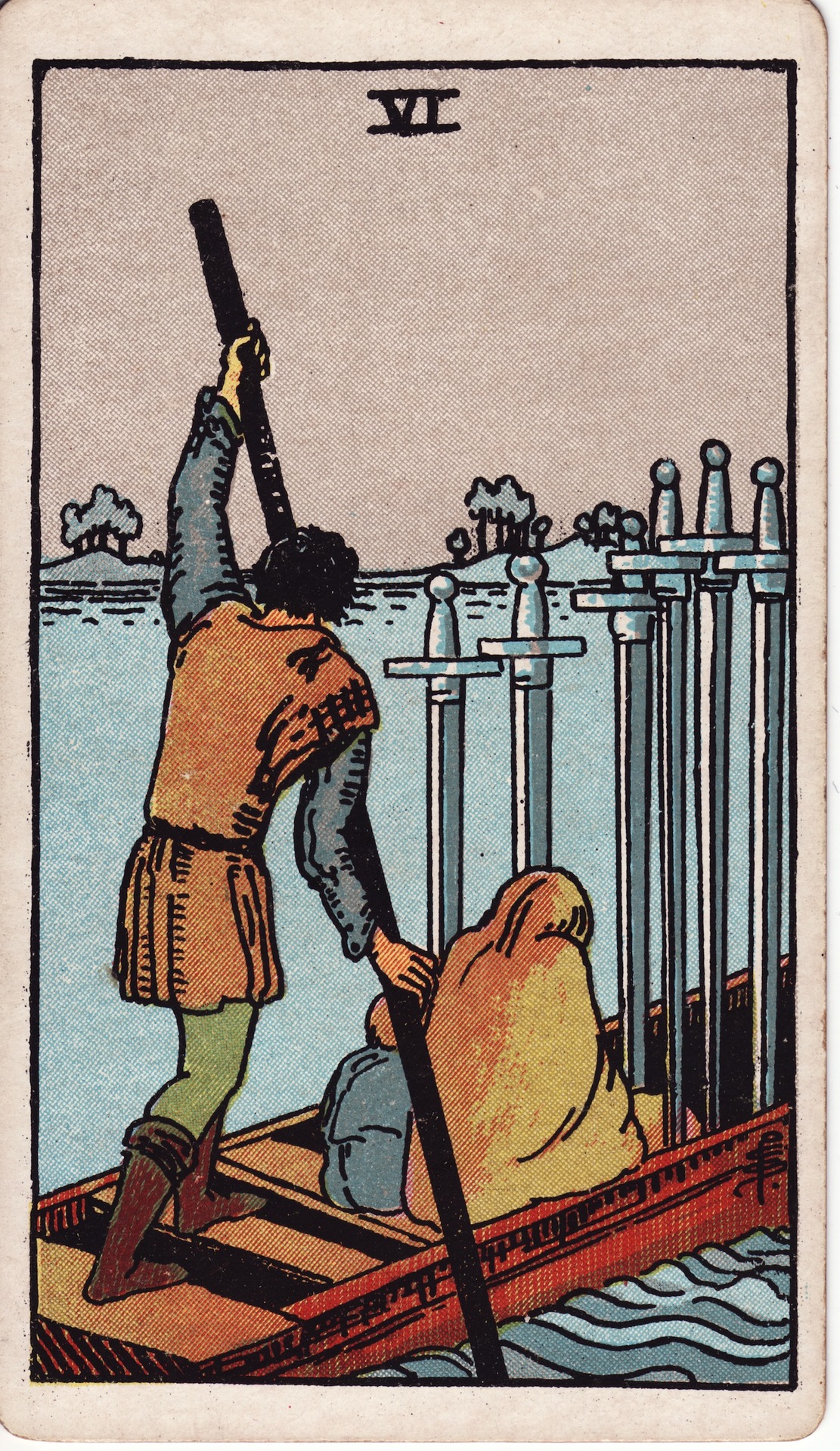
Six Of Swords - Rider-Waite-Smith Tarot
Table of Contents
Key Themes and Symbolism
The Six of Swords is one of the tarot's most emotionally nuanced cards. Every element of its composition reinforces the theme of necessary transition, the kind that doesn't feel good but is clearly right.
The two bodies of water. This is the card's most telling visual detail. The rough water behind the boat represents where the woman has been: turbulent, chaotic, emotionally dangerous. The calm water ahead represents where she's going: not paradise, not perfection, but somewhere quieter. Somewhere she can think. The transition from rough to calm is happening in real time, right there in the image, and the boat is the vehicle carrying her across the threshold. In practical terms, the two bodies of water remind you that the discomfort of transition is temporary. The water ahead is genuinely calmer than the water behind, even if you can't feel it yet from the middle of the crossing.
The six swords in the hull. The swords aren't left behind on the shore. They're in the boat, traveling with the passengers. This is the card's most honest detail. You don't leave your pain behind when you transition away from a difficult situation. You carry it with you. The memories, the lessons, the scars, they're part of the cargo. The Six of Swords doesn't promise you'll arrive at the new shore unburdened. It promises you'll arrive at a place where the burden becomes manageable, where the swords can eventually be put down rather than carried in a constant state of readiness.
The cloaked woman. She's covered, head bowed, turned away from the viewer. She isn't looking back at what she left, and she isn't looking forward at where she's going. She's looking down, inward, processing. Her posture suggests grief, exhaustion, and the kind of resignation that isn't giving up but is instead releasing the need to understand everything right now. She's not ready to look up yet. She's in the in-between, and the Six of Swords says that being in the in-between is its own kind of necessary.
The child. The small figure beside the woman introduces vulnerability and responsibility. She isn't just making this journey for herself. Someone depends on her. The child adds weight to the decision: leaving isn't easy, but staying would have been worse, not just for her but for someone she's protecting. In readings, the child often represents the tender, vulnerable part of yourself that you're finally choosing to safeguard.
The ferryman. The boatman at the stern is an archetype that appears across mythologies, from Charon ferrying souls across the river Styx in Greek mythology to countless folk stories about guides who carry travelers across dangerous waters. The ferryman represents help, guidance, and the recognition that some crossings can't be made alone. In practical terms, this might be a therapist, a mentor, a trusted friend, or any support system that helps you navigate a transition you couldn't manage on your own.
The number six. Sixes in the tarot represent harmony, balance, and resolution after the disruption of the fives. The Six of Wands is victory and recognition. The Six of Cups is nostalgia and emotional generosity. The Six of Pentacles is charitable exchange. Here in the Swords suit, the six's resolution takes the form of distance, the mental clarity that comes from putting space between yourself and the source of your pain. The mind can't think clearly while it's still in the fight. The Six of Swords creates the distance necessary for perspective.
Upright Meaning
When the Six of Swords appears upright, you're in transition. Something difficult is behind you, and you're moving toward something calmer, even if you can't clearly see the destination yet. This is a card about necessary movement, not joyful movement.
General
The Six of Swords upright is the tarot's transition card, and it's important to understand what kind of transition it describes. This isn't the exciting leap into a new opportunity. It's the weary, necessary departure from a situation that's become unsustainable. The woman in the boat isn't enthusiastic about her journey. She's grieving what she left, tired from whatever drove her to leave, and uncertain about what's ahead. But she's moving. And the card says that moving, even when it feels like surrender, is exactly right.
The key theme is mental clarity through distance. The Swords suit governs the mind, and the Six of Swords specifically addresses what happens to your thinking when you physically, emotionally, or psychologically remove yourself from a source of pain or confusion. Solutions that were invisible while you were embedded in the problem begin to appear. Perspectives you couldn't access while you were drowning in the situation start to emerge. The Six of Swords says that sometimes the most intelligent thing your mind can do is create distance rather than trying to think its way through from the inside.
This card frequently appears during literal transitions: relocations, changes of environment, travel that puts physical distance between you and something difficult. But it applies equally to internal transitions: the decision to stop engaging with a toxic thought pattern, the choice to let go of an argument that was consuming your mental energy, the shift from obsessing over what happened to quietly accepting that it happened and asking what comes next.
Love and Relationships
In love readings, the Six of Swords upright often indicates a relationship that's transitioning from a turbulent period into calmer waters. The storm isn't over because you pretended it didn't happen. It's over because you and your partner did the hard work of navigating through it and are now emerging on the other side. The mood is subdued rather than celebratory. You're not back to normal yet. You're just past the worst of it, and the relief of that alone is significant.
For some readers, the Six of Swords indicates leaving a relationship entirely. The woman in the boat with her child is an unmistakable image of departure, specifically departure with someone who depends on you. If a relationship has become emotionally destructive or unsafe, this card validates the decision to go. It doesn't promise that leaving will feel good. It promises that the water ahead is calmer than the water behind, and that's enough reason to keep rowing.
For singles, the card can indicate moving on from a past relationship that's been occupying too much mental space. The swords in the hull are the memories and lessons from that relationship. They're coming with you. But the act of transitioning toward new emotional territory means they'll gradually become historical rather than active.
Career and Finances
In career readings, the Six of Swords represents professional transitions: leaving a toxic workplace, moving to a new position, changing industries, or relocating for work. The common thread is that the move is motivated by escaping something difficult rather than racing toward something exciting. You're not leaving because you found a dream job. You're leaving because staying costs more than going.

A boat navigating through misty waters near lush fog-covered hills evoking the quiet journey toward calmer shores that defines the Six of Swords
The card also appears when a professional crisis is settling. The project that nearly failed is stabilizing. The difficult period at work is ending. You're not celebrating yet, but the worst is behind you, and the mental space that opens up as the crisis recedes allows you to think more clearly about your long-term direction.
Financially, the Six of Swords suggests moving away from financial difficulty. Debts are being managed. Bad financial decisions are being corrected. The approach is gradual rather than dramatic. You're not winning the lottery. You're paddling steadily toward solvency, and the progress is real even if it's slow.
Health
In health readings, the Six of Swords indicates recovery as a journey rather than an event. You're leaving behind the acute phase of an illness, a mental health crisis, or a period of physical decline, but healing is happening gradually rather than suddenly. The card encourages patience with the process and reminds you that convalescence has its own timeline that can't be rushed.
Mental health applications are particularly strong for this card. Moving away from a depressive episode, transitioning out of a period of intense anxiety, or beginning to emerge from grief are all Six of Swords experiences. The card acknowledges that you're not healed yet but affirms that you're heading in the right direction. The rough water is behind you. The calm water is ahead. Trust the crossing.
Reversed Meaning
The Six of Swords reversed disrupts the journey. The transition stalls, is resisted, or hasn't started yet despite the clear need for departure.
General
Reversed, the Six of Swords most commonly indicates resistance to a necessary change. You know you need to leave the situation, the relationship, the job, the mindset, but something keeps you anchored to the turbulent water. Fear of the unknown. Attachment to what's familiar even when it's painful. The conviction that things might get better if you just try harder or wait longer. The reversed card is honest: sometimes they do get better. But more often, the resistance to transition prolongs suffering unnecessarily.
Another interpretation is that a transition you've already begun is hitting complications. The journey across the water has stalled. Unfinished business pulls you back toward the shore you left. Issues you thought you'd resolved resurface and demand attention before you can complete the crossing. The reversal says that you can't move forward cleanly until you address what's been left unresolved behind you.
In some readings, the reversed Six of Swords indicates a return, coming back to a place, a person, or a situation you previously left. Whether this return is wise or unwise depends entirely on context. Sometimes returning is necessary to finish what you started. Sometimes it's regression disguised as unfinished business.
Love and Relationships
Reversed in love readings, the Six of Swords often indicates staying in a difficult relationship when you know it's time to go. The reasons for staying are understandable: children, shared finances, fear of being alone, the hope that things will change. The card doesn't judge these reasons. It simply observes that the rough water isn't getting calmer while you stay, and the calm shore on the other side isn't getting closer.
For those going through a breakup, the reversed card can indicate difficulty moving on. You're stuck in the emotional waters between what was and what's next, unable to reach either shore. The swords in the hull feel heavier reversed, the memories and pain of the relationship are actively weighing you down rather than being passively transported.
It can also signal returning to an ex. The relationship you thought you'd left behind pulls you back. Again, the card doesn't automatically condemn this. It asks you to examine whether the return is growth or repetition.
Career and Finances
In career readings, the reversal often points to feeling stuck in a professional situation you want to leave. The escape plan hasn't materialized. The new job hasn't come through. The toxic workplace is still your workplace, and the longer you stay, the harder leaving feels. The reversed Six of Swords encourages you to examine what's keeping you anchored and to address those specific obstacles rather than waiting for circumstances to change on their own.
Financially, the reversal can indicate setbacks in financial recovery. Just when debts were becoming manageable, an unexpected expense pulls you back. The steady paddle toward stability hits choppy water again. The advice isn't to panic but to recognize that financial recovery isn't always linear, and a temporary setback doesn't undo the progress you've already made.
Health
In health readings, the reversed Six of Swords can indicate a relapse or a stalled recovery. The progress you were making hits a plateau or reverses. A mental health condition you thought was improving flares up again. The card doesn't suggest catastrophe. It suggests that healing isn't a straight line and that some setbacks are part of the process rather than evidence that the process has failed.
It can also indicate resistance to treatment, the refusal to accept help from the "ferryman" in whatever form that takes. If you've been avoiding therapy, medication, lifestyle changes, or medical advice, the reversed Six of Swords asks you to reconsider whether going it alone is actually working or whether accepting guidance might make the crossing easier.
Card Combinations
The Six of Swords' meaning shifts meaningfully depending on its companions in a spread.
Six of Swords + The Moon. A transition shrouded in uncertainty. You're leaving but you can't see where you're going. The Moon adds confusion, illusion, and the fear of the unknown to the Six of Swords' journey. This combination asks you to trust the direction even when you can't see the destination. The water ahead is still calmer than the water behind, even if the fog makes it impossible to see the shore. Intuition is more reliable than logic during this crossing.
Six of Swords + The Empress. A transition that leads to nurturing, growth, and abundance. Whatever you're leaving, what you're heading toward involves creativity, comfort, and the kind of flourishing that wasn't possible in the environment you left. This is a deeply encouraging combination, especially for those leaving toxic relationships or sterile work environments. The far shore isn't just calm. It's fertile.
Six of Swords + Ten of Swords. The transition follows a complete ending. The Ten of Swords represents rock bottom, the absolute conclusion of a painful cycle. Paired with the Six of Swords, it says that the ending, however devastating, is what made the journey possible. You couldn't have left until everything fell apart, and now that it has, the only direction left is forward. This combination often appears after betrayals, dramatic losses, or crises that strip away everything that was keeping you stuck.
Six of Swords + Ace of Cups. Emotional renewal awaits on the far shore. The Six of Swords carries you away from emotional depletion, and the Ace of Cups promises that where you're heading holds fresh emotional beginnings: new love, renewed emotional health, or a reconnection with the capacity for joy. The sadness of the journey is temporary. What arrives when you land is worth the crossing.
Astrological Connections
The Six of Swords is associated with Mercury in Aquarius, a combination that blends communication with unconventional thinking and intellectual detachment. Mercury governs the mind, logic, and how we process information. Aquarius governs innovation, independence, and the ability to see situations from an elevated, objective perspective. Together, they describe the mental process the Six of Swords enacts: the capacity to step back from an emotionally charged situation and view it with enough distance to make a rational decision about what comes next.
Mercury in Aquarius doesn't process emotions in the traditional sense. It processes them by reframing them as information. The grief of leaving becomes data about what wasn't working. The fear of the unknown becomes a problem to be solved rather than a feeling to be paralyzed by. The cloaked woman in the boat might be heartbroken, but the part of her that decided to get in the boat in the first place was operating from Mercury in Aquarius energy: detached enough to see clearly, analytical enough to recognize that staying was worse than going, and unconventional enough to choose departure when everything familiar was pulling her to stay.
The broader Swords suit corresponds to the element of air, connecting to Gemini, Libra, and Aquarius. The Six of Swords specifically channels air's capacity for perspective, the ability to rise above a situation and see it from a vantage point that's unavailable when you're in the middle of it. The journey across the water is also a journey from emotional immersion (the choppy water of feelings) to mental clarity (the calm water of perspective).
If you have strong Aquarius or Mercury placements in your natal chart, you may find the Six of Swords' themes particularly resonant, especially the ability to make difficult transitions through intellectual clarity rather than emotional readiness. Sometimes the mind knows it's time to leave before the heart agrees, and Mercury in Aquarius trusts the mind.
Reading Tips for the Six of Swords
The Six of Swords requires sensitivity because it often appears during some of the most difficult transitions in a person's life.
Don't minimize the grief. The Six of Swords is ultimately a positive card, it's moving toward better conditions, but the journey it depicts is sad. The woman in the boat is grieving. Honor that. Don't rush to reassure the querent that "everything's going to be great." Acknowledge that leaving is hard, that carrying wounds across water is exhausting, and that the calm shore ahead doesn't erase the pain of what drove the departure. The card's hope lives in the direction, not in the denial of difficulty.
Identify the rough water. When the Six of Swords appears, ask what the "choppy water" represents in the querent's life. What are they leaving or what do they need to leave? The specificity matters. Sometimes it's obvious: a failing relationship, a toxic job, a living situation that's become untenable. Sometimes it's more internal: a mental health pattern, a belief system, a relationship with alcohol, a self-destructive habit. The card works the same way regardless of what the rough water represents.
Notice who's in the boat. The presence of the child and the ferryman matters in readings. Who is the querent bringing with them on this transition? Who depends on them? Who is helping them navigate? If the querent feels alone in their transition, the ferryman's presence is a reminder to seek and accept help. No one makes this crossing entirely alone.
Pay attention to the direction. In the traditional Rider-Waite-Smith image, the boat moves from left (past) to right (future). This directional symbolism reinforces the card's message about forward movement. If the card appears reversed, the directionality disrupts, suggesting backward movement, returning to the past, or being stuck in the middle with no momentum in either direction.
This card often validates a decision already made. The Six of Swords frequently appears after someone has already decided to leave, to move, to end, to transition, but is second-guessing themselves. The card's appearance is confirmation: the decision was right. The rough water behind you is proof that staying wasn't working. The calm water ahead is evidence that the direction you've chosen leads somewhere better. Trust the choice you already made.
Frequently Asked Questions
Is the Six of Swords a yes or no card?
The Six of Swords leans toward yes, but it's a qualified yes. It says yes to movement, yes to transition, yes to the direction you're considering, but with the caveat that the journey won't be emotionally easy. It's not the enthusiastic yes of the Ace of Wands or the comfortable yes of the Ten of Cups. It's the resolute yes of someone who's weighed the costs and decided that going is better than staying. If your question is "should I leave?" the Six of Swords is one of the clearest yes cards in the deck.
Does the Six of Swords mean travel?
It can, and frequently does. Literal travel, especially travel motivated by leaving a difficult situation, is one of the card's traditional meanings. Relocation, emigration, moving to a new city, or even a shorter trip taken to clear your head all fall under the Six of Swords. The travel isn't vacation-style. It's purposeful. You're going somewhere specific because where you are isn't working. That said, the card just as often represents metaphorical travel: moving emotionally, mentally, or spiritually from one state to another without physically going anywhere.
What does the Six of Swords mean for someone's feelings?
When this card appears in a position about feelings, it indicates emotional transition. The person is moving away from how they used to feel toward something new and uncertain. They might be processing the end of their feelings for someone, gradually recovering from heartbreak, or slowly shifting from resentment toward acceptance. The emotional register is muted rather than intense. They're not burning with passion or drowning in grief. They're in the grey, exhausted middle ground of transition, where the sharpest pain has dulled but the new emotional landscape hasn't fully formed yet.
How does the Six of Swords differ from the Eight of Cups?
Both cards involve leaving something behind, but the motivation and energy are different. The Eight of Cups is a voluntary departure driven by spiritual or emotional dissatisfaction. The person walking away from eight stacked cups is choosing to leave something that looks fine on the surface because it no longer fulfills them. The Six of Swords departure is more urgent. The woman in the boat isn't leaving because she's unfulfilled. She's leaving because the water behind her is rough. The Eight of Cups is the seeker who walks away from comfort to find meaning. The Six of Swords is the survivor who leaves turbulence to find safety.
What should I do when I get the Six of Swords?
Accept the transition. Whatever crossing is happening in your life, the card confirms that it's the right move. Stop looking back at the rough water with longing or regret. The turbulence you left was real, and your memory might soften it over time, but the card's clear imagery reminds you: that water was choppy. This water, right here in the middle of the journey, might feel uncertain, but it's already calmer. Keep moving forward. Accept help from whatever "ferryman" is available to you, whether that's a therapist, a friend, a mentor, or an organized support structure. And be patient with yourself. You're carrying six swords in the hull. You're allowed to grieve what those swords represent while simultaneously heading toward something better.
The Six of Swords is one of the tarot's most quietly powerful cards. It doesn't offer the dramatic revelation of The Tower or the triumphant resolution of The World. It offers something smaller and more honest: a boat, a ferryman, a direction, and the promise that the water ahead is calmer than the water behind. The woman in the boat is everyone who has ever known they needed to leave before they were ready to leave, everyone who has packed their swords and their grief into a small vessel and trusted that the act of moving was enough, even before the destination became clear. For a broader exploration of all 78 cards, visit the Celesian tarot reader. To understand how Mercury in Aquarius shapes your approach to difficult transitions, intellectual processing, and the courage of detachment, explore your natal placements with the natal chart calculator. And to continue through the Swords suit, look back at the Five of Swords, whose hollow victory created the conditions that made departure necessary, and ahead to the Seven of Swords, where the mind's journey takes a more strategic and secretive turn.