
Ten of Swords Tarot Card Meaning: Upright, Reversed, Love, Career, and More
A figure lies face down on the ground with ten swords plunged into their back. It's excessive. It's dramatic. It's almost theatrical in its brutality, and that excessiveness is part of the card's meaning. The sky above is pitch black, but on the far right horizon, a band of golden light is breaking through. The darkness occupies most of the sky, but it's the gold that draws the eye, a thin line of dawn that refuses to be ignored. A still body of water stretches behind the figure, calm and reflective despite the violence in the foreground. The ground is flat and barren. There's nowhere to hide from what's happened, and there's nothing left to protect. Everything that could go wrong has gone wrong. Every sword that could land has landed. And in the exhausted silence that follows the final blow, the sky begins to lighten.
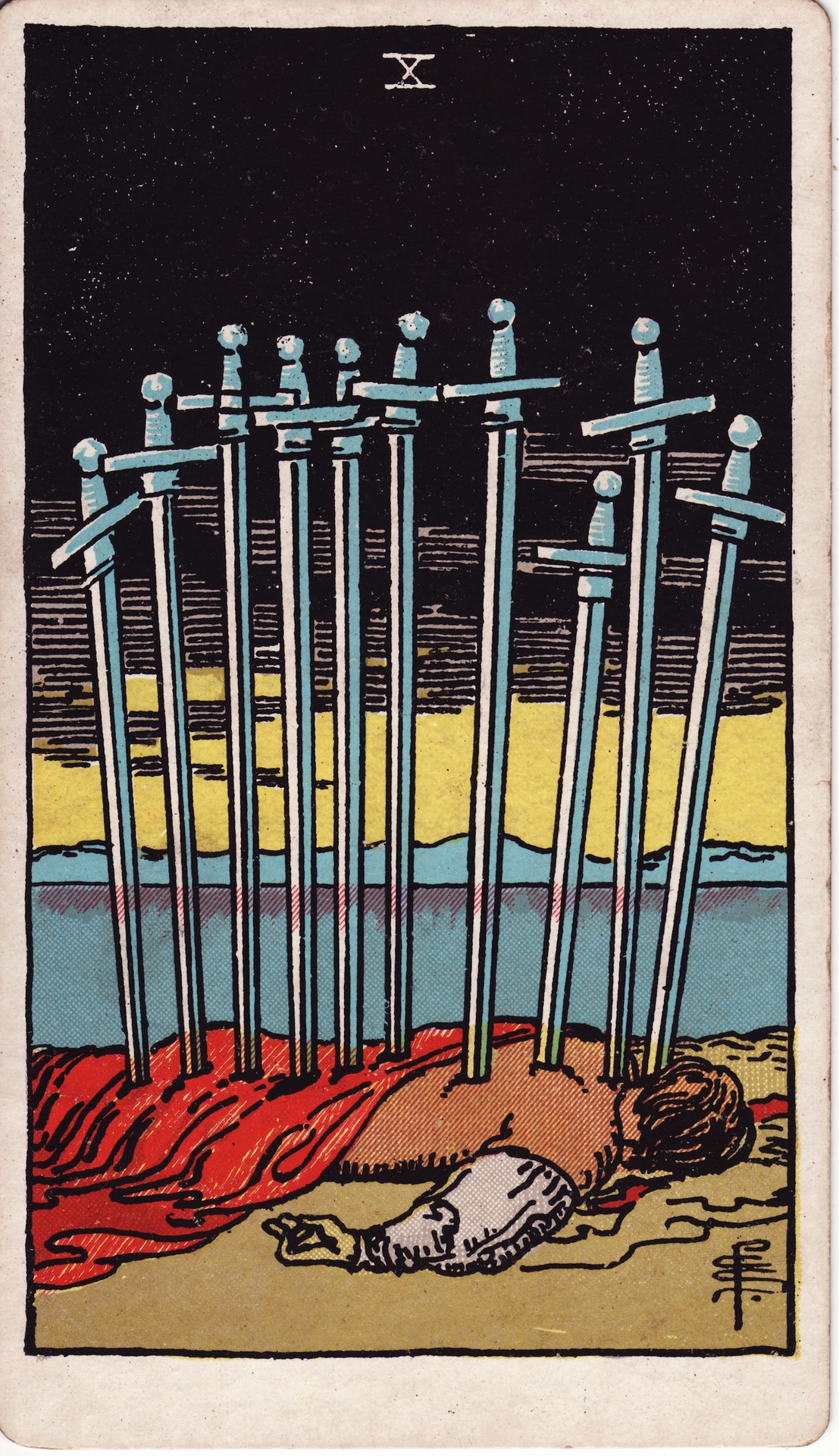
Ten of Swords - Rider-Waite-Smith Tarot
The Nine of Swords was anxiety at its peak, the mind's torture chamber running at full capacity. The Ten of Swords is what the Nine was afraid of: the thing actually happening. The catastrophe arriving. The worst-case scenario becoming real. But here's the paradox that makes the Ten of Swords one of the most important cards in the deck: once the worst has actually happened, the anxiety about it ends. The Nine's torment was fueled by uncertainty, by the space between "what if this happens" and "this has happened." The Ten eliminates that space entirely. The blow has landed. All ten of them have. And in the strange, terrible relief of rock bottom, a new truth emerges: you can't fall any further. The only direction left is up. That golden light on the horizon isn't optimism. It's a fact. The darkness that dominates the sky is ending, not because someone wished it away but because that's what darkness does after it reaches its fullest expression. It breaks.
Table of Contents
Key Themes and Symbolism
The Ten of Swords is the Swords suit's climax and conclusion, and every element of its imagery serves the dual theme of absolute ending and imminent renewal.
The ten swords in the back. Ten swords is more than enough to kill someone. One would suffice. Three would be emphatic. Ten is overkill, and that excess is deliberate. The card is acknowledging that the ending you're experiencing feels disproportionate, excessive, unfair. It's not one blow. It's everything at once. The number ten represents completion in the tarot, the full expression of the suit's energy. With Swords, that completion takes the form of the mind's journey reaching its ultimate conclusion: every mental conflict, every deception, every imprisonment, every anxiety the suit has explored across the preceding nine cards has culminated in this final, decisive collapse. There's nothing left to add. The story the mind was telling has ended.
The face-down figure. The person isn't fighting. They're not reaching for help. They're not trying to remove the swords. They've surrendered completely to the ending. This posture of total surrender is important because it distinguishes the Ten of Swords from cards of active suffering. The figure isn't in pain. The figure is past pain. They've entered the state beyond struggle where the body simply accepts what has happened. In practical terms, this represents the moment when you stop fighting the inevitable: the relationship that's been dying finally dies, the project that's been failing finally fails, the truth you've been avoiding finally arrives and there's nothing left to argue with.
The golden horizon. The most crucial element of the card. Despite the black sky, despite the ten swords, despite the fallen figure, light is breaking on the horizon. This is the Ten of Swords' promise: every ending contains the seed of a beginning. The golden light isn't metaphorical. It's the literal dawn that follows every night, rendered in the card as proof that the cycle of darkness has a built-in expiration. The dawn doesn't appear because the figure deserves it or earned it. It appears because that's what dawn does. It's the natural consequence of darkness reaching its fullest extent, and it will arrive whether you're ready for it or not.
The calm water. The body of water behind the scene is perfectly still. Compare this to the choppy waters of the Five of Swords or the transitional waters of the Six of Swords. The stillness here represents the exhaustion of emotional turbulence. There's no more churning because there's nothing left to churn. The emotions have been fully spent, and what remains is a flat, reflective surface that mirrors both the darkness and the approaching light. This calm isn't peace yet, but it's the precondition for peace.
The flat, barren ground. There's nothing growing here. Nothing standing. The landscape has been stripped down to its most basic form: flat earth, still water, dark sky, approaching light. This barrenness is simultaneously devastating and clarifying. When everything has been taken away, what remains is the foundation. You can see the ground clearly when nothing is blocking the view, and building on bare ground, while starting from scratch, means building without the unstable structures that were there before.
The number ten. Tens in the tarot represent the completion of a cycle and the transition to what comes next. The Ten of Wands is the burden of completion. The Ten of Cups is emotional fulfillment. The Ten of Pentacles is material legacy. The Ten of Swords is the completion of the mental journey through the suit, and it completes that journey through destruction rather than achievement. This isn't failure. It's the kind of ending that happens when a pattern has been fully expressed and can't sustain itself any longer. The cycle breaks because it's finished, and what follows is the beginning of a new cycle.
Upright Meaning
When the Ten of Swords appears upright, something is ending. Completely, decisively, and probably painfully. The card doesn't soften the impact. But it frames the ending within a larger truth: this is rock bottom, and rock bottom has a floor.
General
The Ten of Swords upright is the tarot's announcement that a situation has reached its absolute conclusion. This isn't the gradual fading of the Eight of Cups or the transitional departure of the Six of Swords. This is sudden, complete, and final. Something you were holding onto has collapsed. Something you were trying to maintain has broken beyond repair. The ending may come through betrayal, through circumstances beyond your control, through the accumulated weight of problems that finally broke the structure, or through the simple, brutal arrival of a truth that can no longer be denied.
The card's essential message is dualistic. Yes, this is devastating. Yes, this is the worst it can be. And yes, precisely because this is the worst it can be, it can only get better from here. The swords are all in. There are no more to come. The figure on the ground has absorbed every blow the situation had to deliver, and while the figure is down, they're not destroyed. The golden horizon testifies that what follows this darkness isn't more darkness. It's dawn.
In practical terms, the Ten of Swords often appears at moments of crisis that, in hindsight, become turning points. The firing that led to the career you actually wanted. The breakup that freed you from a relationship that was slowly suffocating you. The financial collapse that forced you to rebuild on a more sustainable foundation. The card doesn't promise these silver linings in the moment. In the moment, it's just ten swords in the back on barren ground. The golden light becomes visible only when you lift your head enough to see the horizon.
Love and Relationships
In love readings, the Ten of Swords upright typically indicates the end of a relationship. Not a rough patch. Not a fight that can be repaired with a conversation. An ending. The relationship has reached the point where continuing isn't possible, either because of betrayal, accumulated damage, fundamental incompatibility that can no longer be denied, or simply the exhaustion of everything that was holding it together.
The card's betrayal dimension is particularly strong in love readings. Ten swords in the back is the imagery of being stabbed from behind, and in relational terms, this can represent infidelity discovered, trust violated in a way that can't be restored, or the realization that someone you trusted completely was not who they appeared to be. The devastation of this discovery is total, and the card doesn't minimize it.
But the golden horizon applies here too. The end of a relationship that needed to end, however painful in the moment, opens space for what comes next. The card doesn't promise you'll find love again. It promises that the darkness of this particular ending is temporary and that the capacity to love didn't die with the relationship. It's lying on the ground right now, exhausted and pierced, but the dawn is coming.
For singles, the Ten of Swords can indicate the final release of a past relationship that's been haunting you. The last thread of hope, denial, or fantasy about reconciliation snaps. It hurts. And it frees you in a way that a gradual letting-go never could.
Career and Finances
In career readings, the Ten of Swords represents decisive professional endings: termination, business failure, the collapse of a project you'd invested everything in, or the sudden dissolution of a professional partnership. The card's excess, ten swords rather than one, reflects how overwhelming professional loss can feel when it arrives suddenly and completely.

Dramatic sunrise over calm ocean with vibrant sky creating a scene of hope emerging after darkness that captures the Ten of Swords promise of dawn after the darkest night
The card also appears in situations of professional betrayal: the colleague who undercut you, the partner who took the company, the employer who exploited your loyalty. The swords-in-the-back imagery is literal here, depicting harm that came from behind, from directions you weren't guarding because you trusted the people positioned there.
Financially, the Ten of Swords can indicate bankruptcy, significant financial loss, or the collapse of a financial structure you depended on. It's the card of financial rock bottom. And like all rock bottom experiences, it has the peculiar quality of eliminating the fear of falling, because you've already fallen as far as you can go. Financial rebuilding from zero is daunting, but it's also clarifying. You know exactly where you stand because there's nothing obstructing the view.
Health
In health readings, the Ten of Swords can indicate a health crisis, a diagnosis, a collapse, or the point at which a condition that's been worsening reaches its peak severity. The card is serious in health contexts and shouldn't be minimized. However, its essential character, rock bottom with dawn approaching, also suggests that the worst of the health challenge is here, and what follows is recovery rather than continued decline.
The card can also represent the psychological impact of a health event: the devastation of a serious diagnosis, the collapse of denial about a chronic condition, or the grief that accompanies a permanent change in physical capacity. The Ten of Swords validates the enormity of these experiences while pointing toward the adaptation and recovery that follow them.
Reversed Meaning
The Ten of Swords reversed shifts the energy from the moment of collapse to its aftermath: recovery, resistance to endings, or the refusal to accept that something is truly over.
General
Reversed, the Ten of Swords most commonly indicates that you're beginning to recover from a devastating experience. You're lifting your head from the ground. The swords are being removed, one by one. The golden horizon that was visible in the upright card is now closer, brighter, more real. You're not healed yet, but you're past the worst of it, and the direction of your trajectory has shifted from falling to rising.
This reversal often represents the moment when survival becomes apparent. During the upright Ten of Swords, survival felt uncertain. The reversal is the moment when you realize: I'm still here. I made it through. The situation was as bad as I feared, and I didn't die. That realization, simple as it sounds, is transformative because it changes the relationship from victimhood to survivorship.
Alternatively, the reversed Ten of Swords can indicate resistance to an ending that needs to happen. You're clinging to a situation, relationship, or identity that has already died, performing CPR on something that can't be revived. The reversal asks whether you're delaying an inevitable ending and extending your suffering unnecessarily. Sometimes the most compassionate thing you can do for yourself is accept that the ten swords have landed and stop trying to pretend they haven't.
Less commonly, the reversal can indicate a near-miss, a catastrophe that almost happened but was averted at the last moment. You came to the edge of rock bottom without actually hitting it, and the close call serves as a wake-up call for changes that prevent the full collapse from occurring.
Love and Relationships
Reversed in love readings, the Ten of Swords indicates the early stages of recovery from a devastating relationship ending. The acute grief is passing. You're beginning to imagine a future that isn't defined by the loss. The swords are coming out, slowly and painfully, but they're coming out.
For couples who survived a crisis that looked like an ending, the reversed card suggests the tentative, fragile beginning of rebuilding. The relationship hit rock bottom, and both partners are now choosing to build something new on the cleared ground. This rebuilding requires honesty about what happened and why, without which the new structure will rest on the same unstable foundation that collapsed.
It can also indicate difficulty letting go. If a relationship has ended but you're still checking their social media, still replaying conversations, still hoping for a text, the reversed Ten of Swords says the ending happened whether you accept it or not, and your recovery depends on accepting it.
Career and Finances
In career readings reversed, the Ten of Swords indicates professional recovery. The job loss is being processed. New opportunities are appearing. The business failure is being examined for lessons rather than simply mourned. The professional identity that collapsed is being rebuilt, and the new version incorporates everything you learned from the collapse.
Financially, the reversal indicates moving away from financial rock bottom. Debts are being addressed. Income is being restored. The financial devastation was real, but the recovery is underway, and the lessons learned from the collapse are informing a more sustainable financial approach.
Health
Reversed in health readings, the Ten of Swords indicates recovery from a health crisis. The worst has passed. Treatment is working. The body is beginning to heal. The psychological devastation of the diagnosis or crisis is giving way to the practical work of recovery. The reversal doesn't promise complete restoration, but it promises that the trajectory is now upward.
Card Combinations
The Ten of Swords' meaning transforms dramatically based on surrounding cards.
Ten of Swords + The Fool. Ending and beginning in the same breath. The Fool is the tarot's card of fresh starts, new adventures, and the leap into the unknown with nothing but trust. Paired with the Ten of Swords, this combination says that the devastating ending is directly creating the conditions for a completely new beginning. The slate has been wiped clean, and The Fool is standing at the edge of the cliff, ready to leap into whatever comes next. This is one of the most powerful transformation combinations in the deck.
Ten of Swords + Judgement. Resurrection after destruction. Judgement represents awakening, reckoning, and being called to rise into a higher version of yourself. Combined with the Ten of Swords, it says the ending wasn't just an ending. It was a necessary destruction that makes rebirth possible. The figure on the ground will rise, and what rises will be fundamentally different from what fell. This combination often appears during spiritual awakenings triggered by crisis.
Ten of Swords + Three of Swords. Compounded grief. Both cards depict swords piercing flesh, and together they describe a situation where loss layers upon loss. The Three's heartbreak combines with the Ten's total ending to produce an experience of grief that's both specific (the Three's particular pain) and total (the Ten's complete collapse). This is the combination of multiple losses arriving simultaneously: the breakup and the job loss, the betrayal and the illness, the accumulation of blows that leaves no area of life untouched.
Ten of Swords + The Star. Healing follows devastation. The Star is the tarot's most hopeful card, representing renewal, serenity, and the return of trust after trauma. Paired with the Ten of Swords, it promises that the dawn visible on the Ten's horizon leads to genuine healing rather than mere survival. What follows this ending won't just be "getting by." It will be a period of real restoration, reconnection with hope, and the quiet discovery that you're stronger than what broke you.
Astrological Connections
The Ten of Swords is associated with Sun in Gemini, a placement that creates a fascinating tension between vitality and mental fragmentation. The Sun represents the core self, vitality, consciousness, and the fundamental expression of who you are. Gemini governs the mind, communication, duality, and the capacity to hold multiple perspectives simultaneously. When the Sun enters Gemini, identity itself becomes mental, fluid, and communicative.
The problem that produces the Ten of Swords is Gemini's duality pushed to its breaking point. Gemini can hold two perspectives. It can hold three, four, five. But ten? Ten swords represent ten perspectives, ten truths, ten realities all demanding attention simultaneously, and the mind that tries to hold all of them collapses under the weight. The Sun in Gemini's collapse isn't a failure of intelligence. It's a failure of the attempt to be everything, see everything, and understand everything at once. The figure on the ground fell not because they were weak but because they tried to carry more mental weight than any one person can bear.
The recovery pathway of Sun in Gemini is simplification. When the figure rises (and they will, because the Sun always rises), they won't try to carry ten swords anymore. They'll pick up one or two, the perspectives that genuinely matter, and leave the rest on the ground. The Ten of Swords teaches Sun in Gemini that not every thought deserves engagement, not every perspective needs to be held, and sometimes the most intelligent thing the mind can do is let some of its contents go.
If you have Sun in Gemini or strong Gemini placements in your natal chart, you may recognize the Ten of Swords' pattern of mental overload: the attempt to process, understand, and integrate more information than the mind can hold, followed by the collapse that forces simplification.
Reading Tips for the Ten of Swords
The Ten of Swords demands the reader's full attention because it appears at genuinely difficult moments in people's lives.
Honor the ending before mentioning the dawn. The golden horizon is important. It's the card's hope. But jumping immediately to "don't worry, things will get better" invalidates the person's current experience. They're lying on the ground with ten swords in their back. Acknowledge that before pointing at the sky. "This is devastating, and I see that" comes first. "And dawn is coming" comes second. The order matters.
Assess the drama factor. The Ten of Swords is, by design, dramatic. Ten swords is overkill. This can indicate that the querent is experiencing the situation as more catastrophic than it objectively is, or that they're engaging in dramatic narratives about their suffering. This isn't the same as saying the suffering isn't real. It's asking whether the response is proportional. Sometimes the Ten of Swords says "yes, this is genuinely that bad." Sometimes it says "you're interpreting a setback as an apocalypse."
Look for the cycle. The Ten of Swords is a completion card. It ends a cycle that began with the Ace of Swords' flash of mental clarity and progressed through conflict, deception, imprisonment, and anguish. When this card appears, ask: what cycle is ending? What pattern has played out completely? What mental habit, relationship dynamic, or professional situation has reached the point where it can't continue? Understanding what's ending helps the querent prepare for what begins next.
Note the position in the spread. The Ten of Swords in the past position means the devastation has already occurred and the querent is in recovery. In the present position, the collapse is happening now. In the future position, a significant ending is approaching. In the advice position, the card may be counseling the querent to let something die rather than continuing to sustain it artificially.
Remind the querent of the dawn. After honoring the difficulty, do point to the golden horizon. The Ten of Swords without its dawn is just devastation. The dawn is what makes it a complete card, an ending that contains its own beginning. The person who hears "the worst is behind you" when they feel like they're at the worst is hearing something they might not believe yet but will remember later.
Frequently Asked Questions
Is the Ten of Swords a death card?
The Ten of Swords is not about physical death. It represents the metaphorical death of a situation, relationship, belief system, or period of life. It's a card of endings, and the endings it depicts are total and irreversible, but they're endings of circumstances, not of life itself. The card's imagery is deliberately over-the-top (ten swords when one would suffice) to emphasize that the ending feels apocalyptic while reminding the reader through the golden horizon that even the most devastating endings lead to new beginnings.
Does the Ten of Swords mean betrayal?
Betrayal is one of the card's primary meanings, particularly because of the swords-in-the-back imagery. Being stabbed in the back is a universal symbol of betrayal by someone who was trusted, someone who was behind you, someone you weren't guarding against because you believed they were an ally. However, the card's meaning is broader than betrayal alone. It encompasses any total ending: the collapse of a plan, the failure of an enterprise, the arrival of a truth that demolishes a false structure. Betrayal is the most emotionally charged version of the Ten of Swords, but not the only one.
What comes after the Ten of Swords?
In the tarot's structure, the Ten of Swords is followed by the Page of Swords, which represents a fresh, curious, and mentally alert approach to the world. This sequence is significant: after the mind's complete collapse, what emerges is a beginner's mind, one that approaches thought with curiosity rather than exhaustion, with questions rather than assumptions, with the openness of someone who's been freed from the weight of everything they thought they knew. The cycle from Ace to Ten has completed, and the court cards that follow represent matured expressions of the Swords energy that incorporate the lessons of the entire journey.
How should I react when I pull the Ten of Swords?
First, take a breath. The card looks alarming, and it's meant to. Then look at the golden horizon. The card's message isn't "everything is ruined." It's "something has ended completely, and within that ending is the seed of what comes next." Ask yourself what in your life is reaching its natural conclusion. What are you holding onto that's already over? What truth are you avoiding that, if accepted, would free you from the ongoing pain of resistance? The Ten of Swords' practical advice is counterintuitive: stop fighting. Let the ending happen. The swords are already in. Struggling against them just extends the suffering. Acceptance of what's happened is the first step toward the dawn the card promises.
Is the Ten of Swords the end of the suit?
It's the end of the numbered cards (Ace through Ten), which represent the Swords suit's experiential journey from the clarity of the Ace through the conflicts, losses, and mental challenges of the subsequent cards to the total conclusion of the Ten. However, four court cards follow: Page, Knight, Queen, and King of Swords. These represent personalities and approaches to the Swords energy rather than experiences within it. They show how the lessons of the numbered cards can be embodied as character traits: the Page's curiosity, the Knight's intellectual pursuit, the Queen's perceptive clarity, and the King's authoritative wisdom. The Ten ends the journey. The court cards show what you can become once you've survived it.
The Ten of Swords is the tarot's most devastating card and, paradoxically, one of its most hopeful. It shows you the worst because the worst is what's happening, and it refuses to look away from the ten swords, the fallen figure, the black sky. But it also shows you the golden light that's already breaking on the horizon, not as a promise you have to earn but as a fact you have to accept: endings lead to beginnings, darkness gives way to dawn, and the person on the ground will eventually lift their head and see that the sky has changed. For a broader exploration of all 78 cards, visit the Celesian tarot reader. To understand how Sun in Gemini shapes your mental patterns and your experience of the mind's capacity to hold, release, and rebuild, explore your natal placements with the natal chart calculator. And to continue through the Swords suit, look back at the Nine of Swords, whose anguish preceded and prophesied this collapse, and ahead to the Page of Swords, where the mind wakes from its long dark night and discovers that it can think again, freshly, curiously, and without the weight of everything that came before.