
Three of Swords Tarot Card Meaning: Upright, Reversed, Love, Career, and More
Three swords pierce a red heart suspended in a grey sky. Rain falls in heavy, diagonal sheets behind it. There are no figures, no landscape, no secondary details. Just a heart, three blades, and rain. It's the most visually simple and emotionally devastating card in the entire tarot. You don't need to know anything about symbolism to understand what this card means. You've felt it. Everyone has. The moment when something you loved broke open, when a truth you weren't ready for arrived anyway, when the person you trusted said the thing that couldn't be unsaid, or when you realized, in a single terrible flash of clarity, that something you'd built your hopes on was already gone.
The Two of Swords chose not to look. The blindfold stayed on. The swords stayed crossed. The stalemate held for as long as the figure could maintain it. The Three of Swords is what happens when the blindfold comes off and the truth that was always there makes itself felt in the most visceral possible way: through the heart. This isn't intellectual pain. The swords are instruments of the mind, but they're piercing the heart, which means the Three of Swords lives at the intersection where mental clarity and emotional suffering collide. You see something clearly. The seeing hurts. And the hurt is the proof that the seeing matters, because you can't be wounded by a truth that doesn't touch something you genuinely care about.
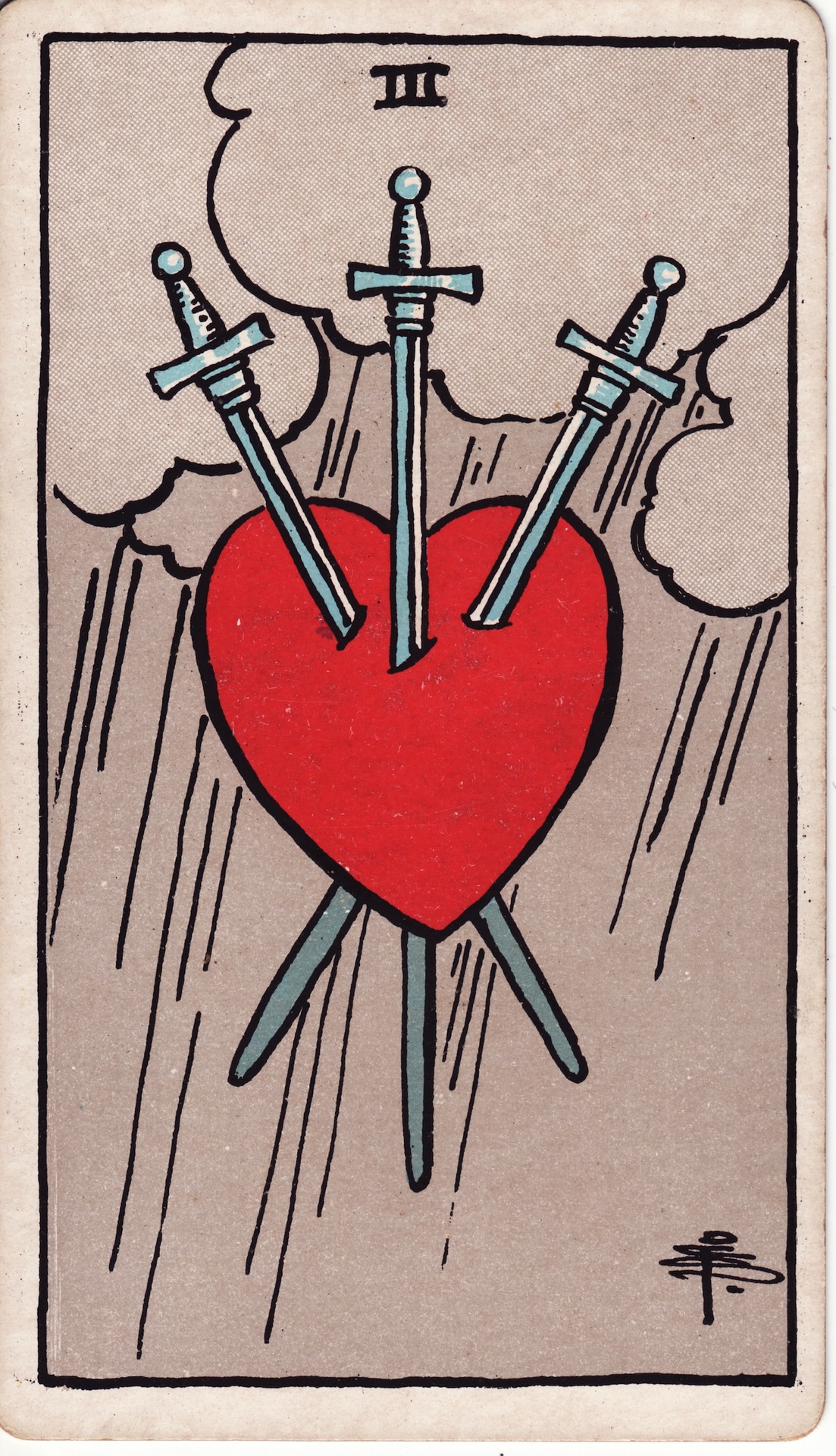
Three Of Swords - Rider-Waite-Smith Tarot
Table of Contents
Key Themes and Symbolism
The Three of Swords is the tarot's most direct image of heartbreak, stripped of any softening context. Every element serves the single purpose of communicating emotional pain caused by truth.
The heart. A vivid red heart, the universal symbol of love, emotion, and vulnerability, hangs in the center of the card. It's not a cartoon heart or an abstraction. In the Rider-Waite-Smith tradition, it's rendered as a fleshy, real-looking organ, making the violence of the swords' penetration feel physical rather than merely symbolic. The heart represents whatever you love most: a relationship, a hope, a belief, an identity. It's the thing you were protecting with the Two of Swords' crossed blades. And now it's been pierced.
The three swords. Three blades pass through the heart from different angles, creating a pattern that suggests multiple sources or dimensions of pain. This isn't a single wound. It's the convergence of several painful truths or several aspects of a single devastating realization. The number three in tarot often represents synthesis, the point where two opposing forces produce a third element. In the Swords suit, the Ace offered clarity, the Two created a stalemate between two truths, and the Three is what happens when those truths stop being theoretical and become personal: they synthesize into grief.
The rain. Heavy grey rain fills the background, creating the atmosphere of a storm that makes everything heavier and darker. Rain in tarot symbolizes tears, emotional release, and the cleansing that comes after grief. The rain isn't gentle. It's a downpour. But rain also carries the implicit promise that storms pass, that the sky will eventually clear, and that what the rain waters will eventually grow. The Three of Swords doesn't include that growth in its image. It only shows the storm. But the rain's dual nature, as both suffering and nourishment, is always present.
The grey sky. There's no sun, no moon, no stars, no landscape. Just undifferentiated grey. The Three of Swords strips away everything except the pain and its cause, because when you're in the middle of heartbreak, nothing else exists. The world contracts to the wound. Context disappears. The grey sky is the honest depiction of what grief feels like from the inside: a world drained of color, beauty, and possibility, at least temporarily.
The absence of figures. Unlike most tarot cards, the Three of Swords contains no human figure. The heart stands alone, which universalizes the experience. This isn't one person's specific grief. It's the grief itself, the archetype of heartbreak that every human recognizes regardless of its particular cause. The absence of a figure also means there's no one to comfort the heart, no one holding it, no one trying to remove the swords. The image captures the moment of impact, not the aftermath.
The number three. Beyond the synthesis mentioned above, three carries additional weight in the Swords suit. Three is a creative number, associated with expression, communication, and bringing inner realities into the outer world. The Three of Swords represents the painful creativity of grief: the way heartbreak expresses truths that were previously hidden, the way sorrow communicates what words couldn't, and the way losing something teaches you, with perfect clarity, exactly how much it meant.
Upright Meaning
When the Three of Swords appears upright, it delivers the reading's hardest message: something hurts, and the hurt is real, and the card doesn't offer a way to avoid it. The pain may have already arrived or it may be approaching, but the Three's presence means that going around it isn't an option. The only way is through.
General. The upright Three of Swords represents heartbreak, grief, sorrow, painful truth, loss, and the suffering that accompanies seeing something clearly that you wish you hadn't. It appears during breakups, betrayals, losses, and any moment when reality punctures a cherished illusion. But the card also carries a less obvious meaning: liberation through truth. The swords cause pain, but they also cut through denial. After the Three of Swords, you can't pretend anymore. The illusion is gone. And while the truth hurts more than the illusion did, it's also the only foundation you can actually build on.
Love. In love readings, the Three of Swords is the card most associated with heartbreak. It can indicate a breakup, an affair discovered, a betrayal of trust, or the painful realization that a relationship can't give you what you need. The card doesn't specify whose fault it is. Sometimes the swords come from a partner's actions. Sometimes they come from your own recognition of a truth you've been avoiding. Either way, the experience is one of deep emotional wounding. For singles, the Three of Swords often appears when past heartbreak is still affecting your present, when old wounds haven't healed and are coloring your approach to new connections with fear, defensiveness, or the expectation that love will inevitably hurt.
Career. In career readings, the Three of Swords indicates professional disappointment: being passed over for a promotion, losing a job, a project failing, or the painful realization that your career path isn't fulfilling you. It can also represent workplace conflict that crosses the line from professional disagreement into personal hurt, the colleague's betrayal, the boss's unfairness, or the discovery that an organization you believed in doesn't share your values.
Finances. Financially, the Three of Swords indicates loss or painful financial news. An investment fails. A source of income disappears. A financial arrangement falls apart. The card can also represent the emotional pain that accompanies financial difficulty: the shame, the anxiety, the grief of losing security. Financial pain is never purely financial. It cuts into self-worth, relationship stability, and your sense of safety in the world.
Health. In health readings, the Three of Swords is associated with grief's physical effects: chest pain, heart conditions, immune suppression from stress, insomnia, and the overall physical toll that emotional suffering takes on the body. The card can indicate a painful diagnosis, though its primary health message is about the connection between emotional pain and physical wellbeing. Unprocessed grief lives in the body, and the Three of Swords urges you to take emotional wounds as seriously as physical ones.

A silhouette sitting by a rainy window deep in thought capturing the solitary grief and inner storm of the Three of Swords
Reversed Meaning
When the Three of Swords appears reversed, the acute phase of heartbreak is shifting. The swords may be slowly withdrawing from the heart. The rain may be lightening. The reversal doesn't mean the pain is gone, but it indicates that the relationship to the pain is changing, either toward healing or toward a deeper, more complicated form of suffering.
General. The reversed Three of Swords represents recovery from grief, forgiveness, the release of old pain, or alternatively, the suppression of grief, the refusal to process pain, and the internalization of sorrow that prolongs suffering indefinitely. The reversal can go either way. In its healing aspect, it indicates that the worst is behind you and the slow, nonlinear process of recovery has begun. In its shadow aspect, it indicates that you're burying the pain rather than processing it, telling yourself you're "over it" while the swords remain lodged in a heart you've simply stopped looking at.
Love. In love readings, the reversed Three of Swords carries two distinct possibilities. The healing interpretation suggests that a couple is working through past hurt, forgiving old wounds, and moving toward reconciliation. The conversations that needed to happen are happening. The pain that needed to be acknowledged is being acknowledged. The relationship is doing the hard work of repair. The shadow interpretation suggests that you're staying in a painful situation and pretending it doesn't hurt, suppressing your grief about a relationship's problems rather than addressing them, or rushing past the healing process because you're afraid of what full grief would require.
Career. In career readings, the reversed Three of Swords indicates that a professional disappointment is beginning to resolve. The sting of the rejection or failure is fading, and you're starting to see the situation with more perspective. It can also indicate learning from career setbacks rather than just suffering through them. The reversal's shadow in career matters is the refusal to learn from professional pain, repeating the same patterns that led to the original disappointment because you never fully examined what went wrong.
Finances. Financially, the reversed Three of Swords suggests that a financial loss is being processed and recovered from. The worst of the financial pain is behind you, and practical steps toward recovery are available. It can also indicate that financial grief is being suppressed rather than addressed, that you're not looking at the numbers because looking would make the loss feel real.
Health. In health readings, the reversed Three of Swords is a positive signal for recovery from grief-related health issues. The emotional processing is beginning to produce physical benefits: better sleep, reduced stress symptoms, the slow return of energy and appetite. However, if the reversal represents suppressed grief, the health message is cautionary: emotions that aren't processed don't disappear. They move into the body. The reversed Three asks whether your physical symptoms might be unprocessed emotional pain looking for an outlet.
Card Combinations
The Three of Swords takes on different emotional textures depending on its companions.
Three of Swords + The Star. One of the most healing combinations in the deck. The Three brings heartbreak. The Star brings hope, renewal, and the quiet faith that healing is possible. Together, they describe the moment after the worst of the pain when you look up and realize that something beautiful is still there, that the capacity for hope survived the grief, and that the future, while different from what you imagined, still holds light. This combination often appears when someone is in the early stages of genuine recovery.
Three of Swords + Ten of Cups. A painful juxtaposition. The Three pierces the heart while the Ten shows the family harmony that's been lost or damaged. Together, they can indicate a family crisis, a domestic situation where love exists but is currently overshadowed by pain, or the grief of watching a family dream fall apart. The Ten's presence also offers hope: the infrastructure of love is still there, even if it's wounded. Recovery is possible if the swords can be addressed.
Three of Swords + Death. Heartbreak meets transformation. This combination indicates that the pain isn't just temporary suffering. It's the catalyst for a fundamental change in who you are. The relationship, belief, or identity that the swords pierced needed to die for something new to emerge. This pairing is difficult but ultimately powerful, suggesting that the grief, fully felt and processed, leads to a rebirth that wouldn't have been possible without the loss.
Three of Swords + Nine of Cups. An interesting tension between present pain and eventual fulfillment. The Three says you're hurting now. The Nine promises that genuine satisfaction lies ahead. Together, they deliver the hardest message in tarot to hear while you're suffering: this pain is taking you somewhere good. The destination exists. The journey through grief is the price of admission. This combination is most meaningful when someone is questioning whether their pain has any purpose.
Astrological Connections
The Three of Swords is associated with Saturn in Libra, a placement that combines the planet of hard lessons, reality, and unavoidable consequences with the sign of relationships, beauty, and the desire for harmony. When Saturn occupies Libra, it tests relationships with the cold precision of a blade and reveals, without mercy, which connections are built on genuine substance and which are built on comfortable illusions.
Saturn in Libra doesn't destroy relationships. It shows you which ones can bear weight and which ones can't. The destruction that follows isn't Saturn's doing. It's the natural consequence of building on inadequate foundations. The Three of Swords carries this energy: the heartbreak it depicts isn't random cruelty. It's the pain of discovering that something you trusted wasn't what you thought it was, and that discovery, while devastating, is ultimately Saturn's most unwelcome but most valuable gift.
Libra's influence gives the Three of Swords its specifically relational focus. This isn't abstract intellectual pain. It's the pain that comes through other people: lovers who betray, friends who disappoint, partners who leave, or the simple, terrible realization that love, by itself, isn't always enough. Libra wants harmony, and Saturn insists on truth, and when truth and harmony conflict, the Three of Swords is the result: a heart that wanted peace but received precision instead.
Saturn is also the planet of time, which connects the Three of Swords to the temporal nature of grief. The pain isn't permanent, even though it feels that way. Saturn's lessons have beginnings, middles, and ends. If you have Saturn in Libra in your natal chart, you may have a particular sensitivity to relational pain and a hard-won wisdom about love's requirements. Explore your Saturn placement with the natal chart calculator to understand how this demanding teacher operates in your relationship patterns.
Reading Tips for the Three of Swords
Don't panic. The Three of Swords is one of the most feared cards in the deck, and its appearance can create anxiety in both reader and querent. But the card rarely means something catastrophic is about to happen out of nowhere. More often, it confirms pain that's already present or names a truth that's already known but unacknowledged. When this card appears, take a breath. Ask the querent what they're already grieving. The answer usually comes quickly, because the Three of Swords appears when the pain is already there, not when it's coming from some unexpected direction.
Honor the grief without fixing it. The Three of Swords doesn't need a solution. It needs a witness. When this card appears in a reading, the most powerful thing you can do is acknowledge the pain directly. "This hurts, and the hurt is real" is a more useful statement than "but things will get better." The querent knows things might get better. What they need right now is permission to feel the pain fully rather than being rushed past it toward premature comfort.
Look for the truth hidden in the pain. The Three of Swords is a Swords card, which means it's fundamentally about the mind and truth, even though its emotional content dominates the experience. Ask what truth the heartbreak is revealing. What did the querent learn that they didn't know before? What illusion has been shattered? The answer to these questions often contains the seed of recovery, because understanding why the pain happened is the first step toward integrating it.
Check surrounding cards for timing and outcome. The Three of Swords alone doesn't tell you whether the heartbreak leads to recovery, deeper suffering, transformation, or liberation. The surrounding cards provide this context. Positive cards suggest the grief is a passage, not a destination. Difficult cards suggest there's more processing needed. Court cards might identify who's involved. Aces might indicate new beginnings emerging from the ashes.
Frequently Asked Questions
Is the Three of Swords a yes or no card?
The Three of Swords is a no, or more precisely, a "yes, but it will hurt." If you're asking whether something will work out in a way that brings happiness, this card says the path ahead involves pain. That doesn't mean the eventual outcome is negative, grief can be the doorway to something better, but the immediate experience involves suffering that can't be bypassed. For relationship questions, the card says there's heartbreak involved, whether that means the relationship is in trouble or that getting what you want requires going through something painful first. The honest answer is: this isn't going to be easy. Whether it's worth the difficulty depends on what lies beyond the pain.
Does the Three of Swords always mean a breakup?
No. The Three of Swords can indicate a breakup, but it can also indicate any form of emotional pain: betrayal, grief over a loss that isn't romantic, disillusionment, the pain of seeing something clearly for the first time, or the hurt that comes from necessary but difficult growth. In relationship readings, the card doesn't automatically mean the relationship ends. It might mean the relationship goes through a painful but ultimately strengthening crisis. It might mean one partner's actions hurt the other without ending the partnership. The card represents the experience of heartbreak, not the specific circumstances that caused it.
What should I do when I pull the Three of Swords?
Feel it. That's the card's primary instruction. Don't numb, don't distract, don't rush to "what's next." The Three of Swords demands that you honor the grief by actually experiencing it. Practically, this might mean allowing yourself to cry, talking to someone you trust about what you're going through, journaling about the pain to give it form and boundaries, or simply sitting with the discomfort rather than fleeing from it. The card's secondary instruction is to identify the truth embedded in the pain. What did you learn? What do you now see that you couldn't see before? That truth, however unwelcome, is the foundation for whatever comes next.
How long does the Three of Swords' pain last?
The Three of Swords depicts a moment, not a permanent state. The rain in the background is a storm, not a new climate. In practice, the card's influence in a reading corresponds to the period of acute grief: the days or weeks immediately following a loss or painful discovery when the wound is fresh and the pain dominates everything. The duration depends on the depth of the attachment that was wounded and the querent's willingness to process the grief rather than suppress it. Grief that's felt fully passes more quickly than grief that's avoided. The Three of Swords says: the fastest way through this is straight through.
Can the Three of Swords be a positive card?
Not in the traditional sense. It's never comfortable or welcome. But the Three of Swords is one of the most important cards in the deck because it represents the role of pain in human growth. Every significant transformation includes a moment of loss, a shedding of something that was loved but isn't needed anymore. The Three of Swords is that moment. It's the breakup that frees you to find genuine love. It's the career failure that redirects you toward work that matters. It's the shattered illusion that finally puts you in contact with reality. The pain is real. And so is the clarity it creates.
The Three of Swords is the card that nobody wants and everybody needs. It arrives in readings the way truth arrives in life: at the worst possible time, in the most painful possible way, and with exactly the information required to free you from something that was already hurting you more than you realized. The heart hangs in the rain with three blades through it, and the image is so simple that it needs no interpretation. You know what it means because you've lived it. But the card's deeper message isn't about the pain. It's about what the pain makes possible: the end of pretending, the beginning of honest grieving, and the first raw, real step toward a life built on truth rather than the comfortable lies the swords just cut through. For a deeper exploration of all 78 cards, visit the Celesian tarot reader. To understand how Saturn in Libra tests your relationships and teaches you about the difference between genuine love and comfortable attachment, explore your natal placements with the natal chart calculator. And to continue through the Swords suit, look back at the Two of Swords, whose careful blindfold the Three has now ripped away, and ahead to the Four of Swords, where the exhausted mind finally lays down its blades and rests, because after the Three's storm, rest isn't laziness. It's survival.