
Four of Swords Tarot Card Meaning: Upright, Reversed, Love, Career, and More
A knight lies on a stone tomb inside a church, his hands pressed together in prayer. He's wearing full armor, which means he's not a civilian at rest. He's a warrior who has temporarily set aside his fight. Three swords hang on the wall above him, pointed downward, while a fourth sword lies beneath his effigy, carved into the tomb itself. A stained glass window glows softly in the background, depicting a figure offering blessings to a kneeling supplicant. The scene is absolutely still. No wind, no movement, no sound. The knight isn't dead, though the tomb imagery suggests something adjacent to death: the complete cessation of activity, the deliberate withdrawal from everything that moves and demands and conflicts. He's resting in the only way the Swords suit knows how to rest, by putting the weapons down and lying perfectly still in a consecrated space where the mind's battles can't reach him.
The Three of Swords was heartbreak, the raw wound of truth piercing the heart. The Four of Swords is what comes after the wound: the period of recovery when the body and mind demand silence, solitude, and the kind of deep rest that can't happen while you're still fighting. This is the tarot's convalescence card. Not the cheerful, getting-better-every-day kind of recovery you see in movies, but the flat-on-your-back, can't-think-clearly, need-to-stop-everything kind of recovery that follows genuine mental and emotional exhaustion. The knight didn't choose to lie down because he was lazy. He chose to lie down because he couldn't stand up anymore, and the Four of Swords says that choice was the wisest one he's made.
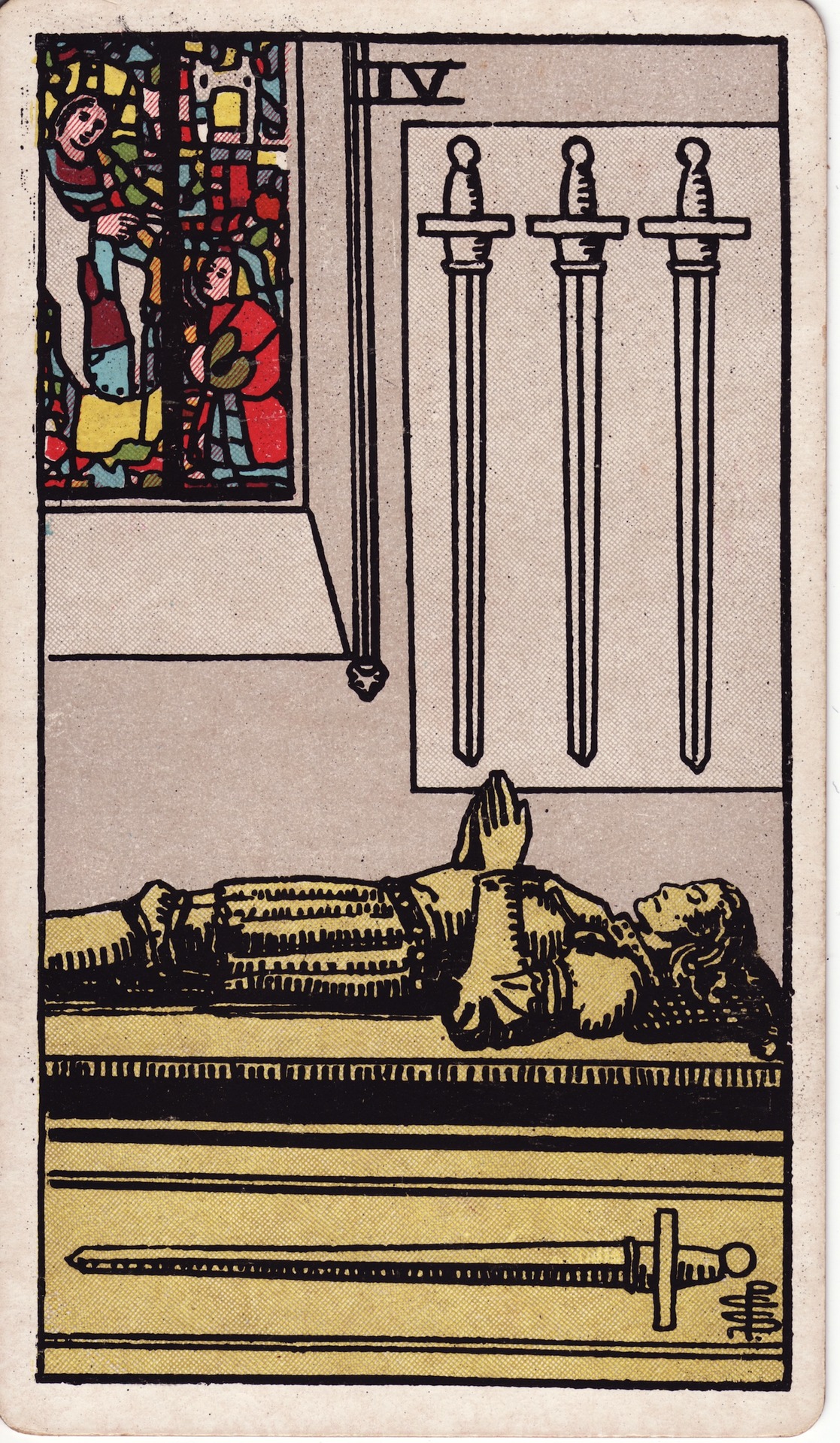
Four Of Swords - Rider-Waite-Smith Tarot
Table of Contents
Key Themes and Symbolism
The Four of Swords is the tarot's portrait of strategic withdrawal, the recognition that continuing to fight while wounded only makes the wounds worse. Every element of the image reinforces this theme of sacred rest.
The stone tomb. The knight lies on what appears to be a sarcophagus, the kind of carved stone effigy found in medieval churches where important figures were memorialized. The tomb imagery is deliberately ambiguous. Is the knight dead, or merely resting? The answer is somewhere in between: he's in a state of such complete withdrawal that he might as well be outside the world of the living. The tomb represents the protected space that deep rest requires, a place set apart from daily life, where the noise and demands of the world can't penetrate. In modern terms, this might be a retreat center, a hospital room, a quiet bedroom with the phone turned off, or simply a mental space you've created by refusing to engage.
The three swords on the wall. Three swords hang on the wall above the knight, pointed downward but not threatening him. They're the conflicts, worries, and mental burdens he carried into this room, now temporarily put aside. They haven't disappeared. The problems that exhausted him are still there, hanging on the wall, waiting. But for now, they're on pause. The Four of Swords doesn't promise that your problems will be gone when you wake up. It promises that stepping back from them, even briefly, will give you the strength and clarity to face them differently.
The fourth sword. One sword lies beneath the knight, carved into the tomb itself, running along the length of his body. This sword isn't on the wall with the others. It's part of him, integrated into his resting posture. This represents the core of mental awareness that doesn't shut off even during rest, the mind's basic operating system running in the background while the higher functions recover. Even in deep meditation or sleep, consciousness persists. The fourth sword is the thread of awareness that will eventually lead the knight back to waking life when the rest is complete.
The prayer position. The knight's hands are pressed together in prayer, a gesture of surrender, devotion, and the request for help from something beyond the self. The Four of Swords isn't just physical rest. It's spiritual rest, the kind of recovery that requires releasing control, surrendering the need to fix everything, and trusting that the universe, the body, or whatever you have faith in will do some of the healing work while your conscious mind is quiet.
The stained glass window. The church setting with its glowing window adds a sacred dimension to the rest. This isn't sleeping in because you're bored. It's resting in a space that's been designated for healing, reflection, and the kind of stillness that organized religions have always recognized as essential to human wellbeing. The window's image of a blessing figure reinforces the idea that grace, help, and healing are available to the knight while he rests, working on him without his active participation.
The number four. In numerology, four represents structure, stability, foundations, and the creation of secure containers. The Four of Swords creates a container for recovery: the four walls of the church, the four sides of the tomb, the stable structure within which the mind can stop defending itself and simply rest. After the instability of the Ace's breakthrough, the Two's indecision, and the Three's heartbreak, the Four provides the first solid ground, not for action, but for the absence of action that makes future action possible.
Upright Meaning
When the Four of Swords appears upright, the message is unambiguous: rest. Stop. Withdraw. Whatever you've been doing, whatever you've been fighting, whatever has been consuming your mental energy, the card says it's time to step back and let your mind recover. This isn't a suggestion. It's a prescription.
General. The upright Four of Swords represents rest, recuperation, mental retreat, meditation, contemplation, and the strategic withdrawal from conflict or stress. It appears when you've pushed yourself to the point of mental exhaustion and your mind is demanding a break. The card can indicate literal rest, taking time off, sleeping more, stepping away from a stressful situation, or it can indicate the internal practice of quieting the mind: meditation, therapy, journaling, or simply allowing yourself to think about nothing for a while. The Four of Swords says that doing nothing right now is the most productive thing you can do.
Love. In love readings, the Four of Swords indicates a period of quiet in a relationship, a pause that's necessary for healing or reflection. If the relationship has recently gone through conflict (especially the kind represented by the Three of Swords), this card suggests that both partners need space to recover before engaging again. It's not a breakup card. It's a time-out card. The relationship isn't ending. It's breathing. For singles, the Four of Swords suggests a period of voluntary solitude, stepping back from dating to recover from past relationships, to get clear about what you want, or simply to enjoy the peace of being alone without the pressure of pursuing connection.
Career. In career readings, the Four of Swords strongly suggests taking a break from work. This might mean vacation, sick leave, a sabbatical, or simply establishing better boundaries between work and personal time. If you've been working unsustainable hours or dealing with extreme workplace stress, this card says the breaking point is near if it hasn't already arrived. The Four doesn't advocate quitting. It advocates retreating strategically so you can return stronger. It can also indicate a period of professional contemplation, stepping back to evaluate your career direction rather than continuing on momentum alone.
Finances. Financially, the Four of Swords suggests a period of financial stillness, not making major money moves. Don't invest aggressively. Don't make large purchases. Don't restructure your finances. Let things be stable and quiet while you recover the mental clarity needed for good financial decisions. The card can also indicate that financial stress has been contributing to your exhaustion and that addressing the stress matters more right now than addressing the finances themselves.
Health. In health readings, the Four of Swords is one of the most important cards in the deck. It directly prescribes rest as medicine. If you've been ignoring your body's signals, pushing through illness, or treating rest as optional, this card says rest is the treatment. It's strongly associated with recovery from illness, post-surgical healing, mental health breaks, and the recognition that the mind and body are connected systems that both require downtime. Sleep, meditation, reduced stimulation, and the permission to do nothing are all part of the Four of Swords' health prescription.

A person relaxing by a tranquil lake during sunset reflecting the peaceful solitude and restorative stillness that the Four of Swords prescribes
Reversed Meaning
When the Four of Swords appears reversed, the rest period is either ending or being refused. The knight is stirring on his tomb. The swords on the wall are calling him back. The question is whether he's ready to rise or whether he's being forced up before the recovery is complete.
General. The reversed Four of Swords represents restlessness, the inability to relax, forced reentry into activity, burnout from refusing to rest, and the sometimes difficult process of emerging from a period of withdrawal. It can indicate that you need rest but won't allow yourself to take it, driven by guilt, anxiety, or the belief that stopping means failing. It can also indicate that a necessary rest period is coming to an end and it's time to gradually reengage with the world. The reversal asks: are you rising because you're ready, or because you can't bear the stillness? The answer matters, because premature reentry leads back to the same exhaustion that created the need for rest in the first place.
Love. In love readings, the reversed Four of Swords can indicate emerging from a period of romantic isolation, ready to engage with love again after a recovery period. It can also indicate restlessness within a relationship's quiet phase, one partner wanting to resume normal activity before the other has finished processing. The card warns against rushing the healing process in relationships. If you needed time apart after a conflict, returning to full engagement before both people are ready usually reopens the wound rather than healing it.
Career. In career readings, the reversed Four of Swords can indicate returning to work after a break, reengaging with professional life after a period of contemplation, or being called back into action before you feel ready. It can also signal burnout that's being ignored, the refusal to take the break you desperately need because professional culture has convinced you that rest is weakness. The reversed card in career contexts often serves as a warning: if you don't rest voluntarily, your body or mind will eventually force the rest involuntarily, and that version is never on your terms.
Finances. Financially, the reversed Four of Swords suggests that a period of financial stillness is ending and it's time to make decisions again. It can also indicate anxiety about financial matters disrupting your ability to rest, the mind that can't stop calculating, worrying, and planning even when the body needs it to stop.
Health. In health readings, the reversed Four of Swords is a serious alert about burnout and the refusal to rest. If you've been pushing through exhaustion, ignoring your body's demands for sleep, or treating self-care as an indulgence you can't afford, this reversal says the consequences are accumulating. It can also positively indicate the end of a convalescence, the moment when you feel well enough to resume normal activity. Context determines which interpretation applies: are you getting up because you're healed, or because you're impatient?
Card Combinations
The Four of Swords' stillness takes different forms depending on its companions.
Four of Swords + The Hermit. Two cards of withdrawal and solitary contemplation. Together, they create an extremely powerful message about the need for extended solitude and deep inner work. This isn't a weekend off. This is a genuine retreat from the world, a period of spiritual and psychological exploration that requires significant time alone. The Hermit brings wisdom-seeking to the Four's rest, suggesting that the stillness isn't just recovery but also a journey inward that will produce genuine insight.
Four of Swords + Three of Swords. The wound and its treatment side by side. This combination directly connects the rest to a specific heartbreak: you're lying down because the Three's swords cut deep, and the Four is the recovery that follows. The combination normalizes the need for rest after emotional trauma and validates the querent's withdrawal as an appropriate response to genuine pain, not avoidance but self-preservation.
Four of Swords + Ace of Wands. Rest meets new creative energy. This combination suggests that a period of recovery is about to give way to a burst of inspiration and motivation. The Four clears the mental space. The Ace fills it with fire. If you've been resting and are starting to feel restless, this combination says the restlessness is the creative energy returning, and it's almost time to rise from the tomb and take action.
Four of Swords + The Tower. A combination that suggests the rest was forced rather than chosen. The Tower's destruction created a situation so overwhelming that complete withdrawal was the only option. Together, they describe the aftermath of a crisis: the shocked stillness that follows catastrophe, when the mind can't process what's happened and simply shuts down to protect itself. The Four in this context is the body's circuit breaker, preventing further damage by temporarily disconnecting.
Astrological Connections
The Four of Swords is associated with Jupiter in Libra, a placement that combines the planet of growth, wisdom, and expanded perspective with the sign of balance, relationships, and the pursuit of harmony. When Jupiter occupies Libra, it produces a deep understanding that peace isn't passive. It's a chosen condition that requires wisdom, effort, and sometimes the deliberate decision to withdraw from conflict.
Jupiter's influence gives the Four of Swords its quality of wisdom-in-rest. This isn't idle rest. It's the kind of recovery that produces insight. Jupiter expands whatever it touches, and in the Four of Swords, it expands the benefits of stillness. The knight lying in the church isn't just regaining strength. He's gaining perspective that he couldn't access while in the middle of the fight. Jupiter's gift is the ability to see the bigger picture, and the bigger picture only becomes visible when you step back far enough to take it all in.
Libra's influence adds the relational dimension. The rest the Four of Swords prescribes often involves relationships: stepping back from interpersonal conflict, creating space between yourself and the people whose demands are exhausting you, or simply giving a relationship room to breathe. Libra understands that the best thing you can do for your connections with others is sometimes to temporarily withdraw from them, not as rejection but as an act of care for both yourself and the relationship.
If Jupiter in Libra is present in your natal chart, you may have a natural understanding of the value of strategic retreat and may find that your best insights come during periods of deliberate stillness. Explore your Jupiter and Libra placements with the natal chart calculator.
Reading Tips for the Four of Swords
Take it literally. The Four of Swords is one of the most straightforward cards in the deck. When it appears, the querent usually needs physical rest, mental quiet, or both. Don't overcomplicate the interpretation. Ask the querent: when did you last take a real break? The answer, or the look on their face when they try to answer, usually tells you everything you need to know.
Distinguish rest from avoidance. The Four of Swords prescribes rest, not escape. There's a difference between lying down to recover and lying down to avoid facing something. In most readings, the Four is genuinely about necessary rest. But if the surrounding cards suggest active problems being ignored (such as the Seven of Swords or reversed cards indicating avoidance), the Four might be indicating withdrawal that's gone too long or become a form of hiding.
Connect it to the Three. In the Swords' numerical sequence, the Four directly follows the Three of Swords' heartbreak. When both cards appear in a reading, the message is clear and compassionate: you were hurt (Three), and now you need to heal (Four). This sequence normalizes the experience and gives the querent permission to rest without guilt. The knight didn't lie down because he's weak. He lay down because he's wise enough to know that wounds need time.
Notice the prayer hands. The knight's prayer position is easily overlooked but deeply significant. It suggests that the rest being prescribed isn't purely physical. It's spiritual. The querent may benefit from meditation, prayer, spiritual practice, or simply the act of surrendering control and trusting that healing will happen without their constant management. The Four of Swords says: let go. Something larger than your conscious mind is available to help, but it can only reach you when you stop fighting long enough to receive it.
Frequently Asked Questions
Is the Four of Swords a yes or no card?
The Four of Swords is a "not yet." It doesn't deny what you're asking for, but it says the timing isn't right. You need to rest, recover, and gain clarity before moving forward. If you're asking whether to take action, the answer is: not now. If you're asking whether something will work out, the answer is: it might, but you need to be in a better state of mind to navigate it well. The Four of Swords says wait, but it says it with compassion rather than frustration. The pause it prescribes isn't a punishment. It's preparation.
What does the Four of Swords mean for relationships?
In relationship readings, the Four of Swords indicates a necessary period of quiet. For couples, it might mean taking space after an argument, reducing the intensity of interaction to let both people recover, or simply acknowledging that the relationship is in a restful phase rather than an active one. Not every phase of a partnership needs to be exciting or dramatic. Sometimes the healthiest thing a relationship can do is be boring for a while, giving both people room to exist without performance or conflict. The card doesn't indicate problems. It indicates the rest that prevents problems.
Does the Four of Swords mean someone is isolating themselves?
The Four of Swords can indicate healthy withdrawal or unhealthy isolation, depending on context. Healthy withdrawal is temporary, intentional, and aimed at recovery. The person knows why they're stepping back, how long they need, and they plan to reengage when they're ready. Unhealthy isolation is prolonged, fear-driven, and disconnected from any recovery process. The person withdraws because they can't face the world and the withdrawal becomes its own trap. Surrounding cards help distinguish between these: positive cards suggest the retreat is productive, while cards of fear, stagnation, or avoidance suggest it's become a problem.
How long does the Four of Swords' rest period last?
The Four of Swords doesn't specify duration because the rest takes as long as it takes. In practice, the card's influence in a reading usually corresponds to days or weeks rather than months, though individual situations vary. The knight in the image is wearing armor, which means he intends to return to the fight. This isn't permanent withdrawal. It's a tactical pause. The rest period ends when the mind regains enough clarity and energy to reengage productively, which the querent will usually feel as a natural readiness rather than a forced obligation.
Can the Four of Swords represent meditation?
Yes. The Four of Swords is the tarot's most direct endorsement of meditation and contemplative practice. The knight lying in the church with hands in prayer is essentially meditating: conscious but still, present but withdrawn from external engagement, allowing the mind to settle into a state of quiet awareness. When this card appears, it's often encouraging the querent to establish or deepen a meditation practice, or more broadly, to find any practice that quiets the mind: yoga, nature walks, journaling, time spent in silence, or simply the discipline of sitting still and letting thoughts pass without engaging them.
The Four of Swords is the tarot's permission slip to stop. Not forever. Not out of weakness. But with the strategic wisdom of a warrior who knows that rest isn't the opposite of strength. It's the source of it. The knight lies in his consecrated space, swords on the wall, hands in prayer, and trusts that the world he temporarily left will still be there when he rises, and that he'll face it better for having stopped. The three swords above him haven't vanished. The conflicts and pains that drove him to rest are real and waiting. But they're not going anywhere, and neither is he, and in the sacred quiet between battles, something heals that fighting never could. For a deeper exploration of all 78 cards, visit the Celesian tarot reader. To understand how Jupiter in Libra shapes your relationship with peace, balance, and the wisdom of retreat, explore your natal placements with the natal chart calculator. And to continue through the Swords suit, look back at the Three of Swords, whose heartbreak drove the knight to this tomb, and ahead to the Five of Swords, where the rest period ends and the mind returns to the world of conflict, this time armed with the clarity that only genuine rest can provide.