
Seven of Swords Tarot Card Meaning: Upright, Reversed, Love, Career, and More
A man tiptoes away from a military encampment, carrying five swords in his arms, glancing back over his shoulder with an expression that's equal parts self-satisfaction and anxiety. He's moving quickly but quietly, weight on the balls of his feet, body angled away from the tents behind him where two swords remain stuck in the ground, left behind because he couldn't carry them all. In the distance, a group of figures stands near the camp, apparently unaware of the theft. The sky is yellow, a strange, unnatural color that suggests something is off about the scene, something that doesn't quite fit the honest light of day. The whole image is a snapshot of a plan in progress, a strategy being executed that depends entirely on nobody noticing until it's too late.
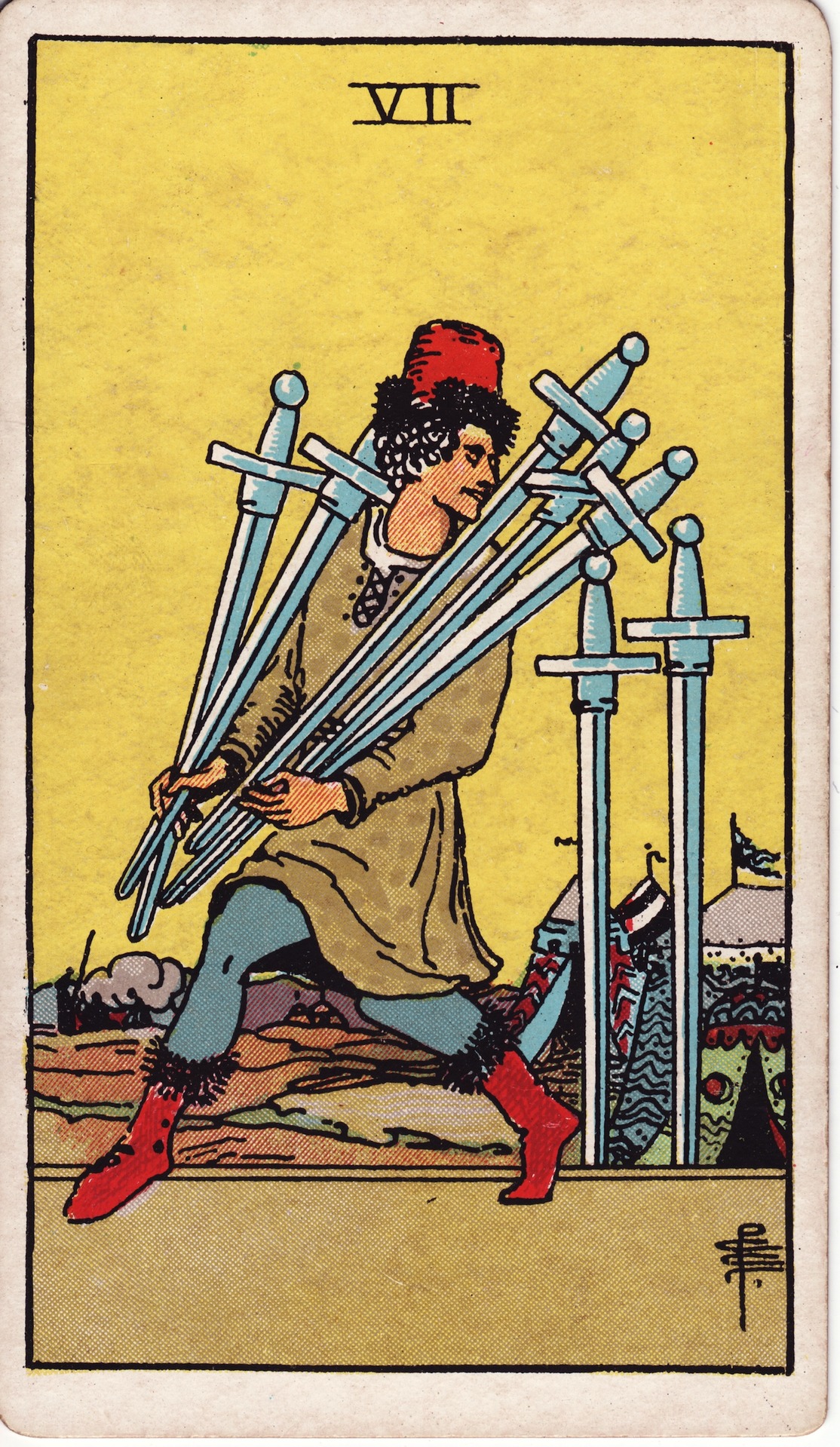
Seven of Swords - Rider-Waite-Smith Tarot
The Six of Swords was transition, the honest departure from difficulty toward something calmer. The Seven of Swords is a very different kind of departure. This isn't someone leaving openly with their wounds and their grief in a boat for everyone to see. This is someone sneaking away with what they can grab, hoping the people they're taking from won't notice. The card occupies morally ambiguous territory that makes it one of the most interesting and uncomfortable cards in the entire deck. Is this man a thief? A strategist? A survivor doing what he has to do? The card doesn't answer that question for you. It forces you to answer it for yourself based on the context of your own life, and that's precisely what makes it so powerful.
Table of Contents
Key Themes and Symbolism
The Seven of Swords is the tarot's most sophisticated exploration of deception, and its imagery rewards careful attention because nothing in this card is straightforward.
The five stolen swords. The man carries five swords, an awkward, unstable load. He's taken more than he can comfortably manage, which is a critical detail. Greed, overreach, or desperation has driven him to grab as much as possible rather than taking only what he needs. The precarious load suggests that the plan, however clever, has a fundamental flaw: he's overextended. In practical terms, this represents any situation where you've taken on more deception than you can sustain, told more lies than you can keep track of, or tried to manipulate more variables than any one person can control.
The two swords left behind. He couldn't carry all seven. Two remain planted in the ground at the camp, and those abandoned swords are the card's quiet warning. No deception is perfect. No scheme accounts for everything. The two swords left behind represent the evidence, the loose ends, the details that will eventually expose the plan. They're also a reminder that taking from others always leaves something behind for them to find, and what they find might be exactly the information they need to understand what happened.
The backward glance. The man looks over his shoulder, which tells you two things. First, he knows what he's doing is risky. He's watching for detection. Second, he's not fully committed to moving forward because part of his attention is still fixed on what's behind him. This divided attention is the psychological profile of deception: the liar who can't fully relax because part of their mind is always monitoring whether they've been caught. It's an exhausting way to live, and the card captures that exhaustion in a single glance.
The yellow sky. The strange, sickly yellow of the sky is unsettling. It's not the warm gold of dawn or the rich amber of sunset. It's an in-between color that creates a feeling of wrongness, of things being not quite right. Atmospherically, the yellow sky is the card telling you that something in the situation isn't what it appears to be. The light is off. The energy is off. Trust that instinct.
The distant figures. The people at the camp are unaware of the theft, but they're present. They exist. They'll eventually notice the missing swords. This detail matters because it grounds the card in social reality. Deception doesn't happen in a vacuum. There are always other people who will be affected, and those people will eventually discover what was done. The question isn't whether the theft will be discovered. It's when, and what the consequences will be.
The number seven. Sevens in the tarot are assessment cards. The Seven of Wands assesses your ability to defend your position. The Seven of Cups assesses your relationship with fantasy and choice. The Seven of Pentacles assesses the return on your investment. Here, the Seven of Swords assesses your relationship with truth, asking whether the strategy you're employing is clever or corrosive, whether the shortcut you've found is genius or self-defeating.
Upright Meaning
When the Seven of Swords appears upright, deception is in play. Someone is being dishonest, cutting corners, or pursuing a strategy that depends on secrecy rather than transparency. The card doesn't always condemn this. Sometimes it acknowledges that unconventional approaches are necessary. But it always asks you to examine whether the approach is truly strategic or simply dishonest.
General
The Seven of Swords upright announces that someone in the situation is not being fully honest. This might be you. It might be someone you're dealing with. In either case, the card insists that you look directly at the deception rather than ignoring it.
When the card reflects your own behavior, it's asking you to examine why you're choosing stealth over honesty. Are you avoiding a difficult conversation by working around the person instead of talking to them? Are you presenting a partial truth that technically isn't a lie but deliberately creates a false impression? Are you taking credit for work you didn't do, or taking resources that don't belong to you? The Seven of Swords doesn't scream "you're a bad person." It says "you're being clever in a way that has costs you haven't fully calculated."
When the card reflects someone else's behavior, it's a warning to pay attention to what doesn't add up. The colleague whose explanation has gaps. The partner whose story changed between Tuesday and Thursday. The deal that looks too good to be true because it is. The Seven of Swords asks you to trust your instincts about dishonesty rather than dismissing them out of politeness or wishful thinking.
There's a third interpretation that's often overlooked: legitimate strategy. Not every form of stealth is deception. Sometimes you need to operate quietly because announcing your plans would sabotage them. The job search you're conducting while still employed. The exit strategy you're building before leaving a controlling relationship. The competitive move you're developing that only works if competitors don't see it coming. In these cases, the Seven of Swords isn't about dishonesty. It's about strategic discretion, and the card respects the difference even if it insists you be honest with yourself about which one you're actually practicing.
Love and Relationships
In love readings, the Seven of Swords upright is one of the most challenging cards to receive. Its most direct meaning is infidelity, deception, or emotional dishonesty within a relationship. Someone isn't being truthful about their feelings, their actions, or their commitments.
If the card points to your partner, it suggests behavior that doesn't match their words: unexplained absences, stories that don't quite hold together, a phone that's suddenly always face-down. The card isn't conclusive proof of betrayal, but it's a strong signal that the trust foundation of the relationship deserves examination. Don't confront based on a tarot card alone, but do pay attention to the patterns the card is highlighting.
If the card points to you, it asks why you're being dishonest with your partner. Are you avoiding a conversation about your real feelings? Hiding something because you're afraid of the consequences? Maintaining a relationship through performance rather than genuine connection? The Seven of Swords in this position is an invitation to choose honesty before the two swords left behind expose the truth on their own terms.
For singles, the card can indicate someone who isn't presenting themselves honestly in the dating process, whether that's misrepresenting their intentions, their availability, or their identity. It can also reflect your own tendency to present a curated version of yourself rather than the real one, which attracts people who like the performance but won't connect with the person behind it.
Career and Finances
In career readings, the Seven of Swords frequently points to workplace dishonesty: credit-stealing, corporate espionage, resume inflation, plagiarism, or the kind of office politics that operates through manipulation rather than merit. Someone is advancing through cunning rather than competence, and whether that someone is you or a colleague, the card says the approach has an expiration date.

A mysterious figure walking through a dimly lit urban alley at night creating a dramatic shadow that evokes the stealth and secrecy of the Seven of Swords
The card can also represent strategic professional moves that require discretion. Interviewing with competitors while employed, developing an entrepreneurial venture on the side, or quietly building alliances before making a power move are all legitimate Seven of Swords activities in the professional sphere. The line between strategic discretion and professional dishonesty depends on your specific situation, and the card asks you to know which side of that line you're on.
Financially, the Seven of Swords warns about fraud, scams, hidden fees, or financial arrangements where someone isn't being fully transparent. Read the fine print. Question deals that seem too generous. If you're the one cutting financial corners, tax avoidance versus tax evasion, creative accounting that pushes boundaries, the card reminds you that the two swords left behind represent the audit trail you're creating.
Health
In health readings, the Seven of Swords can indicate avoidance of health truths. Ignoring symptoms. Skipping recommended screenings because you don't want to know. Presenting yourself as healthier than you are, whether to others or to yourself. The card's deception theme applies internally: the lies you tell yourself about your health are just as dangerous as lies told to others, and often more so because you're the only one who can seek treatment.
It can also indicate the need for a second opinion in medical situations. If a diagnosis or treatment plan doesn't feel right, the Seven of Swords validates the instinct to investigate further rather than accepting the first explanation at face value. Sometimes the deception the card flags is institutional rather than personal.
Reversed Meaning
The Seven of Swords reversed shifts from active deception toward its consequences: exposure, confession, the decision to come clean, or the lingering paranoia of someone whose schemes are unraveling.
General
Reversed, the Seven of Swords most commonly indicates that a deception is being exposed. The two swords left behind have been found. The loose ends are being pulled. The truth is emerging, either because someone discovered it or because the person who was lying has decided they can't sustain the performance anymore.
This can manifest as confession. The weight of maintaining a lie becomes heavier than the consequences of telling the truth, and the reversed card represents the moment of release when honesty finally replaces the exhausting architecture of deception. The confession might not go smoothly. The people who were deceived have legitimate reasons to be angry. But the reversal signals that the truth is now in motion and can't be put back in the box.
Alternatively, the reversed Seven of Swords can indicate getting caught. Not the graceful confession you chose but the involuntary exposure you feared. Someone found the evidence. Someone compared notes. Someone asked the right question at the right time and the story collapsed. Getting caught is more painful than confessing, but both lead to the same place: the deception is over and whatever comes next has to be built on honesty.
Less commonly, the reversed card can indicate a reformed approach. Someone who previously operated through deception and manipulation is choosing a different path. The experience of being caught or the internal cost of dishonesty has prompted genuine change. This interpretation is most relevant when the card appears alongside growth-oriented cards like Temperance or The Star.
Love and Relationships
Reversed in love readings, the Seven of Swords often signals that hidden truths within a relationship are surfacing. An affair is discovered. A financial secret is revealed. The emotional dishonesty that's been corroding the relationship from the inside finally becomes visible.
The aftermath is painful but potentially healing. Some relationships survive the exposure of deception and emerge stronger because the truth, however difficult, creates a foundation that the lie never could. Other relationships end because the trust damage is too extensive to repair. The reversed card doesn't predict which outcome is more likely. It says the deception phase is ending and the reconstruction phase is beginning.
For couples, the card can also indicate a mutual decision to stop playing games with each other. Both partners drop the strategic positioning, the subtle manipulations, the half-truths told to avoid conflict, and commit to radical honesty. This is uncomfortable but transformative.
For singles, the reversed Seven of Swords can indicate recognizing your own patterns of emotional dishonesty in dating and choosing to break them. It can also signal discovering that someone you're interested in wasn't being truthful about their situation.
Career and Finances
In career readings reversed, the Seven of Swords often points to the exposure of professional misconduct. The colleague who stole credit gets called out. The corporate fraud is discovered. The resume fabrication is uncovered during a reference check. The reversed card says that professional deception, however clever, has a shelf life, and that shelf life has expired.
It can also represent choosing professional integrity over professional expediency. You had the opportunity to cut corners, take shortcuts, or manipulate your way forward, and you chose not to. The reversed Seven of Swords acknowledges the courage this requires, especially in environments where dishonesty is normalized.
Financially, the reversal can indicate discovering hidden charges, fees, or financial manipulation. It's also the card of settling financial dishonesty: paying back what's owed, correcting tax errors, or coming clean about financial realities you've been hiding from a partner or family member.
Health
Reversed in health readings, the Seven of Swords indicates that health truths can no longer be avoided. The symptoms you've been ignoring demand attention. The denial about a condition breaks down. You finally go to the doctor, get the test, face the diagnosis. The reversal is ultimately positive for health because it moves you from avoidance to engagement, from pretending everything is fine to acknowledging what's actually happening so it can be addressed.
It can also indicate discovering that a health provider wasn't being fully transparent about treatment options, side effects, or prognosis. The reversed card empowers you to ask harder questions and demand more complete information.
Card Combinations
The Seven of Swords changes its tone significantly depending on surrounding cards.
Seven of Swords + The High Priestess. Your intuition knows what your conscious mind hasn't admitted yet. The High Priestess represents deep, subconscious knowing, and paired with the Seven of Swords, she's telling you that you already sense the deception. You might not have evidence. You might not have a rational explanation for your suspicion. But The High Priestess says your intuition is picking up what your eyes haven't seen yet. Trust it.
Seven of Swords + Justice. Consequences are arriving. Justice is the tarot's card of accountability, fairness, and cause-and-effect, and when it appears alongside the Seven of Swords, the message is unambiguous: deception will be exposed and the consequences will be proportional to the offense. If you've been on the receiving end of dishonesty, this combination promises that fairness will prevail. If you've been the one deceiving, it warns that the reckoning is near.
Seven of Swords + The Magician. Strategy at its most potent. This combination can indicate either brilliant strategic thinking or masterful manipulation, depending on the context and the querent's intentions. The Magician has all the tools and the skill to use them. Paired with the Seven of Swords, those tools are being deployed with cunning and purpose. The question is whether the purpose is constructive or destructive.
Seven of Swords + Three of Swords. Deception causes heartbreak. This is one of the most painful combinations in the deck, indicating that someone's dishonesty will result in genuine emotional devastation. The Three of Swords is raw, honest grief, the kind that comes from having the truth pierce your heart. Paired with the Seven of Swords, the source of that grief is betrayal, and the wound is deep because the deception was personal.
Astrological Connections
The Seven of Swords is associated with Moon in Aquarius, a placement that combines emotional detachment with intellectual independence. The Moon governs your inner emotional landscape, your instincts, and your subconscious patterns. Aquarius governs unconventional thinking, social dynamics, and the impulse to operate outside established norms. Together, they create a psychological profile that's capable of emotional detachment in situations where most people would be overwhelmed by guilt or anxiety.
Moon in Aquarius can compartmentalize. It can separate what it feels from what it does, which is exactly the psychological capacity required for the Seven of Swords' brand of deception. The man in the card isn't trembling with guilt. He's calm, calculating, executing a plan with the emotional distance necessary to pull it off. Moon in Aquarius processes emotions intellectually rather than viscerally, and this ability to think about feelings rather than feel them is what makes the Seven of Swords' stealth possible.
The shadow of this placement is emotional dishonesty with yourself. Moon in Aquarius can be so detached from its own emotional truth that it doesn't recognize when its "strategic" behavior is actually a defense against vulnerability. The Seven of Swords sometimes describes people who deceive not out of malice but out of an inability to be emotionally honest, people who'd rather outmaneuver a difficult conversation than sit in the discomfort of having it directly.
If you have Moon in Aquarius or strong Aquarius placements in your natal chart, the Seven of Swords may feel uncomfortably familiar, not because you're dishonest, but because you recognize the temptation to handle emotional situations through strategy rather than directness.
Reading Tips for the Seven of Swords
The Seven of Swords is one of the most misread cards in the deck, usually because readers default to "someone's lying" without exploring the card's full range of meaning.
Check who's doing the deceiving. The most important question when the Seven of Swords appears: is the deception coming from the querent, from someone in their life, or from the situation itself? These three possibilities produce very different readings. "You're being dishonest," "someone is being dishonest with you," and "the situation isn't what it appears to be" are all valid Seven of Swords interpretations, and surrounding cards help determine which applies.
Consider strategic necessity. Not every Seven of Swords is a moral failure. Sometimes the card describes the strategic discretion that difficult situations require. A woman planning to leave an abusive partner needs to be strategic about how and when she goes. An employee in a toxic workplace needs to secure a new position before announcing their departure. The card respects the difference between deception for personal gain and discretion for self-preservation.
Look for the two swords left behind. In every Seven of Swords situation, something has been overlooked. What's the loose end? What's the evidence that the plan didn't account for? What's going to eventually reveal the truth? Identifying the "two swords" in a reading gives the querent practical information about where the vulnerability lies.
Watch for self-deception. The card isn't always about lying to others. Sometimes it's about lying to yourself. The story you tell yourself about why you deserve that thing you took. The justification you've constructed for behavior you know is wrong. The narrative that paints you as the strategist when you're actually the thief. Self-deception is the Seven of Swords at its most insidious because there's nobody to catch you except yourself.
Pair this card with the question's emotional stakes. The Seven of Swords hits differently in a love reading versus a career reading. In love, deception destroys intimacy and trust, and the card's appearance demands serious attention. In career, strategic thinking is often expected and rewarded, and the card's appearance might actually validate a competitive approach. Context determines the card's moral weight.
Frequently Asked Questions
Does the Seven of Swords always mean cheating?
No. In love readings, the Seven of Swords frequently points to infidelity, but it has a broader range of meaning that includes any form of emotional dishonesty: hiding your true feelings, maintaining a facade, avoiding difficult conversations through misdirection, or presenting a version of yourself that isn't authentic. The card can also appear in love readings to indicate strategic behavior that isn't necessarily unfaithful, such as playing hard to get, withholding information to maintain power in the dynamic, or testing a partner's reaction before revealing something vulnerable. Context from surrounding cards and the specific question asked determine whether the card is flagging infidelity or a different form of relational dishonesty.
What should I do if the Seven of Swords appears as advice?
When the Seven of Swords appears in the advice position, it's usually counseling strategic discretion rather than open deception. The advice is: don't show your full hand right now. Be strategic about what you reveal and to whom. This doesn't mean lie. It means recognize that not everyone needs to know everything, and that timing your disclosures can be as important as the disclosures themselves. In competitive situations, the card advises thinking several moves ahead and not telegraphing your strategy. In personal situations, it might advise handling a sensitive matter quietly rather than making it public before you're ready.
How does the Seven of Swords relate to the Seven of Wands?
The Seven of Wands defends a position openly, standing on a hilltop fighting off challengers with direct force. The Seven of Swords avoids the direct fight entirely, preferring to take what it needs through stealth rather than confrontation. Both cards deal with opposition, but their strategies are opposite. The Seven of Wands says "stand your ground and fight." The Seven of Swords says "take what you can and leave before they notice." Neither approach is inherently better. The right one depends entirely on the situation, your resources, and whether the fight is one you can actually win through direct engagement.
Can the Seven of Swords be positive?
Yes, in specific contexts. The card can represent intelligence, resourcefulness, and the ability to think unconventionally in situations where conventional approaches have failed. Whistleblowers who need to gather evidence covertly, people escaping dangerous situations through careful planning, entrepreneurs protecting intellectual property from competitors, all of these are positive Seven of Swords scenarios. The card becomes negative when the cleverness serves self-interest at someone else's direct expense, when the "strategy" is actually just dishonesty wearing a better outfit.
What does the Seven of Swords mean for trust?
The Seven of Swords is the tarot's most direct statement about compromised trust. When it appears in a reading about trust, it says the trust has already been damaged, whether by your actions, someone else's, or a situational dynamic that's created suspicion. The path forward depends on whether the deception continues or stops. Trust can be rebuilt after the Seven of Swords, but only if the deception is acknowledged, the behavior changes, and the person whose trust was broken is given the time and evidence they need to believe in the change. The two swords left in the ground aren't just evidence of the theft. They're also the starting point for accountability. What you do with those two swords determines whether trust is eventually restored or permanently destroyed.
The Seven of Swords is the tarot's most uncomfortable mirror, not because it shows you doing something wrong, but because it asks you to be honest about the difference between strategy and deception, between discretion and dishonesty, between cleverness and betrayal. The man in the card is smiling because his plan is working. But the yellow sky says the light is wrong, the two remaining swords say the plan is incomplete, and the distant figures say that someone will eventually notice what's missing. Every lie carries its own expiration date, and the Seven of Swords is both the lie and the clock counting down to its exposure. For a broader exploration of all 78 cards, visit the Celesian tarot reader. To understand how Moon in Aquarius shapes your relationship with emotional honesty, detachment, and the temptation of strategic thinking over direct feeling, explore your natal placements with the natal chart calculator. And to continue through the Swords suit, look back at the Six of Swords, whose honest departure stands in stark contrast to the Seven's sneaking exit, and ahead to the Eight of Swords, where the mind's strategies finally turn inward and become the prison instead of the escape.