
Eight of Swords Tarot Card Meaning: Upright, Reversed, Love, Career, and More
A woman stands blindfolded, her arms bound loosely to her body, surrounded by eight swords planted in the wet ground around her. The swords form an incomplete fence. They're close together, suggesting imprisonment, but they don't actually enclose her. There are gaps. Spaces wide enough to walk through. Her feet are in shallow water, and behind her a castle sits on a rocky cliff in the distance, suggesting that help, structure, or safety exists but feels impossibly far away. The sky is grey and overcast. Everything about the scene communicates constraint, limitation, and helplessness. And everything about the scene, if you look carefully, communicates that the constraint is an illusion.
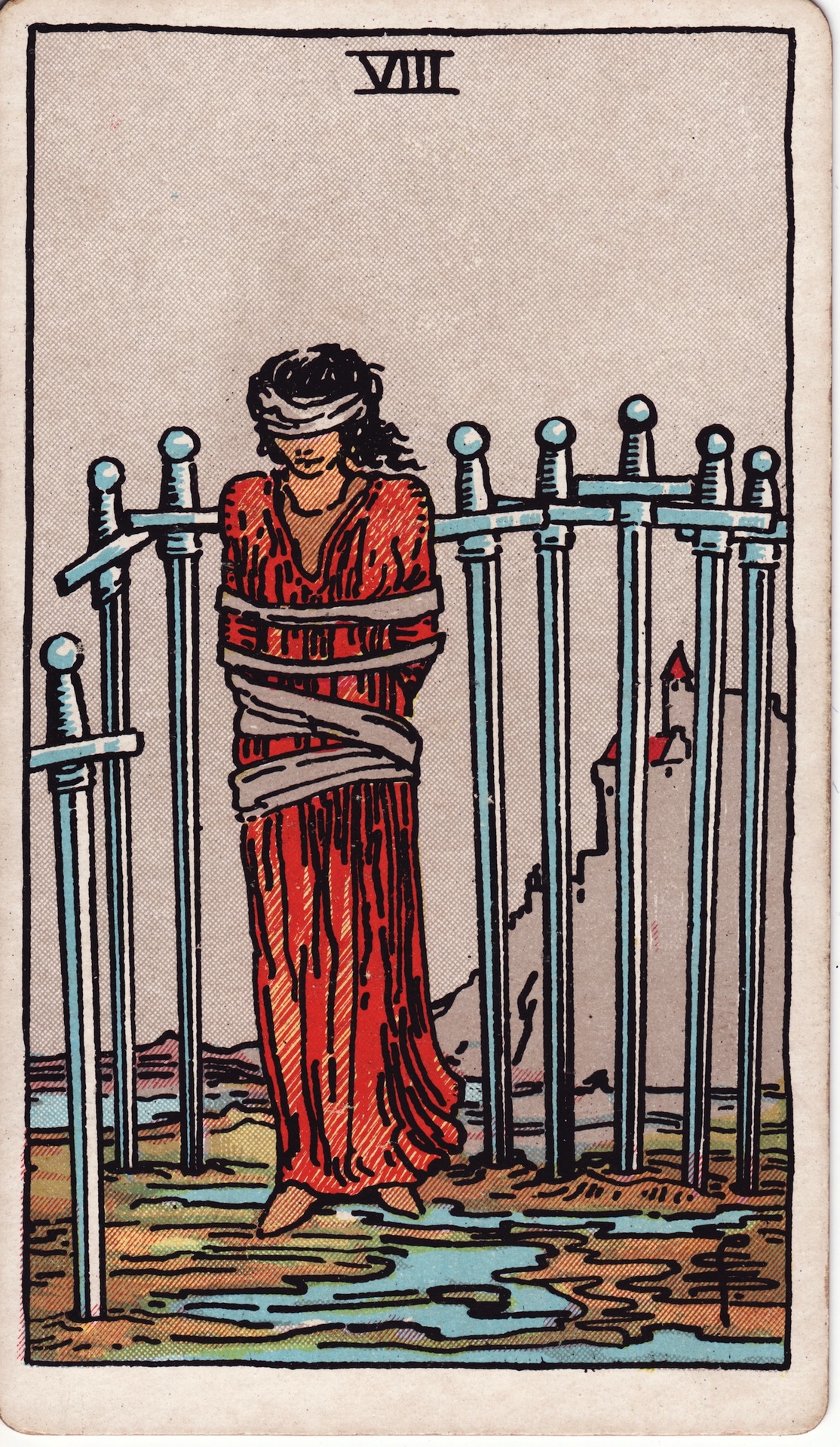
Eight of Swords - Rider-Waite-Smith Tarot
The Seven of Swords was deception directed outward, the mind using its cleverness against others. The Eight of Swords is what happens when that same mental energy turns inward and starts deceiving you. This is the tarot's most direct portrait of self-imposed imprisonment: the situation where the barriers feel absolutely real and absolutely insurmountable, but closer examination reveals that they're maintained by your own thoughts rather than by external force. The blindfold isn't locked on. The ropes aren't tight. The swords have gaps between them. The woman could leave if she chose to. But she doesn't know that, because she can't see, and she can't see because she's accepted the blindfold as permanent rather than removable. The Eight of Swords is the card that asks the question nobody wants to hear: what if you're not actually trapped?
Table of Contents
Key Themes and Symbolism
The Eight of Swords is a masterclass in visual storytelling, and every element of the image serves the card's central paradox: apparent imprisonment that's actually self-imposed.
The blindfold. The woman can't see. That's the foundation of everything else in the card. If she could see, she'd notice the gaps between the swords. She'd see that her binding is loose. She'd spot the path out. But the blindfold prevents perception, and without perception, she defaults to assumption. She assumes she's trapped because it feels like she's trapped, and the feelings are so convincing that she never tests them against reality. In practical terms, the blindfold represents the mental patterns, beliefs, anxieties, and stories that prevent you from seeing your situation accurately. It's not external. Nobody is holding it on. She could reach up and remove it at any time, but doing so requires the terrifying act of questioning whether everything you believe about your situation is wrong.
The loose binding. Her arms are wrapped, not chained. The binding is cloth, not iron. It restricts but doesn't truly immobilize. This detail is the card's compassion: it acknowledges that the constraint feels real. You're not making it up. The limitation is there. But the nature of the limitation matters enormously. The difference between a cloth binding and a chain is the difference between something you can work yourself free from and something that requires an external key. The Eight of Swords says your binding is the former, even when it feels like the latter.
The eight swords. The swords surround the woman but don't form a complete circle. There are gaps, spaces where a person could walk through without touching a single blade. The swords represent the thoughts, fears, and mental constructs that create the feeling of being boxed in. Eight is a lot of swords. The mind has produced many reasons why escape is impossible: it's too risky, you're not capable, the timing isn't right, other people will judge you, you don't deserve better. Each sword is a separate reason, and together they feel overwhelming. But none of them is actually blocking the exit.
The water at her feet. Standing water in the tarot represents stagnant emotions. The woman isn't on solid ground. She's in the murky, unclear emotional territory that anxiety and helplessness create. The water is shallow, barely covering her feet, but it adds to the discomfort and the feeling of being stuck. Emotionally, she's not drowning, but she's definitely not on dry land. The water represents the emotional component of mental imprisonment: the fear, the sadness, the resignation that accumulate when you believe you can't move.
The distant castle. Behind her, on the cliff, sits a structure that represents authority, protection, or refuge. It's visible but far away. The castle might represent the help that exists but feels inaccessible, the therapy you haven't started, the conversation you haven't had, the support system you haven't reached out to. It might also represent the institutional or societal structures that contributed to the feeling of entrapment in the first place. The castle's distance is part of the illusion: it looks unreachable from behind the blindfold, but the actual distance is navigable once you can see.
The number eight. Eights in the tarot represent mastery, power, and the consolidation of energy. The Eight of Wands is swift, decisive action. The Eight of Cups is the courage to walk away from emotional investment. The Eight of Pentacles is disciplined skill-building. Here in the Swords suit, the eight's power has turned paradoxical: the mind has become so effective at constructing narratives that it's trapped itself in one. The mastery of intellect has become the mastery of self-limitation. The same mental capacity that could liberate the woman is the exact capacity that's keeping her imprisoned.
Upright Meaning
When the Eight of Swords appears upright, you feel trapped. The feeling is real. The trappedness is not, or at least not in the way you think. The card's central message is that the barriers you're experiencing are maintained by your own thoughts, beliefs, and fears rather than by external circumstances that genuinely can't be changed.
General
The Eight of Swords upright is the tarot's intervention for overthinking. It appears when the mind has constructed such an elaborate, convincing case for why you're stuck that you've stopped looking for exits. The card acknowledges the psychological reality of feeling trapped while simultaneously pointing out that feeling trapped and being trapped are not the same thing.
This isn't about blame. The Eight of Swords isn't saying "you're doing this to yourself, so stop it." Mental imprisonment is real. Anxiety is real. Depression's paralysis is real. Learned helplessness from past experiences is real. The card isn't dismissing any of that. What it's doing is introducing a possibility you may not have considered: that despite how real the limitations feel, there are options you're not seeing because the blindfold has convinced you there's nothing to look for.
The practical application varies by context, but the card consistently asks: what would change if you removed just one assumption? If you stopped assuming you can't leave the job, what options appear? If you stopped assuming the relationship is unchangeable, what conversations become possible? If you stopped assuming you don't deserve better, what standards would you set? The Eight of Swords doesn't ask you to solve everything at once. It asks you to remove the blindfold and look, actually look, at whether the swords around you have gaps.
Love and Relationships
In love readings, the Eight of Swords upright often describes a relationship where one or both partners feel trapped but where the entrapment is largely internal. You feel like you can't leave but can't articulate a concrete reason why. You feel like you can't speak honestly but nobody has explicitly told you not to. You feel like the relationship has no room for your authentic self, but the constraints are built from your own fear of rejection rather than from your partner's actual behavior.
The card also appears in relationships with genuine power imbalances, emotional abuse, or controlling dynamics, but even here its message has nuance. The Eight of Swords acknowledges that the emotional manipulation creating the trapped feeling is real, while also pointing toward the internal resources (courage, clarity, support-seeking) that the victim may not realize they possess. The card is never about dismissing someone's experience. It's about illuminating the path out that's hidden behind the blindfold.
For singles, the card often indicates self-limiting beliefs about love: "I'm too old," "I'm not attractive enough," "all the good ones are taken," "I'll just get hurt again." These beliefs function as the swords in the card, creating an apparently solid barrier that is actually full of gaps. The Eight of Swords invites you to test each belief against reality rather than accepting it as fact.
Career and Finances
In career readings, the Eight of Swords describes the feeling of being stuck in a professional situation with no way out. The job you hate but "can't" leave. The career path that no longer fits but feels impossible to change. The professional identity that's become a cage. The card's message is consistent: examine the word "can't." Often it means "won't because I'm afraid of what happens if I try," and that's a very different thing from genuine impossibility.
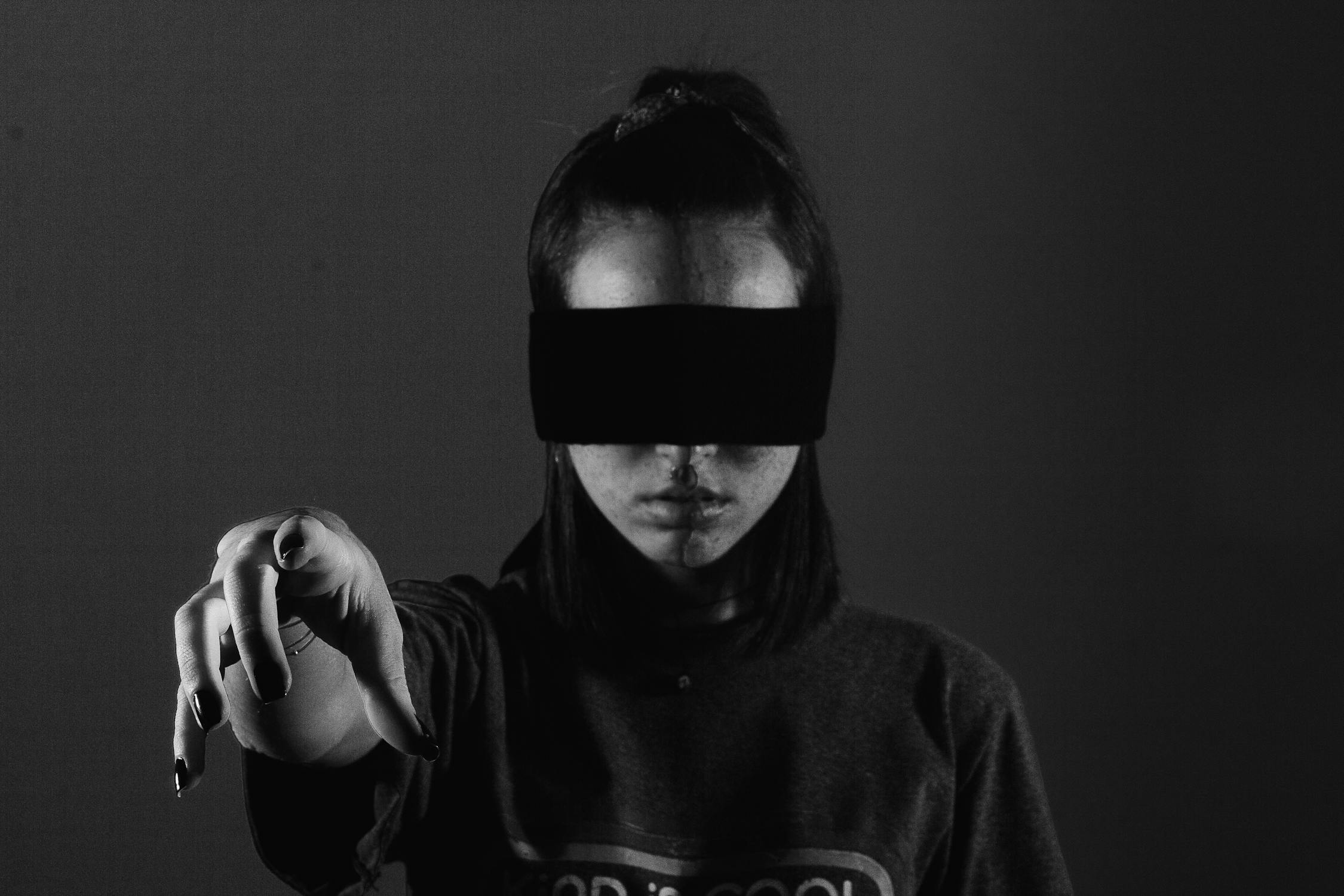
A blindfolded woman reaching forward in dramatic black and white creating a mysterious mood that captures the Eight of Swords energy of searching for an unseen exit
The card also appears when professional confidence has been eroded by a toxic work environment, a series of rejections, or imposter syndrome that's convinced you your skills have no value elsewhere. The swords surrounding you are the internal narratives: "I'm not qualified enough," "the job market is terrible," "I should be grateful for what I have." Each narrative might contain a grain of truth, but the Eight of Swords says the grain has been inflated into a mountain that's blocking your view of actual options.
Financially, the card indicates feeling trapped by debt, expenses, or financial obligations that seem to leave no room for change. The feeling is valid. The math may genuinely be tight. But the Eight of Swords asks whether you've explored every option or whether the overwhelm has caused you to stop looking. Financial counseling, restructuring, assistance programs, creative income solutions, these are the gaps between the swords that the blindfold prevents you from seeing.
Health
In health readings, the Eight of Swords often points to the psychological dimension of physical illness: anxiety that worsens symptoms, catastrophic thinking that makes recovery feel impossible, or the helplessness that comes from feeling at the mercy of your body. The card acknowledges that illness is real and that its physical effects are not imaginary. What it questions is the narrative layer you've built on top of the illness, the "I'll never get better" story that becomes its own barrier to recovery.
Mental health is the card's most direct application. Anxiety, depression, PTSD, and other conditions that create the lived experience of being trapped without visible chains are the Eight of Swords in its most literal form. The card validates the experience while gently pointing toward the therapeutic and practical resources that can loosen the binding, from professional help to medication to lifestyle changes to the simple but profound act of telling someone what you're going through.
Reversed Meaning
The Eight of Swords reversed is one of the most liberating reversals in the deck. The blindfold comes off. The binding loosens. The gaps between the swords become visible, and movement becomes possible.
General
Reversed, the Eight of Swords indicates a breakthrough in perspective. You're seeing your situation clearly for the first time, and what you see is that you're not as trapped as you thought. The assumptions that maintained the prison are being questioned. The beliefs that held you in place are losing their grip. You're not free yet, the swords are still there, the wet ground is still uncomfortable, but the critical shift has happened: you've removed the blindfold and you can see the exit.
This reversal often coincides with a moment of clarity that arrives through therapy, an honest conversation, a book that reframes your thinking, or simply the accumulation of enough evidence that the old narrative can no longer hold. The moment might feel dramatic, a sudden flash of "wait, I don't have to live like this." More often it's gradual, a slow dissolution of the prison as each assumption gets examined and found to be less solid than it appeared.
The reversed Eight of Swords also indicates taking the first steps toward freedom. Not complete liberation, that's a process, but the first concrete action: making the appointment, starting the search, having the conversation, setting the boundary. The first step is always the hardest because it contradicts the old story of helplessness, and taking it changes everything.
Love and Relationships
Reversed in love readings, the Eight of Swords signals awakening within a relationship dynamic. You're recognizing patterns you'd previously been blind to. The manipulative behavior you'd normalized. The standards you'd lowered so gradually you forgot what they used to be. The voice you'd surrendered incrementally. The reversal is the moment of recognition, and recognition is the first step toward change.
For those in genuinely toxic relationships, the reversal often represents the moment when leaving transforms from abstract wish to concrete possibility. You can see the exit now. The fear doesn't disappear, but it's no longer the only thing you can feel. Courage and clarity are emerging alongside it.
For singles, the reversal indicates breaking free from self-limiting beliefs about love and dating. The stories about being unworthy, unlovable, or destined to be alone are losing their power. You're beginning to test them against evidence and finding them exaggerated. This shift opens the door to connections that the old beliefs would have prevented.
Career and Finances
In career readings reversed, the Eight of Swords indicates a professional breakthrough. The career trap you felt locked in is revealing its exits. You're updating your resume, exploring options, recognizing that your skills transfer further than you assumed. The professional paralysis is thawing, and momentum is building toward change.
Financially, the reversal indicates finding solutions to financial problems that seemed unsolvable. A repayment plan takes shape. A new income source appears. A financial advisor identifies options you hadn't considered. The feeling of financial imprisonment gives way to the recognition that the situation, while difficult, has workable paths forward.
Health
Reversed in health readings, the Eight of Swords is encouraging. It indicates emerging from the psychological dimension of illness. The catastrophic thinking softens. Hope returns. You're engaging with treatment more actively rather than passively accepting the worst-case narrative. The reversal often coincides with seeking help you'd been avoiding, whether that's a therapist, a specialist, or a support group.
For mental health specifically, the reversed Eight of Swords can indicate a meaningful shift in conditions like anxiety or depression. Not a cure, but a loosening, a day when the weight lifts enough that you can see that better days are possible. That visibility is itself a form of healing.
Card Combinations
The Eight of Swords' meaning deepens considerably depending on what appears beside it.
Eight of Swords + The Devil. The most intense imprisonment combination in the deck. The Devil adds addiction, toxic attachment, and material bondage to the Eight of Swords' mental imprisonment. Together, they describe a situation where both external circumstances (an addictive substance, a toxic person, a binding financial obligation) and internal beliefs are conspiring to keep you stuck. Breaking free requires addressing both dimensions: the external chain and the internal blindfold.
Eight of Swords + Strength. The antidote appears alongside the poison. Strength's quiet courage, patience, and inner power directly counter the Eight of Swords' helplessness. This combination says you have the resources to free yourself, and the method is Strength's method: not brute force but gentle, persistent self-compassion. The lion doesn't need to be slain. The blindfold doesn't need to be ripped off. Patient, steady courage will dissolve the prison one assumption at a time.
Eight of Swords + Ace of Swords. A breakthrough of mental clarity. The Ace of Swords is the purest expression of intellectual truth in the deck, the single flash of insight that cuts through confusion. Paired with the Eight of Swords, the Ace is the moment the blindfold falls: a sudden, clear perception of reality that instantly reveals the prison as an illusion. This combination often signals an epiphany, a conversation, or a piece of information that changes everything you thought you knew about your situation.
Eight of Swords + Four of Swords. Rest before liberation. The Four of Swords' call for stillness and recovery combined with the Eight's imprisonment suggests that the way out begins with stopping the frantic mental activity that's maintaining the cage. Before you can see the gaps between the swords, you need to quiet the mind enough to look. Meditation, rest, withdrawal from the stimuli that feed your anxiety, these are the preliminary steps that make the Eight of Swords' liberation possible.
Astrological Connections
The Eight of Swords is associated with Jupiter in Gemini, a combination that creates an interesting tension between expansion and mental restlessness. Jupiter is the planet of growth, optimism, and big-picture thinking. Gemini is the sign of communication, curiosity, and mental agility. Together, you'd expect liberation and expansive thought. Instead, the Eight of Swords shows what happens when Jupiter's expansiveness turns inward in a Gemini context: the mind expands its problems rather than its solutions. Every worry gets bigger. Every fear gets more elaborate. Every reason you can't do something gets a paragraph of supporting evidence.
Jupiter in Gemini can think in circles. Gemini's native mental energy, which usually serves curiosity and learning, gets hijacked by Jupiter's amplification and produces overthinking on a grand scale. The woman in the Eight of Swords isn't stuck because she lacks intelligence. She's stuck because her intelligence has been turned against her, constructing an increasingly sophisticated case for her own helplessness. The more she thinks about her situation, the more trapped she feels, because Jupiter is expanding the Gemini mind's output of reasons to stay rather than reasons to go.
The liberation of this placement comes when Jupiter's optimism reasserts itself. Jupiter is fundamentally a benefic planet. It wants growth, freedom, and expansion. When the Eight of Swords reverses, it's Jupiter remembering its nature: "wait, I'm the planet that says things work out, that options exist, that the universe is abundant." The shift from Jupiter-amplified fear to Jupiter-amplified hope is the reversal of this card in action.
If you have Jupiter in Gemini or strong Gemini placements in your natal chart, you may recognize the Eight of Swords' pattern: the mind that can brilliantly argue both for and against any course of action, and that sometimes gets so caught up in the argument that it forgets to actually move.
Reading Tips for the Eight of Swords
The Eight of Swords requires both honesty and compassion from the reader. It's one of the most therapeutically potent cards in the deck, and it demands careful handling.
Lead with validation, then introduce possibility. The worst thing a reader can do with the Eight of Swords is leap straight to "you're not really trapped, just change your thinking." That dismisses the querent's real experience. Start by acknowledging the pain, the frustration, and the genuine difficulty of their situation. Then, gently, introduce the card's central message: the barriers might not be as absolute as they appear. This sequence matters. Validation before challenge. Empathy before insight.
Ask about the blindfold specifically. What is the querent not seeing? What assumption are they making about their situation that they haven't tested? What would change if that assumption turned out to be wrong? The blindfold is the key to the entire card, and helping the querent identify what's blocking their vision is the most useful thing a reading can do.
Don't oversimplify real constraints. The Eight of Swords' message that imprisonment is self-imposed has limits. Some prisons are real. Financial hardship, systemic oppression, abusive relationships with genuine danger, chronic illness, these involve constraints that can't be wished away with positive thinking. The card isn't saying "just think different thoughts and everything will be fine." It's saying "within the real constraints of your situation, there are options you're not seeing because fear has narrowed your vision." Respect the difference.
Notice this card's frequency in the reading. If the Eight of Swords appears alongside other entrapment cards (The Devil, the Five of Pentacles, the Ten of Wands), the feeling of being stuck is coming from multiple directions and the situation may require more than a perspective shift. If it appears alongside liberation cards (The Star, Strength, the Ace of Swords), the breakthrough is imminent and the reading can lean into encouragement.
This card often appears when someone is ready to hear its message. The Eight of Swords tends to show up not when someone is fully embedded in their prison with no awareness of it, but when they're already starting to question the walls. The card's appearance is often confirmation of a suspicion the querent already holds: "maybe I'm not as stuck as I think." Meet that emerging awareness with support.
Frequently Asked Questions
Is the Eight of Swords a bad card?
The Eight of Swords describes a painful experience, feeling trapped, helpless, and unable to see options, but the card itself contains its own solution. Unlike cards that depict external catastrophes, the Eight of Swords' problem is perceptual rather than circumstantial, which means the solution is also perceptual. Removing the blindfold, questioning the assumptions, seeking a new perspective, these are all actions available to the person in the card. In that sense, the Eight of Swords is one of the most empowering "difficult" cards in the deck because it tells you that you hold the key to your own liberation, even when you can't feel it in your hand.
What does the Eight of Swords mean for feelings?
When the Eight of Swords represents feelings, it indicates emotional paralysis. The person feels stuck, anxious, overwhelmed, and unable to see a way forward in their emotional life. They may feel trapped by circumstances they believe they can't change, or frozen by fear of making the wrong choice. The card's nuance is that these feelings, while valid, are being amplified by thought patterns that exaggerate the situation's hopelessness. The person feels worse than the situation warrants because their mind is constructing worst-case scenarios and treating them as certainties.
How do I break free from Eight of Swords energy?
The card itself provides the answer: remove the blindfold first. In practical terms, this means examining the beliefs and assumptions that are maintaining your feeling of entrapment. Write them down. Test each one. "I can't leave this job." Can't, or won't because you're afraid? "Nobody will understand." Have you asked? "I have no options." Have you looked, really looked? The second step is seeking outside perspective, the ferryman, the therapist, the friend who sees your situation without your blindfold on. The third step is small action. You don't need to escape the entire prison at once. You need to walk through one gap between two swords. One step breaks the pattern of immobility, and once you're moving, the rest follows.
Does the Eight of Swords represent anxiety?
The Eight of Swords is one of the tarot's most accurate depictions of anxiety's lived experience. The blindfold represents the tunnel vision that anxiety creates, where every option looks dangerous and doing nothing feels like the only safe choice. The surrounding swords are the catastrophic thoughts that anxiety generates: the what-ifs, the worst cases, the imagined disasters that feel as real and threatening as actual blades. The loose binding is the paralysis, the inability to act despite knowing intellectually that action is possible. If you live with anxiety, you already know this card intimately. It's the tarot saying "I see what you're dealing with, and I want you to know that the cage is not as solid as it feels."
How does the Eight of Swords differ from The Devil?
Both cards deal with entrapment, but the nature of the imprisonment differs. The Devil depicts chains that are loose but represent bondage to material attachments, addictions, or toxic relationships with an external component. There's an outside force, a substance, a person, a pattern of behavior, that's actively binding you. The Eight of Swords' imprisonment is entirely internal. There is no external captor. The swords aren't attached to anything. The blindfold isn't being held by anyone. The prison is constructed and maintained by your own mind. The Devil asks "what are you chained to?" The Eight of Swords asks "what are you choosing not to see?" Both require liberation, but The Devil's liberation involves breaking an external bond while the Eight of Swords' liberation involves changing an internal perception.
The Eight of Swords is the tarot's most compassionate confrontation. It sees you standing in your prison of thoughts, blindfolded by beliefs you didn't choose, bound by fears that accumulated gradually enough that you forgot they could be loosened, surrounded by blades that are real enough to cut but spread far enough apart to walk between. And it says, with the firmness of something that genuinely wants you free: the exit is right there. You don't need anyone's permission to remove the blindfold. You don't need to fight the swords. You need to see them for what they are, thoughts posing as walls, and then walk through the gaps they can't close. For a broader exploration of all 78 cards, visit the Celesian tarot reader. To understand how Jupiter in Gemini shapes your mental patterns and the tendency to think yourself into corners or out of them, explore your natal placements with the natal chart calculator. And to continue through the Swords suit, look back at the Seven of Swords, whose outward deception set the stage for the Eight's inward self-deception, and ahead to the Nine of Swords, where the mental anguish the Eight tried to contain finally erupts into the raw, unfiltered experience of anxiety at its peak.