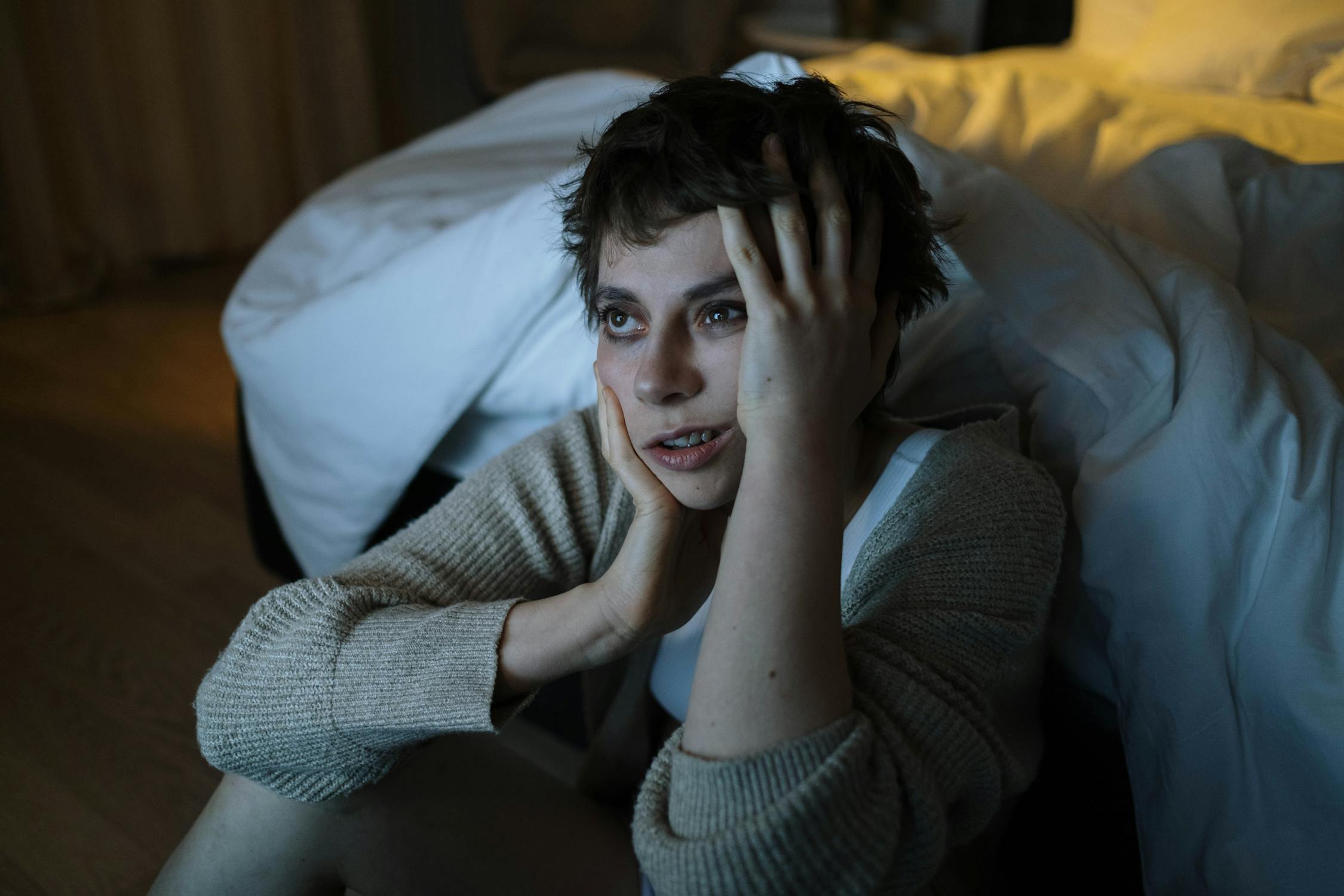
Nine of Swords Tarot Card Meaning: Upright, Reversed, Love, Career, and More
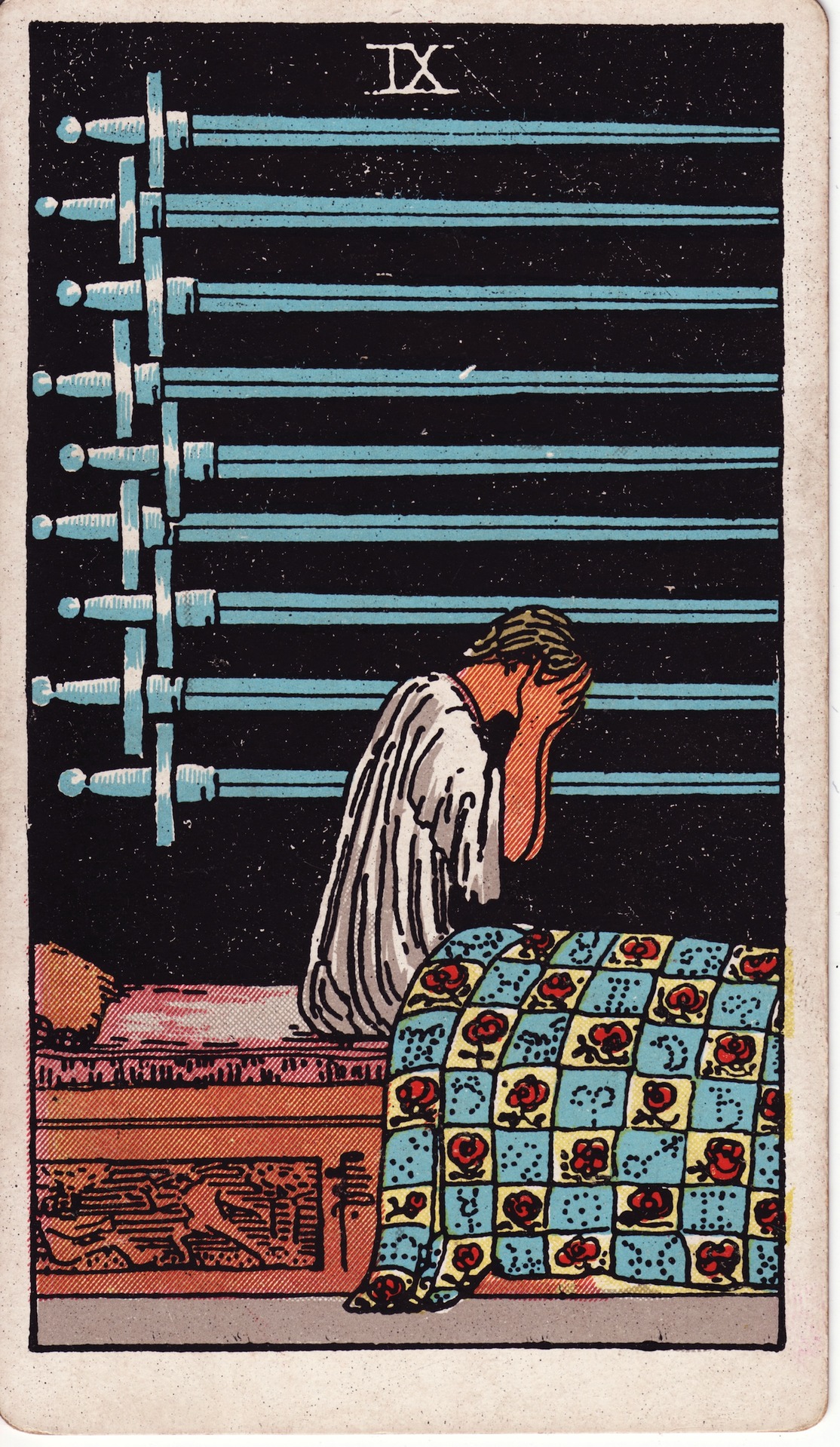
A person sits upright in bed, face buried in their hands. It's the middle of the night. The room is completely dark except for what the card's composition allows us to see: nine swords hang horizontally on the wall behind and above the figure, suspended like a display of the mind's accumulated weapons against itself. The person's quilt is decorated with a pattern of roses and astrological symbols, beautiful details that go completely unnoticed by the figure because none of it matters at three in the morning when the mind has decided that everything is falling apart. The bed's carved panel shows a scene of one figure defeating another, a depiction of conflict that lives beneath the sleeper, built into the very structure they rest on. The entire image is a portrait of a single, universal human experience: waking up in the dark and being consumed by worry that feels absolutely real and absolutely insurmountable, even though the morning will likely reveal it as manageable.
Nine of Swords - Rider-Waite-Smith Tarot
The Eight of Swords was the mind imprisoning itself, the blindfold and the incomplete cage of thoughts posing as walls. The Nine of Swords is what happens when that imprisoned mind finally breaks down. The walls didn't open. The blindfold didn't come off. Instead, the pressure built until the only possible release was anguish, the raw, uncontrollable eruption of every fear, every guilt, every regret, every worst-case scenario the mind had been compiling in the dark. If the Eight of Swords is the cage, the Nine of Swords is the screaming inside it. This is the tarot's most visceral depiction of mental suffering, and it sits one card before the Ten of Swords for a reason: the anguish of the Nine is the mind reaching the absolute limit of what it can endure before something fundamentally changes.
Table of Contents
Key Themes and Symbolism
The Nine of Swords is the tarot's anxiety card, and every visual element reinforces the experience of mental anguish that feels total and inescapable.
The sitting figure. The person has woken from sleep, or been unable to sleep at all, and is now sitting upright in the most vulnerable space imaginable: their own bed, in the dark, alone. This is the specific geography of anxiety. It strikes when you're most exposed, when the distractions of daytime activity have fallen away and there's nothing left between you and your thoughts. The hands covering the face are a universal gesture of despair, the body's instinctive attempt to block out what the mind refuses to stop producing.
The nine swords. The swords are mounted on the black wall behind the figure, arranged in a horizontal row. They're not threatening the person physically. Nobody is holding them. They're displayed like trophies or like the accumulated evidence the mind has collected in its case against you. Each sword represents a separate worry, fear, guilt, or regret, and the nine of them together form the comprehensive argument for hopelessness that anxiety presents at its most persuasive. The horizontal arrangement is significant: the swords are at rest, static, unchanging. The fears they represent aren't dynamic. They're the same fears recycling through the mind in an endless loop, never resolving, never changing, just replaying.
The black background. The room is entirely dark. This isn't just nighttime. It's the visual representation of the mind's tunnel vision during anxiety. When you're in the Nine of Swords state, there is no broader context. No perspective. No "yes, but also..." The darkness is absolute, and within it, the swords are the only visible thing. This is how anxiety works: it eliminates everything from your awareness except the threat, creating an artificial reality where only the negative exists.
The quilt. The bedcover is richly decorated with roses and zodiac symbols, representing the beauty, order, and meaning that exist in the person's life but that are completely invisible to them during this episode. You have good things. You have structure. You have a life that, in daylight, has texture and richness and purpose. The quilt says all of that is still there. You just can't see it right now because the darkness has consumed your entire field of vision. The roses and symbols are a promise: what the night obscures, the morning reveals.
The carved panel. The bed's base shows a carved image of combat, one figure striking another. This detail is easy to miss but profoundly important. The conflict is built into the structure of where the person rests. It's foundational. It suggests that the anxiety isn't a random intrusion into an otherwise peaceful life. It's growing from something deeper: unresolved conflict, suppressed aggression, old wounds that have been pushed beneath the surface and are now erupting through the structure that was supposed to contain them.
The number nine. Nines in the tarot represent near-completion, the penultimate step in each suit's journey. The Nine of Wands is weary persistence. The Nine of Cups is satisfaction and wish fulfillment. The Nine of Pentacles is material independence. Here in Swords, the near-completion is ominous: the mental journey through conflict (Five), deception (Seven), and imprisonment (Eight) is approaching its breaking point. The Nine is the crisis before the conclusion, the moment when the pressure becomes unsustainable. What follows in the Ten of Swords is the total collapse that allows something new to begin.
Upright Meaning
When the Nine of Swords appears upright, you're in the grip of anxiety, guilt, despair, or overwhelming mental anguish. The card doesn't soften this. It names the experience directly.
General
The Nine of Swords upright is the tarot's most honest portrayal of what anxiety feels like from the inside. It's three in the morning and you're convinced your life is falling apart. Every mistake you've ever made is replaying simultaneously. Every relationship feels fragile. Every responsibility feels impossible. The future is a catalogue of disasters waiting to happen, and the past is a record of failures you can't undo. This is the Nine of Swords experience, and the card validates it by depicting it without flinching.
But here's the card's critical nuance: the swords are on the wall, not in the person's body. Compare this to the Three of Swords, where the blades pierce the heart directly, or the Ten of Swords, where they're embedded in the figure's back. In the Nine, the suffering is entirely mental. The fears are real as experiences. They're real as psychological states. But the card asks whether they're real as facts. Is your life actually falling apart, or does it feel like it's falling apart because your mind has entered the state where everything looks catastrophic? The Nine of Swords doesn't dismiss mental suffering. It says the suffering is the problem, not the situations the suffering claims to be about.
This distinction matters because it changes the response. If your life were genuinely collapsing, you'd need external solutions: money, help, escape. If the Nine of Swords is accurate, what you need is internal: relief from the mental pattern that's generating anguish out of proportion to the actual situation. Therapy, medication, grounding techniques, honest conversation with someone who can reflect reality back to you, these are the Nine of Swords' practical interventions.
Love and Relationships
In love readings, the Nine of Swords upright often indicates anxiety about a relationship that's consuming your peace. You're lying awake worrying about whether your partner is faithful, whether the relationship is sustainable, whether you said the wrong thing, whether they're losing interest. The worry is corrosive. It eats at the relationship from the inside because you can't be present with your partner when your mind is consumed by fear of losing them.
The card can also indicate guilt within a relationship. Something you did or didn't do is haunting you. An infidelity, a lie, a moment of cruelty, an opportunity you missed. The guilt plays on repeat, especially at night, and it's preventing you from engaging honestly with your partner because honest engagement would mean confronting the thing you're trying not to think about.
For singles, the Nine of Swords often reflects the anxiety of loneliness: the 3am thought spiral about whether you'll find someone, whether you're lovable, whether the pattern of failed relationships means something is fundamentally wrong with you. These fears feel rational at night and proportional at night, and the card acknowledges that, while also noting that the morning usually offers a kinder perspective.
Career and Finances
In career readings, the Nine of Swords describes work-related anxiety that has broken through the boundary between professional and personal life. You're taking your work worries to bed with you. The presentation you're not ready for. The deadline you might miss. The performance review you're dreading. The layoffs that might include you. The card says the worry is real but also asks whether the proportion is accurate. Are you facing a genuine professional crisis, or is anxiety inflating a manageable challenge into an existential threat?
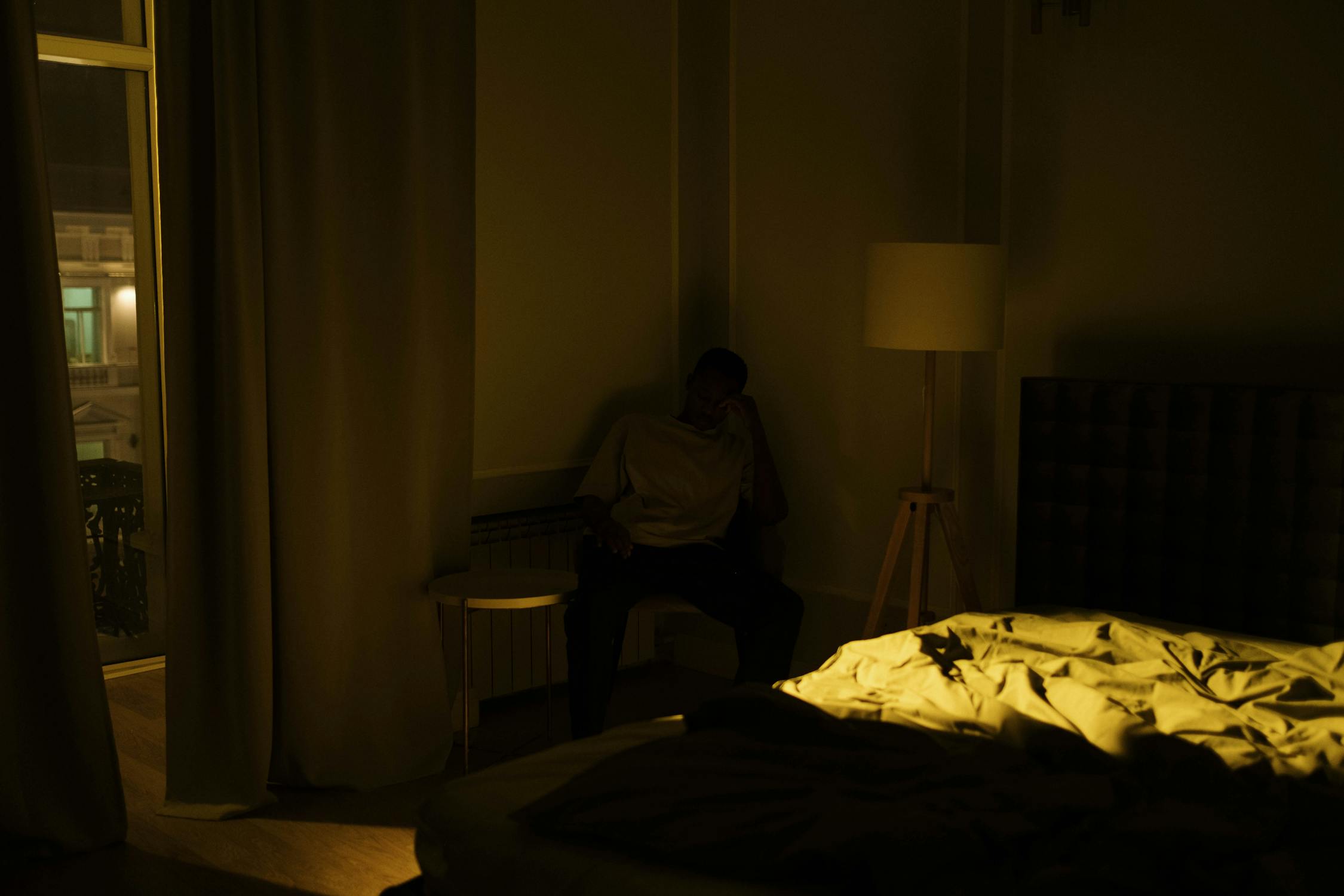
A man experiencing insomnia sitting in a dimly lit bedroom corner at night reflecting on the sleepless worry and mental anguish of the Nine of Swords
Financially, the Nine of Swords points to money anxiety: waking up in the middle of the night doing math in your head, catastrophizing about bills, worrying about the future with an intensity that prevents rational planning. Financial anxiety is particularly susceptible to the Nine of Swords pattern because the fears have numbers attached to them, which makes them feel more concrete than emotional worries. But the card's message holds: the anxiety itself is the problem. It paralyzes you when you most need to act, and it distorts your assessment of how dire the situation actually is.
Health
In health readings, the Nine of Swords is one of the most direct cards about mental health in the entire deck. It can indicate anxiety disorders, insomnia, depression, panic attacks, PTSD, and the full spectrum of conditions where the mind generates suffering that's independent of physical circumstances. The card doesn't minimize these conditions. It depicts them honestly and with compassion.
Physically, the Nine of Swords connects to the bodily effects of sustained worry: insomnia, headaches, digestive problems, elevated cortisol, compromised immune function, and the general physical deterioration that chronic mental distress produces. The mind and body aren't separate systems, and the suffering the Nine depicts in the mental realm creates real damage in the physical one.
The card's health message is also an urgent call to seek help. The figure sitting alone in the dark, overwhelmed and unable to sleep, is someone who needs support. Whether that's a therapist, a doctor, a crisis line, or simply a person who'll sit with them while the darkness passes, the Nine of Swords insists that suffering alone in silence is not the only option.
Reversed Meaning
The Nine of Swords reversed begins to release the pressure. The anxiety eases, the nightmares recede, and the first tentative light of perspective enters the darkness.
General
Reversed, the Nine of Swords most commonly indicates that the worst of the anxiety is passing. The night is ending. The fears that felt so absolute at three in the morning are starting to lose their power as daylight returns and perspective reasserts itself. You're not anxiety-free, but the grip is loosening. You can breathe a little deeper. You can think a little more clearly. The loop of catastrophic thoughts is slowing down enough that you can start to evaluate individual fears rather than being overwhelmed by all of them simultaneously.
This reversal often coincides with taking concrete action against the anxiety. You called the therapist. You talked to someone about what you've been carrying. You started the medication. You wrote the fears down and looked at them in writing, where they lost some of their nighttime power. The reversed Nine of Swords rewards action, however small, because any action breaks the paralysis that the upright card depicts.
In some readings, the reversal can indicate suppressed anxiety, worries pushed below the surface rather than genuinely resolved. The nightmares stop because you've learned to numb yourself rather than because you've addressed their source. This interpretation applies when the reversed card appears alongside cards of avoidance or denial.
Less commonly, the reversal can intensify the card's meaning, indicating anxiety that has become so normalized you no longer recognize it as abnormal. You've adapted to the constant low-grade dread, which means you're not seeking help because you've accepted suffering as your baseline.
Love and Relationships
Reversed in love readings, the Nine of Swords often signals relief. The relationship anxiety that was consuming you is beginning to ease, either because the situation has genuinely improved or because you've found ways to manage the worry so it doesn't dominate your entire emotional landscape.
For couples, the reversal can indicate a breakthrough conversation where someone finally shares the fears they've been carrying alone. The silence breaks. The worry that was festering in isolation gets exposed to the light of honest communication, and the partner's response, "I'm here, we can handle this together," begins the healing process.
For those recovering from relationship trauma, the reversed Nine of Swords indicates that nightmares about past experiences are becoming less frequent and less intense. The healing isn't complete, but the acute phase of post-relationship anguish is passing.
Career and Finances
In career readings reversed, the Nine of Swords suggests that work anxiety is becoming manageable. The presentation went better than you feared. The performance review wasn't catastrophic. The situation you'd built into a disaster in your mind turned out to be navigable. The reversal is the relief of discovering that the reality was smaller than the fear.
Financially, the reversal indicates that financial anxiety is either resolving because the situation is actually improving, or it's being managed through concrete planning that replaces worry with action. The shift from anxious inaction to organized response is the Nine of Swords reversed in its most practical form.
Health
Reversed in health readings, the Nine of Swords indicates improvement in mental health conditions. Sleep is returning. Anxiety attacks are less frequent. The therapy is working. The medication is taking effect. The darkness isn't gone, but it's lighter than it was, and the trend is encouraging.
It can also indicate finally seeking help for mental health conditions you've been suffering through alone. The reversal gives the courage to make the call, book the appointment, or admit to someone that you're not okay.
Card Combinations
The Nine of Swords' meaning shifts depending on the cards beside it.
Nine of Swords + The Moon. Anxiety fueled by the unknown. The Moon adds confusion, illusion, and the fear of what you can't see to the Nine's already intense anguish. This combination describes fears that have no clear object, free-floating anxiety that attaches itself to whatever is nearest. The worry isn't about anything specific. It's about everything, or more accurately, it's about the vast, dark uncertainty that The Moon represents. Working with this combination requires anchoring: focusing on what you can see and know rather than what you're imagining.
Nine of Swords + The Sun. Dawn after the darkest night. This is one of the most reassuring combinations available for the Nine of Swords. The Sun promises that the anxiety will pass, that joy will return, that the fears consuming you right now will dissolve in the light of what's actually real. This doesn't mean the suffering wasn't real. It means the suffering has an expiration date, and The Sun's warmth and clarity are approaching. Hold on.
Nine of Swords + The Hermit. Solitary reflection that either deepens or resolves the suffering. The Hermit represents withdrawal and introspection, which can go two ways with the Nine of Swords. If the Hermit's withdrawal is wise, it means that quiet, focused self-examination will help you understand the roots of your anxiety and begin to address them. If the withdrawal is excessive, it means isolation is feeding the anguish by removing the human connection that could ground you. Context determines which interpretation applies.
Nine of Swords + Six of Cups. Anxiety rooted in the past. The Six of Cups represents nostalgia, childhood, and past emotional experiences, and paired with the Nine of Swords, it suggests that the fears keeping you awake originate in old experiences rather than current circumstances. Childhood wounds, past trauma, or unresolved grief from earlier in life are surfacing through the anxiety. Addressing the present worry alone won't fully resolve the anguish. The deeper, older pain beneath it needs attention too.
Astrological Connections
The Nine of Swords is associated with Mars in Gemini, a combination that produces relentless, aggressive mental energy. Mars is the planet of action, aggression, and drive. Gemini is the sign of the mind, communication, and mental processing. When Mars enters Gemini, the warrior energy that would normally express itself through physical action gets channeled into thought. The result is a mind that attacks its own contents with the intensity of a battlefield, thoughts that cut like weapons, inner dialogue that's hostile and relentless, and a mental state where the brain can't stop fighting even when there's nothing to fight except itself.
Mars in Gemini talks fast, thinks faster, and worries fastest of all. The mental energy is inexhaustible, which is the problem: you can't tire out this placement. It will stay awake all night generating scenarios, arguments, counterarguments, fears, and responses to fears. The nine swords on the wall are Mars in Gemini's arsenal, weapons the mind has forged from every piece of negative information it's ever collected, ready to deploy against you the moment silence gives them an opening.
The constructive expression of Mars in Gemini is fierce intellectual advocacy, the ability to argue passionately, research obsessively, and communicate with urgency. When this energy is directed outward toward worthy causes, it produces activists, journalists, debaters, and people who fight with words on behalf of others. The Nine of Swords shows what happens when that same fierce energy has no external target and turns inward.
If you have Mars in Gemini in your natal chart, you may recognize the Nine of Swords' relentless mental quality: the brain that won't stop, that generates worry as its default product when it doesn't have a constructive problem to solve. Giving the mind productive work during daylight hours can reduce the likelihood that it will generate its own dark content at night.
Reading Tips for the Nine of Swords
The Nine of Swords requires the reader to be part counselor, handling the card's intense emotional content with care and responsibility.
Take this card seriously. The Nine of Swords can indicate genuine mental health crises. When it appears, especially in prominent positions or alongside other difficult cards, don't treat it casually. Ask the querent how they're doing. Not how their love life is, not how work is going. How they are. The card gives permission to ask directly, and the querent may need to hear someone ask.
Distinguish between proportion and dismissal. The Nine of Swords' key insight, that the anxiety is often disproportionate to the actual situation, must be communicated carefully. "Your fears are bigger than reality" is very different from "you're overreacting." The first validates the experience while offering perspective. The second invalidates the experience entirely. Always choose the first.
Look for the source. The Nine of Swords describes the symptom (anxiety, insomnia, anguish), but surrounding cards often reveal the cause. Is there a relationship card nearby that suggests the anxiety is relational? A career card that points to professional stress? A Major Arcana card that indicates a deeper, transformative process? The Nine of Swords rarely exists in isolation. It's the eruption of something that's been building, and identifying what's been building gives the querent something actionable.
Note this card's position in the Swords sequence. The Nine sits between the Eight (self-imposed imprisonment) and the Ten (complete ending). This position matters. It says the anguish is not the beginning. It's the climax of a process, and what follows (the Ten) is the breakdown that finally allows something new to emerge. The suffering of the Nine is real, but it's also temporary in the specific sense that it can't sustain itself at this intensity. Something will give.
Offer practical resources when appropriate. If a reading context allows it, the Nine of Swords is an appropriate card for mentioning that professional help exists: therapists, crisis lines, doctors, and the understanding that what they're experiencing is a recognized condition with effective treatments. Tarot can provide insight, but the Nine of Swords sometimes calls for intervention that goes beyond what a reading can offer.
Frequently Asked Questions
Is the Nine of Swords the worst card in the deck?
It's one of the most psychologically painful cards, but "worst" depends on how you define the term. The Nine of Swords depicts suffering that's primarily mental and often disproportionate to external circumstances, which means it responds to treatment, perspective shifts, and support. Cards like the Ten of Swords or The Tower depict external events that can't be undone through internal work alone. The Nine of Swords is intensely painful to experience, but it's also one of the most responsive cards to intervention. The suffering it depicts is real, but the card's imagery reveals that the swords are on the wall, not in the body. The anguish is the mind's production, and productions can be changed.
Does the Nine of Swords mean depression?
It can. The card's imagery, a person alone in the dark, overwhelmed by internal suffering, unable to sleep, maps closely onto the experience of depression and anxiety disorders. However, the card can also represent acute but temporary episodes of worry: the night before a big event, the aftermath of bad news, the period of intense stress that resolves once the stressor passes. The distinction between clinical depression and situational anguish is beyond what a single tarot card can diagnose, but the Nine of Swords acknowledges both experiences and takes both seriously. If the card resonates with ongoing, persistent suffering rather than a specific situational trigger, professional help is the appropriate response.
What does the Nine of Swords mean at night vs. morning?
This is a question about the card's temporal dimension, and it's perceptive. The Nine of Swords specifically depicts nighttime suffering because that's when anxiety is strongest: distractions are gone, the world is silent, and the mind has nothing to do but loop through its fears. When the card appears in a reading, it's highlighting the quality of nighttime worry, the things that feel catastrophic at 3am and merely concerning at 3pm. The morning doesn't make the problems disappear, but it changes their proportion. Daylight, activity, human connection, and the simple biological shift from cortisol-heavy night hours to more balanced daytime chemistry all reduce the Nine of Swords' intensity. The card's wisdom is that if you can hold on through the night, the morning will offer a different view.
How does the Nine of Swords differ from the Three of Swords?
The Three of Swords is heartbreak. The pain is caused by a specific event: a betrayal, a painful truth, a loss. Three swords pierce the heart directly, and the suffering is proportional to the cause. The Nine of Swords is anxiety. The pain is generated by the mind and may or may not correspond to a specific external event. Nine swords hang on the wall, but none of them touch the person. The Three of Swords says "this happened and it hurts." The Nine of Swords says "my mind won't stop telling me everything is terrible." The Three is acute and specific. The Nine is pervasive and often disproportionate.
Can the Nine of Swords indicate nightmares?
Yes, literally. The card is the tarot's nightmare card, and it can indicate actual disturbing dreams that disrupt sleep and leave their emotional residue into waking hours. Recurring nightmares, night terrors, and trauma-related dreams that replay distressing events all fall under the Nine of Swords. The card connects nighttime dreams to daytime psychological states, recognizing that what haunts you at night is revealing what your conscious mind hasn't fully processed during the day. If the Nine of Swords appears alongside questions about sleep or recurring dreams, address the underlying anxiety that's generating the nightmares rather than the nightmares themselves.
The Nine of Swords is the tarot's darkest hour, and it uses that phrase in its most literal sense. It's the card of the mind at 3am, sitting up in bed, overwhelmed by the weight of every fear, every regret, every imagined catastrophe that the silence and the darkness have amplified into absolute certainty. The person in the card is suffering genuinely. The swords are real as experiences even though they're on the wall and not in the body. But the card's gift, buried in its darkness, is the truth that this particular kind of suffering is the mind's production rather than reality's verdict. The night will end. The morning will offer a different perspective. And the nine swords, examined in daylight, will shrink from the existential threats they posed in the dark to the manageable concerns they actually are. For a deeper exploration of all 78 cards, visit the Celesian tarot reader. To understand how Mars in Gemini shapes your mental patterns and your relationship with relentless thought, explore your natal placements with the natal chart calculator. And to continue through the Swords suit, look back at the Eight of Swords, whose mental prison built the pressure that the Nine finally releases, and ahead to the Ten of Swords, where the mind's long journey through conflict, deception, imprisonment, and anguish reaches its final, decisive ending and the promise that endings are also beginnings.