
Eight of Cups Tarot Card Meaning: Upright, Reversed, Love, Career, and More
A cloaked figure walks away. That's the image that defines this card, and it's one of the most quietly devastating scenes in the entire tarot. Eight golden cups stand stacked behind the figure in two neat rows, arranged carefully, clearly the product of time and effort and emotional investment. And the figure is leaving them. Not in anger, not in a dramatic exit with doors slamming and accusations flying, but with a deliberate, weary, almost sacred resolve. The figure walks toward a mountainous landscape under a night sky dominated by both a crescent moon and a full eclipse, a sky that holds darkness and light simultaneously. The path ahead climbs upward and disappears from view. Whatever waits at the top of those mountains, the figure can't see it from here. That's the point. The Eight of Cups isn't about walking toward something better. It's about walking away from something that's no longer enough.
The Seven of Cups presented a dazzling array of fantasies and possibilities, cups floating in clouds, each one glittering with a different promise. The Eight of Cups is what happens after you've tried the fantasies and found them hollow, or after you've built something real that once meant the world to you and discovered, gradually and painfully, that it doesn't anymore. This isn't the grief of losing something. The cups are still there, still full, still standing. Nothing was taken from you. This is the deeper, harder grief of outgrowing something. Of admitting that what you built, what you loved, what you poured yourself into, isn't where your soul needs to be anymore.
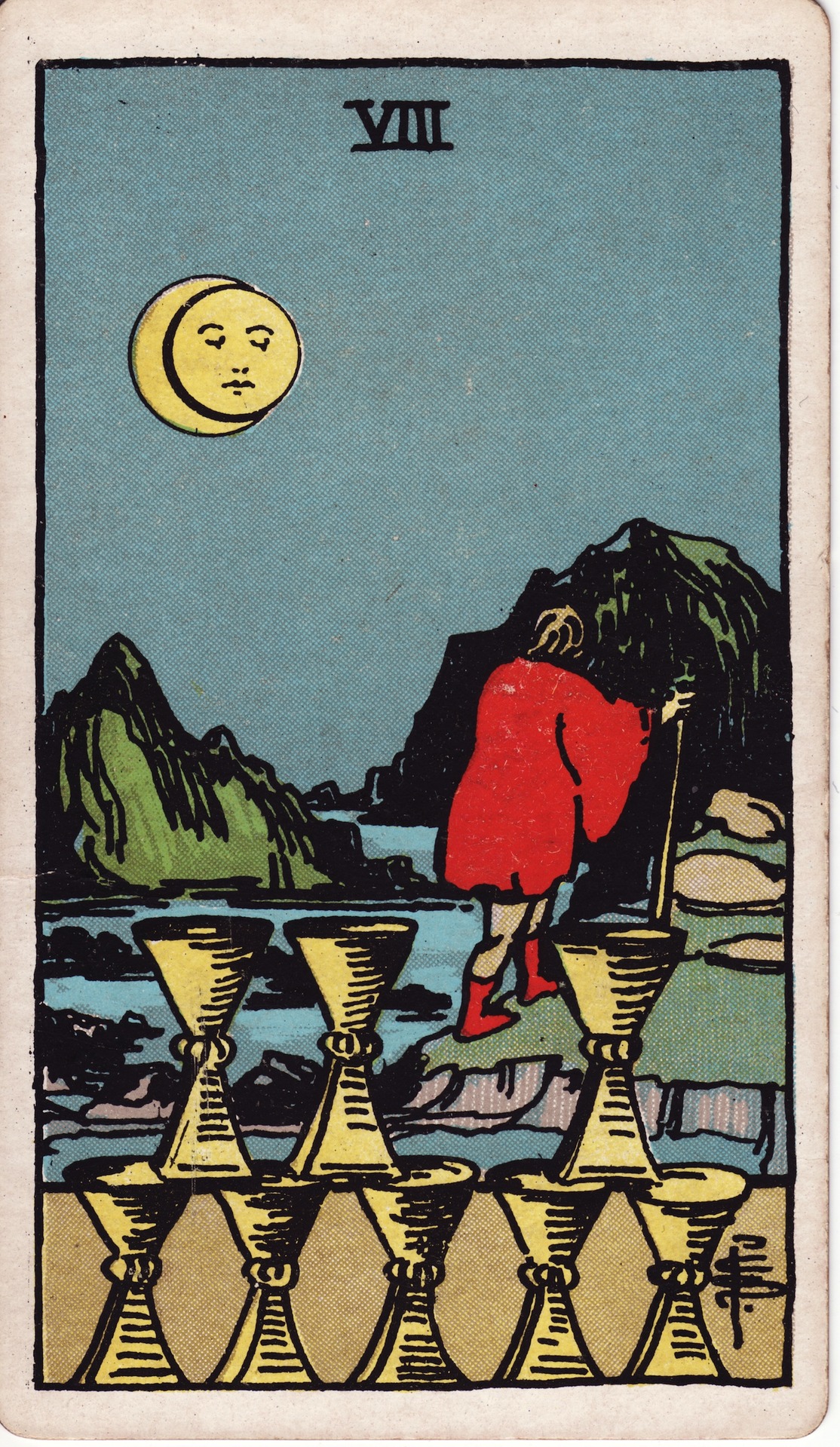
Eight Of Cups - Rider-Waite-Smith Tarot
Table of Contents
Key Themes and Symbolism
The Eight of Cups is the tarot's most eloquent portrait of voluntary departure, the decision to leave behind what's familiar, stable, and emotionally invested in because staying would cost more than going. Every detail of the Rider-Waite-Smith image contributes to this layered meaning.
The eight cups. They're stacked neatly, five on the bottom row and three on top, with a visible gap where a ninth cup would complete the arrangement. This gap is significant. The figure has built something substantial, nearly complete, but there's a missing piece that can't be filled by staying. The eight cups represent emotional investments that were real and meaningful: relationships, projects, identities, communities. They aren't broken or spilled. They're whole. The figure isn't leaving wreckage. They're leaving something that works, just not for them, not anymore.
The cloaked figure. The figure wears a red cloak over darker clothing, red being the color of passion, desire, and life force. They carry a walking staff, which signals both preparation and pilgrimage. This isn't an impulsive flight. It's a journey the figure has considered, packed for, and committed to. The staff also connects the Eight of Cups to The Hermit, another card of solitary seeking, though the Hermit has already found the light he carries. The Eight of Cups figure is still walking toward it.
The mountainous terrain. The path climbs into steep, barren mountains, representing the difficulty of the journey ahead. Leaving isn't the hard part. Walking uphill into unknown territory after leaving, that's the hard part. The mountains don't promise comfort. They promise growth, but only the kind that comes through effort and discomfort.
The eclipsed moon. The sky holds both a crescent moon and what appears to be an eclipse or a peculiar lunar arrangement, sometimes depicted as a moon partially covered by another celestial body. This duality, light and darkness in the same sky, represents the emotional complexity of the departure. The figure isn't happy to leave. They aren't sad, either, or not only sad. They're experiencing both the grief of letting go and the quiet relief of finally being honest about what they need.
The water. In many versions of the card, a river or body of water flows between the cups and the mountains. Water in the Cups suit represents emotion, and the river here suggests that the figure must cross an emotional boundary to reach the new terrain. There's no bridge. You wade through.
The number eight. In numerology, eight represents cycles, power, regeneration, and karmic balance. It's the number of Saturn, the planet of time and consequences. The Eight of Cups carries Saturnian weight: the consequences of emotional investment, the passage of time that changes what things mean, and the cyclical nature of human growth that periodically requires you to leave behind one version of yourself to become the next.
Upright Meaning
When the Eight of Cups appears upright, it signals that the time has come to walk away from something that no longer fulfills you. This isn't advice to run from difficulty or avoid the hard work of making things work. The Eight of Cups assumes you've already done the hard work. You've tried. You've invested. You've given it time. And despite all of that, something essential is missing, something that can't be fixed by trying harder within the existing structure. The card validates the quiet, painful knowledge that sometimes the bravest thing you can do isn't fight for something. It's admit that fighting for it is no longer the right fight.
General. The upright Eight of Cups represents departure, disillusionment, and the spiritual courage required to seek something deeper. It appears when you've reached the limits of what a situation, relationship, or identity can offer you and your inner self is urging you to move on. This isn't about external circumstances forcing your hand. Nobody kicked you out. The cups are still there, still available. You're choosing to leave because staying would mean accepting a version of your life that doesn't match what your soul actually needs. The card often appears during periods of deep introspection when the person has been quietly asking themselves, for weeks or months, whether this is really it.
Love. In a love reading, the Eight of Cups upright is one of the most significant cards in the deck. It suggests that someone is emotionally withdrawing from the relationship, not because of a dramatic betrayal but because of a gradual, honest recognition that the relationship isn't providing the depth, growth, or connection they need. This can mean physically leaving a partner, but it can also mean emotionally disengaging from patterns within the relationship that have become stale or unfulfilling. For singles, the Eight of Cups can indicate that you're walking away from a type of relationship you've been pursuing, a certain kind of partner, a dating pattern, a romantic ideal that's proven empty, in search of something more authentic. It's the card of the person who finally stops settling.
Career. In career readings, the Eight of Cups indicates leaving a job, career path, or professional identity that no longer resonates. You might have spent years building this career. It might pay well. It might look impressive to everyone else. But something inside you has shifted, and the work that once gave you purpose now feels hollow. This card encourages you to trust that feeling even when it doesn't make practical sense, because staying in a career that's emotionally dead extracts a cost that no salary compensates for. The Eight of Cups in career can also indicate the end of a business partnership or the decision to walk away from a project you've invested significant time in.
Finances. Financially, the Eight of Cups suggests a willingness to prioritize emotional and spiritual fulfillment over financial security. This doesn't mean being reckless with money. It means recognizing that money alone isn't enough to make a situation worth staying in. You might accept a pay cut to pursue work that matters to you. You might leave a lucrative arrangement that was ethically uncomfortable. The card asks you to examine what financial security is costing you in other currencies: time, energy, integrity, peace.
Health. In health readings, the Eight of Cups can indicate the need to walk away from health habits, treatments, or approaches that aren't working. It can also point to the emotional roots of physical symptoms, specifically the toll that staying in emotionally depleting situations takes on your body. Depression, fatigue, and a sense of being emotionally drained are all associated with this card. Sometimes the prescription isn't medicine. It's departure.

A lone person walking along a vast sandy beach with mountains in the background capturing the solitary journey of the Eight of Cups
Reversed Meaning
When the Eight of Cups appears reversed, the departure energy is blocked, delayed, or complicated. You know you need to leave. You might have known for a long time. But something is keeping you rooted in place: fear, comfort, obligation, the sunk cost of everything you've already invested, or the terrifying uncertainty of what comes next. The reversed Eight of Cups doesn't judge this hesitation. It understands it. Walking away from something you built with your own hands and heart is one of the hardest things a person can do. But the card also gently insists that delay has its own cost.
General. The reversed Eight of Cups represents fear of change, emotional stagnation, clinging to the familiar, and the refusal to acknowledge that you've outgrown something. It can indicate that you're staying in a situation out of guilt, obligation, or the belief that you should be satisfied with what you have. There's often an element of self-deception: telling yourself that things will get better if you just wait a little longer, try a little harder, lower your expectations a little further. The reversed card can also, in certain contexts, indicate returning to something you previously left, a reconciliation, a second attempt, or the decision that leaving was premature and there's still unfinished business.
Love. In love readings, the reversed Eight of Cups often indicates staying in an unfulfilling relationship because the alternative feels worse. Fear of being alone, fear of hurting your partner, fear of the unknown, financial entanglement, children, shared history, all of these can keep you in a relationship that your heart has already quietly left. The card doesn't demand that you leave immediately. It asks you to be honest about why you're staying and whether those reasons are serving your growth or just managing your anxiety. For singles, the reversed Eight of Cups can suggest that you're returning to an ex or revisiting old relationship patterns rather than doing the harder work of moving forward into new emotional territory.
Career. In career readings, the reversed Eight of Cups suggests professional stagnation caused by the unwillingness to make a change you know is necessary. You might be staying in a job you've outgrown because the salary is comfortable, because starting over feels overwhelming, or because you've defined your identity through this career and can't imagine who you'd be without it. The card can also indicate an attempted career change that didn't work out, sending you back to what you left. If that's the case, the return doesn't have to be a failure. It can be a more informed engagement with work you now appreciate differently.
Career. The reversed Eight of Cups in career can also indicate aimless job-hopping, leaving things too quickly without giving them enough time to develop. Not every dissatisfaction signals that it's time to go. Sometimes the discomfort is growth, and leaving prematurely prevents you from reaching the depth of experience where real fulfillment lives.
Finances. Financially, the reversed Eight of Cups can indicate clinging to financial situations or investments that aren't performing, holding losing positions too long because selling would mean admitting the loss. It can also suggest that financial fears are the primary reason you're staying in a life situation that doesn't serve you. Money is a real constraint. The card acknowledges that. But it asks whether you've explored every option or whether fear has narrowed your vision of what's possible.
Health. In health readings, the reversed Eight of Cups can indicate ignoring the physical symptoms that are telling you something needs to change. The body often knows before the mind does. If you're experiencing chronic fatigue, unexplained pain, or persistent low mood, the reversed Eight of Cups suggests these might be your body's way of saying what your conscious mind won't: this situation is depleting you, and staying is making you sick.
Card Combinations
The Eight of Cups takes on different dimensions depending on the cards surrounding it.
Eight of Cups + The Hermit. This is one of the most powerful combinations in tarot. Both cards depict solitary figures on a journey, but the Hermit has found the inner light that the Eight of Cups figure is still seeking. Together, they describe a spiritual pilgrimage: leaving behind the material and emotional structures of your current life to pursue a deeper understanding of yourself. The journey is solitary by necessity. What you're looking for can't be found in company. It lives in the quiet conversation between you and whatever you call the truth.
Eight of Cups + The Tower. Where the Eight of Cups represents a voluntary departure, the Tower represents forced destruction. Together, they suggest that if you don't leave willingly, the universe will arrange circumstances that force you out. The Tower accelerates what the Eight of Cups was trying to do gently. If you've been postponing a departure you know you need to make, this combination is a warning that the window for a graceful exit is closing.
Eight of Cups + Ace of Cups. A beautiful, hopeful pairing. The Eight of Cups says you're leaving behind old emotional investments. The Ace of Cups says a completely fresh emotional beginning is waiting on the other side. This combination appears when the departure, however painful, leads directly to the kind of love, connection, or emotional fulfillment you couldn't have found within the old structure. You had to empty your hands before they could receive something new.
Eight of Cups + Four of Pentacles. This combination highlights the tension between emotional truth and material security. The Eight of Cups wants to leave. The Four of Pentacles is clutching its resources, terrified of losing what it has. Together, they describe the classic dilemma of someone who knows they need to go but can't let go of the financial safety, the possessions, or the status that staying provides. The question becomes: what's worth more to you, the security or the freedom?
Astrological Connections
The Eight of Cups is associated with Saturn in Pisces, a placement that perfectly captures the card's emotional texture. Saturn is the planet of structure, responsibility, limits, and hard truths. Pisces is the sign of dreams, intuition, compassion, and the desire to dissolve into something greater than the individual self. When Saturn occupies Pisces, it creates a peculiar tension: the need to impose structure on the structureless, to find discipline within surrender, to face hard realities about emotional and spiritual matters that people would rather leave vague.
Saturn in Pisces is the astrological equivalent of waking up from a beautiful dream and realizing you have to get out of bed. The dream was real. The feelings were genuine. But Saturn demands that you deal with what's actually in front of you rather than what you wish were there. In the Eight of Cups, this manifests as the painful clarity that comes when you stop pretending a situation fulfills you and start dealing with the truth that it doesn't.
This placement also connects the Eight of Cups to themes of spiritual maturity. Pisces seeks transcendence. Saturn demands that transcendence be earned through discipline, not escaped into as a way of avoiding reality. The figure walking away in the Eight of Cups isn't floating off into a Piscean fantasy. They're climbing real mountains. The spirituality in this card is grounded, practical, and sometimes exhausting, the kind of spiritual growth that happens through lived experience rather than meditation alone.
If you have natal Saturn in Pisces, or significant Pisces placements that Saturn has transited, the Eight of Cups may carry a particularly personal resonance. Explore your placements with the natal chart calculator to understand how this energy operates in your chart.
Reading Tips for the Eight of Cups
Don't treat it as purely negative. The Eight of Cups isn't a sad card, though it contains sadness. It's a courageous card. It takes more strength to leave something you've built than to stay in it out of habit or fear. When this card appears, acknowledge the difficulty while also honoring the wisdom and bravery of the departure. The figure in the card isn't defeated. They're evolved.
Ask what the "cups" represent. The eight cups left behind are specific to the querent's situation. In a love reading, they might represent years of shared history. In a career reading, they might represent a professional reputation. In a personal growth reading, they might represent beliefs or identities that once served the person but no longer do. Getting specific about what the cups symbolize makes the reading much more useful than a generic "you're walking away from something."
Notice the gap in the cups. The eight cups are arranged with a visible gap, one cup short of completion. This detail matters. The querent has been trying to fill that gap, trying to make the situation feel complete, and it hasn't worked. The Eight of Cups appears when you finally accept that the missing piece can't be found within the current arrangement. It exists somewhere else.
Pay attention to surrounding cards for timing. The Eight of Cups on its own doesn't specify whether the departure has already happened, is happening now, or needs to happen soon. The surrounding cards clarify this. Past-position cards suggest the departure is behind you and the reading is about what comes next. Present-position cards suggest you're in the thick of the decision. Future-position cards suggest the departure is coming whether you're ready or not.
Honor the journey, not just the destination. The figure in the Eight of Cups doesn't know where they're going. The mountains ahead are uncharted. If your querent asks "but what comes next?" the honest answer is that the Eight of Cups doesn't promise a specific destination. It promises that the act of leaving, the journey itself, will teach them what they need to learn. Sometimes the path reveals itself only to people who are already walking.
Frequently Asked Questions
Is the Eight of Cups a yes or no card?
In yes-or-no readings, the Eight of Cups leans toward no, or more precisely, "not this." The card's core message is that the current path, relationship, or situation isn't where your fulfillment lies. If you're asking whether to stay in something, the answer is usually no. If you're asking whether to pursue something new, the answer is conditional: yes, but only if pursuing it requires letting go of something old that you've been clinging to. The Eight of Cups says that the thing you're asking about may not be the right question. The right question might be what you need to leave behind before any new "yes" becomes possible.
What does the Eight of Cups mean for reconciliation?
The Eight of Cups is generally not a reconciliation card. Its energy moves away from the past, not toward it. If you're asking about getting back together with an ex, the Eight of Cups suggests that the relationship ended because something essential was missing, and that missing element hasn't appeared since the breakup. However, context matters. If the Eight of Cups appears reversed in a reconciliation reading, it can indicate that the person who left is reconsidering, feeling drawn back because they haven't fully processed the relationship, or realizing they left too soon. Even in this case, though, returning to the same cups without addressing what caused the departure usually leads to leaving again.
Does the Eight of Cups always mean leaving a relationship?
No. In a love reading, it can mean leaving a specific relationship, but it can also mean leaving a pattern within a relationship: codependency, emotional avoidance, a dynamic where one person gives and the other takes. It can mean leaving behind your own romantic expectations, the fantasy of what the relationship "should" look like, in order to see what it actually is. The departure isn't always physical. Sometimes it's emotional or psychological, a shift in how you relate to the relationship rather than whether you remain in it. The key is that something significant changes in what you're willing to accept.
How is the Eight of Cups different from the Five of Cups?
The Five of Cups is about grief over loss: three cups have spilled, and the figure mourns what's gone while failing to notice the two cups still standing behind them. The Five of Cups is reactive. Something happened to you, and you're processing the pain. The Eight of Cups is proactive. Nothing happened to you. The cups are all still there, all still full. You're choosing to leave because fullness alone isn't enough. The Five of Cups asks: can you see what you still have? The Eight of Cups asks: is what you still have actually what you need? They're separated by the enormous difference between losing something and outgrowing something.
What should I do when I pull the Eight of Cups?
Sit with the discomfort before you act. The Eight of Cups isn't a command to quit your job tomorrow or end your relationship tonight. It's an invitation to be honest with yourself about whether you're staying in something because it genuinely serves your growth or because leaving feels too frightening, too uncertain, too disruptive. If the honesty confirms what you already suspected, then the card asks you to start preparing for departure. Not impulsively, but deliberately. The figure in the card brought a walking staff. They packed. They planned. The courage of the Eight of Cups isn't reckless. It's the courage of someone who has thought carefully, grieved in advance, and decided that the pain of leaving is less than the pain of staying in a life that's too small for who they're becoming.
The Eight of Cups is the tarot's most compassionate portrait of voluntary loss. It doesn't pretend that leaving is easy, and it doesn't promise that what comes next will be better in any obvious, measurable way. What it promises is that you'll be walking in the direction of your own truth, which is the only direction that leads anywhere real. The figure turns their back on eight perfectly good cups, climbs toward mountains they can't see the top of, and does it under a sky that holds both darkness and light at the same time. That's what honest growth looks like: not a triumphant march into guaranteed success, but a quiet, determined walk into the unknown with nothing but the staff you carry and the knowledge that staying was no longer an option your soul could bear. For a deeper exploration of all 78 cards, visit the Celesian tarot reader. To understand how Saturn in Pisces shapes your relationship with emotional honesty and spiritual maturity, explore your natal placements with the natal chart calculator. And to continue through the suit of Cups, look back at the Seven of Cups, whose floating fantasies the Eight of Cups has now left behind for solid ground, and ahead to the Nine of Cups, where the journey through loss and departure eventually leads to the deep, earned satisfaction of finally having what you actually need.