Four of Pentacles Tarot Card Meaning: Upright, Reversed, Love, Career, and More
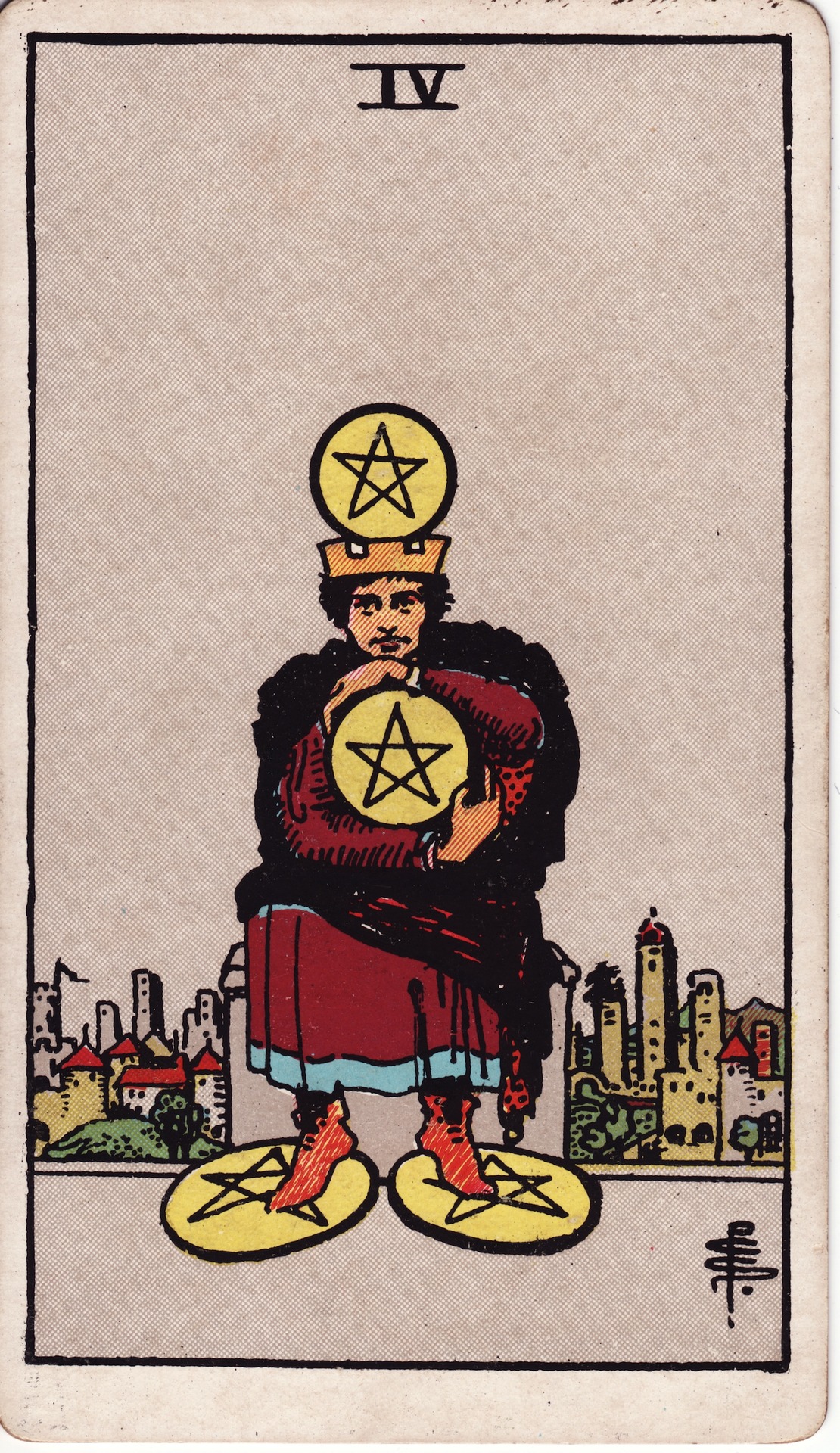
A figure sits on a stone bench outside a city, clutching a golden pentacle to his chest with both arms wrapped tightly around it. A second pentacle balances on top of his crown. Two more pentacles rest beneath his feet, one under each sole, as if he's afraid that even the ground might try to take what's his. His posture is rigid and contracted, the opposite of open or relaxed. His face is tense. Behind him, the skyline of a city rises in the distance, full of buildings and activity, but he's chosen to sit outside it, alone, with his four coins held so tightly that nothing can pry them loose. The image is simultaneously sympathetic and troubling: you understand why someone would want to protect what they've earned, but you can also see that the protection has become a prison. His arms can't reach for anything new because they're wrapped around what he already has. His feet can't walk anywhere because they're pinning coins to the ground. Even his head bears the weight of a pentacle balanced on his crown. He's secure. He's also stuck.
Four of Pentacles - Rider-Waite-Smith Tarot
The Three of Pentacles showed collaborative mastery, people working together to build something beautiful. The Four of Pentacles is what happens after the building produces results and the builder faces the question of what to do with what he's created. The answer, at least in this card's upright position, is: hold on. Tightly. The Four represents the moment when the natural desire for security hardens into something more rigid, when the reasonable instinct to protect your resources becomes a grip so tight that it prevents circulation, generosity, growth, or the simple ability to enjoy what you've worked so hard to accumulate.
Table of Contents
Key Themes and Symbolism
The Four of Pentacles is the tarot's most direct portrait of the relationship between security and control, and the cost of confusing one for the other.
The clutched pentacle. The figure holds one pentacle pressed against his chest, both arms wrapped around it in an embrace that's less about love and more about possession. This is the central image of the card: resources held so close that they can't be shared, spent, invested, or enjoyed. The clutched coin represents whatever you're holding onto too tightly, money, a relationship, a job, a belief, a routine, anything that's become so precious to you that the thought of losing it has eclipsed your ability to actually use it. The irony is visible in the image: the coin is right there against his heart, but he can't look at it, admire it, or do anything with it because all his energy goes into making sure nobody takes it away.
The pentacle on the crown. The coin balanced on the figure's head represents the mental burden of constant vigilance over resources. It's the anxiety that sits on top of every other thought: "Is my money safe? Is my position secure? Will I lose what I have?" This pentacle isn't held by hands. It's balanced, precariously, on a crown, suggesting that the figure's authority and identity have become entangled with his material possessions. He doesn't just have money. He is his money. His sense of self is propped up by what he owns, which means any threat to his possessions feels like a threat to his existence.
The pentacles under the feet. Two coins rest beneath the figure's feet, one under each sole. He stands on his resources, literally. This positioning has a dual meaning. On one hand, his wealth provides a foundation, something solid to stand on. On the other hand, his feet can't move because they're busy securing the coins. The pentacles under his feet are the resources that should enable movement but have instead become the reason he can't go anywhere. Financial security was supposed to provide freedom. Instead, it's provided a reason to stay exactly where he is, forever, because moving means risking what's underfoot.
The solitary position. The figure sits alone, outside the city. The city behind him represents community, commerce, social life, the dynamic world where people exchange resources, build relationships, and participate in the flow of giving and receiving that makes economies and communities function. The figure has removed himself from all of it. His possessiveness has isolated him. You can't participate in the flow of life while simultaneously refusing to let anything flow out of your hands. The Four of Pentacles shows the natural endpoint of extreme hoarding: loneliness.
The rigid posture. Everything about the figure's body language communicates tension and contraction. His arms are closed. His body is hunched. His position is static. Compare this to the Two of Pentacles, whose figure was dancing, loose, and adaptive. The Four of Pentacles is the opposite of flexibility. He's frozen in place by his own grip, and the rigidity that keeps his possessions secure also keeps him from living fully.
The number four. In numerology, four represents stability, structure, foundation, and sometimes stagnation. The Four of Wands was celebration within structure. The Four of Cups was emotional stagnation. The Four of Swords was rest and retreat. The Four of Pentacles is material stagnation, the moment when the structure you've built becomes the structure that confines you. Fours are necessary. Foundations matter. But the shadow of every four is the inability to grow beyond the foundation once it's been laid.
Upright Meaning
When the Four of Pentacles appears upright, you're in a period of holding on, protecting resources, maintaining control, and prioritizing security above almost everything else.
General
The Four of Pentacles upright isn't automatically negative, though it's often read that way. At its healthiest, it represents financial prudence, appropriate boundaries, and the discipline to save rather than spend. Not every situation calls for generosity and flow. Sometimes the right move is to conserve your resources, protect your position, and resist the pressure to give away what you've earned before you've secured your own foundation.
The problem arises when this conserving energy becomes your only mode. The Four of Pentacles turns problematic when the temporary need to hold tight becomes a permanent posture, when saving becomes hoarding, when boundaries become walls, and when the fear of losing what you have prevents you from pursuing what you could gain. The card asks you to honestly evaluate your relationship with security: is your grip appropriate to your circumstances, or has it tightened beyond what the situation requires?
This card often appears when someone is being asked to let go of something, spend money, share resources, take a risk, or open up emotionally, and they're resisting. The resistance isn't irrational. They've worked hard for what they have. They've been burned before. They know what it feels like to lose. But the Four of Pentacles says that holding on too tightly has its own cost, and that cost is the life you're not living while you're busy protecting the life you already have.
Love
In love readings, the Four of Pentacles upright often represents possessiveness, emotional guardedness, or a relationship where control has replaced connection. One partner may be holding onto the relationship with a grip that suffocates rather than nurtures, monitoring, restricting, or refusing to give the other person space because any loosening of the grip feels like a threat.
For those in relationships, this card can indicate that someone is prioritizing financial security over emotional connection. The partner who works constantly but is never emotionally present. The couple that has a comfortable material life but hasn't had a genuine conversation in months. The relationship where everything looks secure from the outside but feels empty from the inside.
For singles, the Four of Pentacles often signals that past wounds are preventing you from opening up to new connection. You've been hurt before. You lost something or someone. And now you're holding so tightly to your emotional security that nobody new can get close enough to matter. The card understands why you're guarded. It also says the guardedness has become its own form of loss.
Career
The Four of Pentacles in career readings indicates a period of professional conservatism, staying in a safe position, avoiding risks, and prioritizing job security over career growth. This isn't always wrong. Sometimes the secure job with the steady paycheck is exactly what you need. But the Four asks whether your attachment to professional security has become an obstacle to professional fulfillment.
This card often represents the person who stays in a job they've outgrown because leaving feels too risky. The paycheck is good. The benefits are solid. The work is unfulfilling but not unbearable. And so they stay, year after year, clutching the pentacle of their salary to their chest while the city of professional possibilities continues to bustle behind them, unvisited and unexplored.
The Four of Pentacles can also indicate a work environment that's controlling or hoarding, an employer who demands loyalty but doesn't reward it, an organization that accumulates resources without distributing them fairly, or a boss who holds onto information and authority as tightly as the figure holds his coins.
Finances
Financially, the Four of Pentacles is the card of the miser, though that's the extreme reading. More commonly, it represents a period of aggressive saving, risk avoidance, and the prioritization of financial security above everything else. Money comes in and stays in. Investments are conservative to the point of producing minimal returns. Spending feels physically uncomfortable.
The financial warning of this card is that money is a tool, not an identity. The purpose of financial security is to enable a good life, not to become the entire focus of life at the expense of everything that makes life worth living. If you're sacrificing relationships, experiences, health, or joy in order to accumulate money you never spend, the Four of Pentacles says you've confused the means for the end.
The positive financial reading of this card is simpler: save. Protect your resources. This isn't the time to take financial risks or make large purchases. Build the cushion. Secure the foundation. Just don't forget that the foundation is supposed to support something, not exist for its own sake.
Health
In health readings, the Four of Pentacles can indicate physical tension held in the body, particularly in the chest, shoulders, and back, the areas that contract when you're holding on too tightly. Chronic stress related to money, security, or control can manifest as tension headaches, digestive problems, or cardiovascular strain. The body carries what the mind won't release.
The card can also suggest resistance to necessary health changes. Holding onto habits, routines, or substances that provide comfort but damage health, because letting go feels like losing something even when what you're losing is harmful.
Reversed Meaning
When the Four of Pentacles appears reversed, the grip loosens. This can be liberating or frightening depending on whether the release is voluntary.
General
The Four of Pentacles reversed most commonly indicates a release of control. You're letting go of something you've been holding too tightly, money, a relationship, a job, a belief, a need for security, and discovering that the release produces relief rather than the catastrophe you feared. The coins that seemed so essential when you were clutching them turn out to be less important than the freedom you gain when you open your hands.
This reversal is often positive. It represents generosity after a period of hoarding. Openness after guardedness. Willingness to take a risk after a long period of playing it safe. The reversed Four of Pentacles says the thing you were afraid of losing either wasn't worth the energy of protecting or was never really at risk in the first place.
However, the reversal can also indicate loss of control over resources. Money slipping away. Security eroding. The uncomfortable experience of watching what you've accumulated diminish despite your efforts to prevent it. In this reading, the reversed Four doesn't represent willing release but unwilling loss, the miser whose grip has been pried open by circumstances rather than by choice.
Context and surrounding cards determine whether the reversal represents liberation (positive) or loss (negative). In most readings, it's the former: a necessary and healthy loosening of a grip that had become too tight.
Love
In love readings, the Four of Pentacles reversed is often a positive sign. It indicates that emotional walls are coming down. Possessiveness is relaxing. Someone who's been guarded is beginning to open up. The relationship is moving from control to trust, from holding on to letting in.
This reversal frequently appears when past relationship wounds are finally healing. The jealousy that was rooted in previous betrayal is softening. The need to control a partner that came from fear of abandonment is loosening. The inability to be vulnerable that resulted from past heartbreak is gradually dissolving. The reversed Four says: the healing has progressed enough that you can let someone in without feeling like you're risking everything.
For singles, the reversal suggests readiness to date again after a period of self-protective withdrawal. You've been guarding your heart. Now you're ready to use it.
Career
The Four of Pentacles reversed in career readings often signals a significant professional shift: leaving the safe job, starting the risky venture, making the career change that fear of financial insecurity had been preventing. The reversed card says the shift is happening whether or not you feel fully ready, and that the freedom on the other side of the leap is worth the temporary insecurity.
This reversal can also indicate being let go from a position or losing a professional role you'd been clinging to. While painful, the loss often turns out to be the push needed to pursue something more aligned with your actual capabilities and desires.
Finances
Financially, the reversed Four of Pentacles represents either healthy generosity or unhealthy spending, depending on context. The positive reading: you're loosening your grip on money, investing wisely, spending on experiences and relationships rather than just accumulating, and discovering that financial flow produces more abundance than financial hoarding. The negative reading: you're spending recklessly, losing financial discipline, or hemorrhaging money through poor decisions or circumstances beyond your control.
Health
In health readings, the reversed Four of Pentacles indicates the release of physical tension and the letting go of habits or patterns that were providing false security at the expense of genuine health. It can also represent finally seeking treatment for a condition you'd been trying to control on your own.
Card Combinations
The Four of Pentacles' meaning transforms with its neighbors.
Four of Pentacles + The Empress. A tension between abundance and scarcity mentality. The Empress overflows with generosity, fertility, and the confidence that there's always enough. The Four of Pentacles clutches what it has in fear of there not being enough. Together, these cards ask: are you receiving the abundance that's available to you, or are you so focused on protecting your existing resources that you can't see the new growth trying to reach you? The Empress says open your hands. The Four says don't you dare. The reading's advice depends on which energy is dominant and which needs balancing.
Four of Pentacles + Ace of Pentacles. New opportunity meets resistance to change. The Ace offers a fresh financial or material beginning, but the Four's grip prevents you from reaching for it. This combination often appears when someone is so invested in maintaining their current financial structure that they can't accept an opportunity that would require temporary disruption. The message: you might need to release what you're holding to receive what's being offered. The new coin can't land in a closed fist.
Four of Pentacles + Death. A powerful transformation is coming to your relationship with security and control. Death represents endings that lead to necessary new beginnings. Paired with the Four, it says the thing you're clinging to is going to change whether you approve or not, and that the transformation, though frightening, will ultimately free you from a pattern of holding that was limiting your life far more than protecting it.
Four of Pentacles + Six of Pentacles. The miser meets the giver. The Six represents generosity and the flow of resources between people. Paired with the Four, it highlights the contrast between hoarding and sharing, and asks which approach is actually serving you. This combination often appears when someone needs to shift from a scarcity mindset to an abundance mindset, recognizing that sharing resources, whether money, time, or emotional availability, often produces more security than clutching them.
Astrological Connections
The Four of Pentacles is associated with Sun in Capricorn, a placement that illuminates both the card's strengths and its shadows. The Sun represents identity, ego, and the core sense of self. Capricorn represents structure, ambition, discipline, and the drive to build lasting material achievement. When the Sun is in Capricorn, identity becomes entangled with material accomplishment, you are what you've built, what you own, what you've achieved.
This is the Four of Pentacles' central dynamic: the person on the card doesn't just have resources. His identity depends on them. The pentacle on his crown literally sits on top of his head, his sense of self, his status. Losing his possessions wouldn't just be a financial setback. It would be an identity crisis. Sun in Capricorn at its best produces people who build lasting structures, manage resources wisely, and take responsibility for their material reality. At its worst, it produces people who can't separate their self-worth from their net worth, who measure themselves and others by material achievement, and who hold onto resources with a grip that prevents them from participating in the natural flow of giving and receiving that healthy financial and emotional life requires.
Saturn, as Capricorn's ruler, adds the element of fear. Saturn governs limitation, restriction, and the anxiety that comes from understanding how much can go wrong. The Four of Pentacles' tight grip is Saturn's fear made physical: the fear of loss, the fear of poverty, the fear of vulnerability. Saturn's fears aren't irrational. Loss is real. Poverty is real. But Saturn's influence becomes destructive when the fear of losing something prevents you from ever enjoying, sharing, or fully using what you have.
To understand how the Sun and Capricorn shape your own relationship with material security, identity, and the balance between protection and generosity, explore your natal placements with the natal chart calculator.
Reading Tips for the Four of Pentacles
Don't default to negative. The Four of Pentacles is often read as purely negative, as greed or hoarding. But sometimes the querent genuinely needs to protect their resources. If someone is going through financial instability, a divorce, a job loss, or any situation where their material security is genuinely threatened, the Four of Pentacles might be appropriate advice: hold on. Protect what you have. Now isn't the time for generosity or risk. Context determines whether the grip is pathological or prudent.
Identify what's being held. The Four of Pentacles applies to anything that can be possessed or controlled, not just money. Someone might be clutching a relationship, a job, a routine, a belief system, or their physical health. Ask the querent what they're most afraid of losing right now. That's what the Four of Pentacles is addressing.
The reversed card is usually good news. Unlike many reversals, the Four of Pentacles reversed is positive more often than negative. The release of a too-tight grip tends to produce relief, freedom, and the rediscovery that life is more enjoyable when your hands are open. Read the reversal with optimism unless surrounding cards specifically indicate financial loss or instability.
Look for the fear underneath. The Four of Pentacles is always, at its core, about fear. Fear of loss. Fear of poverty. Fear of vulnerability. Fear of change. The coins are the symptom. The fear is the cause. The most useful reading of this card addresses the fear directly rather than just commenting on the behavior it produces.
Frequently Asked Questions
What does the Four of Pentacles mean as feelings?
As feelings, the Four of Pentacles represents fear of vulnerability and the desire to maintain control over a situation or relationship. The person whose feelings this card describes cares about you, possibly deeply, but they're terrified of what that caring means. Caring makes you vulnerable. It gives someone the power to hurt you. The Four of Pentacles person responds to that vulnerability by tightening their grip: becoming possessive, controlling, or emotionally guarded to the point of seeming cold. Their feelings are genuine but their expression is constrained by fear. What looks like indifference might actually be a very tight hold on emotions that feel too dangerous to release.
Is the Four of Pentacles a yes or no card?
The Four of Pentacles is generally a no, or at best a "not yet." The card represents holding back, restriction, and resistance to change, none of which supports forward movement on whatever you're asking about. If your question involves taking a risk, making a change, or opening up to something new, the Four says you're not ready, or the conditions aren't right, or the fear that's preventing you from acting needs to be addressed before progress is possible. Reversed, the card shifts toward yes, indicating that you're releasing the resistance and becoming ready to move forward.
Does the Four of Pentacles mean someone is controlling?
It can, particularly in relationship readings. The Four of Pentacles frequently indicates controlling behavior rooted in fear of loss. This manifests as possessiveness in relationships, micromanagement at work, or financial control in partnerships. The important nuance is that the control usually isn't malicious. It's anxious. The person represented by this card isn't controlling because they enjoy domination. They're controlling because they're terrified of what happens if they loosen their grip. Understanding the fear doesn't excuse the behavior, but it does inform how to address it.
What does the Four of Pentacles mean for finances?
The Four of Pentacles is the tarot's most direct card about financial behavior. Upright, it says you're saving aggressively, spending minimally, and prioritizing financial security above everything else. This can be wise or excessive depending on your circumstances. If you're building an emergency fund or paying off debt, the Four validates your discipline. If you're sitting on substantial savings while refusing to invest, spend on things that bring joy, or share with people who need help, the Four says your financial behavior has crossed from prudent into fearful. Reversed, the financial energy loosens: you're either spending more freely (which can be healthy or reckless) or experiencing financial losses that force you to release resources you'd prefer to keep.
How does the Four of Pentacles relate to the other fours?
All four fours in the tarot represent a form of stability that borders on stagnation. The Four of Wands is celebratory stability, the joy of a secure foundation. The Four of Cups is emotional stagnation, boredom and apathy from too much comfort. The Four of Swords is deliberate rest, necessary withdrawal to recharge. The Four of Pentacles is material stagnation, security that's become a trap. Each four asks the same fundamental question: is this stability serving you, or has it stopped serving you and become the thing that prevents your growth? The answer varies with the suit, but the question is universal.
The Four of Pentacles is the tarot's most uncomfortable mirror for anyone who's ever held on too tightly to something that security demanded they protect and growth demanded they release. The figure on the card isn't a villain. He's someone who earned what he has and is terrified of losing it. That fear is human. That grip is understandable. But the image tells its own story: the coins are secure, and so is the loneliness, the rigidity, and the inability to participate in the living world that continues to move behind him while he sits, frozen, outside the city walls. The question the Four asks isn't whether you should protect what matters. It's whether the cost of your protection has exceeded the value of what you're protecting. For a broader exploration of all 78 cards, visit the Celesian tarot reader. To understand how the Sun in Capricorn shapes your relationship with security, identity, and the material structures you build and sometimes cling to, explore your natal placements with the natal chart calculator. And to continue through the Pentacles suit, look back at the Three of Pentacles, whose collaborative craftsmanship built the wealth now being clutched, and ahead to the Five of Pentacles, where the grip finally fails and the figure discovers what it feels like to lose everything he was trying so desperately to hold.