The Devil Tarot Card Meaning: Upright, Reversed, Love, Career, and More
A horned, bat-winged creature crouches on a black pedestal, half goat and half man, with the inverted pentagram blazing between his horns. His right hand is raised in a gesture that's almost a blessing, but not quite. In his left hand he holds a lowered torch, its flame aimed downward, lighting nothing. Below him, two naked human figures stand chained to his pedestal by loose chains around their necks. The man and woman both have small horns sprouting from their heads and tails growing from their bodies, signs that they've begun to take on the nature of the creature who holds them. But here's the detail that changes everything: look at the chains. They're loose. The loops around their necks are wide enough to slip off. The figures could free themselves at any time. They don't.
This is The Devil, card fifteen of the Major Arcana, and he's the card that shows you the prison you've built for yourself. Not the prison imposed by fate, circumstance, or other people, but the one you maintain through your own choices, habits, and willful blindness. After Temperance offered perfect balance and the middle way, The Devil asks the uncomfortable question: what if you don't want the middle way? What if the excess feels better than the balance? What if the chains feel safer than the freedom? The Devil isn't an external force that's been inflicted on you. He's the part of you that chooses bondage because the alternative, genuine freedom, is more frightening than any cage.
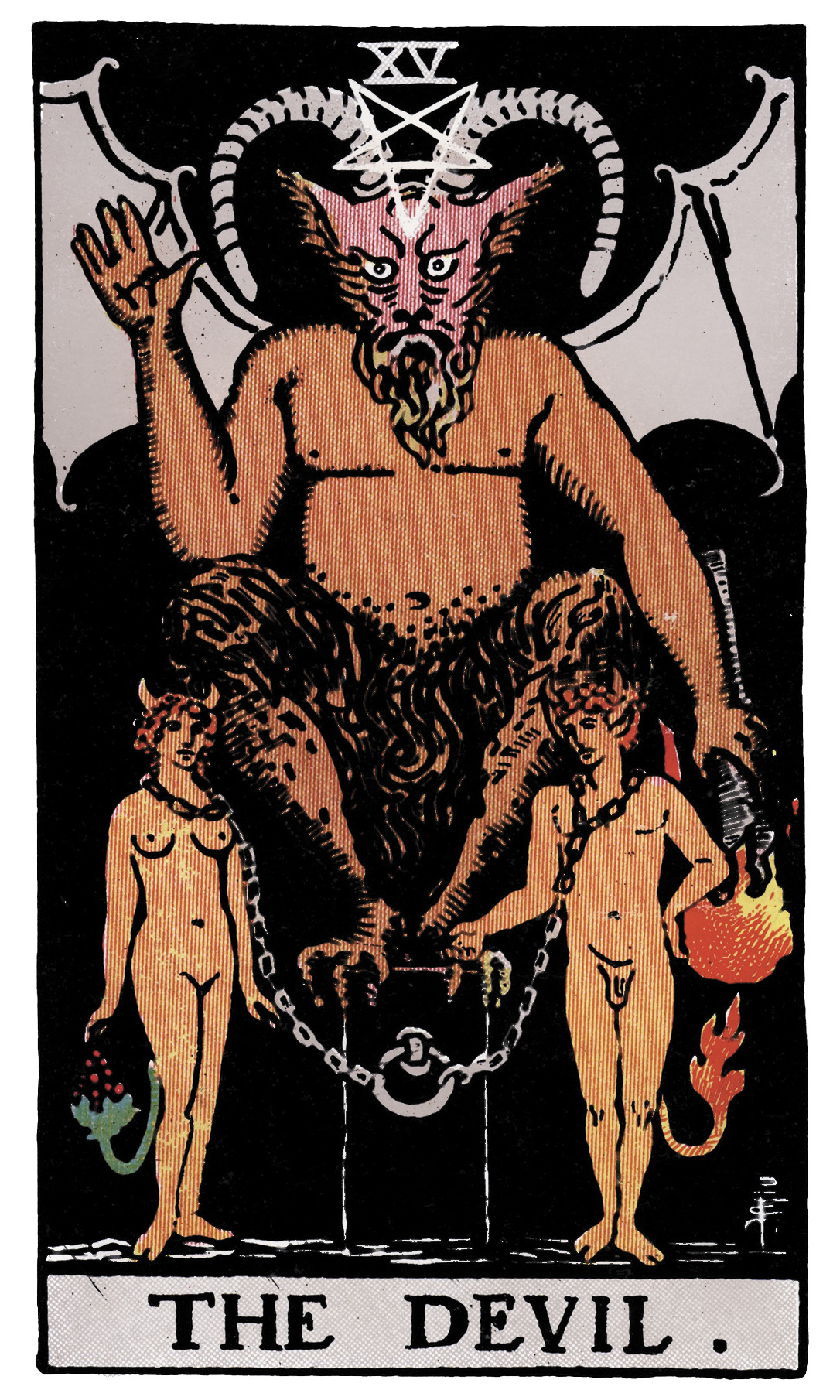
The Devil - Rider-Waite-Smith Tarot
Table of Contents
Key Themes and Symbolism
The Rider-Waite-Smith Devil card is a deliberate inversion of The Lovers (card six). Where The Lovers showed two figures standing freely beneath an angel, The Devil shows two figures chained beneath a demon. The visual parallel is intentional and devastating: what began as choice has become compulsion. What began as desire has become dependency.
The Baphomet figure. The Devil is depicted as Baphomet, the half-goat, half-human figure that represents the union of animal instinct and human consciousness, but corrupted. Unlike Temperance's angel, which blended opposites into harmony, The Devil's blending produces something grotesque: intelligence enslaved by instinct, consciousness in service to appetite. The bat wings (as opposed to angelic feathered wings) represent the nocturnal, the hidden, the things that operate in darkness because they can't survive the light.
The inverted pentagram. Between The Devil's horns, a five-pointed star points downward. The upright pentagram represents spirit governing matter, the higher self guiding the lower impulses. Inverted, it represents matter governing spirit: the body's desires overruling the soul's wisdom. The inverted pentagram isn't evil in itself. It's a symbol of priorities reversed, of the moment when what you want in the short term overrides what you know is right in the long term.
The raised right hand. The Devil's hand gesture mirrors the blessing gesture seen in The Hierophant, but where The Hierophant blesses with spiritual authority, The Devil's gesture is a dark parody. It suggests a false blessing, a counterfeit wisdom that says: "indulge," "you deserve this," "one more time won't hurt," "you can stop whenever you want." The Devil speaks in the voice of rationalization, the voice that makes destructive choices sound perfectly reasonable.
The lowered torch. Fire normally represents illumination, passion, and spiritual light. The Devil's torch points downward, lighting nothing, wasting energy. This is passion without purpose, desire without direction, the life force squandered on things that consume without nourishing. The downward flame represents the way addictive or compulsive behaviors burn through your energy, your resources, and your time without producing anything of lasting value.
The chained figures. The man and woman from The Lovers reappear here, but transformed. They've grown horns and tails, taking on the characteristics of the creature they serve. This is the nature of addiction and compulsion: the longer you serve it, the more you become it. Your personality reshapes itself around the dependency. Your values adjust to accommodate the behavior. Your self-image absorbs the chains until you can't imagine yourself without them. But the chains are loose. This is The Devil's most important detail and its most hopeful message. The bondage is voluntary. The exit is available. The figures stay because they choose to, not because they must.
The black pedestal. The Devil sits on a half-cube, a black pedestal that represents the material world in its most limited, restrictive form. The full cube (seen in The Emperor's throne) represents the ordered material world. The half-cube represents a world that's been reduced to its lowest expression: material comfort without meaning, physical pleasure without joy, possession without satisfaction. It's enough to sit on, but not enough to build on.
The darkness. The background is entirely black. There's no landscape, no sky, no horizon, no distance. The Devil's world has no perspective. When you're in The Devil's grip, you can't see past the immediate craving, the immediate fear, the immediate situation. The darkness represents the tunnel vision of addiction and compulsion: the way destructive patterns shrink your world until the only thing that exists is the need and its temporary satisfaction.
The number fifteen. Fifteen reduces to six (1+5=6), connecting The Devil directly to The Lovers. This numerical link reinforces the visual parallel: The Devil is The Lovers' shadow. Every choice (Lovers) creates the possibility of compulsion (Devil). Every desire, if left unexamined, can become a chain. Fifteen also carries the energy of tested intelligence, five (change) multiplied by three (creative expression), suggesting that The Devil's prison is partly a creation of your own clever mind, the rationalizations that keep you chained.

Close-up of a strong woman breaking symbolic chains representing the power to free yourself from The Devil's bondage
Upright Meaning
When The Devil appears upright, something has power over you that shouldn't.
General
The Devil upright is the card of bondage, addiction, materialism, shadow, and the destructive patterns you maintain because the pain of the familiar feels safer than the uncertainty of freedom. He appears when something in your life has shifted from choice to compulsion, when a behavior that once served you has become a chain you're serving instead.
The Devil's domain isn't limited to dramatic addictions like substances or gambling. He governs every pattern where you've traded your freedom for a counterfeit security: the toxic relationship you stay in because being alone feels worse. The job you hate that you won't leave because the salary is comfortable. The scroll through social media that was supposed to last five minutes and consumed two hours. The shopping that soothes the anxiety but deepens the debt. The people-pleasing that earns approval but erases your boundaries. Any behavior where you say "I should stop" but don't, that's The Devil's territory.
The shadow aspect of The Devil is psychologically significant. Carl Jung described the shadow as the parts of yourself that you deny, repress, or hide because they don't fit your self-image. The Devil brings the shadow into visibility. He shows you the desires you've been pretending you don't have, the fears you've been pretending don't control you, the patterns you've been pretending don't exist. This is uncomfortable, but it's also genuinely therapeutic. You can't free yourself from something you won't admit is there.
The materialism dimension of The Devil speaks to the confusion between having and being. The Devil's world is entirely material: the black pedestal, the physical chains, the focus on the body and its appetites. There's nothing spiritual in The Devil's domain, not because spirituality is absent, but because it's been buried under layers of acquisition, consumption, and the pursuit of pleasure as an end in itself. The Devil asks: are you living, or are you just consuming?
The most important teaching of The Devil is contained in those loose chains: you have more power than you think. The bondage feels total, but it's not. The prison feels inescapable, but the door is unlocked. The patterns feel hardwired, but they were learned, and what was learned can be unlearned. The Devil isn't the card that says "you're trapped forever." He's the card that says "notice that you're trapping yourself, and notice that you could stop."
Love
In love readings, The Devil upright often indicates a relationship driven by obsession, codependency, or unhealthy attachment rather than genuine love. The connection feels intense, even intoxicating, but the intensity comes from need rather than joy. You can't imagine being without this person, but that's not love. That's dependency. Love makes you more of yourself. The Devil's version of love makes you less.
This card can indicate relationships with power imbalances: one partner dominating while the other submits, not from healthy choice but from fear, low self-worth, or the belief that this is the best they can get. The Devil in love says: look honestly at the dynamic. Is it nourishing both of you, or is it feeding one person at the other's expense?
The Devil can also represent intense physical attraction that overrides better judgment. You know this person isn't right for you. Your friends have told you. Your gut has told you. But the chemistry is so strong that you keep going back. The Devil acknowledges the power of physical desire without judging it, but he also points out that desire without discernment is a leash, not a liberation.
For singles, The Devil may indicate repeating a destructive pattern in your romantic choices. You keep choosing the same type of person and getting the same type of result. The Devil says: the pattern isn't bad luck. It's a choice you're making, probably unconsciously, and understanding why you make it is the first step toward making a different one.
Career
In career readings, The Devil upright points to professional situations where you feel trapped: the golden handcuffs of a well-paying job you despise, the company whose values you've outgrown but whose paycheck you need, the industry you entered for the wrong reasons and can't seem to leave. The Devil in career says: you're not actually trapped. You've convinced yourself you are because the alternative (risk, change, the unknown) feels worse than the current misery.
This card can also indicate workaholic behavior: the compulsive overwork that masquerades as dedication but is actually avoidance of everything else in life. If work has become the substance you use to numb yourself, The Devil is calling it what it is.
The Devil in career warns against unethical professional behavior: cutting corners, deceiving clients, compromising your integrity for profit. These choices create their own kind of bondage. Each ethical compromise makes the next one easier and the chains heavier.
Finances
Financially, The Devil upright warns about the bondage of debt, materialism, and the confusion between wealth and worth. If you're drowning in debt, The Devil isn't just describing your financial situation. He's describing the psychological relationship with money that created it: the compulsive spending, the lifestyle inflation, the belief that acquiring things will fill the emptiness inside.
This card can also indicate financial arrangements that feel inescapable: loans with predatory terms, business partnerships where you're being exploited, or financial obligations that have become so large they seem to control your entire life. The Devil's message is the same in finance as everywhere else: the chains are looser than they look. There are options you haven't explored because the paralysis of "I can't" has prevented you from seriously asking "how could I?"
Health
In health readings, The Devil upright directly addresses addiction and self-destructive behavior. Substance abuse, eating disorders, compulsive exercise, self-harm, or any pattern where you're knowingly damaging your body but can't seem to stop. The Devil isn't moralizing about these behaviors. He's illuminating them: showing you clearly what's happening so you can make a conscious choice about what to do next.
This card can also indicate health issues caused by excess: liver damage from drinking, lung problems from smoking, metabolic issues from overeating, or injury from pushing the body beyond its limits. The body is keeping score, and The Devil says the score is becoming visible.
The mental health dimension of The Devil is significant. Depression, anxiety, and obsessive thought patterns all have a Devil quality: they feel inescapable, they narrow your world, they consume your energy without producing anything useful, and they can be addressed even though they feel permanent. If The Devil appears in a health reading, the message isn't "you're broken." It's "the cage door is open, and there's help available if you walk through it."
Reversed Meaning
When The Devil appears reversed, the chains are coming off.
General
The Devil reversed is one of the most liberating cards in the deck. It represents breaking free from bondage, overcoming addiction, releasing unhealthy attachments, and reclaiming the power you'd given away. The thing that controlled you is losing its grip. The pattern that defined you is dissolving. The chains you wore for so long are finally coming off, and the feeling is equal parts exhilarating and terrifying.
The terror is real. Freedom after bondage is disorienting. When the chains come off, you have to figure out who you are without them. If your identity has been built around the addiction, the toxic relationship, or the soul-crushing job, losing that structure feels like losing yourself. The reversed Devil says: what you're losing isn't yourself. It's the prison that prevented you from finding yourself. The disorientation is temporary. The freedom is permanent, if you choose it.
The reversed Devil can also indicate that you're becoming conscious of a pattern that was previously invisible. You're seeing the shadow for the first time. The rationalization that kept the behavior hidden from your awareness has cracked, and you can now see clearly what you've been doing and why. This awareness doesn't automatically solve the problem, but it's the absolute prerequisite for solving it. You can't break chains you can't see.
Love
In love, The Devil reversed signals the end of an unhealthy relationship dynamic. You're finally seeing the toxicity for what it is. The codependency is loosening. The power imbalance is being addressed. The obsessive attachment is maturing into something healthier, or dissolving entirely as you recognize it was never really love.
This card reversed can indicate the courage to leave a relationship that's been holding you captive. The relationship that looked permanent, that felt impossible to escape, is showing cracks, and you're finding the strength to walk through them. The reversed Devil says: leaving isn't failure. Staying in bondage is.
For singles, the reversed Devil indicates breaking the pattern of destructive romantic choices. You're no longer attracted to the type of person who chains you. Your taste has evolved. Your standards have risen. The relationships you were drawn to from a place of wounding are being replaced by the possibility of relationships drawn from a place of wholeness.
Career
In career readings, The Devil reversed represents breaking free from professional bondage. Quitting the job that's been consuming you. Leaving the industry that conflicts with your values. Setting boundaries against the workaholic pattern that was erasing your personal life. The professional chains are loosening, and you're finding the courage to pursue work that aligns with who you actually are rather than who the chains shaped you to be.
This card reversed can also indicate the exposure of workplace corruption, dishonesty, or exploitation. What was hidden is coming to light. What was tolerated is becoming intolerable. The systems of control that kept people compliant are being challenged and dismantled.
Finances
Financially, The Devil reversed signals the beginning of financial liberation. Getting out of debt. Breaking free from a financial arrangement that was exploiting you. Changing the spending patterns that created the bondage. The financial situation isn't fixed yet, but the awareness that it needs to be fixed, and the willingness to do the work, is now present.
This card reversed encourages a fundamental reassessment of your relationship with money. Not just your spending habits, but your beliefs about what money means, what it can provide, and what you've been sacrificing to acquire it. The reversed Devil says: money is a tool. When it becomes a master, it's time to renegotiate the relationship.
Health
In health readings, The Devil reversed is the card of recovery. Breaking the addiction. Starting the treatment. Making the lifestyle change you've been avoiding. Reaching out for help after a period of trying to manage alone. The reversed Devil says the healing has begun, and the courage required to start is itself evidence that you're stronger than you believed while you were in The Devil's grip.
This card reversed particularly supports addiction recovery. If you're in a recovery program, The Devil reversed validates your progress. The chains are coming off. The work is real. The freedom is genuine. If you've been considering getting help but haven't taken the step, the reversed Devil says: the step is available and you're ready for it.
Card Combinations
The Devil's meaning intensifies with the cards around him.
The Devil and The Lovers. The mirror pair of the Major Arcana (cards six and fifteen). The Lovers represent conscious choice and genuine connection. The Devil represents the shadow of that choice: desire turned to obsession, partnership turned to dependency. Together, they indicate a relationship that exists on the boundary between love and addiction, where the intensity could serve growth or destruction depending on whether the participants can maintain consciousness within the heat.
The Devil and Temperance. A direct tension between balance and excess. Temperance offers the middle way. The Devil rejects moderation in favor of more, always more. Together, they indicate a struggle between your higher aspirations and your lower impulses, between the part of you that knows what's healthy and the part that craves what isn't. This combination often appears when someone is actively working to overcome a compulsive pattern: the aspiration (Temperance) and the pull (Devil) are both present simultaneously.
The Devil and The Tower. A sequential pair in the Major Arcana (cards fifteen and sixteen). The Devil represents the bondage. The Tower represents the dramatic, sudden destruction of that bondage. Together, they indicate that the chains you won't remove voluntarily are about to be shattered involuntarily. This combination is the tarot's most direct warning: free yourself now, or life will free you in a way that's far more painful and far less controlled.
The Devil and The Star. A powerful contrast between darkness and light. The Devil represents the shadow, the chains, the narrowed world. The Star represents hope, healing, and the vast, open sky. Together, they indicate that liberation is not only possible but imminent. The darkness you're in has a horizon, and beyond it, something genuinely healing is waiting. This combination often appears for people who are on the edge of breaking free but need encouragement to take the final step.
Astrological Connections
The Devil is associated with the zodiac sign Capricorn and its ruling planet Saturn.
This association might seem counterintuitive. Capricorn is typically described as disciplined, ambitious, and responsible, qualities that seem opposite to The Devil's themes of indulgence and bondage. But Capricorn's shadow is precisely where The Devil lives. Capricorn's ambition can become obsession. Its discipline can become rigidity. Its respect for structure can become imprisonment within structures that no longer serve growth. The Devil represents what happens when Capricorn's virtues curdle into their shadows: when hard work becomes workaholism, when practicality becomes materialism, and when the drive for success becomes a chain that binds you to achievements you don't even enjoy.
Saturn, Capricorn's ruler, is the planet of limitation, structure, responsibility, and consequence. Saturn builds the walls, and The Devil shows what happens when you build them so high you can't get out. Saturn's limitations serve growth when they're appropriate: discipline, boundaries, and delayed gratification are Saturn's gifts. But when Saturn's restrictions become ends in themselves, when you serve the structure instead of the structure serving you, Saturn's walls become The Devil's prison.
The Earth element connects The Devil to the material world. The Devil's bondage is almost always material: physical addiction, financial debt, toxic environments, the endless pursuit of things and pleasures and status markers. There's nothing spiritual in The Devil's domain because Earth without spirit becomes heavy, dark, and suffocating. The Devil shows what happens when you build an entire life on material foundations without any spiritual ventilation: the walls close in.
In your natal chart, strong Capricorn or Saturn placements (Sun, Moon, or Ascendant in Capricorn, or Saturn in prominent aspect to personal planets) can indicate susceptibility to The Devil's patterns: workaholic tendencies, excessive attachment to status and material success, difficulty distinguishing between useful discipline and imprisoning rigidity. The 10th house (Capricorn's natural home) governs career, public reputation, and authority, all areas where The Devil's chains can bind most tightly.
Reading Tips for The Devil
The chains are always loose. This is The Devil's single most important message and the one that must be communicated in every reading where this card appears. The bondage is real, but it's voluntary. The querent has more power than they think. The exit exists. The first step is always available.
Don't judge. The Devil deals with addiction, compulsion, toxic relationships, and shadow behaviors. These are sensitive topics that carry enormous shame. Your job as a reader isn't to moralize about the querent's choices. It's to illuminate them. The Devil already knows what the querent is doing wrong. What the querent needs is the recognition that change is possible, not a lecture about why it's necessary.
Look for what's being avoided. The Devil often appears not because the querent is currently in bondage but because they're about to make a choice that would create bondage. The card is the tarot's warning system: this path leads to chains. If the querent is considering a new relationship, job, financial decision, or behavior pattern, The Devil says: look more carefully. There's a trap here that you're not seeing because the bait is attractive.
Shadow work is the deeper invitation. Beyond the surface-level message about bondage and addiction, The Devil invites shadow work: the psychological process of examining and integrating the parts of yourself you've been denying. What desires are you ashamed of? What fears control your behavior without your conscious awareness? What parts of your personality have you disowned because they don't fit your self-image? The Devil says: these hidden parts are running the show. Acknowledge them, and you take back the power you've been giving them.
Frequently Asked Questions
Is The Devil card a bad card?
The Devil is one of the most feared cards in the tarot, but "bad" is too simple. It's a card of honest confrontation. It shows you the chains you're wearing, the patterns you're maintaining, and the shadow behaviors you've been denying. That confrontation can feel bad, but the information it provides is invaluable. You can't free yourself from something you won't look at. The Devil forces you to look. And crucially, the card's most important detail, the loose chains, is actually hopeful: it says the bondage isn't permanent. Freedom is always available.
What does The Devil mean in a love reading?
In love, The Devil typically indicates a relationship marked by obsession, codependency, unhealthy attachment, or power imbalance rather than genuine partnership. The connection may feel intense, even addictive, but the intensity comes from need rather than nourishment. It can also indicate strong physical chemistry that overrides better judgment. The Devil in love asks you to examine whether the relationship is making you more free or more bound, more yourself or less. Reversed, The Devil in love is powerfully positive: it means the unhealthy dynamic is breaking and genuine freedom, either within the relationship or through leaving it, is becoming available.
Is The Devil a yes or no card?
The Devil is generally a "no" in yes or no readings, or more precisely a "yes, but you'll regret it." The thing you're asking about may be available to you, but pursuing it comes with chains attached. The short-term gain carries a long-term cost that you're not fully seeing. If you're asking whether you should do something and The Devil appears, the card is saying: you can, but consider the price. The pleasure or benefit is real, but so is the bondage that follows.
What is the difference between The Devil and Death?
Death and The Devil both deal with darkness, but in fundamentally different ways. Death represents necessary transformation: things ending so new things can begin. Death is natural, inevitable, and ultimately serves growth. The Devil represents unnecessary bondage: things persisting that should have ended, patterns that serve no purpose except to keep you trapped. Death clears the ground for new growth. The Devil prevents new growth by keeping you chained to the old ground. Death is nature. The Devil is the refusal of nature.
What zodiac sign is The Devil associated with?
The Devil is associated with Capricorn, the cardinal earth sign ruled by Saturn. This connects The Devil to themes of ambition, structure, material success, and the shadow side of these qualities: workaholism, materialism, rigidity, and the construction of prisons from the same materials you meant to build a life with. People with strong Capricorn or Saturn placements in their natal chart may be particularly susceptible to The Devil's patterns, not because they're flawed, but because their gifts (discipline, drive, practicality) can become chains when taken to extremes without spiritual balance.
For deeper exploration of all 78 cards, visit the Celesian tarot reader. To understand how The Devil's Capricorn energy connects to your personal astrology, check your Saturn and Capricorn placements with the natal chart calculator. And to follow The Fool's Journey, read about Temperance, whose careful balance The Devil now threatens with the seduction of excess, and The Tower, whose lightning bolt shatters the chains that The Devil convinced you were permanent.