
Ten of Wands Tarot Card Meaning: Upright, Reversed, Love, Career, and More
A figure hunches forward under the weight of ten wooden wands, all clutched together in their arms. The bundle is enormous, taller than the person carrying it, and the sheer awkwardness of the load forces their body into a strained, forward-leaning posture. They can barely see where they're going. The wands block their view of the path ahead, and their steps look labored, the kind of shuffling walk that belongs to someone operating on fumes. In the distance, a small town sits on the horizon. Houses. Rooftops. A destination. The finish line is visible, but the distance between where the figure stands and where they're trying to arrive feels enormous when every step costs this much effort. The sky is pale, the ground is flat, and there's nobody else in the frame. No one is coming to help carry the load. It's just this person, ten heavy sticks, and the stubborn decision to keep walking.
This is the Ten of Wands, the final numbered card in the suit of fire, and it captures a truth that most success stories leave out: the weight of what you've built can crush you just as thoroughly as failure ever could. The Nine of Wands showed you the battle-worn warrior leaning on their last reserves, still standing despite the injuries. The Ten shows what happens when you pick up everything you've fought for and try to carry it all at once. You've won. You've gathered the wands. You've accumulated the responsibilities, the achievements, the commitments. And now you're discovering that having everything you wanted is its own kind of prison when you refuse to put any of it down.
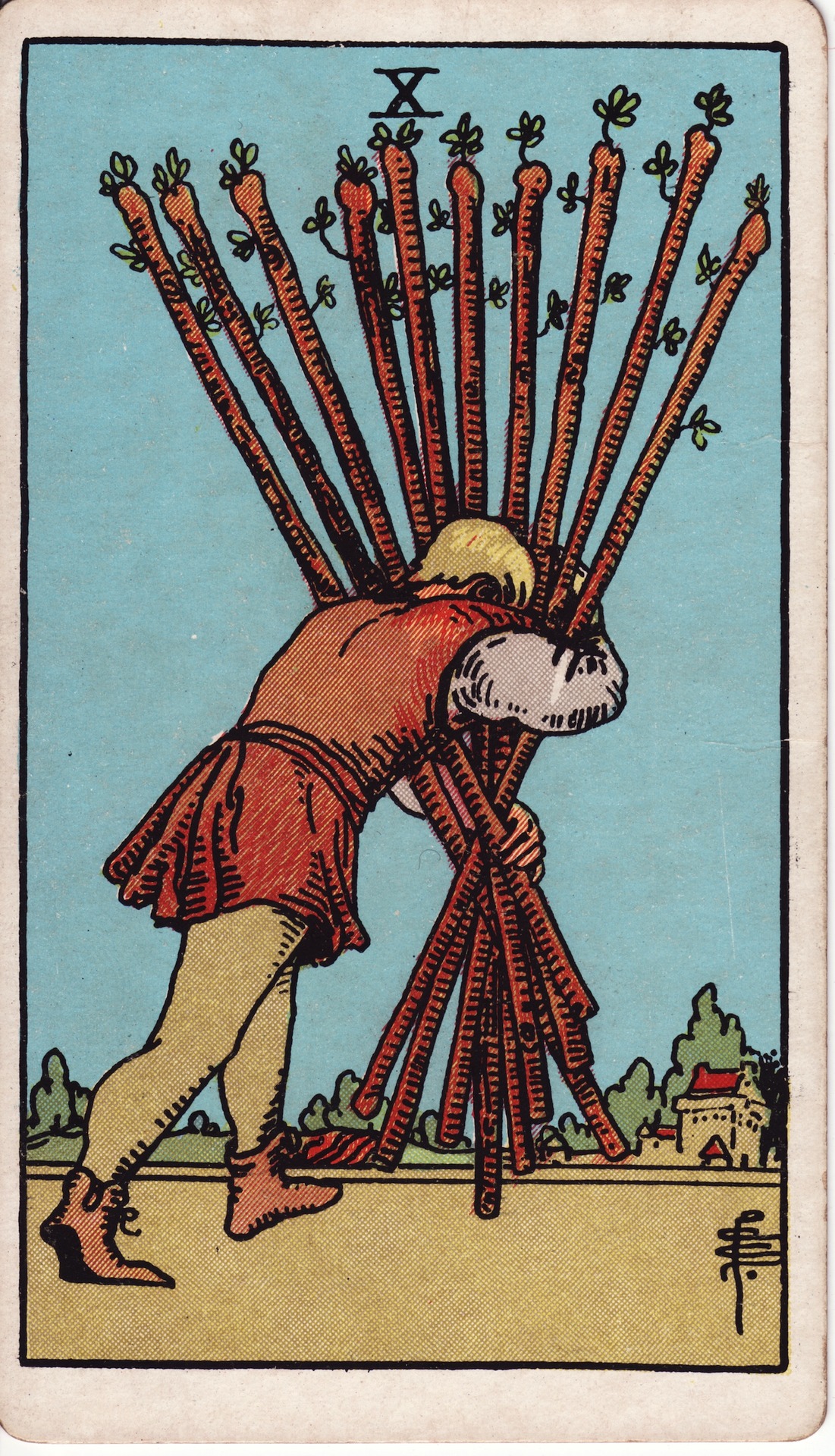
Ten Of Wands - Rider-Waite-Smith Tarot
Table of Contents
Key Themes and Symbolism
The Ten of Wands is a card about what happens when enough becomes too much.
The ten wands. In the Ace through Nine, each successive wand represented a new level of creative fire, ambition, or challenge added to the journey. The Ace was the spark. The Three was the first expansion. The Five was competition. The Seven was defending your position. The Nine was endurance through injury. Now, at the Ten, every single one of those experiences is being carried simultaneously. The figure hasn't discarded any of them. They haven't delegated any of them. They've collected all ten, every ambition, every responsibility, every fight, every victory, and they're hauling the entire pile forward as if dropping a single one would mean losing everything.
The obscured vision. This is one of the card's most telling details. The figure can't see clearly. The wands they're carrying block their own line of sight. This is what overcommitment does to perspective. When you're buried under obligations, you lose the ability to see the bigger picture. You can't assess which responsibilities actually matter and which ones you could safely release because the load itself is blocking your view. The person in this card might be walking toward the town, or they might be veering off course entirely. They literally can't tell, and they won't be able to until they put something down.
The hunched posture. The figure's body tells the story the face can't (because the face is hidden). The back is bent. The shoulders are rolled forward. The knees are slightly buckled. This is the posture of someone who's been carrying weight for a long time, long enough that the strain has become structural. The body has adapted to the burden, not in a healthy way, but in the way bodies do when the alternative is collapse. This speaks to the creeping nature of overload. You don't usually notice when you've taken on too much because each individual addition felt manageable. It's only when you try to stand up straight and realize you can't that the cumulative weight becomes undeniable.
The distant town. The town on the horizon represents the goal, the finish line, the place where the figure can finally set the wands down. It's close enough to see but far enough to feel punishing. This detail adds a bittersweet quality to the card. The Ten of Wands isn't hopeless. There is a destination. The work isn't infinite. But the last leg of any journey, the final push when you're already depleted, is where most people either break through or break down. The town says: you can get there. The distance says: but it's going to cost you.
The isolation. Nobody else appears in the card. There's no helper, no partner, no team sharing the weight. This isolation might be circumstantial or it might be self-imposed. Many people who end up in a Ten of Wands situation didn't run out of people willing to help. They stopped asking. Whether out of pride, perfectionism, control issues, or the belief that no one else could carry the wands as well as they can, the figure has made this a solo mission. The card asks: is that necessary, or is that a choice you're making at your own expense?
The number ten. Ten is the number of completion and culmination in the tarot. It's the end of the numbered sequence, the point where the energy of a suit reaches its maximum expression and begins to transform into something new. In the Wands, this means the fire element has been pushed to its absolute limit. There's no Eleven of Wands. The system has maxed out. What comes next is a new beginning (the Page of Wands), but first, the Ten demands you reckon with everything the suit's journey has accumulated. Tens in tarot also carry echoes of the Major Arcana card that shares their number: The Wheel of Fortune. The Wheel reminds you that cycles turn. The burden of the Ten is not permanent. Something will shift. The only question is whether you'll put the wands down voluntarily or whether they'll fall because you've collapsed under them.
Vivid orange flames and sparks dancing against a dark backdrop representing the fire element of the Wands suit pushed to its extreme
Upright Meaning
When the Ten of Wands appears upright, you're carrying too much and you probably know it.
General
The Ten of Wands upright is the tarot's burnout card. It appears when you've taken on more than any one person can reasonably manage and the consequences of that overload are showing up in your body, your mood, your relationships, and the quality of your work. You're not failing. That's what makes this card so insidious. You're succeeding, technically. The wands are still in your arms. You're still moving forward. But the success is costing you more than it's giving you, and the gap between the effort you're expending and the satisfaction you're receiving has widened into something unsustainable.
This card often shows up for the person who says yes to everything. The volunteer who chairs three committees. The employee who picks up everyone else's slack. The parent who manages the household, the career, the social calendar, and the emotional wellbeing of every family member while running on four hours of sleep. The entrepreneur who handles every aspect of the business because delegating feels like losing control. You're that person right now, or you're becoming them, and the Ten of Wands is the moment the universe taps you on the shoulder and says: this isn't sustainable.
The crucial question the Ten of Wands poses isn't "can you carry all of this?" You've already proven you can. The question is "should you?" Just because you're capable of bearing a burden doesn't mean the burden is yours to bear. Some of those wands belong to other people. Some of them are obligations you picked up out of guilt rather than genuine commitment. Some of them are achievements that mattered at one point in your life but no longer align with who you're becoming. The Ten doesn't ask you to drop everything. It asks you to be honest about which wands are actually yours.
Love
In love readings, the Ten of Wands upright suggests that the relationship has become another item on an already overwhelming to-do list rather than a source of joy and support. This isn't necessarily about the relationship being bad. It's about the relationship suffering because one or both partners are stretched so thin by external obligations that there's nothing left to bring to the partnership. Date nights get canceled because of work deadlines. Conversations stay shallow because neither person has the energy for depth. Intimacy fades because exhaustion kills desire more effectively than any conflict could.
If you're the one carrying the burden, this card asks you to consider what you're sacrificing by refusing to lighten your load. If your relationship is wilting because you won't delegate, won't say no, won't set boundaries with work or family or volunteer commitments, the Ten is telling you that your heroic effort to do everything is destroying the thing that's supposed to matter most.
If you're single, the Ten of Wands often indicates that you're too overwhelmed by current responsibilities to meaningfully pursue or sustain a new relationship. This isn't a judgment. It's a practical reality. Love requires space, emotional availability, and presence. When all of those are consumed by obligation, there's nothing left to offer a partner. The card suggests clearing some of the load before trying to add another person to your life.
Career
This is the Ten of Wands' home territory. In career readings, this card almost always points to overwork, excessive responsibility, or a job that demands more than it returns. You've taken on projects, roles, or obligations that have expanded beyond what's reasonable, and the quality of everything is slipping because there isn't enough of you to go around.
The Ten of Wands in career often describes the person who gets promoted into a role they're not given adequate resources to fill. The manager whose team is understaffed. The freelancer who took on too many clients because saying no felt risky. The business owner who does the books, the marketing, the customer service, and the product development because they can't afford to hire help, or won't. The card validates your effort while simultaneously warning that the effort alone isn't enough. Working harder won't solve a structural problem. You need to work differently: delegate, negotiate, eliminate, or ask for help.
There's also a dimension of accountability here. Sometimes the Ten of Wands appears because you've volunteered for burdens that weren't assigned to you. You picked up someone else's project because it was easier than watching them struggle. You said yes to a committee because saying no felt selfish. These aren't bad impulses, but they've accumulated into a situation where your own core work is suffering because you're carrying everyone else's wands along with your own.
Finances
Financially, the Ten of Wands points to a situation where the cost of maintaining your commitments is straining your resources. You might be carrying debt from investments or projects that haven't paid off yet. You might be financially supporting people or obligations that have outgrown your budget. The card can also indicate that you're working yourself into the ground for money, trading health and happiness for income in a way that's approaching diminishing returns.
The financial burden here isn't necessarily about being broke. It can show up even with a healthy income if that income comes at an unsustainable personal cost or if the obligations attached to the money (mortgages, business expenses, family support, lifestyle maintenance) consume everything you earn. The Ten of Wands asks: is this financial path worth what it's costing you in time, energy, and quality of life?
Health
The Ten of Wands in a health reading is a serious warning about stress-related illness. Your body is absorbing the burden your schedule won't acknowledge. Back pain, tension headaches, insomnia, chronic fatigue, digestive issues, muscle tightness, weakened immunity: these are the Ten of Wands symptoms. They're your body's way of communicating what your mind won't accept: you're carrying too much and something has to give.
This card often appears for people who use busy-ness as a coping mechanism, who fill every hour with activity because slowing down would mean confronting emotions or realities they'd rather avoid. The body keeps the score. Ignoring the physical signals won't make them disappear. It'll make them escalate until they become impossible to ignore. Rest isn't optional. It's as essential as any responsibility you're carrying, and the Ten of Wands wants you to recognize that before your body forces the issue.
Reversed Meaning
When the Ten of Wands appears reversed, the burden is shifting. You're either learning to put things down or you're about to break because you won't.
General
The Ten of Wands reversed has two primary expressions, and the context of the reading determines which one applies.
The first, and more hopeful, expression is release. You've recognized that you're carrying too much, and you're actively choosing to set things down. You're delegating, saying no, quitting commitments that don't serve you, or restructuring your life to eliminate the unsustainable weight. This version of the reversed Ten feels like exhaling after holding your breath for too long. The relief is physical. You might feel lighter, clearer, and slightly disoriented because you've been hunched under the load for so long that standing straight feels unfamiliar.
The second expression is collapse. You didn't put the wands down voluntarily. They fell because you couldn't hold them anymore. The project fails. The relationship breaks. The body gives out. The business goes under. This version of the reversed Ten isn't punishment. It's the natural consequence of refusing to acknowledge limits. The universe respects your free will, but it also respects physics. There's a maximum amount of weight any structure can bear, and exceeding it produces predictable results.
The reversed Ten of Wands can also indicate that you're avoiding responsibility rather than thoughtfully releasing it. Instead of delegating with care, you're dumping obligations. Instead of having honest conversations about your capacity, you're ghosting commitments. Instead of restructuring, you're running away. This version looks like freedom but creates new problems: broken trust, unfinished business, and the guilt that comes from abandoning things rather than completing them.
Love
Reversed in love, the Ten of Wands can signal that a burden within the relationship is finally being addressed. Maybe you've had the conversation about sharing household responsibilities more equitably. Maybe you've both agreed to cut back on external commitments to protect the relationship's space. Maybe you've decided that trying to maintain a picture-perfect partnership while managing everything else in your lives was never realistic, and you're choosing authenticity over performance.
Alternatively, the reversed card can indicate that one partner has reached the point of not caring anymore. Not in a dramatic, argument-driven way, but in the quiet, exhausted way where someone simply runs out of energy to keep trying. The wands drop not because the problem was solved but because the person carrying them lost the will to keep holding on. If this resonates, it's a signal that the relationship needs urgent, honest attention before the disengagement becomes permanent.
For singles, the reversed Ten suggests you're emerging from a period of being too burdened to date. Your load is lightening. Space is opening up in your life that wasn't there before, and with it comes the emotional availability that new connections require.
Career
In career, the reversed Ten of Wands often marks the beginning of a more sustainable work pattern. You might be leaving a job that demanded too much, renegotiating your role to match realistic capacity, hiring help, automating tasks, or finally accepting that you can't do everything yourself. The relief can be dramatic. People who've been grinding under a Ten of Wands workload for months or years sometimes describe the reversal period as feeling like they've been released from prison.
The shadow side of the career reversal is quitting too abruptly or dropping responsibilities without a transition plan. Walking out of a job feels liberating in the moment but can create professional consequences if it's done without notice or care. The reversed Ten encourages release, not destruction. Put the wands down carefully. Hand them to someone else. Don't just let them crash.
Finances
Financial obligations are becoming more manageable. Debts might be getting paid down, expensive commitments might be wrapping up, or you might be making decisions to simplify your financial life: downsizing, cutting subscriptions, selling assets you no longer need. The reversed Ten of Wands financially can also indicate receiving help, whether through a partner's income, a financial windfall, or finally accepting assistance you'd been too proud to take.
Health
Health improves as the burden lifts. Stress symptoms begin to resolve. Sleep comes easier. Chronic tension releases. The body was holding the weight of your schedule, and as the schedule eases, the body follows. The reversed Ten of Wands in health is often the card that appears when someone finally takes the vacation, starts the therapy, or makes the lifestyle change they've been putting off because they were "too busy." Your body is grateful. It's been waiting for permission to heal.
Card Combinations
The Ten of Wands tells different stories depending on the cards surrounding it.
Ten of Wands + The World. This combination says: the finish line isn't just close, you're about to cross it. The World is the Major Arcana's card of completion, fulfillment, and the successful end of a major cycle. Paired with the Ten of Wands, it confirms that the burden you've been carrying is almost ready to be set down for good. The effort has been enormous, but the payoff is real. Keep going. You're closer than you think.
Ten of Wands + The Emperor. Structure, authority, and delegation are the answer to your burden. The Emperor doesn't carry everything himself. He builds systems and assigns roles. This combination is a direct instruction: stop trying to do it all alone. Create structure. Establish boundaries. Put someone competent in charge of the things you don't need to personally manage. Your burden isn't a badge of honor. It's a management failure, and The Emperor knows how to fix it.
Ten of Wands + The Hermit. You need to step back from the chaos of your obligations and spend time alone figuring out what actually matters. The Hermit's lantern cuts through the obscured vision of the Ten. In solitude, away from the demands of others, you can finally see which wands are essential and which ones you picked up out of habit, obligation, or fear. This combination often appears when burnout has progressed to the point where a real period of withdrawal and reflection, not just a weekend off, is necessary.
Ten of Wands + Ace of Wands. A new creative spark is trying to ignite, but you have no hands free to hold it. This combination highlights the cost of overcommitment at its sharpest: you're so busy maintaining what you've already built that you can't pursue what excites you. The Ace is an opportunity, an idea, a calling. But it requires space, energy, and availability that the Ten hasn't left you. Something has to go if you want to make room for what's trying to come in.
Astrological Connections
The Ten of Wands corresponds to Saturn in Sagittarius, specifically the third decan of Sagittarius (approximately December 11 through December 21). This is one of astrology's most inherently tense combinations, and it perfectly captures the card's central conflict.
Sagittarius is the sign of expansion, adventure, optimism, and the belief that more is always better. Jupiter rules Sagittarius, and Jupiter says yes to everything: more travel, more knowledge, more experience, more projects, more life. Sagittarian energy is the impulse to explore every opportunity, pursue every interest, and expand in every direction simultaneously.
Saturn is the opposite force. Saturn contracts, limits, structures, and demands accountability. Saturn says: you can't do everything. You have finite time, finite energy, finite resources. Every commitment has a cost. Every yes to one thing is a no to something else. Saturn is the reality check that Jupiter tries to outrun.
When you put Saturn in Sagittarius, you get the Ten of Wands scenario exactly. The Sagittarian impulse has said yes to everything, chased every opportunity, picked up every wand. And now Saturn is standing at the end of the road, arms crossed, pointing out that the accumulated weight of all those yeses has become unsustainable. The burden of the Ten isn't bad luck or someone else's fault. It's the natural consequence of expansion without limitation, of ambition without boundaries, of enthusiasm without the discipline to choose.
People with Saturn in Sagittarius in their natal chart often have a lifelong relationship with this tension. They're drawn to big visions but struggle with the practical weight of executing them. They overcommit because their faith in their own capacity outpaces their actual bandwidth. And they eventually learn, sometimes the hard way, that saying no isn't a failure of spirit. It's a success of wisdom.
The Ten of Wands lesson, filtered through its Saturnian lens, is fundamentally about mature responsibility. Not the immature version where you take on everything to prove your worth, but the mature version where you take on only what you can carry with integrity and release the rest without guilt.
Reading Tips for the Ten of Wands
The Ten of Wands requires nuance because the line between admirable dedication and self-destructive martyrdom is thin, and this card walks it.
Don't romanticize the struggle. There's a cultural tendency to celebrate overwork, to treat exhaustion as evidence of commitment and burnout as a badge of honor. The Ten of Wands doesn't share that perspective. This card isn't impressed by how much you can carry. It's concerned about what the carrying is costing you. When this card appears, resist the urge to frame the burden as noble. It might be necessary. It isn't noble. Noble would be asking for help.
Look for what can be released. The Ten of Wands rarely means you need to drop everything. It means you need to drop something. Ask the querent (or yourself): of all the responsibilities you're carrying, which ones are actually essential and which ones are you holding because letting go feels like failure? The card isn't anti-responsibility. It's anti-unnecessary-burden. There's a difference, and finding it is the work the Ten demands.
Check whether the burden is chosen or imposed. Some Ten of Wands situations are self-inflicted: the person took on too much voluntarily and needs to learn to say no. Other situations are externally imposed: the person is carrying weight that was dumped on them by an employer, a family system, or a culture that exploits their willingness to work hard. The reading should differentiate between these because the remedy is different. Self-imposed burdens require internal boundary-setting. Imposed burdens may require confrontation, renegotiation, or leaving.
Pay attention to the town. The destination in the card matters. This isn't a hopeless image. There's a finish line. The person will arrive. When this card appears, part of the reading should acknowledge that the hard part is temporary. It won't feel this heavy forever. The question isn't whether you'll survive but what condition you'll be in when you arrive, and whether you can lighten the load enough to actually enjoy what's waiting for you.
Connect to the Nine. The Nine of Wands was about resilience under pressure: the wounded warrior still standing. The Ten is the next step: that warrior has picked up everything and is now trying to carry it forward. If the Nine appeared earlier in the reading, the Ten might be telling you that the defensive posture of the Nine has hardened into a refusal to release anything, that the survival instinct has become a hoarding instinct. Sometimes the strongest thing you can do is set something down.
Frequently Asked Questions
Is the Ten of Wands a yes or no card?
The Ten of Wands leans toward no, but with important context. It's not a flat rejection. It's a "not like this." Whatever you're asking about, the card suggests that pursuing it under current conditions will add to an already unsustainable load. The answer becomes yes only if you're willing to restructure, delegate, or release other commitments to make genuine space for the new thing. Trying to add one more wand to the pile you're already struggling to carry is the definition of what this card warns against.
What does the Ten of Wands mean in a love reading?
In love, the Ten of Wands most commonly indicates that the relationship is being neglected because one or both partners are overwhelmed by other obligations. It can also point to an imbalance where one person is doing all the emotional labor, carrying the communication, the planning, the conflict resolution, and the caretaking while the other person benefits without contributing equally. Less commonly, it can indicate that the relationship itself has become a burden, something you're maintaining out of duty rather than desire. In all cases, the card asks what needs to change so the relationship can breathe.
How does the Ten of Wands differ from the Nine of Wands?
The Nine of Wands is about defense and endurance. It's the moment when you're battered but still holding your ground, watching for the next challenge, and drawing on deep reserves of resilience. The Ten of Wands is about burden and overcommitment. It's what happens after the battle when you try to carry everything you've accumulated, fought for, and defended all at once. The Nine asks: can you keep standing? The Ten asks: should you keep carrying? The Nine's challenge is external threats. The Ten's challenge is the weight of your own success.
What should I do when I pull the Ten of Wands?
Take an honest inventory of everything you're currently responsible for. Write it down. Then categorize each item: essential (truly can't be dropped), delegable (important but doesn't require you personally), and optional (you're doing it out of habit, guilt, or perfectionism). The card's medicine is in the third category. Those optional burdens are the wands you can set down without anything falling apart. Start there. The relief of releasing even one unnecessary obligation often creates enough clarity and energy to address the rest.
Does the Ten of Wands mean my hard work won't pay off?
No. The town on the horizon confirms that the destination exists and is reachable. Your hard work hasn't been wasted. The card's warning isn't that you've been working for nothing. It's that you've been working too hard, or working on too many things simultaneously, and the strain is threatening to undermine the very success you're trying to reach. The payoff comes. But it comes faster, and you're in better shape to enjoy it, if you lighten the load before you arrive.
The Ten of Wands is the suit of fire's final exam, and the question isn't whether you're strong enough. You are. You've proven that through every card from the Ace to the Nine. The question is whether you're wise enough to recognize that strength without discernment becomes its own kind of weakness: the ability to carry everything becoming the compulsion to carry everything. For a deeper exploration of all 78 cards, visit the Celesian tarot reader. To understand how Saturn in Sagittarius expresses in your personal astrology, explore your natal placements with the natal chart calculator. And to continue through the suit of Wands, look back at the Nine of Wands, whose battle-worn resilience the Ten now carries forward, and ahead to the Page of Wands, where the fire element begins its journey anew with a spark of pure, unburdened enthusiasm.