Tea Leaf Reading: A Beginner's Guide to Tasseography and How to Read Tea Leaves
You've finished your cup of tea and a scatter of wet leaves clings to the bottom. Most people rinse it out without a second thought. But for centuries, readers across dozens of cultures have turned that leftover residue into a divination practice that's as personal as your fingerprint and as accessible as your kitchen cupboard. Tea leaf reading, formally called tasseography, is the art of interpreting the patterns, shapes, and positions of tea leaves remaining in a cup after drinking. No special deck required. No complex chart calculations. Just a cup of tea, a quiet moment, and a willingness to look closely at what the leaves left behind.
Tasseography sits alongside tarot, rune reading, palmistry, and the I Ching as one of the world's oldest forms of divination. But where those practices require cards, stones, or coins, tea leaf reading needs only what's already sitting in most kitchens. That simplicity is part of its appeal, and also part of why it's been practiced by everyone from Victorian parlor guests to modern spiritual practitioners looking for a grounded, tactile form of intuitive guidance.
This guide covers everything you need to start reading tea leaves today: the history behind the practice, how to prepare your cup, what the symbols mean, how position in the cup affects timing, and how to develop the intuitive muscle that turns scattered leaves into meaningful messages.
What You'll Learn
What Is Tasseography?
Tasseography comes from the French word "tasse" (cup) and the Greek suffix "graph" (writing). It literally means "cup writing," and that's a useful way to think about it. When you drink a cup of loose leaf tea, the leaves that remain settle into patterns unique to that specific moment and that specific person. The reader's job is to interpret those patterns as symbols, much the way you'd interpret the imagery on a tarot card, but with shapes formed by nature rather than an artist.
The practice isn't limited to tea. Coffee ground reading (called cafeomancy) uses the same principles with Turkish or Greek coffee sediment. Even wine sediment has been read historically. But tea remains the most popular medium because loose leaf tea produces the clearest, most varied patterns and because the ritual of brewing and drinking creates a natural period of reflection before the reading begins.
What makes tasseography different from other divination methods is its organic randomness. A tarot deck has 78 fixed cards with established meanings. Runes have a set alphabet. Tea leaves have no predetermined symbols. The shapes emerge from the interaction between the tea, the water, the cup, and your movements while drinking. That means every reading is genuinely one of a kind, shaped by forces too subtle and numerous to consciously control.

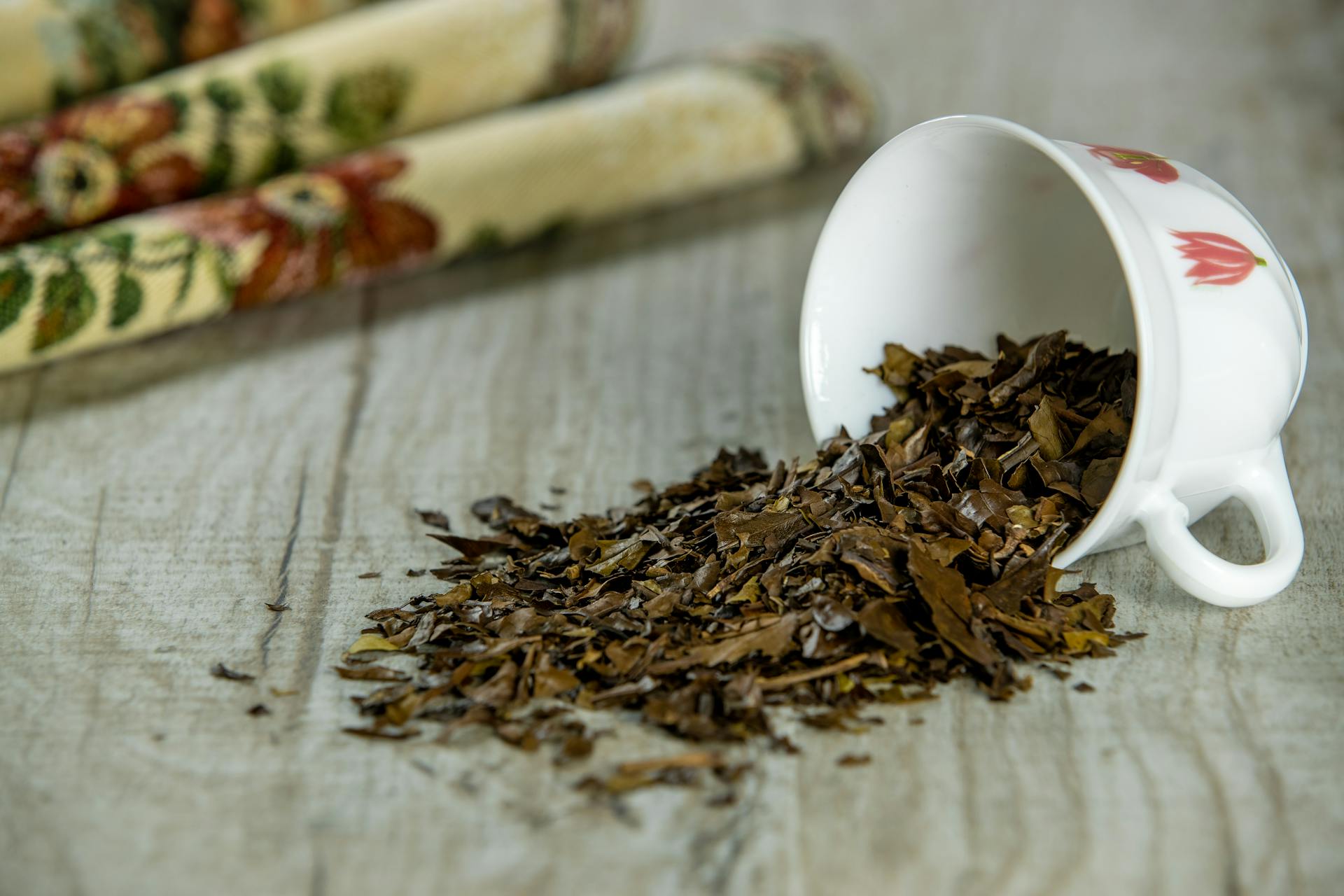
Overhead view of dried herbal tea leaves and flowers inside a cup representing the raw materials of tasseography
The History of Tea Leaf Reading
Tea leaf reading traces its origins to ancient China, where tea drinking began thousands of years ago. According to tradition, monks and scholars noticed that the leaves remaining after drinking sometimes formed recognizable shapes, and they began assigning meaning to those shapes as a form of meditation and guidance. The practice spread along trade routes to the Middle East, where coffee ground reading developed as a parallel tradition, and eventually reached Europe in the 17th century alongside the tea trade itself.
The practice took root in Europe during the 1600s and 1700s, particularly in England, Scotland, and Ireland, where tea drinking became a daily ritual across social classes. By the Victorian era, tasseography had become a popular parlor activity. It was considered a respectable form of fortune telling, socially acceptable enough for drawing rooms but mysterious enough to generate genuine excitement. Victorian-era publishers produced guides to tea leaf symbols, many of which form the basis of symbol dictionaries still used today.
In Romani culture, tea leaf reading became an important divination practice integrated with other forms of fortune telling. Scottish and Irish traditions developed their own symbol sets and methods, some of which differ significantly from the English parlor tradition. The practice also thrived in Greek, Turkish, and Armenian cultures through coffee ground reading, which uses identical interpretive principles with a different medium.
The 20th century saw tasseography decline as tea bags replaced loose leaf tea in most households. You can't read a tea bag. But the 21st century has brought a revival, driven partly by the resurgence of loose leaf tea culture and partly by a broader interest in accessible, hands-on spiritual practices that don't require purchasing specialized tools.
What You Need to Get Started
The beauty of tea leaf reading is its simplicity. You need four things:
A light-colored teacup. White or cream interiors work best because the dark tea leaves show up clearly against the pale background. Avoid cups with patterns or images on the inside, as these can interfere with your reading. A wide, shallow cup is easier to read than a tall, narrow mug. Traditional tasseography cups have a wide brim and a rounded interior, which gives leaves more surface area to form patterns. But any light-colored cup will work for a beginner.
A saucer. You'll use this during the draining step. Any saucer that fits your cup is fine.
Loose leaf tea. This is non-negotiable. Tea bags won't work because the leaves are ground too fine and trapped inside the bag. You want whole or broken leaf tea that can move freely in the water and settle into distinct shapes. Black tea is the traditional choice because its dark leaves create strong contrast against a white cup. Chinese black teas and English breakfast blends work well. Herbal teas with larger leaf pieces and flower petals can also produce interesting readings, though some readers find they're harder to interpret because the pieces are too large to form detailed shapes.
Hot water. That's it. No infuser, no strainer, no filter. The whole point is to let the leaves move freely and remain in the cup.
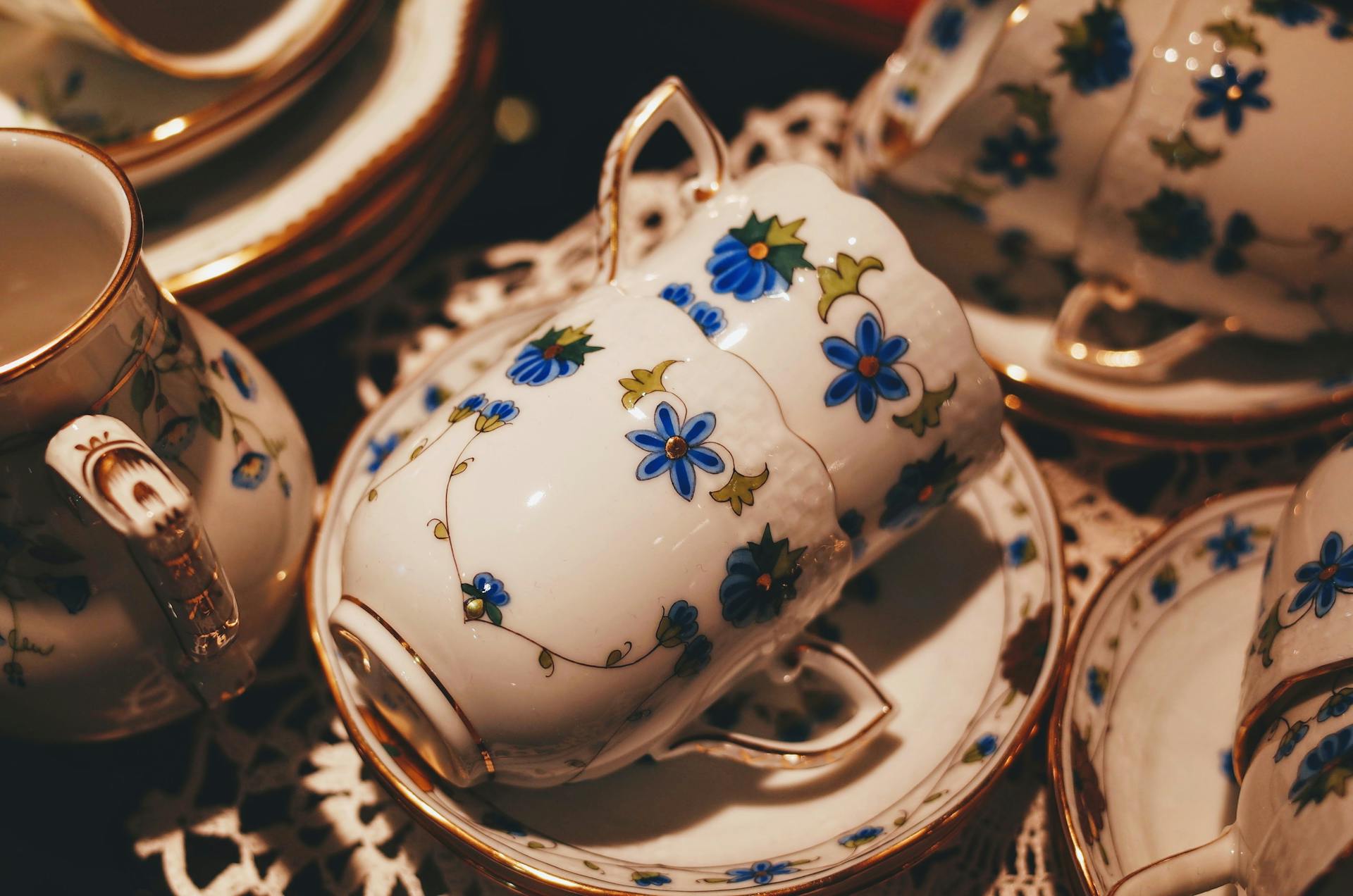
An elegant floral porcelain tea set with gold trim arranged for a tea leaf reading session
How to Prepare Your Cup for a Reading
Preparation matters because the process of making and drinking the tea is part of the reading itself. Here's the method that traditional readers have used for centuries:
Step 1: Add the tea. Place about one teaspoon of loose leaf tea directly into your cup. Don't use an infuser or strainer.
Step 2: Pour and steep. Pour hot (not quite boiling) water over the leaves. Let the tea steep for three to five minutes. Some leaves will float, others will sink. That's normal.
Step 3: Focus your question. While the tea steeps and as you drink it, hold a question or intention in your mind. This doesn't need to be formal. You're not performing a ritual. You're simply directing your attention toward whatever you'd like guidance on. Some readers prefer open-ended questions ("What do I need to know right now?") while others ask specific ones ("What's the energy around this job change?"). Both approaches work.
Step 4: Drink the tea. Drink slowly and mindfully, leaving about a tablespoon of liquid in the bottom of the cup along with the leaves. Don't strain out any leaves that reach your lips; just gently push them aside with your tongue and continue drinking. The act of drinking is what makes the reading personal. Your hand movements, the angle you tip the cup, and how long you take all influence how the leaves settle.
Step 5: Swirl and drain. When only a small amount of liquid remains, hold the cup in your non-dominant hand (left hand if you're right-handed). Swirl the cup three times in a counterclockwise direction. Then flip the cup upside down onto the saucer and let it drain for about a minute. Some readers tap the bottom of the cup three times during this step.
Step 6: Turn and read. Turn the cup right-side up. The leaves that remain clinging to the sides and bottom of the cup are your reading.
How to Read the Leaves: A Step-by-Step Method
Now you're looking at a cup with wet tea leaves stuck to the interior in seemingly random patterns. Here's how to start making sense of what you see:
Start with your first impression. Before you analyze individual symbols, just look at the overall cup. Does it feel busy or sparse? Are the leaves clustered in one area or spread evenly? A crowded cup suggests a busy period ahead. A cup with very few leaves might indicate clarity or a quiet phase. Trust your initial gut reaction before you start picking apart details.
Scan for recognizable shapes. This is the core skill of tasseography, and it works exactly like finding shapes in clouds. Let your eyes relax and see what images emerge from the leaf patterns. You might see letters, numbers, animals, objects, or abstract shapes. Don't force it. The shapes that jump out first are usually the most significant.
Note the size of each symbol. Larger, more distinct shapes carry more weight than small, faint ones. A large, clear bird shape is a stronger message than a tiny ambiguous one.
Consider clusters and relationships. Symbols that appear near each other are related. A heart shape next to a ring means something different than a heart shape next to a cloud. Read groupings as connected statements rather than isolated symbols.
Read the handle position. The handle of the cup represents you, the querent. Symbols near the handle relate directly to your personal life. Symbols on the opposite side of the cup relate to external influences, other people, or circumstances outside your control.
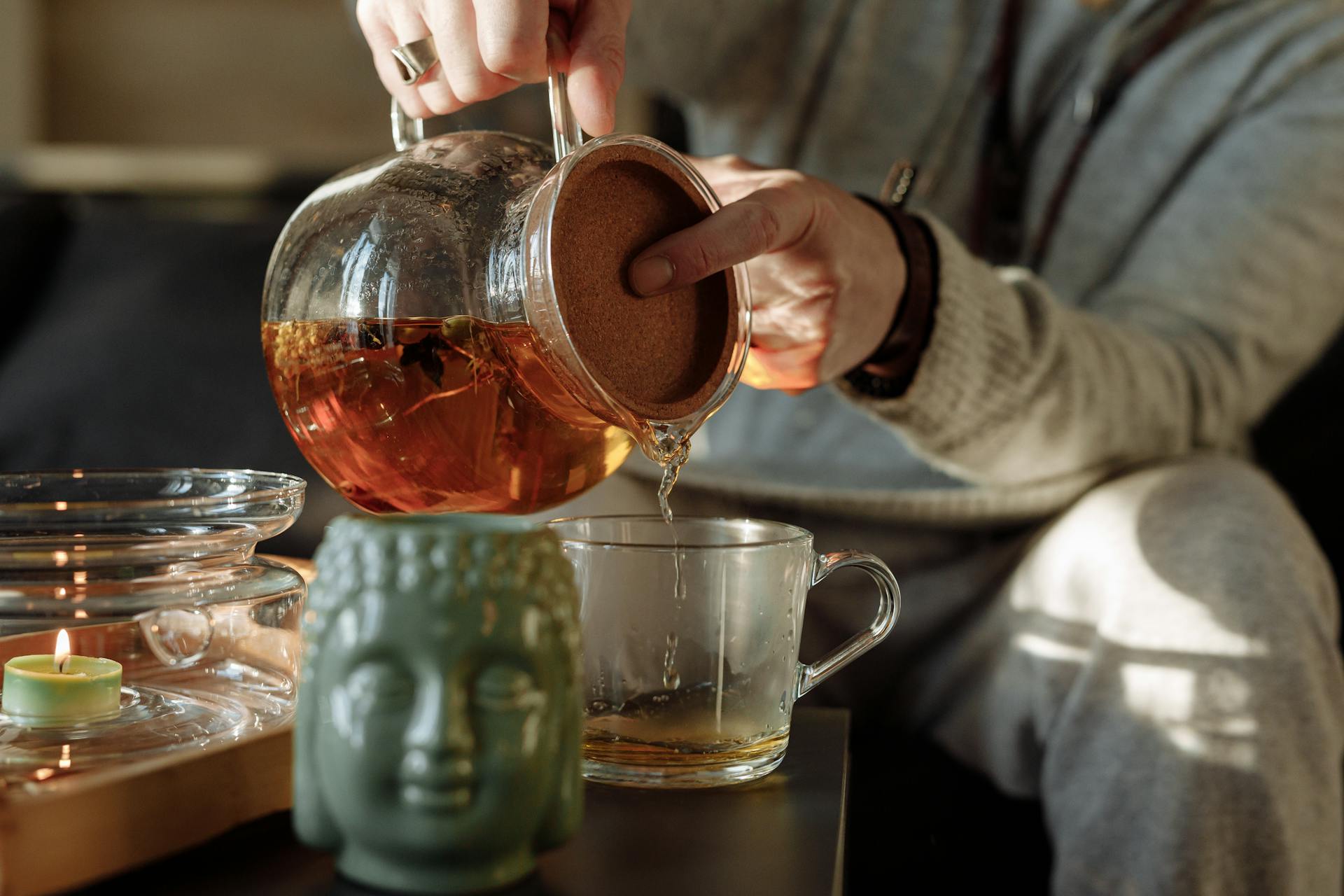
A person pouring herbal tea into a cup by candlelight creating a warm atmosphere for intuitive practice
Common Tea Leaf Symbols and Their Meanings
Tea leaf symbols don't have rigid, universal definitions the way tarot cards do. Different traditions assign slightly different meanings, and your personal associations matter. But certain symbols have been interpreted consistently across cultures and centuries. Here are the most commonly recognized ones:
Animals:
Objects:
Letters and Numbers:
Letters often indicate the initials of a person significant to your question. Numbers can indicate timing (days, weeks, months depending on position) or quantity.
Lines and Dots:
How Position in the Cup Affects Your Reading
Where a symbol appears in the cup is just as important as what the symbol is. Position tells you about timing and significance:
The rim (top of the cup): Symbols near the rim represent the present or very near future. These are things happening now or within the next few days to weeks. Rim symbols carry immediacy and urgency.
The middle of the cup: Symbols in the middle zone represent the near future, roughly weeks to a couple of months out. These are developing situations, things in motion that haven't fully manifested yet.
The bottom of the cup: Symbols at the bottom represent the distant future or deeply buried influences. They can also indicate the outcome of a situation if read in connection with symbols higher in the cup. Some traditions interpret bottom-of-cup symbols as challenges or obstacles, though this isn't universal.
Near the handle: Symbols close to the handle relate to your home life, personal circumstances, and things within your direct control. This is your domain.
Opposite the handle: Symbols on the far side of the cup from the handle relate to external forces, other people's actions, work life, or circumstances you can't directly control.
Left of the handle: Events from the past that are still influencing the present.
Right of the handle: Future events that are approaching.
This positional framework turns a flat list of symbols into a narrative. A fish (good fortune) near the rim and close to the handle tells a very different story than a fish at the bottom of the cup on the opposite side.
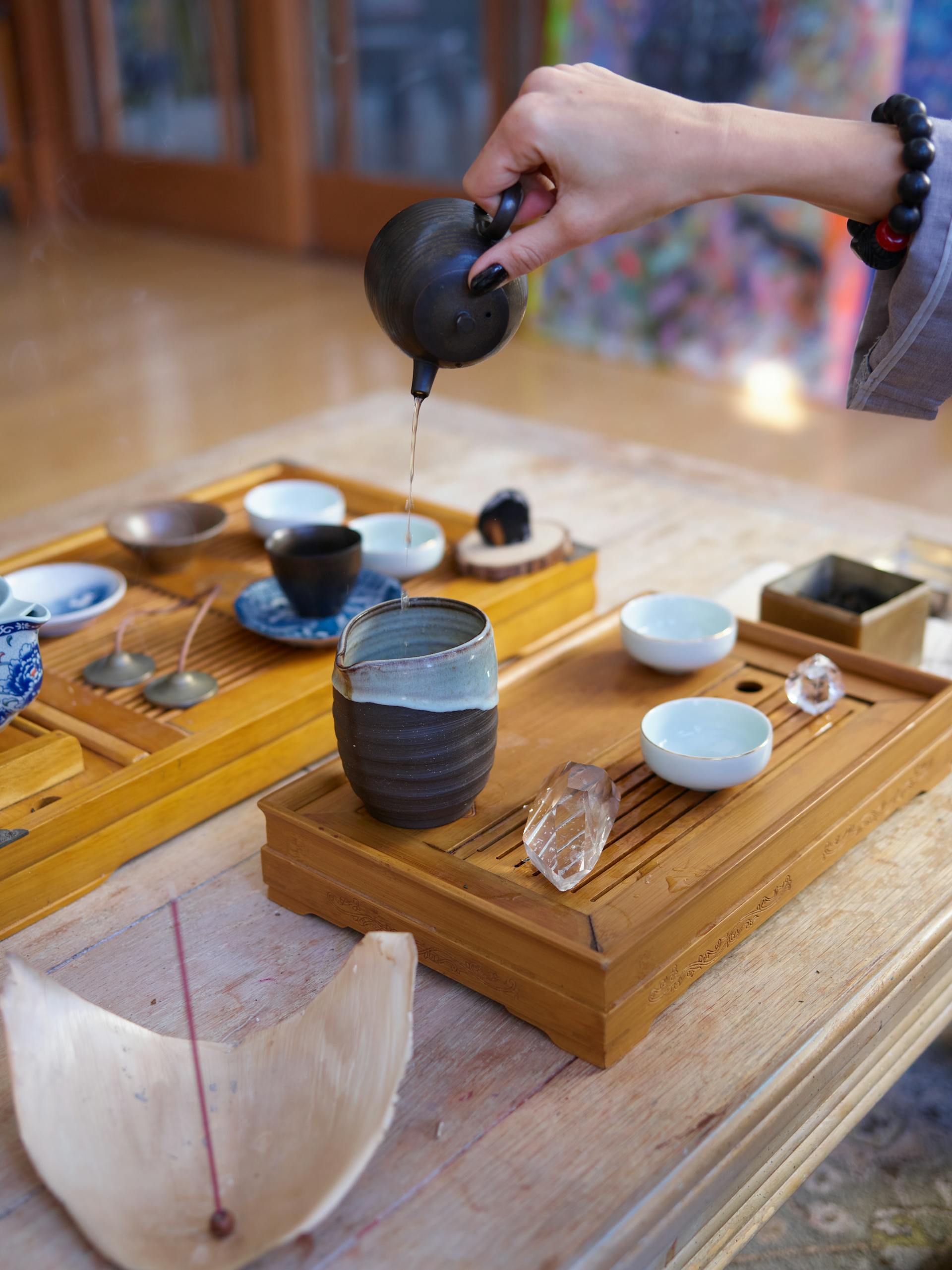
A serene tea ceremony setup with ceramic cups incense and crystals on wooden trays creating a meditative atmosphere for divination
Tips for Developing Your Tea Leaf Reading Skills
Like any form of divination, tea leaf reading improves with practice. Here are some concrete ways to build your skills:
Keep a tea leaf journal. After each reading, sketch or photograph the patterns you see and write down your interpretations. Over time, you'll notice which symbols recur for you and how your interpretations evolve. You'll also be able to look back and check whether your readings corresponded to actual events, which builds confidence and refines your accuracy.
Start with one question per reading. Beginners often try to extract too much from a single cup. Pick one clear question or area of focus. As you get more experienced, you'll naturally start reading broader themes, but starting narrow helps you develop the connection between symbol, position, and meaning.
Practice pattern recognition daily. Tasseography uses the same cognitive skill as seeing shapes in clouds, ink blots, or abstract art. You can train this skill outside of readings by looking for faces and shapes in everyday textures: tree bark, ceiling stains, crumpled fabric. The more you exercise this kind of relaxed pattern recognition, the faster symbols will emerge from the leaves.
Read for friends. Reading for yourself can feel circular because you already know your own situation and might project what you want to see. Reading for someone else forces you to rely on the symbols rather than your own assumptions. Ask them to hold their question privately while they drink, then tell them what you see before they reveal their question. The feedback loop is invaluable.
Don't memorize symbol lists. The lists above are starting points, not rigid definitions. The most important part of any symbol is what it means to you. If you see a shape that looks like a cat, and your first thought is warmth and comfort (because you love your cat), that's more relevant than a book telling you cats mean deception. Traditional meanings provide a foundation. Your intuition builds the house.
Pair it with other practices. Many readers find that tasseography works well alongside tarot reading or daily ritual practices. You might pull a tarot card to set the theme of your day, then do a tea leaf reading in the evening to reflect on how the day unfolded. The practices complement each other because they engage different senses and different modes of interpretation.
Frequently Asked Questions
Can you read tea leaves with any type of tea?
You need loose leaf tea, not tea bags. The leaves in tea bags are ground too finely to form readable patterns. Black tea is the traditional choice because it creates strong contrast against a white cup, but green tea, oolong, and herbal blends with visible leaf pieces all work. Avoid teas with very large chunks (like some fruit blends) since they won't settle into detailed shapes. The key is using whole or broken leaves that can move freely in water and cling to the cup's interior.
Is tea leaf reading accurate?
Tasseography isn't about predicting the future with certainty. It's a reflective practice that uses visual pattern interpretation to surface thoughts, feelings, and possibilities you might not have consciously considered. Think of it the way you'd think about tarot: the symbols provide a framework for reflection and insight rather than literal prophecy. Many practitioners find their readings resonate strongly, especially when they approach the practice with genuine openness rather than testing it for proof.
How often should you do a tea leaf reading?
Most readers recommend no more than one reading per question or topic. Repeating the same question hoping for a different answer dilutes the practice. A daily reading with a general question ("What should I pay attention to today?") works well as a reflective ritual. For specific questions about bigger decisions, give the reading time to unfold before asking again. Weekly readings are a comfortable rhythm for most beginners.
Do you need psychic ability to read tea leaves?
No. Tasseography is a learnable skill that relies on pattern recognition and intuitive interpretation, both of which improve with practice. You don't need to identify as psychic, gifted, or spiritually advanced. If you can spot shapes in clouds, you can learn to read tea leaves. The "intuitive" part develops naturally as you practice. It's less about receiving supernatural information and more about training yourself to notice what your subconscious mind picks up on.
What's the difference between tea leaf reading and coffee ground reading?
The core practice is identical: interpreting symbols formed by the residue left in a cup. Coffee ground reading (cafeomancy) is more common in Turkish, Greek, and Armenian traditions and uses the thick sediment from unfiltered coffee. The grounds tend to produce bolder, more defined patterns than tea leaves. Tea leaf reading is more common in British, Irish, and East Asian traditions. The interpretive principles, symbol meanings, and positional rules work the same way for both. Choose whichever beverage you prefer; the reading method translates directly.
Tea leaf reading is one of the most accessible forms of divination you can practice. It doesn't require special tools, expensive supplies, or years of study to begin. It just asks you to slow down, pay attention, and trust what you see. The leaves won't tell you exactly what's going to happen tomorrow, but they'll give you a framework for thinking about where you are and where you might be heading. And at minimum, you get a good cup of tea out of it. If you're drawn to other forms of intuitive practice, explore our tarot reading tool for card-based guidance, check your natal chart to understand the astrological influences shaping your path, or see how your energy connects with others through a compatibility reading.