
Twin Flame Astrology: How to Spot Soul-Level Connections in Your Birth Chart
You've met someone and it doesn't feel like other relationships. There's an intensity you can't explain, a recognition that happened before your brain caught up to it. Maybe you finish each other's sentences or trigger each other in ways that feel almost surgical. The concept of twin flames, two people who share a soul-level mirror connection, has become one of the most searched topics in modern astrology. And while no birth chart can stamp "twin flame" on a relationship with a certificate and a seal, there are specific astrological indicators that consistently show up when two people share this kind of bond.
Twin flame astrology works primarily through synastry (comparing two natal charts) and composite charts (merging two charts into one). The patterns it looks for aren't the easy, comfortable ones. Twin flame connections show up as intense aspects, overlapping karmic placements, and the kind of planetary contacts that make you feel simultaneously seen and exposed. If you've been wondering whether a particular connection has twin flame energy, your birth charts hold the evidence.
What You'll Learn
What Is a Twin Flame in Astrology?
A twin flame isn't just someone you love deeply. It's someone who mirrors you, reflects back both the qualities you've developed and the ones you've been avoiding. In astrological terms, a twin flame relationship activates the most personal and the most karmic parts of both charts simultaneously. You'll see contacts to inner planets (Sun, Moon, Venus, Mars) layered with contacts to outer planets (Saturn, Pluto) and the lunar nodes.
The twin flame concept suggests that one soul splits into two bodies, and those two people spend their lives drawn toward reunion. Whether you take that literally or metaphorically, the astrological signatures are the same: these relationships produce growth that's accelerated, uncomfortable, and ultimately transformative. They aren't always romantic, though they frequently are. And they aren't always permanent, though the impact always is.
What makes twin flame astrology distinct from general compatibility analysis is the density of contacts between the two charts. A pleasant relationship might have a few nice Venus trines. A twin flame connection will have layers: nodal contacts, Pluto aspects, Saturn bonds, Sun-Moon overlaps, and often a vertex activation or two. It's the stacking of these indicators that separates an intense connection from a twin flame one.
Twin Flames vs Soulmates: The Astrological Difference
People use "twin flame" and "soulmate" interchangeably, but astrologically they're different patterns. Soulmate connections tend to feature harmonious aspects: trines, sextiles, and conjunctions between benefic planets like Venus and Jupiter. They feel supportive. You fit together comfortably. The synastry looks warm.
Twin flame connections include those harmonious contacts but add friction. You'll see hard aspects alongside the soft ones: squares, oppositions, and conjunctions to outer planets that bring intensity. A soulmate chart might show your Venus trine their Moon. A twin flame chart shows your Venus trine their Moon, your Pluto conjunct their Ascendant, your South Node on their Sun, and your Saturn square their Venus. The comfort and the challenge arrive together.
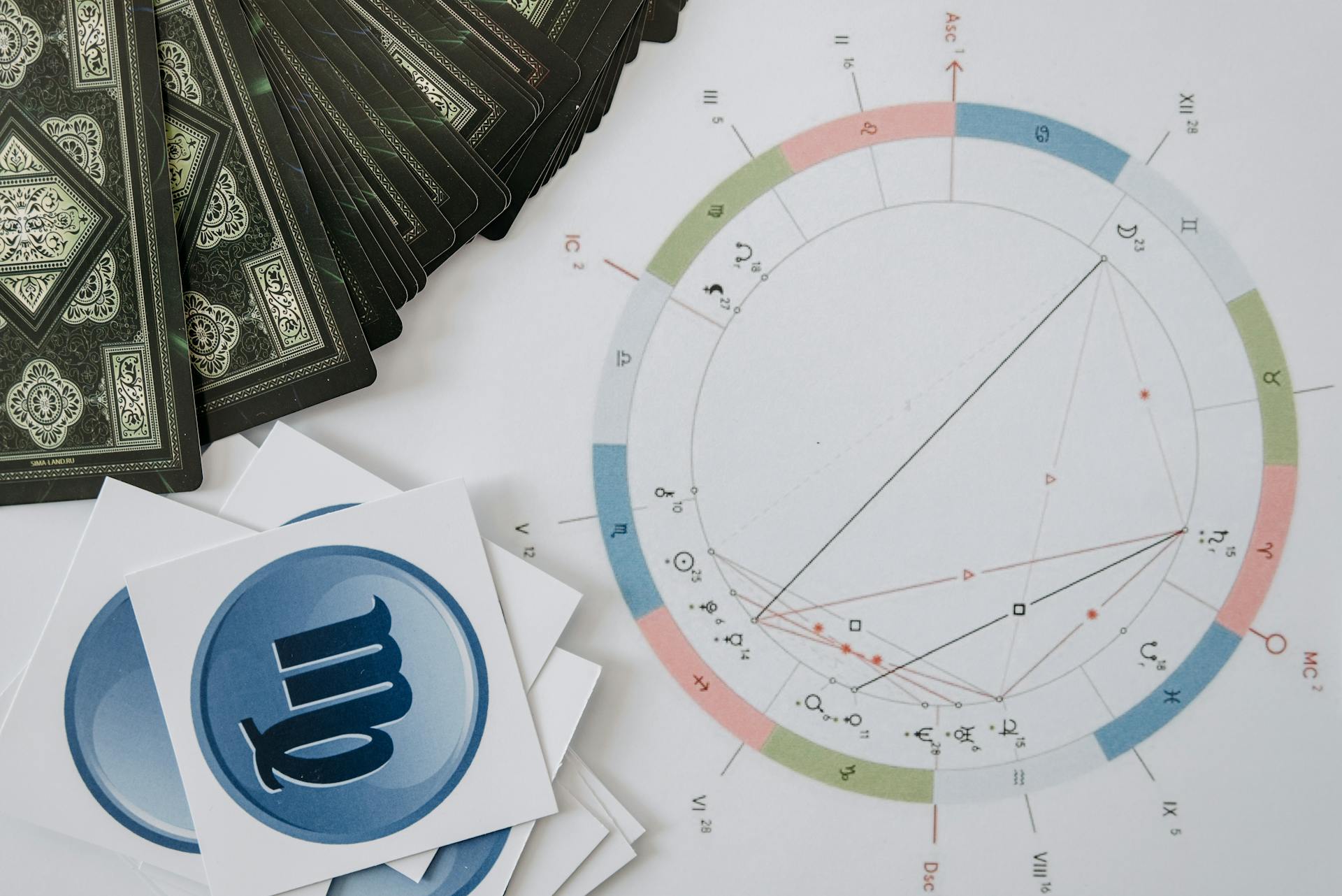
Astrology chart and zodiac symbols laid out for synastry comparison representing soul connections between two birth charts
Here's a practical way to think about it:
Soulmate indicators: Venus-Jupiter aspects, Moon trines, 7th house overlays, harmonious Sun-Moon contacts, benefic planets in the composite chart.
Twin flame indicators: Nodal axis contacts, Pluto conjunctions to personal planets, Saturn aspects to inner planets, Chiron contacts, vertex activations, South Node connections suggesting past-life familiarity, and a composite chart with heavy outer planet presence.
The soulmate relationship helps you feel at home. The twin flame relationship forces you to grow. Both are valuable. They just serve different purposes.
The Lunar Nodes: Your Strongest Twin Flame Indicator
If you're looking for one placement that screams "twin flame," start with the lunar nodes. The North Node represents the soul's growth direction in this lifetime. The South Node represents where you've already been, skills you've mastered, and patterns you default to. When someone's personal planets (especially Sun, Moon, or Venus) land on your nodes, the connection carries a fated quality that both people feel immediately.
Conjunctions to the South Node create instant recognition. You meet this person and feel like you've known them forever. There's a deep familiarity that doesn't match the actual time you've spent together. In twin flame astrology, South Node contacts suggest you've done this before, that your souls have a shared history, and this meeting is a continuation rather than a beginning.
Conjunctions to the North Node feel different. Instead of familiarity, there's a pull toward something new. This person activates your growth edge. Being around them pushes you toward the qualities your North Node is asking you to develop. It's exciting but uncomfortable because growth always is.
The strongest twin flame signature involves contacts to both nodes. Their Sun on your South Node and their Moon on your North Node, for example. Or their nodal axis aligning with yours within a tight orb. When the nodes are activated in both directions, the relationship feels both deeply familiar and urgently evolutionary. You can't just coast on the past-life comfort because the North Node keeps pulling you forward.
Check your nodal contacts in synastry with tight orbs, ideally within three degrees for conjunctions. Wider orbs still register, but the tighter the aspect, the more undeniable the connection feels.
Sun-Moon Contacts Between Charts
The Sun and Moon are the two most personal points in your chart. Your Sun sign represents your core identity, and your Moon sign represents your emotional inner world. When these two luminaries form strong contacts between two charts, the connection hits at the deepest identity level.
The classic twin flame Sun-Moon pattern is one person's Sun conjunct the other person's Moon. This creates an immediate sense of being understood. The Sun person embodies qualities the Moon person feels internally but struggles to express, and the Moon person provides emotional depth that the Sun person recognizes as familiar. When it goes both ways (your Sun on their Moon and their Sun on your Moon), the mirroring effect intensifies.
Sun conjunct Sun creates identity resonance. You see yourself in this person. Depending on the rest of the synastry, this can be validating or confrontational, sometimes both in the same conversation.
Moon conjunct Moon creates emotional synchronization. You process feelings the same way. Your emotional rhythms match. This is one of the most bonding aspects in any relationship, and in a twin flame context it creates the sensation that your emotional interiors are made of the same material.
Sun opposite Moon is particularly significant for twin flames. The opposition suggests polarity, two people who represent complementary halves of a whole. One person's conscious identity reflects the other's unconscious emotional nature. This can feel both magnetic and destabilizing, which is exactly what twin flame connections are known for.
Flat lay of astrology tools including natal charts on a desk representing birth chart comparison for relationships
Venus-Mars Aspects and Magnetic Attraction
Venus and Mars govern attraction, desire, and how two people connect romantically and physically. In twin flame astrology, Venus-Mars contacts between charts create the magnetic pull that makes the connection impossible to ignore.
Venus conjunct Mars between charts is straightforward attraction. The Venus person finds the Mars person compelling, and the Mars person finds the Venus person irresistible. When it's mutual (your Venus on their Mars and their Venus on your Mars), the chemistry is explosive and balanced.
Venus opposite Mars carries similar energy but with more tension. The attraction exists, but it operates through polarity rather than fusion. You're drawn to each other precisely because you express romantic and sexual energy in opposite ways.
Venus square Mars shows up frequently in twin flame charts. Squares create friction, and in this case the friction is between how two people give and receive love. It's the aspect that produces arguments that end in reconciliation, the push-pull dynamic that twin flames are known for. The attraction is strong, but it requires constant negotiation.
What distinguishes twin flame Venus-Mars contacts from ordinary attraction is that they don't exist in isolation. In a typical dating situation, you might have one nice Venus-Mars trine and that's the extent of the chemistry. In a twin flame chart, the Venus-Mars contacts are accompanied by everything else on this list: nodal ties, Pluto contacts, Saturn aspects. The attraction is one layer of a much more complex bond.
Saturn Aspects: The Karmic Glue
Saturn is the planet of commitment, responsibility, karma, and time. When Saturn forms strong aspects between two charts, the relationship carries weight. You can't take it lightly even if you try. Saturn contacts create the feeling that this connection is meant to teach you something, and leaving before the lesson is complete feels fundamentally wrong.
Saturn conjunct personal planets (Sun, Moon, Venus, Mars) in synastry creates a bond that feels binding. The Saturn person often takes a stabilizing or structuring role in the relationship, while the personal planet person feels both secured and tested by that structure. In twin flame astrology, these contacts explain why the connection feels impossible to walk away from, even during its most difficult phases.
Saturn conjunct Saturn (a Saturn return overlap) happens when two people are born within a few years of each other and their Saturn placements align. This creates a shared karmic curriculum. You're both working on the same life lessons, which can feel like an immediate bond or like you're both stuck in the same classroom.
Saturn square or opposite Venus is one of the hardest synastry aspects and one of the most common in twin flame charts. It creates a dynamic where love and duty feel intertwined, where the relationship demands maturity, and where running from the connection creates more suffering than staying and working through it.
The reason Saturn shows up so consistently in twin flame astrology is that twin flame connections are fundamentally about growth, and Saturn is the planet that ensures growth happens through sustained effort rather than shortcuts.
Pluto Contacts: Transformation Through Connection
Pluto is the planet of transformation, power dynamics, destruction, and rebirth. When Pluto makes strong contacts to another person's personal planets, the relationship becomes a catalyst for profound change. You don't walk away from a Pluto connection the same person who walked in.
A warm candlelit setting featuring an astrology natal chart representing the deep intimate nature of twin flame chart analysis
Pluto conjunct the Ascendant, Sun, or Moon in synastry is one of the most intense contacts possible. The Pluto person sees past the other person's defenses. There's nowhere to hide. This can feel deeply intimate or deeply threatening, often alternating between the two. In twin flame dynamics, this explains the "I feel completely seen by you and it terrifies me" experience.
Pluto square Venus or Mars creates obsessive attraction. The desire isn't casual; it's consuming. These aspects often correlate with relationships that both people describe as the most intense of their lives, regardless of whether the relationship was ultimately healthy or destructive.
Pluto opposite Moon creates emotional transformation. The Moon person's emotional patterns get dredged up and reshaped by the Pluto person's influence. This is the aspect behind the "you changed me at a fundamental level" testimonials that twin flames often share.
A critical note about Pluto contacts: intensity isn't the same as love. Pluto in synastry can indicate obsession, control, or power struggles just as easily as it indicates transformative soul connection. The difference lies in the rest of the chart and in how both people handle the energy. Twin flame Pluto contacts are accompanied by the supportive contacts (trines, sextiles, nodal connections) that give the intensity a constructive channel. Pluto contacts without that support often indicate a karmic connection that's more about breaking patterns than building a lasting bond.
The Vertex and Fated Encounters
The vertex is a calculated point in your chart that activates during fated events and encounters. It's not a planet, and it's not always active. But when someone's personal planet or angle conjuncts your vertex, the meeting feels destined, like the universe arranged the encounter.
In twin flame astrology, vertex contacts are common. One person's Sun, Moon, or Ascendant on the other's vertex creates the "I was supposed to meet you" feeling. Vertex contacts don't guarantee a smooth relationship; they guarantee a significant one. The encounter changes your trajectory regardless of whether the relationship lasts.
Double vertex contacts (your vertex on their planet and their vertex on your planet) strengthen the fated quality. These relationships feel mutually destined rather than one-sided. Both people describe the meeting as a turning point.
Check for vertex contacts in your synastry with a tight orb of two degrees or less. The vertex is a sensitive point that responds to precision.
Composite Chart Indicators of Twin Flame Energy
The composite chart merges two natal charts into one, creating a single chart that represents the relationship itself. While synastry shows how two individuals interact, the composite chart shows what the relationship is as its own entity.
Twin flame composite charts tend to share several features:
Strong angular placements. When composite planets land in the 1st, 4th, 7th, or 10th houses, the relationship has a visible, structural presence in both people's lives. It's not a background connection; it's a central one.
Sun-Moon conjunction or opposition. This suggests the relationship's identity (Sun) and emotional foundation (Moon) are either unified or operating in complementary polarity. Both configurations indicate a relationship that feels complete in itself.
Pluto conjunct an angle or personal planet. This confirms the transformative quality of the bond. The relationship exists to change both people, and the composite Pluto placement shows where that transformation concentrates.
North Node prominence. A composite North Node in the 1st house, 7th house, or conjunct the Sun suggests the relationship has a forward-moving purpose. It's not just about revisiting old karma; it's about creating something new.
Saturn-Venus contacts. These indicate a relationship that combines love with longevity. The bond is built to last, but it requires work and maturity from both people.
Hands arranging tarot cards with astrology symbols and natal chart on a table for relationship chart reading
How to Read Your Charts for Twin Flame Connections
If you want to assess whether a specific connection has twin flame indicators, here's a practical approach:
Step 1: Pull up both natal charts. You need accurate birth times for both people. Generate your natal chart and ask your partner for their birth details. Without accurate birth times, you'll miss the Ascendant, houses, and vertex, which are some of the most important indicators.
Step 2: Check the lunar nodes. Look for conjunctions between one person's planets and the other's North or South Node. Tight orbs (within three degrees) carry the most weight. Note whether the contacts are to the North Node (growth-oriented) or South Node (familiarity-based). Both present? That's a strong twin flame signature.
Step 3: Examine Sun-Moon contacts. Look for conjunctions, oppositions, and squares between the luminaries. The more Sun-Moon contacts, the more identity-level the connection.
Step 4: Check Venus-Mars aspects. These confirm the attraction layer. Hard aspects (squares, oppositions) are just as significant as soft ones (trines, sextiles) in twin flame charts.
Step 5: Look for Saturn and Pluto contacts. These add the karmic weight and transformative intensity that distinguish twin flame connections from ordinary relationships.
Step 6: Check the vertex. Look for conjunctions from personal planets to the vertex within two degrees.
Step 7: Pull the composite chart. Check for angular planets, nodal prominence, and Pluto contacts to personal planets or angles.
Step 8: Count the layers. A twin flame connection won't rest on one or two indicators. You're looking for a pattern, multiple types of contacts stacking on top of each other. Five or more significant contacts across these categories is where the twin flame signature starts to become convincing.
The biggest mistake people make in twin flame astrology is confirmation bias: wanting a connection to be a twin flame so badly that they stretch the orbs, count minor aspects, and declare the relationship fated based on thin evidence. Be honest about what the charts actually show. A genuine twin flame signature doesn't need to be forced. It jumps off the page.
Frequently Asked Questions
Can astrology tell you who your twin flame is?
Astrology can't name your twin flame or point to a specific person before you meet them. What it can do is analyze the connections between two charts after you've met and identify whether the contact patterns match what's typically seen in twin flame relationships. The indicators (nodal contacts, Pluto aspects, Sun-Moon overlaps, vertex activations) either appear in the synastry or they don't. Astrology confirms or challenges your intuition; it doesn't replace it.
Do twin flames always have the same zodiac sign?
No. Twin flames can be any combination of signs. What matters isn't whether you share a Sun sign but whether your charts create the dense web of contacts described above. Some twin flame pairs have opposing Sun signs, some share the same element, and some have no obvious sign-level connection at all. Focus on the aspects between charts, not the signs themselves. Elemental balance between your big three placements can be interesting, but it's supplementary to the core indicators.
What if we don't have any twin flame indicators?
If you've run through the checklist and the charts don't show the typical twin flame pattern, that doesn't mean your relationship isn't meaningful. It might be a soulmate connection, a karmic relationship, or simply a healthy partnership. Not every profound relationship is a twin flame dynamic, and that's fine. Twin flame connections are specific and relatively rare. A loving relationship with good compatibility and mutual respect doesn't need the twin flame label to be valuable.
Are twin flame relationships always romantic?
Not necessarily. While the Venus-Mars chemistry in most twin flame charts gives the connection a romantic charge, twin flames can also manifest as deep friendships, family bonds, or creative partnerships. The defining quality isn't romance; it's the mirroring effect and the accelerated growth both people experience. If someone triggers your deepest transformation and reflects your most hidden qualities, the astrological contacts will show the same patterns regardless of whether the relationship is romantic or platonic.
How important are birth times for twin flame astrology?
Very important. Without accurate birth times, you lose the Ascendant, the house placements, the vertex, and the precise Moon degree, which are some of the strongest twin flame indicators. If you only have Sun signs or approximate birth times, you can still check some planetary aspects, but the analysis will be incomplete. For a thorough twin flame assessment, you need both charts calculated with birth times accurate to within fifteen minutes.
Twin flame astrology doesn't promise a fairy tale. It reveals the architecture of a connection that challenges, mirrors, and ultimately transforms both people involved. The indicators in your chart won't tell you whether to stay or leave. They'll tell you what the connection is designed to teach you and where the growth potential lives. Generate your natal chart to start mapping your placements. Explore synastry to compare your chart with someone specific. And check your compatibility to see how your signs interact at every level. The charts don't decide for you. They show you what you're working with so you can decide with more clarity.