Sacred Geometry Symbols and Their Meanings: A Beginner's Guide
Sacred geometry is the belief that a small set of shapes and patterns, like the circle, the spiral, and the Flower of Life, repeat all through nature, art, and spiritual traditions, and that those forms carry meaning. The symbols aren't powerful on their own. They're a visual language cultures across the world have used to point at one idea: that proportion, pattern, and order run through everything, from a sunflower head to a spiral galaxy.
If you've seen these designs on jewelry, tattoos, or crystal grids and wondered what they actually mean, this guide walks through the main symbols one by one, then covers where they show up in nature, whether any of it is "real," and how people use them in a spiritual practice today.
What You'll Learn
What Is Sacred Geometry?
Sacred geometry is the study of shapes, proportions, and patterns that seem to underlie the natural world, treated as symbols with spiritual meaning. The word "geometry" comes from Greek roots meaning "earth measure," and long before it was a school subject, people used it to map the stars, build temples, and make sense of how things grow.
The core observation is simple. A few shapes keep reappearing at every scale. The same hexagon that forms a snowflake also forms a honeycomb. The same spiral in a nautilus shell echoes the arms of a galaxy. To the people who first noticed this, that couldn't be an accident. They read it as a sign of a design running through creation, and they turned the shapes into symbols they could meditate on, build with, and pass down.
So sacred geometry sits in two places at once. Part of it is plain mathematics you can measure. The other part is the meaning humans have layered on top: that these patterns connect us to something larger.
Why Is It Called Sacred?
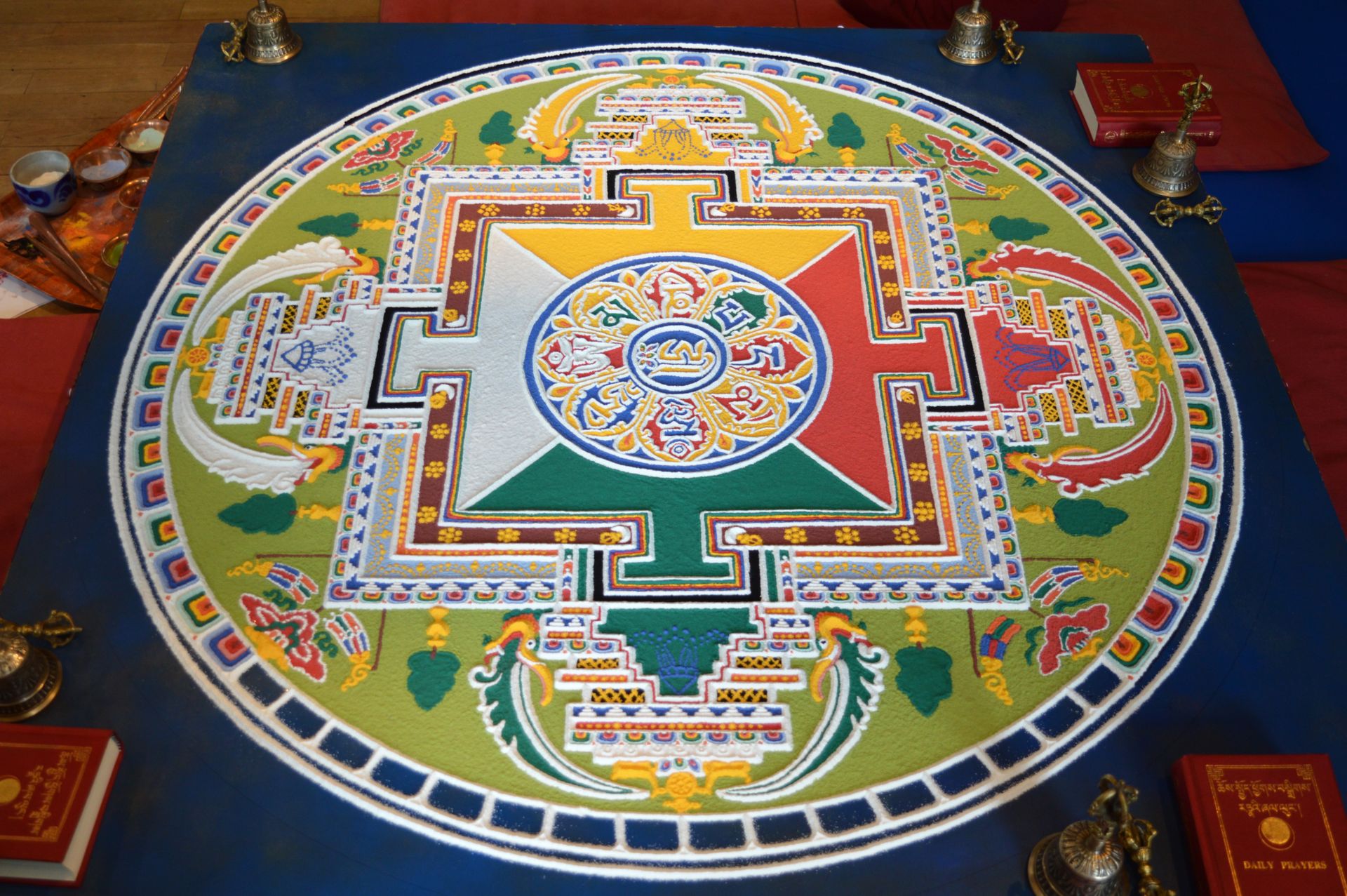
The "sacred" label comes from how widely these shapes turn up in religious and spiritual settings. Gothic cathedrals were laid out with compass-and-straightedge geometry. Islamic art fills mosques with endless geometric tiling because it represents the infinite. Hindu and Buddhist mandalas use concentric circles and squares as maps for meditation. Egyptian and Greek builders tuned their proportions to specific ratios.
Different traditions, same instinct. When people wanted to represent the divine, order, or the cosmos, they reached for geometry rather than a literal picture. A perfect circle has no beginning and no end, so it became a natural stand-in for eternity and wholeness. A pattern that repeats forever suggested a creator without limit.
Calling it sacred doesn't mean every claim attached to it is proven. It means these shapes have carried spiritual weight for thousands of years, across cultures that never met.
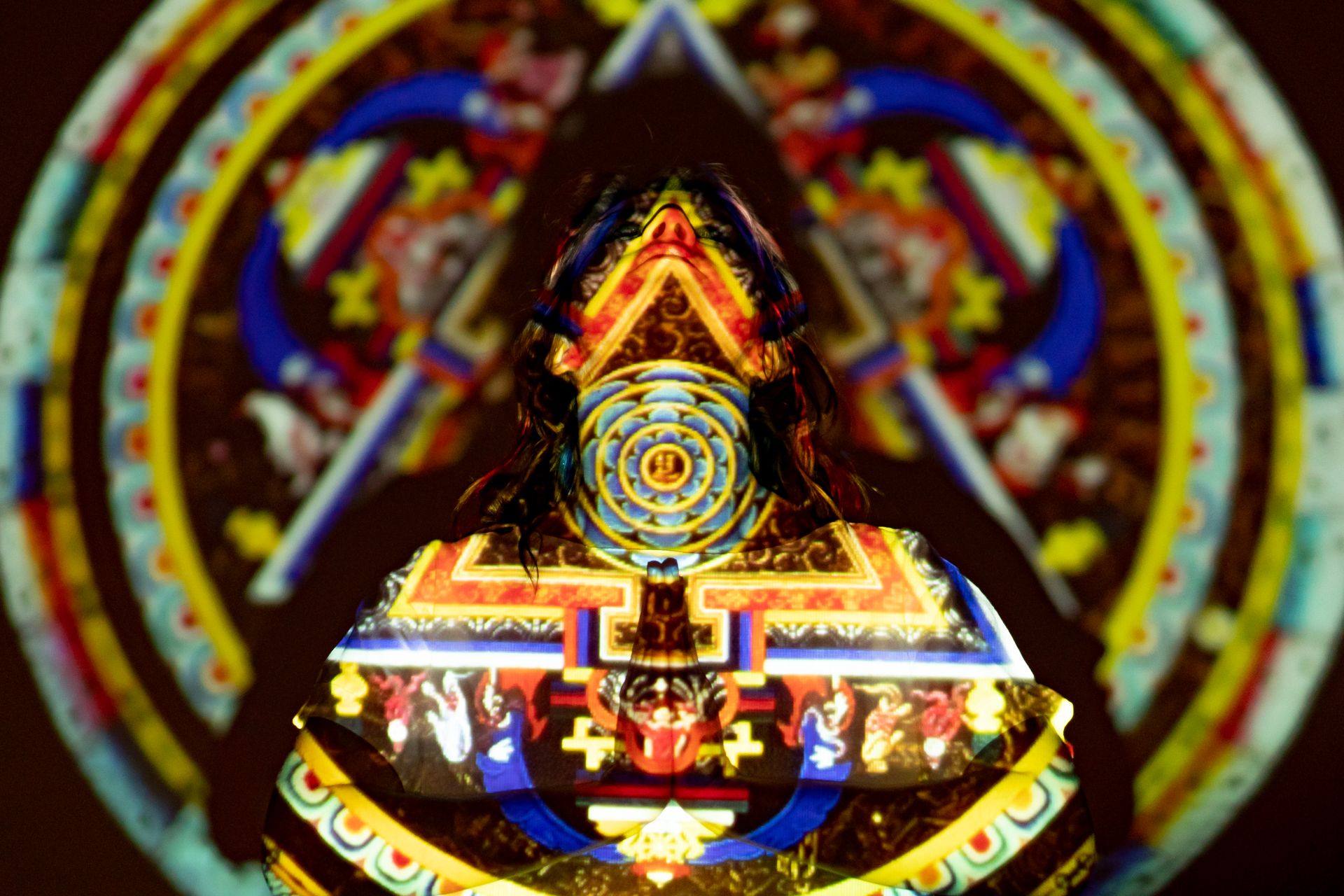
A mandala pattern of concentric circles projected over a seated figure, showing how sacred geometry is used as a focus for meditation
The Main Sacred Geometry Symbols and Their Meanings
Most of sacred geometry builds out of one shape, the circle, repeated and overlapped. Here are the symbols you'll run into most often, roughly in the order they grow from each other.
The Circle
The circle is the starting point. One unbroken line with no corners and no end, it stands for unity, wholeness, and the cycle of life. Almost every other symbol here is made by drawing more circles. Spiritually, it represents the whole, the self, or the universe as a single connected thing.
The Vesica Piscis
Draw two circles the same size so each one's edge passes through the other's center, and the overlap forms a pointed oval called the vesica piscis, Latin for "fish bladder." That almond shape appears in the art of many cultures and is often read as a symbol of creation, balance, and the meeting of two worlds, spirit and matter. It's the first step from one circle toward every pattern that follows.
The Seed of Life
Add more circles around a central one, six evenly spaced so their edges touch the middle, and you get the Seed of Life: seven overlapping circles forming a six-petaled flower. Many traditions link it to creation unfolding in stages, and the seven circles are sometimes tied to the seven days of creation in various myths. It's the seed the larger patterns grow from.
The Flower of Life
Keep extending that grid of overlapping circles outward and you reach the Flower of Life, the pattern most people picture when they hear "sacred geometry." The classic version has 19 complete circles held inside a larger boundary, creating a lattice of petals. It's been found carved into ancient sites around the world, and enthusiasts treat it as a kind of master pattern that contains all the others. Its meaning centers on the interconnection of all life and the idea that everything grows from the same blueprint.
Metatron's Cube and the Platonic Solids
Connect the centers of the circles in the Flower of Life with straight lines and a new figure appears: Metatron's Cube, named for the angel Metatron in some mystical traditions. Hidden inside it are the five Platonic solids, the only five three-dimensional shapes whose faces are all identical regular polygons. The Greek philosopher Plato linked them to the classical elements: the tetrahedron to fire, the cube to earth, the octahedron to air, the icosahedron to water, and the dodecahedron to the heavens or cosmos. Metatron's Cube is often used as a symbol of balance and protection because it holds all these building blocks in one figure.
The Sri Yantra
The Sri Yantra comes from the Hindu tantric tradition. It's built from nine interlocking triangles, four pointing up and five pointing down, that overlap to create 43 smaller triangles arranged around a central point called the bindu. It's used as a focus for meditation, with the center representing the source of creation and the surrounding triangles the unfolding of the universe. Few symbols pack this much structure into a single design.
The Merkaba
The Merkaba is a star tetrahedron, two three-sided pyramids interlocked so one points up and one points down, forming a three-dimensional Star of David. The name is often traced to words meaning "light," "spirit," and "body." In metaphysical circles it's described as a field of energy around the body used for protection and spiritual growth. Whatever you make of that, the shape itself is a clean example of two opposites held in balance.
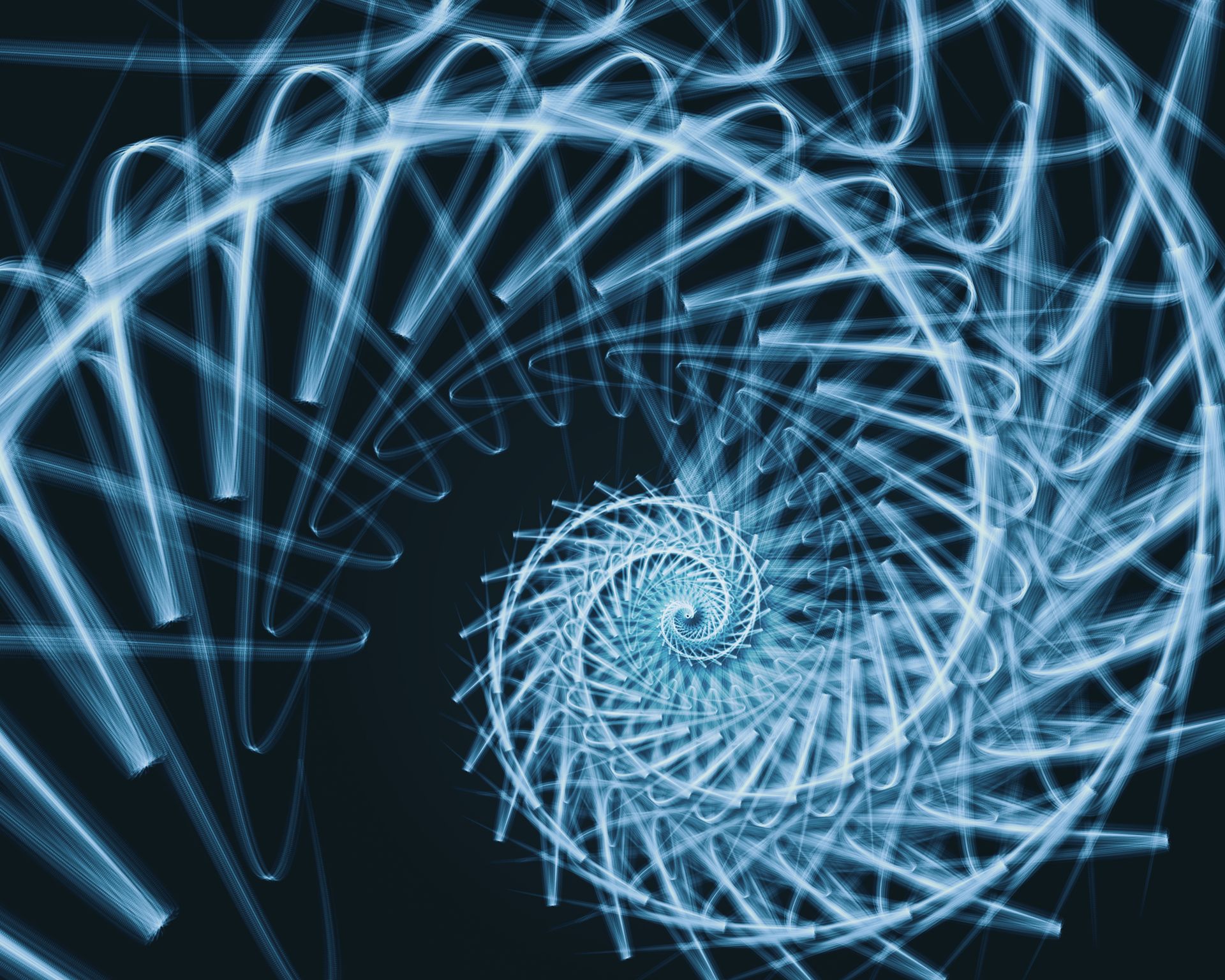
A luminous blue spiral winding inward to a single point, illustrating the logarithmic spiral tied to the golden ratio in sacred geometry
The Golden Ratio and the Fibonacci Spiral
No tour of sacred geometry is complete without the golden ratio, written with the Greek letter phi and equal to about 1.618. Two quantities are in the golden ratio when the larger relates to the smaller the same way the whole relates to the larger. It's a real, well-defined number, not a mystical invention.
It's closely tied to the Fibonacci sequence, where each number is the sum of the two before it: 0, 1, 1, 2, 3, 5, 8, 13, 21, and on. Divide any Fibonacci number by the one before it and you get closer and closer to 1.618 as the numbers grow. Lay those numbers out as squares and you can draw a curve people call the golden spiral.
Artists and architects have used these proportions for centuries because they tend to look balanced to the eye. In sacred geometry, the golden ratio stands for growth that stays in harmony with itself, the same rule repeating at every scale. One honest note: the nautilus shell is often called a perfect golden spiral, but it's actually a logarithmic spiral that doesn't match phi exactly. The pattern in nature is real; the specific golden-ratio claim gets overstated.
Where Sacred Geometry Shows Up in Nature
This is where sacred geometry stops being abstract. The patterns really are out there, and you don't need any belief to see them.
Scientists explain these with physics and efficiency rather than mysticism. A hexagon wins because it saves wax and space. A Fibonacci spiral wins because it packs seeds without gaps. Sacred geometry takes those same patterns and asks a different question: what does it mean that the universe keeps reaching for the same handful of solutions?
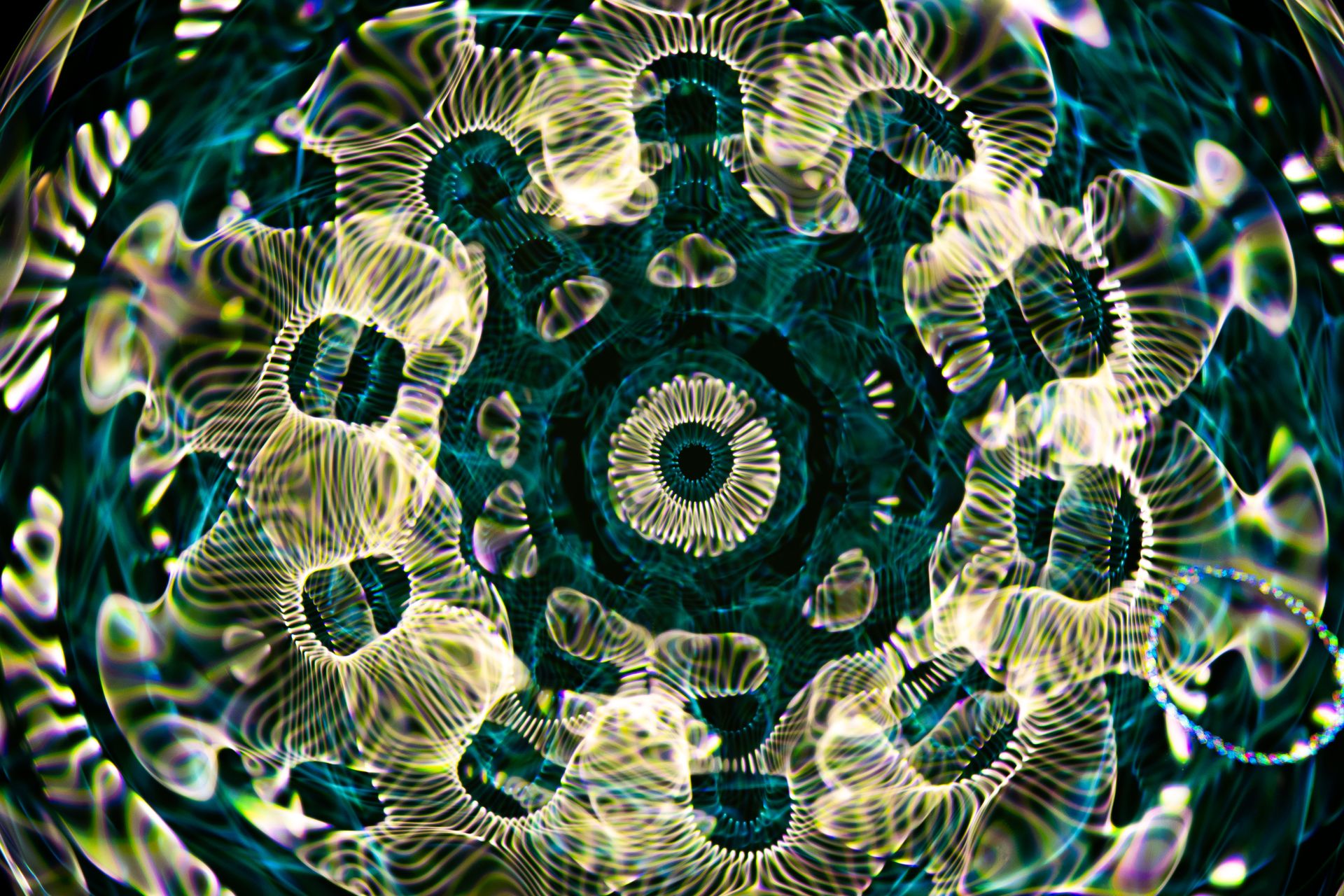
A radial kaleidoscopic pattern of repeating shapes, echoing the fractal symmetry found throughout the natural world
Is Sacred Geometry Real?
Here's the honest answer, in two parts.
The mathematics is completely real. The golden ratio, the Platonic solids, Fibonacci spirals in sunflowers, hexagons in honeycombs, these are measurable facts any mathematician or biologist will confirm. There's genuine wonder in how often nature reuses the same efficient shapes.
The spiritual claims are a different matter. The idea that meditating on the Flower of Life heals your body, that a Merkaba field protects your energy, or that placing symbols in your home shifts your reality, none of that has scientific evidence behind it. That doesn't make the symbols worthless. It means their value works the way a mandala or a religious icon works: as a focus for attention, a reminder of what matters to you, and a beautiful piece of symbolism that helps you slow down and reflect.
So use sacred geometry for what it genuinely offers, meaning, focus, and a sense of connection, without expecting the shapes to do physical work on their own. Read past anyone selling it as a guaranteed cure or a manifestation shortcut.
How to Use Sacred Geometry in Your Practice
If the symbols speak to you, there are simple ways to bring them in.
The thread through all of these is intention and focus, not the shape doing something to you. Pair it with a broader practice like a new moon manifestation ritual or working with healing crystals and it becomes one tool among several.
Sacred Geometry and Astrology
Astrology is quietly built on geometry, which is why the two fit together so well. Your birth chart is a circle, the 360 degrees of the sky, divided into 12 equal slices of 30 degrees each for the signs. The whole thing is a wheel, the oldest sacred shape there is.
The aspects, the angles planets make to each other, are pure geometry too. A trine is 120 degrees, one third of the circle, and tends to feel harmonious. A square is 90 degrees, a quarter of the circle, and brings tension. A sextile is 60 degrees, an opposition is 180. Astrologers have read meaning into these angles for centuries, which is sacred geometry applied to the sky. To see the shapes in your own chart, our piece on birth chart aspects breaks down what each angle means.
Look at the overall pattern your planets form and you get another layer, sometimes called the shape of your chart, from a tight bundle to a spread-out splash. Geometry, again, telling a story.
Frequently Asked Questions
What are the 7 pieces of sacred geometry?
People usually mean the shapes that build on each other: the circle, the vesica piscis, the Seed of Life, the Flower of Life, Metatron's Cube, the Platonic solids, and the Merkaba. The Sri Yantra and the golden spiral are often added to that core list.
What is the most powerful sacred geometry symbol?
There's no single "most powerful" one, since the meaning depends on the tradition. The Flower of Life is the most famous because it's said to contain all the other patterns, so many people treat it as the master symbol.
Is sacred geometry religious?
It isn't tied to one religion. The same shapes appear in Christian, Islamic, Hindu, Buddhist, and Jewish art, along with many older traditions. It's better described as spiritual and cross-cultural than as belonging to any single faith.
What does the Flower of Life mean?
The Flower of Life represents the interconnection of all living things and the idea that everything grows from the same underlying pattern. It's made of 19 overlapping circles and has been found carved at ancient sites around the world.
Does sacred geometry actually work?
The math behind it is real and shows up all through nature. The spiritual claims, like healing or protection, have no scientific proof. Its real value is as a focus for meditation and a meaningful symbol, not as a shape that changes your body or your luck on its own.
Bringing It Together
Sacred geometry is two things at once: a set of real mathematical patterns that genuinely repeat through nature, and a language of meaning humans have built on top of them for thousands of years. You can appreciate the wonder without buying every claim, and you can use the symbols as a focus for reflection without expecting magic.
Ready to see the geometry in your own life? Start with your free natal chart to explore the angles and aspects shaping your personality, pull a tarot reading for a fresh perspective, or check your compatibility with someone through the geometry of two charts combined.