
Scripting Manifestation: How to Write What You Want Into Reality
Scripting is a manifestation technique where you write about your desire as if it has already happened, in vivid present-tense detail, to pull your focus toward what you want instead of what you lack. Rather than asking the universe for a future outcome, you describe the life you're already living once that outcome arrives: how it feels, what you see, and who's beside you. The writing does the work, because it trains your attention and emotions to rehearse the result as real.
People reach for scripting because it's simple, free, and grounding. You need a notebook and a few quiet minutes, not crystals, a full moon, or any special setup. This guide covers what scripting actually is, how it works, the exact steps to do it well, templates you can copy tonight, the mistakes that quietly sabotage people, and how to pair scripting with your birth chart and the lunar cycle for a stronger ritual.
What You'll Learn
A person writing in a journal by warm candlelight, a quiet scene for scripting manifestation
What is scripting in manifestation?
Scripting is journaling your goal in the present tense, as though it's already part of your life. You're not writing a wish list or a plan with steps. You're writing a scene from the version of your life where the thing has already happened, and you're describing it the way you'd describe a good day that actually occurred.
The name comes from screenwriting. A film script lays out what's happening, what people say, and how a moment feels. A manifestation script does the same for your own life. You become the writer of the scene you want to step into, and your job is to make it specific and emotionally believable.
This puts scripting in the same family as other written manifestation tools, but with its own flavor. The 369 manifestation method leans on repetition of a short affirmation. Scripting leans on detail and story. You're not repeating one line over and over. You're painting a full picture you can feel.
How does scripting manifestation work?
There's no claim here that ink on paper bends physics. What scripting reliably does is change where your attention goes and how you feel when you think about your goal, and that shift is the real engine behind most manifestation practices.
When you write a detailed present-tense scene, three things happen. First, you get clear. Vague desires like "I want more money" turn into concrete pictures, and clarity is what lets you recognize and act on opportunities you'd otherwise walk past. Second, you rehearse the emotion. Your nervous system responds to a vividly imagined scene in a way that's similar to a real memory, so scripting lets you practice feeling secure, loved, or successful before the circumstances arrive. Third, you prime your behavior. People who feel like the person who already has the outcome tend to make small daily choices that move them toward it.

An open lined notebook with a pen resting on it under soft natural light
In other words, scripting works less like a magic spell and more like a focusing tool. It takes a foggy hope and turns it into a clear, felt, repeatable image that guides your choices. That's also why the emotional honesty of what you write matters far more than the length.
How to script for manifestation step by step
You can write your first script in under ten minutes. Here's a reliable structure to follow.
1. Pick one specific desire. Choose a single goal for this session. Scripting five unrelated things at once dilutes the focus. Get precise: not "a better job" but "the role at the company I love, with the salary and team I want."
2. Set the scene first. Take three slow breaths and settle. Some people light a candle or play soft music to mark the start of the ritual. If you enjoy that kind of cue, our guide to candle magic colors and meanings pairs well with a scripting practice.
3. Write in the present tense, as if it's done. Open with a line like "I'm so grateful now that" and describe your day inside the reality you want. Keep it in the now, not the someday.
4. Load it with sensory and emotional detail. What do you see when you wake up? What does the text on your phone say? How does your chest feel when you read it? Detail is what makes the scene believable to you.
5. Anchor it in gratitude. Write as someone thankful for what they already have, not someone aching for what's missing. Gratitude is the emotional tone that keeps a script from sliding back into longing.
6. Read it back and feel it. Close by rereading what you wrote, slowly, and letting yourself actually feel the relief and joy of it being true. Then close the notebook and go live your day. The release matters as much as the writing.
What tense should you write in?
Present tense is the heart of scripting. You write as though the outcome is your current reality, because the technique depends on your mind treating the scene as now rather than later.
The trap is the future tense. Lines like "I will have" or "one day I'm going to" quietly tell your brain the thing is still missing and still far off, which keeps you anchored in waiting. "I am" and "I have" close that gap.
A few people prefer past tense for a specific event, writing it like a memory: "Last week I signed the lease and I still can't believe how perfect the place is." That works too, because it also positions the outcome as something that already happened. The rule under both styles is the same. Avoid the future. Write from the inside of the result, not from the doorway looking in.

A woman writing in a journal with a cup of coffee, relaxed and unhurried
Scripting manifestation examples and templates
Here are short templates you can adapt. Swap in your own details and stretch each one into a few paragraphs.
For career or money:
"I'm so grateful now that I love what I do. I wake up genuinely excited for my work, the kind that pays me well and respects my time. My bank balance gives me a quiet sense of safety. I just paid every bill without a second thought, and there's plenty left for the things I enjoy. Money flows to me easily, and I handle it with calm and confidence."
For love and relationships:
"I feel so safe and seen in my relationship. My partner is kind, funny, and completely on my side. This morning we made coffee together and laughed about nothing, and I felt this deep certainty that I'm exactly where I belong. Loving and being loved like this feels natural now."
For health and confidence:
"I'm so thankful for how strong and clear I feel in my body. I sleep deeply and wake up rested. I move through my day with energy and ease, and I treat myself with real kindness. I trust myself, and that trust shows in everything I do."
For a specific event:
"I can hardly believe it actually happened. I opened the email and read the word accepted, and my whole body lit up. I called the people I love and we celebrated. I worked for this, and now it's mine."
If you want to add a reflective layer, pull a card afterward and ask what's supporting your goal right now. A quick tarot reading can turn a script into a two-way conversation with yourself rather than a one-way wish.
How often should you script?
There's no single correct schedule, but consistency beats intensity. A short daily script of a few sentences usually works better than a marathon session once a month, because the point is to keep your attention and emotion tuned to the outcome over time.
Three common rhythms work well. Daily scripting is good for goals you want to keep front of mind, and many people do it as a five-minute morning or bedtime ritual. Weekly scripting suits a longer, more detailed entry, often on a Sunday as you set the tone for the week. Event-based scripting ties the practice to the lunar cycle, which we'll cover next.
The thing to watch for is obsessive checking. Scripting daily out of devotion is healthy. Rewriting the same script ten times a day because you're anxious it isn't working yet usually signals the opposite of trust, and that low-grade worry is the energy you don't want to feed. Write it, feel it, then let it go and get on with your life.
Common scripting mistakes to avoid
A few habits quietly drain the practice. Steering around them is most of the work.
Writing in the future tense. As covered above, "I will" keeps the goal at arm's length. Stay in "I am" and "I have."
Scripting from lack. If the underlying feeling while you write is desperation, you're reinforcing the absence, not the having. Shift into gratitude before you start. If you can't get there, journal the worry separately first to clear it, then script.
Being vague. "I want to be happy and rich" gives your mind nothing to picture. Specifics are what make a scene real and what make opportunities recognizable later.
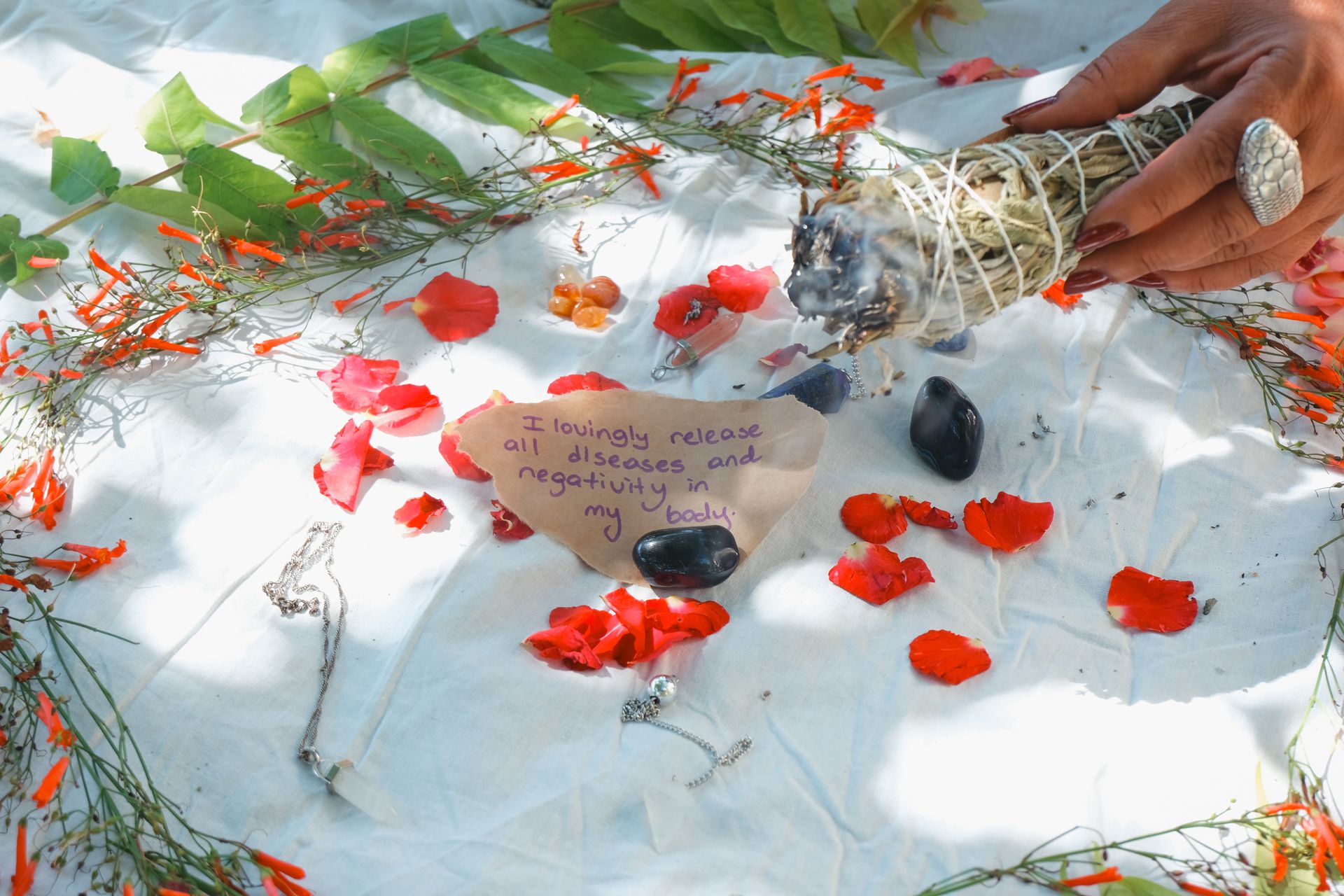
A calm ritual setup with a candle, dried herbs, and soft light for an intentional writing session
Forcing the how. Your script describes the destination and the feeling, not the logistics. You don't have to map out every step of how it arrives. Pinning yourself to one exact path often blocks easier routes you can't see yet.
Never taking action. Scripting is a focusing tool, not a substitute for showing up. Treat it as the thing that clarifies your direction and steadies your nerves, then act on the opportunities it helps you notice.
Pairing scripting with astrology and moon phases
Scripting stands on its own, but tying it to natural cycles can make it feel more like a ritual and less like a chore. The lunar cycle is the easiest anchor.
The new moon is traditionally a time for fresh starts and setting intentions, which makes it a natural moment to script a new goal. Our new moon manifestation guide walks through that energy in depth, and a script fits right into that ritual. The full moon, by contrast, is about completion and release, so it's a fitting time to script gratitude for what's already arrived and to let go of what isn't serving you. For the bigger picture of working with lunar timing, see our guide to setting intentions with moon phases.
Your birth chart can sharpen the focus too. If you're scripting around money and self-worth, the themes of your second house and the placement of Jupiter, the planet of expansion, are worth knowing. You can explore both in our pieces on the second house of money and values and Jupiter in the houses. None of this is required to script well. It just gives your practice a personal shape, so the scenes you write line up with the parts of your chart you most want to grow.
Frequently asked questions
How long should a manifestation script be?
There's no required length. A few honest, detailed sentences that you actually feel beat several pages written on autopilot. Many people script for five to ten minutes. Quality of emotion matters far more than word count.
How long does scripting take to work?
There's no fixed timeline, and it depends on the goal, your beliefs, and the actions you take alongside it. Treat scripting as a daily focusing habit rather than a countdown. The shift in how you feel and what you notice often comes well before the outcome does.
Should I script the same thing every day?
You can, especially for a goal you want to keep central. Just write it freshly each time so it stays felt rather than mechanical. If rewriting it daily starts to feel anxious instead of grounding, that's a sign to script less often and trust more.
Is scripting the same as the law of attraction?
Scripting is one tool people use within the broader law of attraction idea, which holds that focus and feeling shape your experience. Scripting is just the written, scene-based way of doing that work, alongside methods like affirmations and visualization.
Do I need to handwrite or can I type?
Either works. Many people find handwriting slows them down and deepens the feeling, which is the real goal. If typing helps you write more freely or more often, that's the better choice for you. Consistency matters more than the medium.
Bringing it together
Scripting turns a vague hope into a clear, felt scene you can step into a little more each day. Write in the present tense, load it with specific detail, anchor it in gratitude, then close the notebook and go act on what you notice. Done consistently, it's one of the gentlest and most grounding ways to keep your focus on the life you're building.
Ready to give your practice a personal map? Generate your free natal chart to see which placements shape your goals, pull a tarot reading to check in on what's supporting them, or explore your compatibility with someone you're manifesting a deeper connection with.