
Being Late Dream Meaning: Why You Keep Missing the Train
A being-late dream is almost never about being late. You wake with your heart still pounding, certain you missed the flight, blew the exam, or left your own wedding guests waiting, and the relief that none of it happened doesn't quite land. That residue is the point. These dreams run on time pressure, and underneath the clock they ask a quieter question: am I where I'm supposed to be, and am I ready for what's next?
If you've been having them, you're in crowded company. Late dreams sit in the same family as being chased, falling, and showing up naked in public, the anxiety dreams almost everyone has at some point. What sets the late dream apart is its signature: a missed connection, a closing window, and you sprinting toward something you can't quite reach.
What You'll Learn

A woman sleeping peacefully on her side on a soft teal pillow
What Does It Mean to Dream About Being Late?
At its core, a late dream is about the gap between where you are and where you think you should be. Not a literal schedule, but an inner one: the timeline you carry for your career, your relationships, your milestones, your idea of a life on track. When waking life rubs against that timeline, your sleeping mind reaches for the most familiar version of "not making it," which is being late.
It helps to separate this from its cousin, the chase dream. In a chase, you're running away from a threat you don't want to face. In a late dream, you're running toward something you want and can't get to. One is avoidance, the other is longing tangled up with pressure. That difference tells you which conversation you're actually having with yourself.
Most late dreams cluster around a handful of feelings: unpreparedness, the fear of missing out, loss of control over your own pace, and the sense that other people are moving while you're stuck. Read the feeling before the furniture. The train, the airport, the exam hall are just the stage the feeling borrowed for the night.
Why Do You Keep Having Late Dreams?
Recurring late dreams almost always track a recurring stress. If the same one keeps coming back, it's usually a sign your waking schedule is running hotter than you've admitted, or that a specific deadline is sitting in the back of your mind and won't be quiet.
Carl Jung saw dreams like these as compensatory. The psyche notices an imbalance you've been talking yourself out of, and it turns up the volume at night. A string of late dreams during a calm, well-paced month is unusual. A string of them while you're overcommitted, under-slept, and saying "I'm fine" is the dream doing its job.
The good news hidden in that: the dream isn't a prediction. It's feedback. Once the underlying pressure eases, the dreams usually taper off on their own, which is a useful thing to watch for.
Common Being-Late Dream Scenarios and What They Mean
The specific thing you're late for shifts the meaning. Here's how the most common versions tend to read.
Missing a flight. Flights are big transitions, so a missed flight often points to a life window you're afraid is closing. A career move, a relationship decision, a chance to relocate or start over. If the departure board keeps changing gates on you, the anxiety is less about the opportunity and more about not being able to pin down what you even want.
Missing a train or bus. Trains run on routine and shared timetables, so a missed train usually points to the everyday variety of being left behind. Peers getting promoted, friends hitting milestones, the feeling that life is pulling away from the platform while you're still fumbling for your ticket.
Late for an exam or test. This is one of the most common anxiety dreams there is, and it rarely involves a real exam. It surfaces before performance moments of any kind: a review at work, a presentation, a hard conversation. Your mind borrows the oldest template of "being judged" it has on file. More on why in the psychology section below.
Late for work or a meeting. Often tied to duty and the fear of letting people down. If you're the reliable one, the person others count on, this dream can show up when that role is starting to feel heavy.
Late to a wedding, or your own. Weddings are commitment thresholds, so running late to one can carry real cold feet about saying yes to something. If that theme hits home, the deeper dig lives in the wedding dream reading.
Your legs won't move, or time speeds up. When the clock races and your body won't cooperate, the dream is dramatizing powerlessness. You know what needs doing and some force keeps blocking it. That force is often you, in the form of avoidance or exhaustion.
You arrive, and it's already over. The empty room, the cleared tables, the plane long gone. This version carries grief more than panic. It's about a missed chance you've already half-accepted, and the quiet wish that you'd moved sooner.
Everyone else is on time but you. The comparison dream. Less about any single event and more about a running belief that you're behind schedule in life while everyone around you is right where they should be.
The Details That Change the Meaning
Once you know the scenario, the small stuff fine-tunes it.
What you're late *for* names the life domain. An exam points at judgment and evaluation, a flight at transition, a wedding at commitment, work at duty. Start there, then ask what in waking life matches that domain right now.
Lost tickets, passports, or a dead phone mean you're afraid you've misplaced something you need to move forward. Sometimes that's a literal resource, but more often it's readiness, confidence, or a sense of your own legitimacy to even be in the running.
Obstacles that keep multiplying, where you pack a bag that won't close, take a wrong turn, then another, are the dream's way of showing self-sabotage or plain overwhelm. When a task has too many moving parts in waking life, the dream gives you too many to manage in sleep.
And always come back to the feeling on waking. Panicked and wired usually means an active, unresolved pressure. Oddly calm, even relieved, can mean a part of you has made peace with missing the thing, which is worth paying attention to.
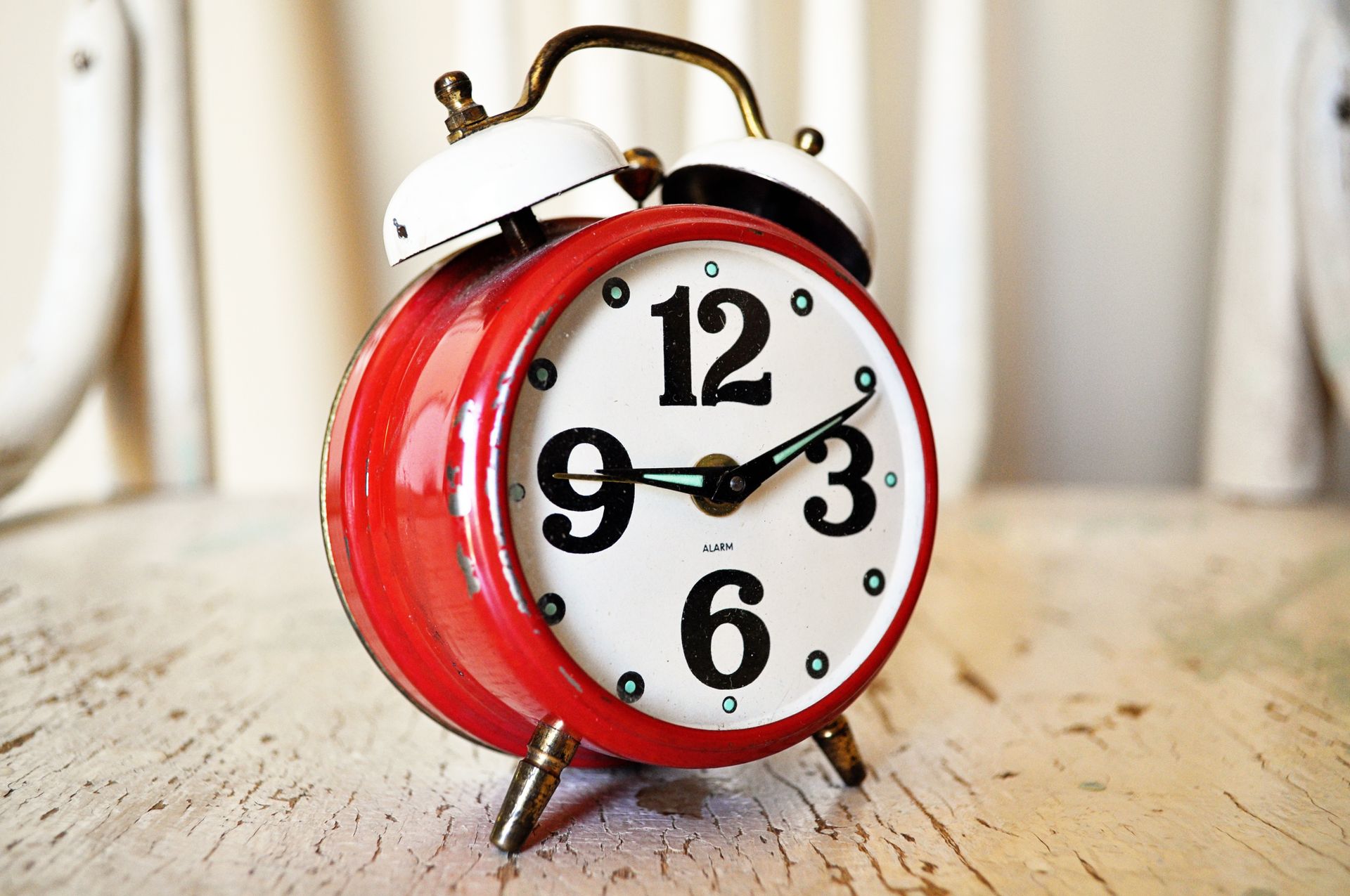
A vintage red twin-bell alarm clock on a weathered painted wooden surface
When a Late Dream Is Just Day Residue
Before you read a late dream as a message, rule out the boring explanation. Dreams recycle the day's material, and few things are stickier than schedule stress.
If you overslept this week, have a real early flight tomorrow, are sitting on a looming deadline, or fell asleep after a tense, clock-driven thriller, your brain may simply be rehearsing. A dream pulled straight from day residue tends to feel flat and literal, almost like replaying a worry rather than exploring one. You wake up, shrug, and move on.
The dreams worth decoding are the ones that carry a charge out of proportion to their content. You weren't actually in danger, nobody important was waiting, and yet the feeling followed you into the morning. That mismatch is your signal that something underneath wants a look.
The Spiritual Meaning: Divine Timing vs Your Timing
Spiritually, the late dream runs into one of the harder lessons: the idea that you can't actually be late for your own life. Many traditions hold that each path unfolds on its own timing, and that the panic of "I'm behind" is a story the anxious mind tells, not a cosmic verdict.
That doesn't make the fear fake. It makes the dream an honest picture of where you're gripping too hard, trying to force a schedule onto something that answers to a different clock. Read this way, a late dream is less a warning and more an invitation to loosen your hold, trust the pace you're actually on, and stop measuring your worth against a timetable you never agreed to.
To be clear, this isn't a promise that everything will arrive on cue if you simply relax. It's a reframe. The dream shows the fear so you can meet it, not a prophecy about what you will or won't reach. If the "behind" feeling is loud, a little shadow work on where that pressure came from tends to do more than any single interpretation.
What Late Dreams Say About Your Chart
Astrology gives time pressure a few natural homes, and your chart can hint at why these dreams land harder for you than for someone else.
Saturn is the obvious one. Saturn is the planet of time, structure, deadlines, and the inner voice asking whether you've done enough. People in the middle of a Saturn return, that late-twenties reckoning when the question "am I where I should be?" gets loud, report late and unprepared dreams often. Looking at Saturn through the houses shows which area of life that pressure tends to target.
Mercury governs travel, transit, and connections, which is why missed-train and missed-flight dreams have a Mercurial flavor. The folklore of Mercury retrograde is practically built from delays and missed links, and if your dreams spike during those windows, the symbolism is doing what Mercury does.
Day to day, the sixth house rules routine, work, and the schedule itself, while the third house covers short journeys and commutes, the exact settings these dreams keep choosing. And by sign, the time-pressure dream tends to find Capricorn placements, with their built-in fear of not achieving, and Virgo placements, who carry the highest standards for being prepared and feel it most when they're not.
Curious where your Saturn and Mercury actually sit? Run your free natal chart and see which houses they light up.
The Psychology of Being Late in Dreams
The examination version of this dream got Sigmund Freud's attention a century ago. He noticed that recurring exam dreams often turned up in people who were long done with school, and frequently right before some unrelated test of nerve. The mind, he suggested, keeps an old "being judged" template handy and reaches for it whenever a new challenge feels like an evaluation.
That lines up with what late dreams do more broadly. They're anxiety wearing a costume. The costume is a clock or a boarding gate, but the fuel is the same thing driving the worry underneath: a fear of falling short, a sense that you have to earn your place, standards you set higher than you'd ever set for a friend.
Perfectionism makes this worse. If you measure yourself against a relentless inner schedule, almost any waking stress can read as "behind," and the dream obliges. Noticing that pattern, and easing the standard, usually quiets the dreams faster than any single symbolic reading. These are close relatives of the teeth falling out dream, another anxiety classic built on a fear of losing control.
How to Work With a Recurring Late Dream
If the same late dream keeps returning, you can work with it instead of just dreading it.
Start by naming the domain. Write down what you were late for and ask what in waking life matches it: a review, a decision, a milestone you feel you're missing. Dreams get quieter once the thing they're pointing at is out in the open.
Next, name the real deadline, if there is one. Vague "I'm behind" pressure feeds these dreams. A specific, written plan starves them. Research by psychologist Gabriele Oettingen on mental contrasting found that pairing a goal with the obstacle in its way, then an if-then plan, moves people further than open-ended worry. Picture the goal, name the obstacle, decide the next small action.
Then look honestly at your schedule. Recurring late dreams are often just an over-full calendar talking. If the dream is really a flag for burnout, the fix is in your waking week, not your dream journal. Simple wind-down habits help too, and if the anxiety carries into your days, some people lean on crystals for anxiety as a grounding ritual, not because a stone resets your nervous system, but because a small calming routine before bed does.
Finally, keep a dream journal by the bed. Late dreams often shift their details over weeks, and tracking which version shows up tells you where the pressure is moving. You can decode new symbols as they appear with the common dream symbols guide or run any dream through the dream interpretation tool.
Frequently Asked Questions
What does it mean when you dream about being late?
It usually means you feel time pressure or unprepared in waking life, not that you're literally running behind. The dream points to a gap between where you are and where you think you should be, often around a decision, a performance moment, or a milestone you fear you're missing.
Why do I keep dreaming about missing a flight or train?
Recurring missed-transit dreams typically track ongoing stress or a specific worry that won't quiet down. Flights tend to symbolize big transitions and closing windows, while trains point to everyday opportunities and the fear of being left behind as others move ahead.
Are being-late dreams a bad omen?
No. They're anxiety dreams, not predictions. They reflect how you feel about your own timing, not what's going to happen. When the underlying pressure eases, the dreams usually fade on their own, which is a sign they were feedback rather than fate.
What does it mean to dream of being late for an exam?
Exam-late dreams rarely involve a real test. They surface before any moment that feels like judgment: a work review, a presentation, a hard conversation. Your mind borrows an old "being tested" template, which is why even people long out of school still have them.
How do I stop having recurring late dreams?
Address the waking pressure feeding them. Name what the dream points at, set a concrete plan for any real deadline, and look honestly at whether your schedule is overloaded. Easing perfectionistic standards and keeping a dream journal to track the pattern tend to help the most.
The Takeaway
A being-late dream isn't a warning that you've missed your chance. It's your mind holding up the gap between your real pace and the timeline you've been measuring yourself against, and asking you to look. Read the feeling, name the pressure, and rule out plain day residue first. Then, if the charge lingers, treat it as useful information about where you're gripping too hard. Curious how your own chart handles time and transitions? Start with your free natal chart, or pull a tarot reading on the decision the dream keeps circling.