Garnet Meaning: Healing Properties, Uses, and How to Cleanse It
Garnet means passion, vitality, and commitment, and it's the deep red stone people reach for when they want to feel more alive, more devoted, and more sure of themselves. Its rich color has been prized for thousands of years, and the name says it all: garnet comes from the Latin granatum, meaning pomegranate, because the glowing red crystals look like the fruit's seeds. It's the birthstone for January and a classic gift for a second wedding anniversary, carrying a clear meaning built around love, energy, and staying true to what matters.
This guide breaks down what garnet means, why it's actually a whole family of stones rather than one, its traditional healing properties, how it connects to your chakras and zodiac sign, and the simple steps to spot a fake, cleanse it, and use it well.
What You'll Learn
What Does Garnet Mean?
Garnet means passion, energy, and devotion. Where a soft stone like rose quartz opens the heart gently, garnet is meant to light a fire in it. It's traditionally the stone of commitment, the kind you give and receive when you want something to last, whether that's a relationship, a goal, or a promise to yourself. It carries a warm, grounding, almost physical energy that people describe as revitalizing, like a stone version of a deep breath and a fresh start.
That meaning has deep roots. Garnet shows up in jewelry from Ancient Egypt more than five thousand years ago, in Roman signet rings used to stamp wax seals, and in the deep red Bohemian garnet pieces that were wildly fashionable in the Victorian era. Across cultures it was carried by travelers and warriors as a protective talisman, believed to guard against harm on a journey and to keep courage burning when things got hard. Whatever you make of that folklore, the through line is consistent: garnet has always been a stone of vitality, protection, and staying power.
What Is Garnet Made Of? The Garnet Group
Here's the part most people miss: garnet isn't a single mineral. It's a whole group of closely related silicate minerals that share the same cubic crystal structure but differ in their chemistry, and that difference in chemistry is what gives you the different colors. So when a shop labels a stone simply "garnet," it's a bit like labeling a stone "quartz" without saying whether it's amethyst or citrine.
The garnet group is usually split into two families. The aluminum garnets include almandine, pyrope, and spessartine, which give you the familiar reds and oranges. The calcium garnets include grossular, andradite, and uvarovite, which is where the yellows, greens, and browns come from. All of them rank between about 6.5 and 7.5 on the Mohs hardness scale, which makes garnet durable enough for daily-wear rings and generally safe to rinse in water, unlike softer stones like malachite or selenite.
Because it forms in metamorphic rocks under heat and pressure, garnet is found all over the world, and geologists actually use it to read the conditions rocks formed under. That earthy, made-under-pressure origin fits its reputation as a grounding, resilient stone.
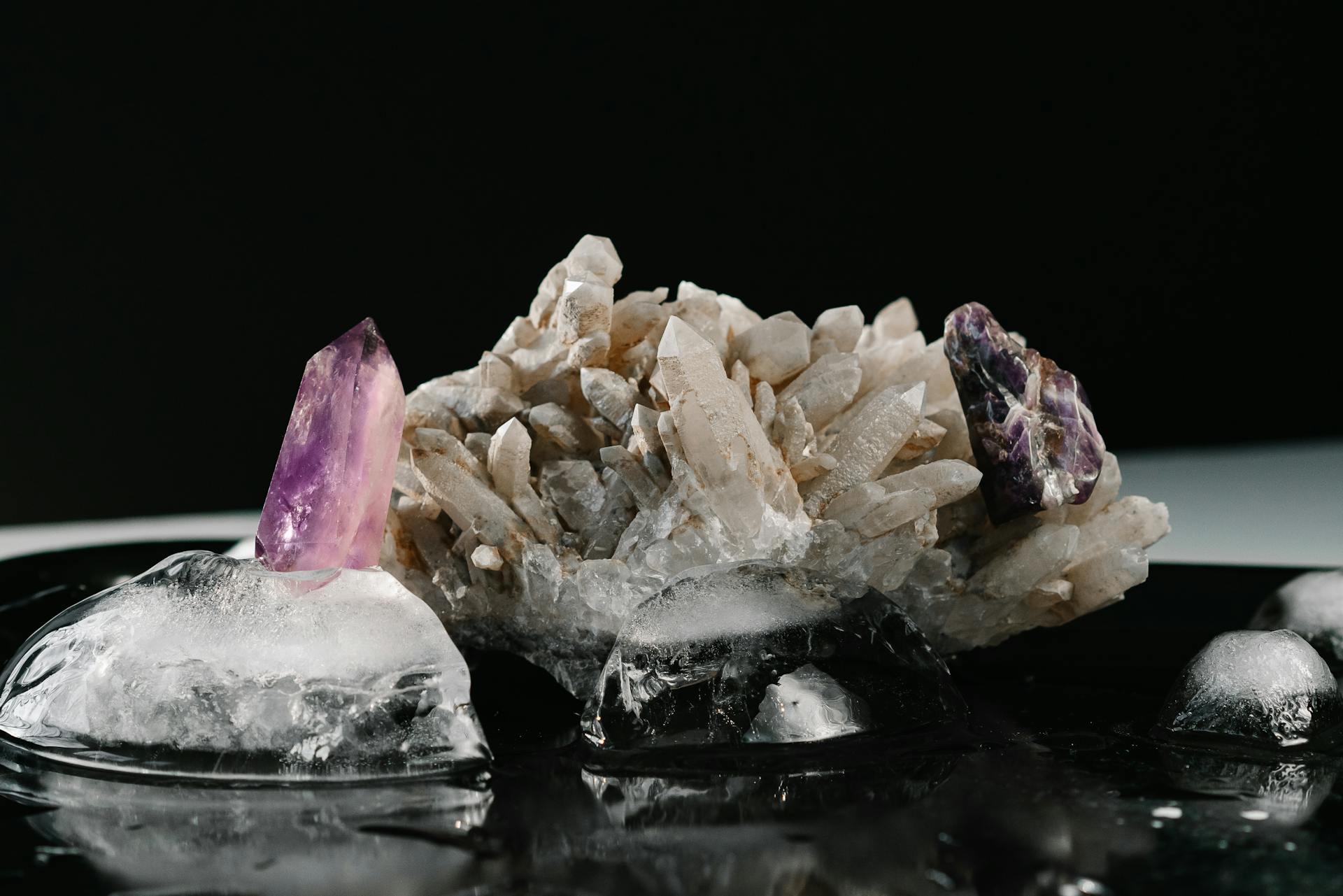
Deep, richly colored crystals arranged on a dark surface, representing the many varieties of garnet
Types of Garnet: More Than Just Red
Ask most people to picture garnet and they'll picture deep red, but the garnet group runs through nearly every color except a true blue, which is exceptionally rare. Knowing the main types helps you shop smarter and understand what you're actually holding.
Some rare garnets even change color, looking bluish-green in daylight and reddish-purple under lamplight. The takeaway: red is just the beginning, and green garnets like tsavorite and demantoid are actually the rarest and priciest of the family.
Garnet Healing Properties and Benefits
Garnet is best known as an energizing, revitalizing stone. In crystal healing traditions, it's used to restore drive when you feel drained, flat, or stuck in a rut, and to reconnect you with your passions when life starts to feel like going through the motions. None of this is a substitute for medical care, but keeping a warm, weighty red stone nearby and using it as a cue to reengage with what you want is a simple, grounding ritual.
Here are the benefits people most often turn to garnet for:
What Does Garnet Do Spiritually?
Spiritually, garnet is a stone of passion and life force. It's associated with the base of the body and the flow of energy up from the earth, so it's often used to feel more embodied, more sensual, and more present, rather than floaty or checked out. Many people pair it with high, airy stones precisely because garnet pulls that energy back down and roots it into action.
It's worth being honest here, because this site would rather be useful than sell you a fantasy. There's no scientific evidence that garnet, or any crystal, emits a measurable energy that heals the body or changes your luck. What garnet reliably offers is a focal point. Choosing a stone that means passion and commitment, holding it while you set an intention, and seeing it on your hand or desk through the day is a mindfulness and motivation practice. The stone doesn't do the work. It reminds you to.
Garnet and the Chakras
Red garnet is most closely tied to the root chakra, the energy center at the base of the spine that governs safety, stability, and your basic sense of being grounded in your body. When that foundation feels shaky, garnet's steadying red energy is used to bring you back down to earth. It also touches the sacral chakra, the center of passion, creativity, and sexuality, which is why garnet has such a strong association with desire and vitality.
Color matters here too. Because the garnet group spans so many hues, different stones are matched to different centers. Deep reds work with the root and sacral chakras, orange spessartine leans sacral, and the rarer green garnets like tsavorite and uvarovite are associated with the heart chakra, the center of love and compassion. If you're new to this system, our guide to the seven chakras explains how each one works and how stones map to them.
Deep red symbolism linked to the root chakra and grounding energy
Garnet, the Zodiac, and the Planets
Garnet is the modern birthstone for January, which ties it most directly to Capricorn and Aquarius, the two signs that share that month. For hardworking, goal-driven Capricorn, garnet's themes of commitment and follow-through are a natural fit, while for Aquarius it can add a spark of warmth and passion to an otherwise cool, cerebral sign. In traditional and older mystical birthstone lists, garnet is also linked with Leo, Virgo, and Scorpio.
On the planetary side, garnet's fiery red color and energizing reputation connect it to Mars, the planet of drive, passion, courage, and desire. Its themes of intense transformation and deep commitment also echo Pluto and the sign Scorpio, while its discipline-and-endurance side nods to Saturn, Capricorn's ruler. To see which of these placements are strong in your own chart, generate your free natal chart and look at where Mars and Saturn sit. You can also explore our crystal healing by zodiac sign guide to match stones to your whole chart.
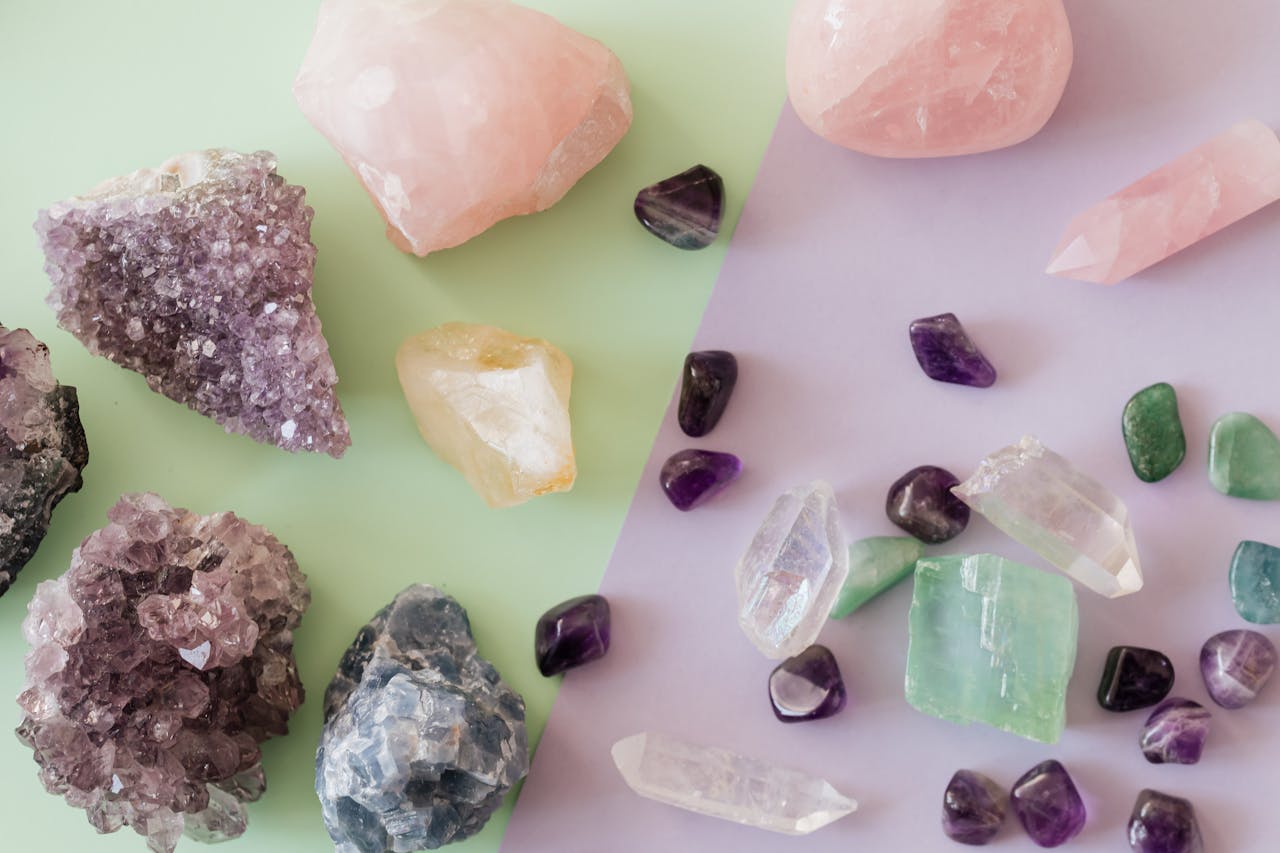
A spread of healing crystals connected to the zodiac signs
How to Use Garnet
Garnet is one of the easier stones to work into daily life, partly because it's durable and partly because it looks good doing it. A few simple ways to use it:
If garnet is your first stone, our beginner's guide to healing crystals walks through choosing, using, and caring for them.
How to Cleanse and Charge Garnet
Garnet is a tough, water-safe stone, so cleansing it is straightforward. Rinse it under cool running water for a minute while you picture any stale energy washing away, then pat it dry. Avoid long salt-water soaks and skip ultrasonic or steam cleaners if your stone has visible cracks or heavy inclusions, since those can worsen a flaw.
For a water-free cleanse, pass the stone through incense or herb smoke, rest it on a selenite plate, or use sound from a singing bowl. To charge it, garnet is refreshingly low-maintenance: unlike amethyst or fluorite, red garnet doesn't fade in the sun, so a few hours of morning sunlight is fine, and moonlight works beautifully too. Many people like to recharge garnet on a windowsill during a full moon, then set a fresh intention for the cycle ahead. Our guide to cleansing and charging crystals and tools covers the same methods in more depth.
Real vs Fake Garnet: How to Tell
Good news first: garnet is affordable, so there's less incentive to fake the common red varieties than there is for pricier stones. That said, imitations do turn up, usually as red glass or, in antique jewelry, as "garnet-topped doublets" that glue a thin garnet slice over cheaper glass. A few honest checks:
One more point worth knowing: synthetic garnets exist, but not the way you'd think. Lab-made materials like YAG (yttrium aluminum garnet) share the garnet crystal structure and were once used as diamond simulants, but they aren't the natural gemstone. And garnet is sometimes confused with ruby. Ruby is corundum, far harder at 9 on the Mohs scale and far more expensive, it glows red under UV light, and it's doubly refractive. If a "ruby" is soft, heavy, singly refractive, and cheap, you're probably holding a garnet, which is nothing to be disappointed about.
Frequently Asked Questions
Can garnet go in water?
Yes. Garnet is a hard, durable stone between 6.5 and 7.5 on the Mohs scale and isn't water soluble, so a short rinse under cool running water is a safe way to cleanse it. Avoid long salt-water soaks, and skip ultrasonic or steam cleaning if your stone is cracked or heavily included.
What is garnet good for?
Garnet is best known for vitality, passion, and commitment. People use it to restore energy and motivation, deepen love and intimacy, build courage before a challenge, and stay grounded and consistent with their goals. It's also a traditional protective and root chakra stone.
What chakra is garnet?
Red garnet is primarily a root chakra stone, tied to grounding, safety, and physical vitality, and it also activates the sacral chakra of passion and creativity. Green garnets like tsavorite are instead associated with the heart chakra.
Is garnet a birthstone?
Yes. Garnet is the modern birthstone for January, which links it especially to Capricorn and Aquarius. It's also the traditional gemstone for a second wedding anniversary and appears on older zodiac stone lists tied to Leo, Virgo, and Scorpio.
What color is real garnet?
Most garnet is deep red, but the garnet group comes in nearly every color except true blue, including orange spessartine, green tsavorite and demantoid, and honey-brown hessonite. Red is simply the most common and affordable, not the only real garnet.
Bringing It Together
Garnet earns its long reputation as the stone of passion, vitality, and commitment. It's durable, affordable, rich with history, and far more varied than its famous red suggests. Keep it clean with a quick rinse, charge it in a little sun or moonlight, and let it be a steady reminder to stay warm, stay grounded, and follow through on what you care about. To see where your own drive and devotion live, generate your free natal chart to find your Mars and Venus placements, pull a tarot reading when you need guidance on a decision, or run a compatibility report to explore the connections that matter most.