
Karmic Astrology: Past Life Indicators in Your Birth Chart
Your birth chart isn't just a snapshot of the sky when you were born. It's a record of patterns your soul has been working through across multiple lifetimes. At least, that's the premise behind karmic astrology, a branch of astrological practice that reads the natal chart as a map of unfinished lessons, inherited talents, and spiritual debts that followed you into this life.
Whether you take past lives literally or treat them as a useful metaphor for deep psychological patterns, the karmic indicators in your chart point to the same thing: areas where you default to old behaviors that feel safe but don't serve your growth, and areas where you're being pushed toward unfamiliar territory that holds the key to your evolution.
The concept isn't new. Hellenistic astrologers discussed fate and necessity through the lunar nodes thousands of years ago. Vedic astrology has always placed karma at the center of chart interpretation. Modern Western astrologers brought these threads together into what we now call karmic astrology, using specific chart placements to identify where past life momentum shows up in your present experience.
This guide covers the primary karmic indicators in your natal chart, how to identify them, what they suggest about your soul's history, and how to work with them constructively.
What You'll Learn
What Is Karmic Astrology?
Karmic astrology is an interpretive framework that reads your birth chart as a record of your soul's journey across lifetimes. Instead of asking only "what kind of person am I?" it asks "what patterns has my soul been repeating, and what's it trying to learn this time around?"
The core idea is straightforward. Certain chart placements, particularly the lunar nodes, Saturn, the 12th house, and retrograde planets, carry information about experiences, skills, and unresolved issues from previous incarnations. These placements don't just describe personality traits. They describe patterns with momentum behind them, behaviors you default to because they're deeply familiar, even when they no longer serve you.
Karmic astrology doesn't require you to believe in literal reincarnation to be useful. Even from a purely psychological perspective, these indicators point to your deepest conditioning, the patterns that feel so natural you don't question them, and the growth edges where you resist change most fiercely. Whether that conditioning comes from "past lives" or from ancestral patterns, early childhood imprinting, and collective unconscious material, the practical application is the same: recognize the pattern, understand its purpose, and choose consciously rather than operating on autopilot.
What separates karmic astrology from general chart reading is the emphasis on trajectory. A standard reading might tell you that your Moon in Capricorn makes you emotionally reserved. A karmic reading would add that this reserve developed over lifetimes of having to be the responsible one, that it's a survival strategy your soul perfected but no longer needs to grip so tightly, and that your North Node placement shows where you're being invited to develop the qualities that balance this ingrained pattern.
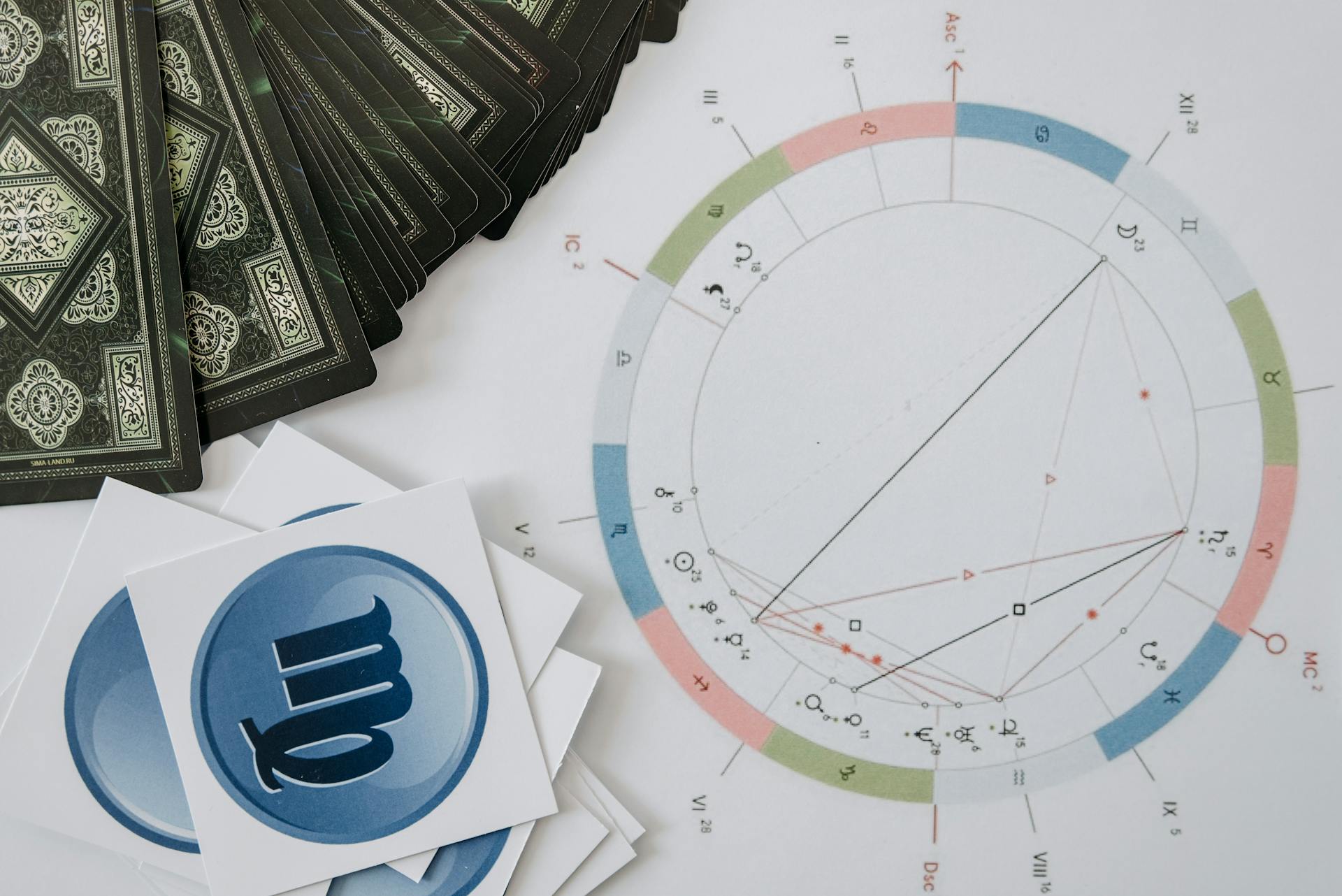
Astrology chart and tarot cards with zodiac symbols laid out on a table for natal chart analysis
The Lunar Nodes: Your Past and Future Story
The lunar nodes are the single most important karmic indicators in your chart. The South Node represents what you're coming from: skills you've mastered, comfort zones you've built, and patterns you tend to fall back on when life gets difficult. The North Node represents what you're moving toward: the unfamiliar qualities your soul is trying to develop in this lifetime.
Think of it this way. Your South Node is a well-worn path through a forest. You know every turn, every root, every shortcut. It feels safe precisely because you've walked it so many times. Your North Node is the trailhead of a path you've never taken. It looks uncertain, maybe even a little threatening, but it leads somewhere you haven't been, and that's exactly why your soul chose it.
South Node in Aries / North Node in Libra. You've spent lifetimes acting independently, leading, fighting, and putting yourself first. The karmic lesson is learning to partner, compromise, and consider other perspectives without losing yourself in the process.
South Node in Taurus / North Node in Scorpio. Past life comfort with material security and stability. Now you're being pushed toward transformation, shared resources, and emotional depth that can't be controlled or predicted.
South Node in Gemini / North Node in Sagittarius. You've gathered information across lifetimes, learned to communicate, and adapted to endless contexts. The growth edge is developing a personal philosophy, committing to a direction, and finding meaning beyond data.
South Node in Cancer / North Node in Capricorn. Deep familiarity with nurturing, family, and emotional caretaking. The karmic push is toward building something in the public world, developing authority, and allowing others to take care of themselves.
South Node in Leo / North Node in Aquarius. Past life experience with personal recognition, creative self-expression, and being center stage. Now you're learning to work within communities, serve collective goals, and find identity beyond personal glory.
South Node in Virgo / North Node in Pisces. Lifetimes of perfecting, analyzing, and serving in practical ways. The karmic direction is toward trust, surrender, spiritual connection, and accepting that not everything can or should be fixed.
The remaining six combinations follow the same logic across the opposite axis. The key principle is that the South Node isn't "bad" and the North Node isn't "good." Your South Node represents genuine abilities and earned wisdom. The problem arises only when you lean on those abilities so heavily that you never develop the complementary skills your North Node is pointing toward.
The house placement of your nodes matters as much as the sign. South Node in the 10th house suggests past life identity was built around career and public status, making it karmically important to develop the 4th house themes of home, family, and inner emotional foundations. Check your 12 houses to understand the full picture.
Saturn: The Planet of Karmic Debt
If the nodes show your karmic direction, Saturn shows your karmic debt. Saturn's position in your chart marks where you owe something, where you skipped steps, took shortcuts, or avoided responsibility in previous lifetimes and now have to go back and do the work properly.
Saturn's lessons feel heavy because they're supposed to. You're not learning something new with Saturn; you're re-learning something you should have mastered before. That's why Saturn areas often come with a sense of inadequacy or chronic difficulty that seems disproportionate to the actual challenge. You're not just dealing with this lifetime's learning curve. You're dealing with accumulated avoidance.
Saturn in the 1st house suggests past life issues around self-assertion and identity. You may have misused personal power or avoided taking responsibility for your impact on others. The karmic lesson is developing authentic self-expression while remaining accountable.
Saturn in the 7th house points to karmic debts in relationships. You may have abandoned partners, manipulated through relationships, or avoided genuine intimacy. The lesson is learning to show up consistently for others without losing yourself. Your compatibility chart can help you understand how these patterns play out with specific people.
Saturn in the 10th house suggests misuse of authority or status in past lives. The karma here involves building a career and reputation through genuine effort and integrity rather than manipulation or exploitation.
Saturn's sign adds texture to the story. Saturn in Gemini carries karmic lessons around communication, honesty, and intellectual responsibility. Saturn in Scorpio involves karmic debt around power, secrets, and emotional manipulation. The sign tells you how you defaulted; the house tells you where.
Your Saturn return (around ages 29 and 58) is the major karmic checkpoint. It's when Saturn returns to its natal position and asks: have you been doing the work, or have you been avoiding it? The difficulty of your Saturn return is often proportional to how much karmic homework you've been putting off.
Hands holding astrological charts and graphs symbolizing the study of karmic patterns in the natal chart
The 12th House: Hidden Karma and Past Life Residue
The 12th house is the chart's storage room for past life material. Planets here operate below the threshold of conscious awareness. You have their energy, you use their energy, but you often can't see how you're using it. Other people can see it clearly. You're the last to know.
The 12th house represents karma that hasn't fully surfaced yet. It's the unprocessed material from previous incarnations that influences your behavior in ways you don't recognize until you do deliberate inner work. Dreams, meditation, therapy, and spiritual practice are the traditional methods for accessing 12th house content, and karmic astrologers consider this house essential for understanding what your soul brought into this life unresolved.
Sun in the 12th house suggests a past life where your identity was suppressed, hidden, or sacrificed. You may have been imprisoned, exiled, or forced to live inauthentically. The karmic pattern is difficulty claiming your identity openly in this life, a tendency to let others define you, or a feeling that your real self is somehow hidden behind a veil.
Moon in the 12th house points to past life emotional trauma that's been carried into your unconscious. Your emotional reactions may sometimes feel outsized or disconnected from present circumstances because they're drawing on a reservoir of feeling that predates this life. Working with your Moon sign becomes especially important with this placement.
Venus in the 12th house suggests past life experiences with love, beauty, or pleasure that ended in loss or sacrifice. You may have a pattern of secret loves, unrequited attachments, or difficulty accepting that you deserve pleasure and beauty in this life.
Mars in the 12th house can indicate past life experiences with violence, either as perpetrator or victim, that left residue in your unconscious. Anger may feel dangerous to you, something to be hidden rather than expressed, because at some deep level you associate it with destruction.
Multiple planets in the 12th house suggest a soul carrying significant unresolved material. This isn't a punishment; it's an indication that your soul is ready to process what it's been storing. The 12th house is traditionally associated with spiritual liberation precisely because confronting what's hidden there is the path to freedom from unconscious repetition.
Retrograde Planets as Karmic Markers
Natal retrograde planets are another key karmic indicator. When a planet is retrograde in your birth chart, its energy turns inward. Instead of expressing that planet's qualities outwardly and naturally, you internalize them, process them privately, and often struggle with them in ways that aren't visible to others.
From a karmic perspective, retrograde planets represent qualities you've already developed in previous lifetimes but need to revisit, refine, or correct. The retrograde motion symbolizes going back over old ground. Something about how you used that planet's energy before wasn't quite right, and you're getting another pass at it.
Retrograde Mercury suggests past life issues with communication, learning, or information. You may have misused knowledge, deceived through words, or failed to speak truth when it mattered. This lifetime, you process information differently from most people, often more deeply and reflectively, but you may struggle with being misunderstood or feeling like your thoughts don't translate clearly to others.
Retrograde Venus points to past life karma around love, values, and self-worth. Relationships may feel like they carry weight beyond the present circumstances. You might attract partners who feel intensely familiar, or you might repeat relationship patterns that don't match your conscious desires. Check your Venus sign for more insight into how this plays out.
Retrograde Mars suggests past life issues with aggression, assertion, and desire. You may have misused force or, alternatively, failed to act when action was needed. In this life, your relationship with anger and drive is complicated. You might suppress these qualities, redirect them inward, or express them in bursts that surprise even you.
Retrograde Jupiter indicates past life excess, overconfidence, or misuse of faith and philosophy. Your relationship with abundance, belief systems, and expansion has a "been there, done that" quality. You're not easily impressed by promises of growth because at some level you've seen how expansion without wisdom can go wrong.
Retrograde Saturn is particularly significant because Saturn is already the planet of karma. Saturn retrograde doubles down on the karmic theme: you're deeply aware of responsibility, perhaps overly so, because you've experienced the consequences of irresponsibility across lifetimes. The fear of failure you carry isn't irrational. It's ancestral.
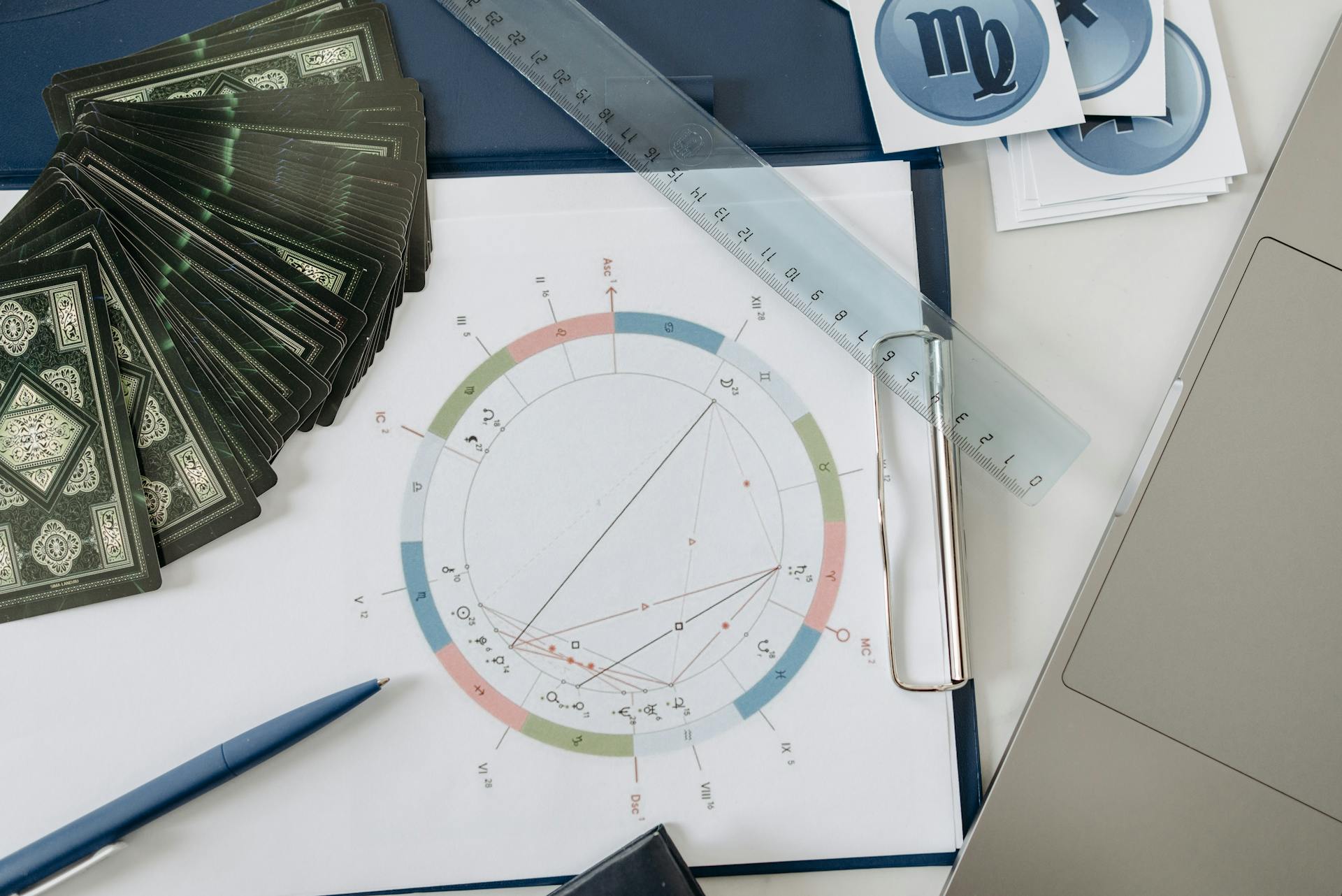
Flat lay of astrology tools including tarot cards and a natal chart on a wooden desk for karmic chart analysis
Karmic Aspects and Configurations
Beyond individual placements, certain aspects and aspect patterns carry karmic significance.
Saturn conjunct a personal planet. When Saturn sits on your Sun, Moon, Venus, Mars, or Mercury, it places karmic weight directly on that planet's themes. Saturn conjunct Venus is one of the most recognized karmic indicators, suggesting past life love that involved sacrifice, restriction, or duty. Saturn conjunct Moon suggests emotional patterns inherited across lifetimes that feel heavy and obligatory.
Pluto aspects to personal planets. Pluto isn't traditionally classified as a karmic planet in the same way Saturn is, but its aspects to personal planets often describe transformative experiences that span lifetimes. Pluto conjunct Sun suggests a soul that's been through death and rebirth, metaphorically or literally, multiple times. Pluto square Moon suggests deep emotional power dynamics that carry generational or karmic weight.
The Yod (Finger of Fate). This aspect pattern involves two planets in sextile, both forming quincunxes (150-degree angles) to a third planet at the apex. The apex planet carries a sense of fated mission, something you can't ignore no matter how uncomfortable it makes you. Karmic astrologers consider the Yod one of the strongest indicators that a soul came into this life with a specific, non-negotiable assignment.
South Node conjunctions. Any planet conjunct your South Node amplifies that planet's karmic significance. It's a planet whose energy you've relied on heavily in past lives, potentially to the point of imbalance. Moon conjunct South Node suggests deep emotional familiarity with old patterns. Mars conjunct South Node suggests past life warrior energy that you default to under stress.
The karmic degree: 29 degrees. In degree theory, planets at the 29th degree of any sign (the "anaretic degree") are considered to carry a karmic quality. The soul has nearly completed its work with that sign's energy and is on the verge of transitioning. There's urgency here, a sense that this is the last chance to master something before moving on.
The 8th House and Karmic Transformation
While the 12th house holds hidden karma and the nodes show your karmic direction, the 8th house is where karmic transformation actually happens. This is the house of death, rebirth, shared resources, and psychological depth. It's not comfortable territory, but it's where you process and release the karmic material that the other indicators identify.
Planets in the 8th house suggest areas where you're meant to undergo deep transformation in this lifetime. The 8th house doesn't let you stay on the surface. Whatever planets you have here, their themes will demand that you go deeper than you're comfortable with, confront truths you'd rather avoid, and emerge changed.
The 8th house and karmic relationships. Composite charts and synastry with heavy 8th house activity often indicate karmic bonds. These are relationships that feel fated, intense from the first meeting, and impossible to approach casually. They're not always romantic. Karmic bonds can show up in family relationships, friendships, and even professional partnerships that carry an unusual weight.
The ruler of your 8th house and its natal condition show how you process transformation. If your 8th house ruler is in good condition (well-aspected, in a sign it functions well in), transformation may be difficult but productive. If it's challenged, the transformative process might feel more like being dragged through it than choosing it.
How to Work With Your Karmic Indicators
Identifying your karmic indicators is the first step. Working with them is where the real value lies. Here's a practical framework:
Map your indicators. Pull up your natal chart and list your South Node sign and house, Saturn sign and house, 12th house planets, retrograde planets, and any planets at the 29th degree. This gives you your karmic profile at a glance.
Identify the pattern. Look for themes that repeat across indicators. If your South Node is in the 2nd house, Saturn is in Taurus, and you have retrograde Venus, there's a clear karmic theme around values, money, and self-worth. Multiple indicators pointing to the same theme suggest that's a primary karmic focus for this lifetime.
Notice your defaults. Your South Node and retrograde planets show where you default under pressure. When life gets difficult, you'll instinctively reach for these familiar energies. That's not wrong, but it's worth noticing. The goal isn't to abandon your South Node strengths but to stop using them as your only tool.
Lean into the North Node. Your North Node describes qualities that feel awkward and unfamiliar. That's by design. If they felt natural, they wouldn't represent growth. Practice North Node behaviors in low-stakes situations first. If your North Node is in Libra, practice asking for input before making decisions. If it's in Sagittarius, explore a philosophy or travel to somewhere completely new.
Work with Saturn consciously. Saturn rewards consistent effort over time. Whatever house Saturn occupies, commit to slow, steady improvement in that area. Don't expect instant results. Saturn's timeline is measured in years, not weeks. But the mastery you build in your Saturn area becomes one of your greatest strengths, precisely because you earned it the hard way.
Use your tarot practice. A regular tarot practice can help you access unconscious karmic material, especially 12th house content. The imagery and symbolism of tarot cards bypass your rational filters and speak directly to the part of you that remembers what your conscious mind has forgotten.
Frequently Asked Questions
How do I know if I have strong karmic indicators in my chart?
Look for multiple placements that point to the same themes. A single retrograde planet doesn't necessarily mean heavy karma. But if your South Node, Saturn, and a 12th house planet all involve the same sign, house, or planetary ruler, that's a strong karmic signature. Planets at the 29th degree, Yod configurations, and heavy 8th house activity add to the picture. Pull up your natal chart and check for these indicators to get a clear picture of your karmic profile.
Can karmic astrology predict my past lives specifically?
Karmic astrology suggests themes and patterns, not specific historical narratives. Your South Node in Leo in the 10th house might suggest past lives involving leadership, performance, or public recognition, but it won't tell you that you were a specific person in a specific century. The value is in recognizing the behavioral patterns you carry, not in constructing detailed past life stories. Focus on how the patterns show up in your present behavior rather than trying to reconstruct historical specifics.
What's the difference between karmic astrology and Vedic astrology?
Vedic (Jyotish) astrology places karma at the center of all chart interpretation, treating the entire birth chart as a karmic document. Western karmic astrology borrows this framework selectively, focusing on specific indicators like the nodes, Saturn, and retrograde planets while using the tropical zodiac and Western house systems. Vedic astrology uses the sidereal zodiac and incorporates additional concepts like dashas (planetary periods) and specific karmic yogas that don't have direct Western equivalents.
Do karmic patterns repeat if you don't resolve them?
According to karmic astrology, yes. Unresolved patterns tend to intensify over time rather than fading away. You'll notice them as recurring relationship dynamics, career obstacles, or emotional reactions that seem disproportionate to their triggers. Your Saturn return is the major checkpoint where unaddressed karma typically demands attention. Working with your indicators consciously, even imperfectly, is better than waiting for circumstances to force the issue.
Can two people share karmic connections?
Absolutely. When your karmic indicators interact with another person's chart, particularly when one person's planets conjunct the other's nodes or Saturn, you'll often feel an instant sense of recognition. Check your compatibility chart to see where your charts overlap on karmic points. These connections aren't always easy, but they're usually significant, relationships that feel like they have a purpose beyond the surface.