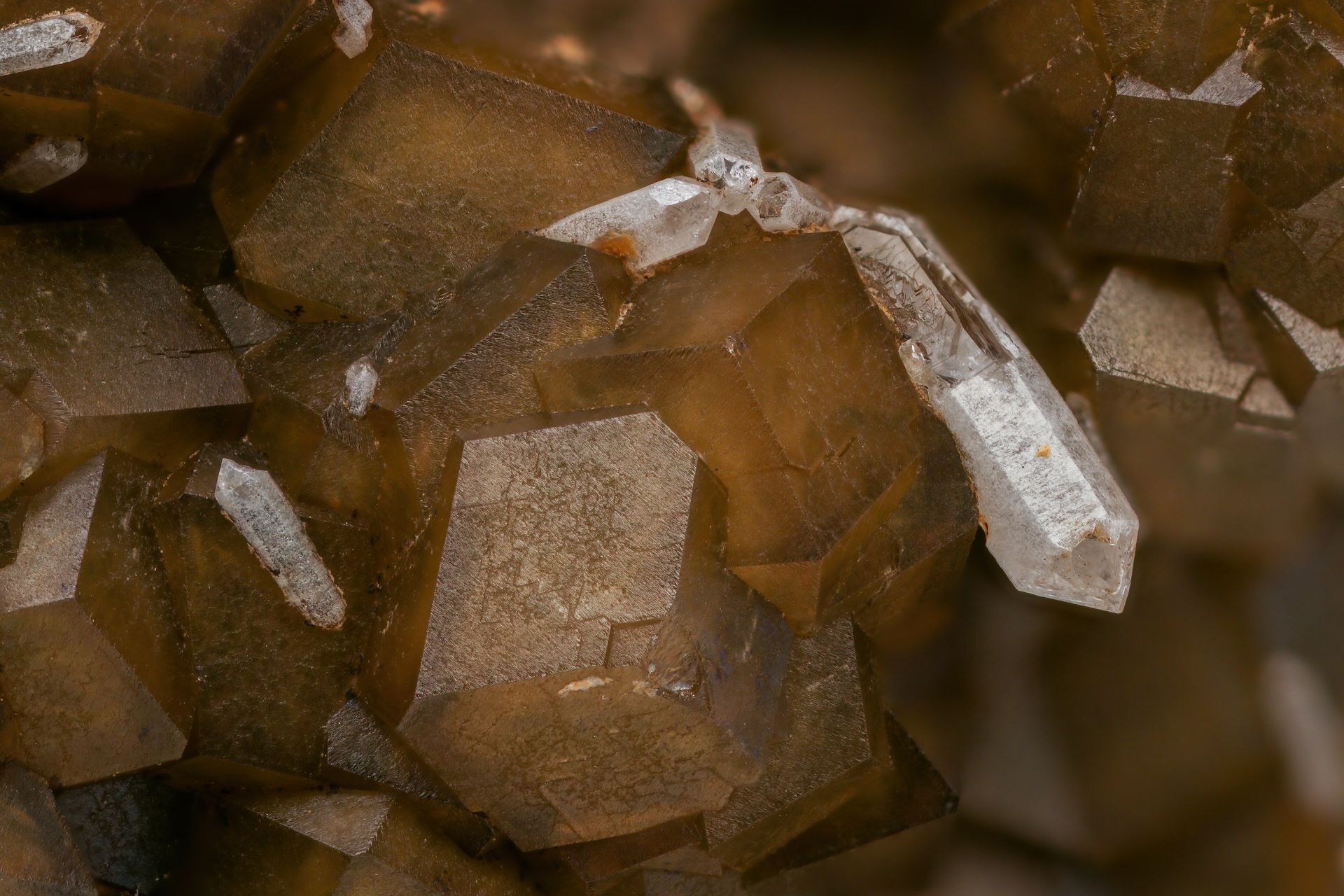
Smoky Quartz Meaning: Healing Properties, Uses, and the Grounding Stone
Smoky quartz is the grounding, steadying member of the quartz family, and its meaning centers on stability, protection, and letting go of what you no longer need to carry. It's the stone people reach for when life feels scattered or heavy, because its reputation is for pulling you back down to earth and quietly draining off stress. The color runs from a pale, smoky gray-brown to a deep chocolate, and in its darkest form it can look almost black.
If clear quartz is the bright amplifier and amethyst is the calm spiritual stone, smoky quartz is the one with its feet planted firmly on the ground. Here's what smoky quartz means, how people use it, how it earns its smoky color, how it links to Capricorn and Saturn in astrology, and how to tell a natural crystal from the lab-treated and look-alike stones sold under its name.
What You'll Learn
What Is Smoky Quartz?
Smoky quartz is a variety of macrocrystalline quartz, the same mineral (silicon dioxide) that gives us clear quartz, amethyst, citrine, and rose quartz. What sets it apart is color: a translucent brown-to-gray tint that can be barely there or as dark as strong coffee. The very dark, nearly opaque black form has its own name, morion, while the softer yellow-brown Scottish variety is called cairngorm.
That cairngorm connection runs deep. Smoky quartz from the Cairngorm Mountains is Scotland's national gemstone, and it turns up in traditional Highland dress, set into kilt pins and the handles of dirks and the small sgian-dubh knife. It's mined all over the world, with fine specimens coming from Brazil, Switzerland, Madagascar, and the granite regions of the United States.
On the practical side, smoky quartz is durable. It sits at 7 on the Mohs hardness scale, hard enough to scratch glass and to stand up to everyday handling, and it has no easy cleavage planes to chip. That toughness matters for how you care for it, which we'll come back to.
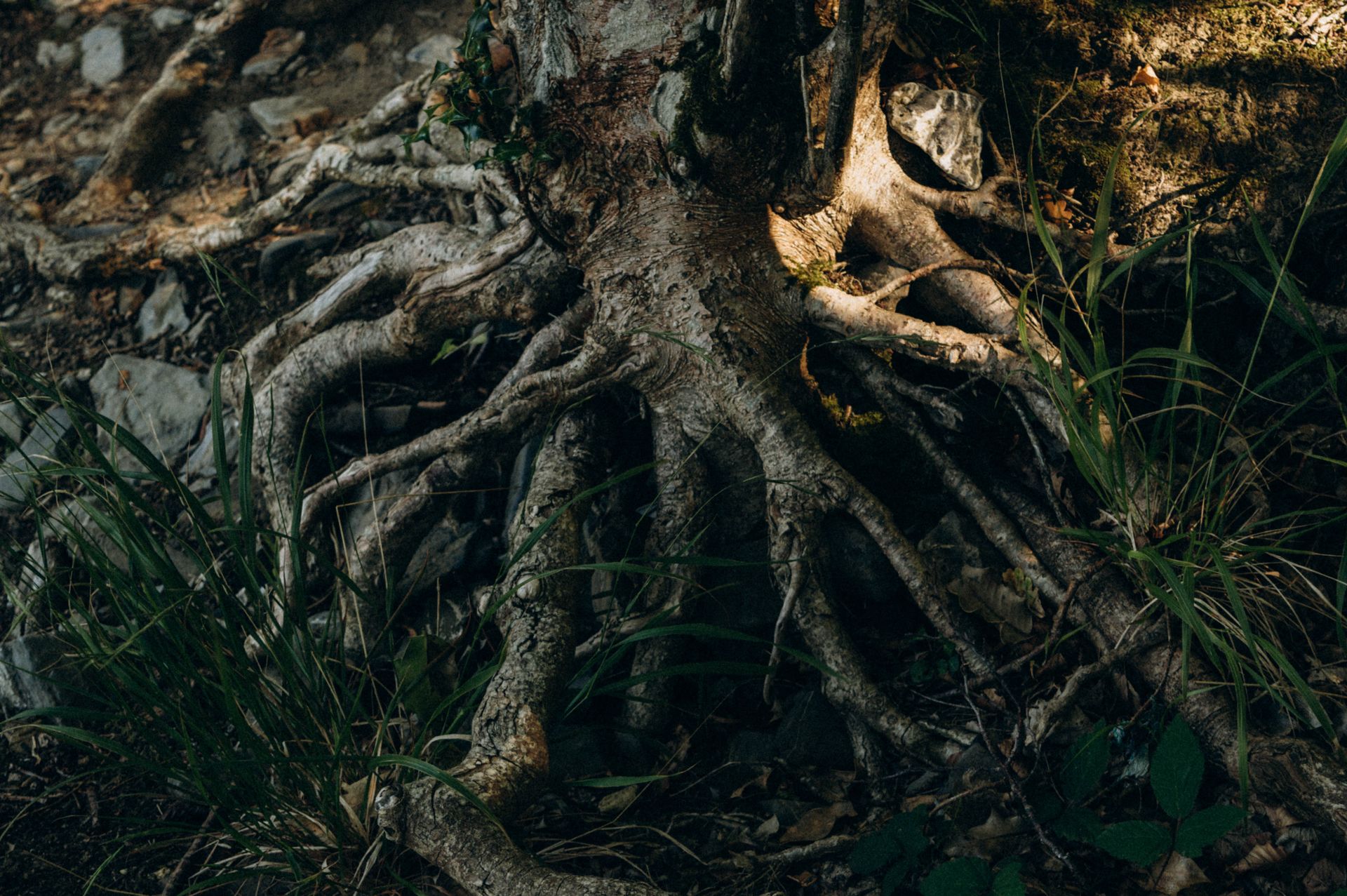
Tree roots gripping the earth, symbolizing the grounding energy at the heart of smoky quartz meaning
What Does Smoky Quartz Mean?
At its core, smoky quartz means grounding. Where a lot of crystals are associated with reaching up toward higher states, smoky quartz is about coming back down, feeling your own weight, and getting steady. It's often called a stone of surrender or letting go, because the idea is that it helps you release stress, resentment, fear, and old baggage rather than clinging to it.
It's also carried as a protective stone. The tradition holds that smoky quartz absorbs and transmutes heavy or negative energy, turning it into something neutral and grounded, a bit like the way black tourmaline is used at the edges of a space. Because it comes from quartz, people also describe it as gently amplifying intention while keeping that intention rooted in the practical, achievable world rather than floating off into fantasy.
Smoky Quartz Healing Properties
In crystal-healing practice, smoky quartz gets grouped with the calming, stabilizing stones. It's important to be clear up front: these are traditional and folk associations, not medical claims, and there's no scientific evidence that any crystal treats a physical or mental condition. With that said, here's how people describe working with it.
Emotionally, smoky quartz is used as an anti-anxiety anchor. Holding a piece during a stressful moment is meant to slow racing thoughts and pull you out of your head and back into your body. Because its theme is letting go, it's also a common choice for grief work, for moving on after a loss, and for shadow work, where you sit honestly with the parts of yourself you'd rather avoid.
Mentally, it's associated with focus and follow-through, the quality of staying grounded enough to actually finish what you start. Practitioners often pair it with a clear goal and use it as a physical reminder to stop spiraling and take the next small step.
Smoky Quartz and the Root Chakra
Smoky quartz is one of the classic root chakra stones. The root chakra, Muladhara, sits at the base of the spine and governs your sense of safety, stability, and belonging in the physical world. When it feels out of balance, you might notice anxiety, restlessness, or a sense of being ungrounded and disconnected from your body.
Because smoky quartz is a dark, earthy, grounding stone, it maps naturally onto this energy center. People place it at the base of the spine during lying-down meditation, hold it in the palm, or keep it in a pocket to feel more settled through the day. Some practitioners also link it to the earth star, an energy point imagined below the feet that connects you to the ground itself. If you want the bigger picture of how these centers work together, our guide to the seven chakras walks through each one in order.
Smoky Quartz Zodiac Signs and Astrology
Smoky quartz is most often tied to Capricorn, the disciplined, earth-sign climber ruled by Saturn. That pairing makes sense: Capricorn is about building something solid in the real world, and smoky quartz is the stone of grounded, patient effort. It's also associated with Scorpio, for its transmuting, shadow-facing side, and sometimes Sagittarius.
The ruling planet most people connect to it is Saturn, the planet of structure, discipline, boundaries, and hard-won maturity. Smoky quartz suits Saturn's lessons about doing the slow, unglamorous work and taking responsibility for your own life. If your chart leans heavy on Saturn, or you're moving through a Saturn return, a grounding stone like this fits the season. Some readers also link smoky quartz to Pluto for its themes of transformation and releasing what's died away. Its element is earth.

A mountain goat climbing steadily upward, echoing Capricorn and Saturn, the astrological home of smoky quartz
You can match crystals to the rest of your chart the same way. Our crystal healing by zodiac sign guide lines up stones with all twelve signs, and the zodiac and chakras piece connects the signs to your energy centers.
How Does Smoky Quartz Get Its Color?
This is the most interesting fact about smoky quartz, and it's genuinely rooted in science rather than folklore. Pure quartz is colorless. Smoky quartz gets its brown-to-gray tint from a combination of two things: tiny amounts of aluminum that slip into the crystal lattice in place of silicon as the crystal grows, plus exposure to natural radiation.
Over long stretches of geological time, trace radioactive elements in the surrounding granite give off low-level gamma radiation. That radiation acts on the aluminum-bearing spots in the crystal and creates what mineralogists call color centers, small structural changes that absorb certain wavelengths of light and leave the stone looking smoky. In other words, a natural smoky quartz got its color from millions of years sitting near mildly radioactive rock. The stone itself is not radioactive, and it's perfectly safe to handle. It's simply a record of a slow natural process.
That mechanism also explains a lot of what comes next, because if nature can make smoky quartz with radiation, so can a lab.
Is Smoky Quartz Irradiated? Natural vs Lab-Made
A large share of the smoky quartz on the market, especially the cheap, jet-black, perfectly even material, was made by taking clear or milky quartz and exposing it to gamma radiation in a lab. This mimics the natural process, produces stable color, and is a normal, accepted practice in the gem trade, much like heat-treated citrine or irradiated blue topaz. The color is real and permanent, and reputable irradiated stones are safe once any short-lived surface activity has dissipated, which is why gemstone material is held before sale.
So irradiated smoky quartz is not fake quartz. It's real quartz that got its color in a lab instead of in the ground. But it isn't natural, and if buying a naturally colored crystal matters to you, that distinction is worth knowing.
A few tells: natural smoky quartz often shows uneven color, with lighter and darker zones, natural inclusions, and sometimes a slightly warmer brown. Very cheap material that's uniformly opaque black or an unnaturally even dark gray, sold in bulk, is more likely to be irradiated or, in the worst case, dyed glass. When it matters, buy from a seller who can tell you the origin and treatment of the stone.
Does Smoky Quartz Fade in Sunlight?
Yes, and this ties straight back to how it got its color. Because smoky quartz owes its tint to radiation-created color centers, strong ultraviolet light can bleach those centers out over time. Leave a smoky quartz on a sunny windowsill for months and you may watch it slowly lighten toward pale gray or even clear.
That has a practical consequence: don't use prolonged sunlight to cleanse or charge smoky quartz. A short spell of morning light won't ruin it, but the sun-charging routine that suits some stones will gradually wash this one out. Reach for moonlight instead, which is a gentler and more fitting match for a grounding stone anyway. We'll cover the full cleansing routine below.
Smoky Quartz vs Black Tourmaline vs Obsidian
Smoky quartz shares shelf space with two other popular dark grounding-and-protection stones, and they're easy to mix up. Here's how to tell them apart.
Smoky quartz is crystalline and translucent. Even in dark pieces you can usually see light passing through the edges, and it often forms clear six-sided points. It's cool to the touch and hard (Mohs 7).
Black tourmaline is opaque, not translucent, and it typically shows lengthwise striations, fine parallel grooves running down the crystal like the ridges on a column. It has a slightly less glassy, more matte look than smoky quartz.
Obsidian isn't a crystal at all. It's volcanic glass, so it has no internal crystal structure, breaks with smooth curved (conchoidal) fractures like a broken bottle, and often feels a touch warmer and lighter than quartz. Its shine is a glassy, almost wet luster.
If someone hands you a dark stone: translucent with points points to smoky quartz, striated and opaque points to black tourmaline, and glassy with curved fracture points to obsidian.
Does Smoky Quartz Actually Work?
Honestly, there's no scientific evidence that smoky quartz, or any crystal, emits or absorbs energy, blocks negativity, or treats stress and anxiety in a measurable way. You'll see it marketed for EMF protection the way black tourmaline is, but there's no research showing any crystal shields you from electromagnetic fields. If a piece of information about a stone sounds like a hard medical or physical claim, treat it with skepticism.
Where smoky quartz genuinely helps is more down to earth. Choosing a grounding object, holding it during a stressful moment, and pausing to breathe is a real self-soothing ritual, and the act of setting an intention with a physical anchor can sharpen focus and follow-through. That's the value: a tactile cue for calm and clarity, not a magical device. Used that way, it fits neatly alongside practices like meditation and mindful home cleansing.
How to Use, Cleanse, and Charge Smoky Quartz
Smoky quartz is one of the easiest stones to work with because it's hard and stable. Here are the common ways people use and care for it.
Ways to use it: hold a tumbled piece during meditation to feel grounded, keep one in your pocket or bag as a stress anchor, place points at the corners of a room as a protective layout, or set a piece on your desk as a focus reminder. It also anchors a crystal grid beautifully as the grounding stone, and it's popular in jewelry, where it pairs well with silver.
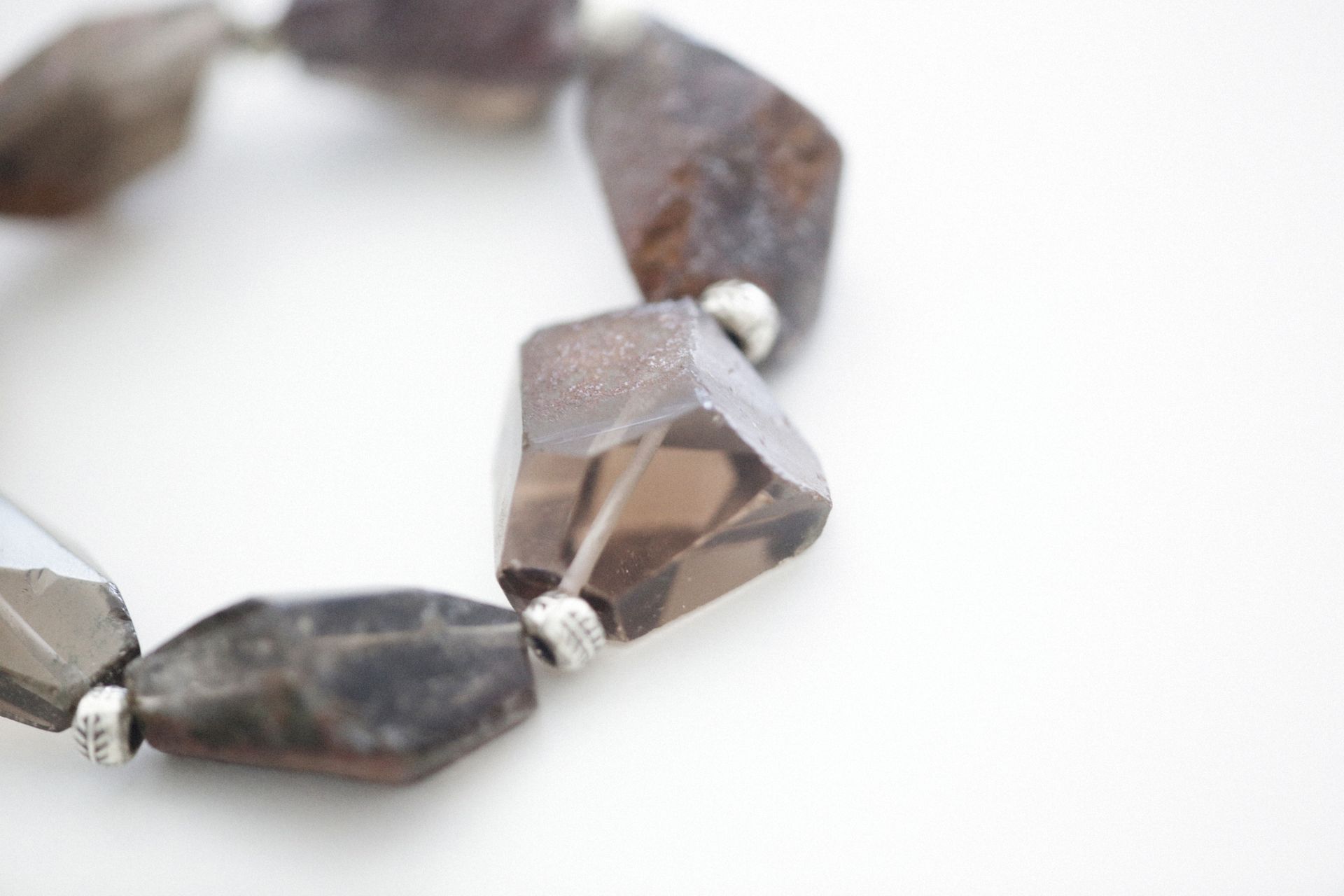
A bracelet of faceted translucent smoky brown quartz beads, one of the most popular ways to wear smoky quartz
How to cleanse it: because it's a hard 7 with no risky cleavage, smoky quartz is water-safe, so brief rinsing under cool running water is fine. You can also cleanse it with smoke, sound, a night on a bed of selenite, or by resting it on the earth. If you cleanse your other tools this way, the same routine you'd use to reset tarot cards works here.
How to charge it: moonlight is the best match. Set it out under a full moon overnight to recharge. Avoid long stretches of direct sun, which, as covered above, can fade the color. Setting an intention as you hold it, then leaving it somewhere you'll see it daily, keeps that intention front of mind.
Frequently Asked Questions
Is smoky quartz radioactive?
No. Natural smoky quartz got its color from being near mildly radioactive rock over geological time, but the stone itself is not radioactive and is safe to handle. Lab-irradiated smoky quartz is also held before sale until any short-lived surface activity fades, so reputable material is safe too.
Can smoky quartz go in water?
Yes. Smoky quartz is a hard, stable stone (Mohs 7) with no easy cleavage, so a brief rinse under cool running water is fine for cleansing. Just dry it afterward. The bigger thing to avoid is prolonged sunlight, which can fade the color.
What is the difference between smoky quartz and morion?
They're the same mineral. Morion is simply the name for very dark, nearly opaque black smoky quartz. Lighter yellow-brown smoky quartz from Scotland is called cairngorm. All three are color varieties of the same quartz.
Who should use smoky quartz?
Anyone drawn to grounding and stress relief, and it's an especially fitting match for Capricorn and Scorpio or for anyone with a Saturn-heavy chart. It's also a good starter stone because it's durable, affordable, and easy to care for.
Is my smoky quartz natural or irradiated?
Natural stones tend to show uneven color, inclusions, and warmer brown tones, while uniformly jet-black, perfectly even, bulk-priced material is more likely lab-irradiated. Both are real quartz. If natural color matters to you, buy from a seller who can confirm the origin and treatment.
Bringing It Together
Smoky quartz is the grounding anchor of the quartz family: a stone for stability, protection, and putting down what you've been carrying too long. It links to the root chakra, to Capricorn and Saturn, and to the practical, patient work of building a steady life. Just remember that its brown color comes from radiation-made color centers, so keep it out of long sun and charge it under the moon instead.
Curious how grounding stones fit your own chart? Cast your free natal chart to see where Saturn and your earth placements sit, pull a tarot card when you need a moment of clarity, or check your compatibility with someone whose energy grounds you.