King of Swords Tarot Card Meaning: Upright, Reversed, Love, Career, and More
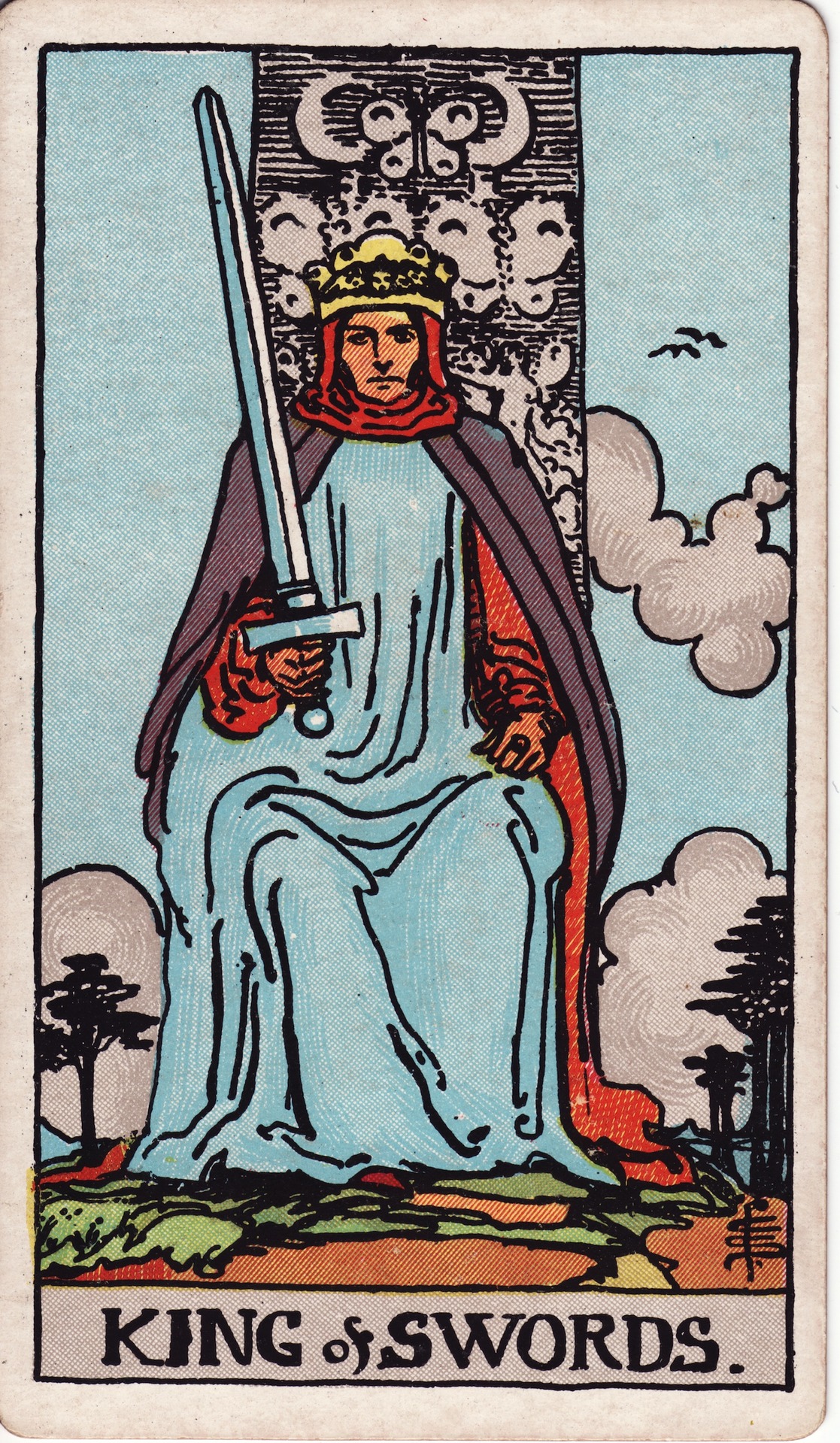
A king sits on a stone throne, his body facing forward but his head turned slightly to the right, as if listening to something that requires his full attention before he renders his judgment. His right hand holds a large sword that tilts slightly to the right, not perfectly vertical like the Queen of Swords' blade, but angled just enough to suggest that this sword is being considered, weighed, and prepared for use rather than held as a static symbol. His left hand rests on his knee. His expression is stern but not unkind, the face of someone who's heard every argument, considered every perspective, and arrived at a conclusion he's prepared to enforce. His throne is carved with butterflies and a sylph, an air spirit, connecting him to the intellectual element that defines his suit. Behind him, clouds fill the sky, but they're organized rather than chaotic, layered and structured like the thoughts of a mind that has learned to arrange its contents rather than being overwhelmed by them. Two birds fly in the distance. The trees in the background stand upright despite the wind, rooted deeply enough to withstand whatever blows through.
King of Swords - Rider-Waite-Smith Tarot
The Queen of Swords internalized her clarity. She sat on her throne and saw truth with surgical precision, choosing when to share what she perceived and when to hold it. The King of Swords externalizes that clarity into authority. He doesn't just see the truth; he governs with it. He makes the ruling. He sets the standard. He's the judge who's listened to every witness, reviewed every piece of evidence, and now rises to deliver a verdict that's fair even when it's unwelcome. Where the Queen's sword was a scalpel for her own perception, the King's sword is the blade of justice itself, the instrument through which intellectual clarity becomes law, decision, and the final word on whatever matter has been brought before him.
Table of Contents
Key Themes and Symbolism
The King of Swords is the tarot's embodiment of intellectual mastery in its most authoritative form, the mind that doesn't just think clearly but uses that clarity to lead, judge, and establish the standards by which others operate.
The slightly tilted sword. Unlike the Queen's perfectly vertical blade, the King's sword leans slightly to the right. This tilt is subtle but significant. A perfectly vertical sword represents abstract truth, truth as a principle. A tilted sword represents truth being applied, angled toward a specific situation, directed at a particular problem. The King isn't contemplating truth in the abstract. He's using it. He's in the process of deciding something, and the sword's angle tells you that his decision has already begun to form. The tilt also suggests that the King understands something the earlier Swords cards don't: that pure, unyielding truth needs to be tempered by practical judgment. A blade that only points straight up is a symbol. A blade that's angled is a tool.
The turned head. The King's body faces forward, but his head is turned to the right. In traditional tarot symbolism, the right side represents the future, action, and the conscious mind. The King is looking toward what's coming, assessing the consequences of his decision before he implements it. This distinguishes him from the Knight of Swords, who charged forward without looking anywhere except straight ahead. The King looks sideways because he knows that judgment has consequences, and a responsible authority considers those consequences before speaking. The turned head is caution, not indecision. He's already made his ruling. He's simply examining how it will land.
The butterflies and sylph. The King's throne is decorated with butterflies and a sylph, an elemental spirit of air. These carvings connect the King to the air element that governs the entire Swords suit. Butterflies represent transformation through intellectual evolution, the capacity to dissolve old thought patterns and emerge with new understanding. The sylph represents the purest expression of air energy: thought itself, communication, the invisible medium through which ideas move and minds connect. The King's throne is literally built on these principles. His authority rests not on physical strength or inherited power but on the quality of his thinking and his ability to communicate that thinking with precision and integrity.
The organized clouds. The sky behind the King contains clouds, but they're arranged in structured layers rather than the chaotic storms that appear earlier in the Swords suit. The Knight of Swords rode through a tempest. The Five of Swords played out under a troubled sky. The King sits beneath clouds that have been sorted, organized, put into order. This is the visual metaphor for a mind that has mastered its own contents. The King still has a complex inner life, thoughts and ideas move through his consciousness constantly, but they move in patterns he controls rather than patterns that control him. Mental mastery isn't the absence of thought. It's the governance of thought.
The two birds. Two birds fly in the distance behind the King. Where the Page of Swords had multiple birds representing scattered incoming information, and the Queen had one representing focused perception, the King has two. These two birds represent the duality of judgment: the ability to hold two perspectives simultaneously, to weigh opposing arguments with equal attention, and to arrive at a conclusion that accounts for both sides. A good judge doesn't listen to one side. He listens to two and decides which carries more weight. The paired birds are the King's fairness made visible.
The upright trees. The trees behind the King stand straight despite the wind. Earlier Swords cards showed trees bent nearly horizontal by storms. The King's trees have weathered the same storms but remained rooted and upright. They represent the stability that intellectual mastery provides: the ability to stand firm in your convictions, to maintain your principles when circumstances try to bend you, and to endure intellectual and emotional pressure without breaking or compromising your integrity.
The King as court card. Kings in the tarot represent the externalized mastery of their suit's energy. Where Queens internalize and embody, Kings externalize and govern. The King of Wands leads through vision and charisma. The King of Cups leads through emotional wisdom and compassion. The King of Swords leads through intellectual authority, ethical judgment, and the power of clear, principled communication. He is the final card of the Swords suit, the culmination of every lesson the suit has taught: the mental breakthrough of the Ace, the difficult choices of the numbered cards, the painful learning of the Six through Ten, and the developing mastery of the Page, Knight, and Queen. Everything the Swords suit has been building toward arrives here, in a mind that knows how to think, how to judge, and how to lead with truth as its primary instrument.
Upright Meaning
When the King of Swords appears upright, you're encountering the energy of intellectual authority, fair judgment, ethical leadership, and the ability to make difficult decisions with clarity and integrity.
General
The King of Swords upright signals that a situation in your life requires clear, authoritative thinking and the courage to act on your conclusions. This isn't a card of contemplation or exploration. The contemplation is finished. The King has already thought it through, already weighed the arguments, already considered the consequences. Now he's ready to decide. When this card appears, the reading is telling you that you either need to step into that decisive authority yourself or that someone with those qualities is about to play a significant role in your situation.
This card often appears when you need to set personal feelings aside and make a decision based on logic, fairness, and principle. The King of Swords doesn't make decisions to please people. He makes decisions that are right. Sometimes those decisions are popular. Sometimes they're not. The King's authority isn't diminished by unpopularity because his authority doesn't rest on being liked. It rests on being fair, being clear, and being willing to enforce standards that he holds himself to as rigorously as he holds others.
The King of Swords also represents communication at its most effective: precise, honest, and delivered with authority. When this card appears, speak clearly. Say what you mean. Don't soften your message so much that it loses its content. Don't harden it so much that it becomes an attack. The King's communication style is the narrow channel between those two extremes: direct enough to be understood, measured enough to maintain respect.
When this card represents a person, expect someone who's intellectually commanding, professionally accomplished, ethically principled, and probably not the most emotionally expressive person you've ever met. This is the lawyer, the judge, the executive, the professor, the strategist, the person who runs organizations through the strength of their thinking and the clarity of their standards. They're not warm in the conventional sense, but they're profoundly trustworthy because their behavior is governed by principles rather than moods.
Love
In love readings, the King of Swords upright represents a relationship dynamic that prioritizes honesty, respect, and intellectual connection. This isn't the passionate romance of the Wands suit or the emotional depth of Cups. It's the kind of love that's built on mutual respect, clear communication, and the belief that a strong partnership requires two people who can think clearly both together and apart.
If this card represents your partner, you're with someone who expresses love through consistency, reliability, and honest communication rather than grand romantic gestures. They'll tell you the truth even when it's uncomfortable. They'll hold you to the standards you've set for yourself. They'll respect your independence because they value their own. This kind of love isn't everyone's preferred style, but for people who've been burned by partners who told them what they wanted to hear instead of what was true, the King of Swords' directness feels like safety.
For singles, the King of Swords suggests approaching dating with clear standards and the willingness to enforce them. Know what you need in a partner. Communicate those needs directly. Don't pretend to want less than you do for the sake of appearing easy-going. The King doesn't negotiate on principles, and neither should you when it comes to the qualities that matter most in a life partner.
The caution in love readings is that the King of Swords can prioritize being right over being connected. A partner who always has the correct analysis of the relationship dynamic but never sits with the feeling underneath it creates a relationship that's intellectually stimulating but emotionally thin. If this card represents your own behavior, ask whether you're leading your relationship with your head so completely that your heart has been sidelined.
Career
The King of Swords is one of the strongest career cards in the deck. He represents professional authority, strategic leadership, and the kind of career success that's built on competence rather than politics. When this card appears in a career reading, you're either being called to step into a position of greater authority or you're about to interact with someone who holds that kind of authority.
This card often signals situations involving law, regulation, policy, or any field where clear thinking and ethical standards are the primary currencies. Lawyers, judges, executives, analysts, consultants, surgeons, engineers, and academics often resonate with the King of Swords' energy. If your career involves making decisions that affect other people's lives, the King says: make those decisions well. Hold yourself to the highest standard. Let your professional reputation be built on integrity rather than charm.
The King of Swords in a career reading can also indicate that a mentor or authority figure is available to help you. This person won't coddle you or tell you what you want to hear. They'll give you the unvarnished assessment of your situation, your strengths, and your weaknesses. Their feedback may sting, but it will be accurate, and acting on it will advance your career more than a dozen comfortable conversations.
Finances
Financially, the King of Swords advises approaching money with strategic, analytical thinking. This is the card of the financial planner, the tax strategist, the investor who reads the prospectus instead of following the hype. When the King appears in financial readings, make decisions based on data rather than emotion. Seek professional advice. Read the fine print. Understand the terms before you commit.
This card can also suggest that a financial dispute is best resolved through formal channels: legal proceedings, mediation, or the involvement of a professional authority. The King of Swords doesn't resolve financial conflicts through avoidance or emotional appeals. He resolves them through the proper application of rules, contracts, and fairness.
Health
In health readings, the King of Swords represents the value of seeking authoritative medical guidance. If you're dealing with a health concern, consult the expert. Get the specialist's opinion. Don't rely on internet research or well-meaning but unqualified advice when your health is at stake. The King represents the doctor, the surgeon, the specialist who brings years of disciplined study and clear analytical thinking to your situation.
This card can also suggest that mental discipline is the health intervention you need most. Not more supplements or treatments, but a structured approach to your mental wellbeing: meditation, cognitive behavioral techniques, or the simple discipline of a consistent routine that supports your mind's ability to function at its best. The King's health is maintained through structure and standards, not through indulgence.
Reversed Meaning
When the King of Swords appears reversed, his authority corrupts. The fair judge becomes the tyrant. The principled leader becomes the manipulator. The clear thinker becomes the person who uses intelligence to control, deceive, or dominate rather than to serve truth.
General
The King of Swords reversed is one of the most concerning court card reversals in the deck because it represents the corruption of intellectual power. The upright King uses his sharp mind to serve justice and truth. The reversed King uses the same sharpness to serve himself. He's still brilliant, still articulate, still commanding. But his intelligence now operates in the service of ego, control, or cruelty rather than fairness and principle.
This reversal often appears when someone in a position of authority is abusing their power. The boss who uses their intelligence to manipulate rather than lead. The partner who uses their verbal skill to win every argument rather than resolve anything. The authority figure who enforces rules selectively, punishing those who challenge them while excusing those who comply. The reversed King's intelligence makes his corruption more dangerous than a less capable person's, because he can construct elaborate justifications for behavior that's fundamentally self-serving.
The reversal can also indicate that you've lost touch with your own intellectual standards. Decisions you'd normally make with care and analysis are being made impulsively or emotionally. You're abandoning principles you used to hold because they've become inconvenient. The reversed King isn't just corruption from the outside. It can be the internal experience of knowing that you're not thinking as clearly or acting as ethically as you're capable of, and choosing not to correct it because correction would require admitting you were wrong.
When this card represents a person, expect someone who's controlling, intellectually arrogant, emotionally cold, or willing to manipulate others for personal gain. This person may be charming and impressive on the surface, but their intelligence serves their agenda rather than the truth. They may use intimidation disguised as debate, criticism disguised as honesty, or authority disguised as expertise. The reversed King is the person everyone defers to but nobody fully trusts.
Love
In love readings, the King of Swords reversed often signals a partner who uses intellectual superiority to control the relationship. This is the person who wins every argument not because they're right but because they're verbally quicker, the person who dismisses their partner's feelings as irrational, the person who reframes every relationship problem as the other person's failure to meet their standard. The reversed King in love is the partner who's always the judge and never the defendant.
This reversal can also indicate emotional unavailability so extreme that it becomes a form of cruelty. The reversed King may withdraw love, affection, or communication as punishment. He may use the silent treatment as a weapon. He may be so committed to maintaining emotional control that he refuses to be vulnerable even when vulnerability is exactly what the relationship needs to survive.
For singles, the reversed King warns against being attracted to someone's intelligence and authority while ignoring the red flags in how they use that intelligence. The most dangerous partner isn't the one who's obviously unkind. It's the one who's brilliant enough to make their unkindness sound reasonable.
Career
The reversed King of Swords in career readings often points to a toxic authority figure in your professional life. A manager who leads through fear rather than respect. A colleague who hoards information as a power strategy. An institution that enforces rules unfairly. If you're dealing with this kind of professional environment, the reversed King validates your perception: the authority you're confronting isn't operating fairly, even if they're skilled at making their unfairness look legitimate.
This card can also indicate that you're misusing your own professional authority or intellectual gifts. Cutting corners ethically. Using your position to avoid accountability. Making decisions that serve your career advancement at the expense of the people who depend on you. The reversed King asks whether your professional conduct could withstand the scrutiny of the upright King's judgment, and if the answer is no, it's time to course-correct.
Finances
Financially, the reversed King of Swords warns about dishonest advice or unethical financial conduct. Someone may be using complex language to obscure bad terms. An authority figure may be making financial decisions that benefit themselves at your expense. If a financial deal feels wrong despite sounding right, the reversed King says trust your instinct over the other person's eloquence. Seek an independent opinion from someone who has no stake in the outcome.
Health
In health readings, the reversed King of Swords can indicate a healthcare provider who isn't acting in your best interest, or your own tendency to intellectualize health problems rather than addressing them. The reversed King analyzes his symptoms endlessly but never commits to the treatment plan. He questions every medical recommendation not out of healthy advocacy but out of a need to maintain control. If this resonates, the message is clear: sometimes the wisest application of intellectual authority is submitting to the expertise of someone who knows more than you do about the specific problem at hand.
Card Combinations
The King of Swords' meaning shifts depending on which cards appear beside him.
King of Swords + Justice. The most powerful pairing for legal matters and ethical decisions. Justice represents the cosmic principle of fairness; the King represents the human authority who enforces it. Together, they indicate a legal proceeding, negotiation, or decision that will be resolved fairly and by the book. If you're involved in any dispute that has an authority figure deciding the outcome, this combination says the outcome will be based on genuine merit and evidence rather than favoritism or manipulation. Truth will prevail.
King of Swords + The Hierophant. Institutional authority combined with intellectual authority. This pairing often represents established systems: the education system, the legal system, the corporate hierarchy, religious institutions. The combination suggests that traditional structures and their rules are highly relevant to your situation. It can also indicate a mentor-student dynamic where someone with both institutional standing and genuine wisdom is available to guide you. Follow the established path. The rules exist for good reasons.
King of Swords + Two of Cups. An unusual pairing that softens the King's intellectual formality with genuine emotional connection. The Two of Cups represents mutual love and partnership. Combined with the King, it suggests a relationship where both people communicate with clarity and honesty and where that honesty strengthens rather than threatens the bond. This is the couple who can discuss anything, who argue productively because both people respect each other's minds, and whose love is built on knowing each other fully rather than maintaining comfortable illusions.
King of Swords + The Tower. A shattering combination. The Tower represents sudden, dramatic upheaval, the destruction of structures that seemed permanent. Paired with the King, it suggests that an authority figure's judgment or decision triggers the upheaval, or that the collapse reveals the truth the King has been pointing toward all along. This combination can also indicate that your own rigid intellectual framework is about to be demolished by an experience that doesn't fit inside it. Sometimes the wisest king is the one who rebuilds after the tower falls rather than the one who tries to prevent the fall.
Astrological Connections
The King of Swords is associated with the fixed and mutable air portion of the zodiac, specifically the last two decans of Libra and the first decan of Scorpio, though the card's strongest association is with Aquarius and its traditional ruler, Saturn. Different tarot traditions assign slightly different ranges, but the air-sign authority of the King connects most naturally to the Libra-Aquarius axis.
Aquarius is the sign of the reformer, the visionary, and the intellectual who thinks in systems rather than individual cases. The King of Swords embodies this Aquarian capacity: he doesn't just judge one situation. He establishes principles that apply across all situations. His rulings create precedent. His standards become the framework others operate within. This is Saturn's influence at work: Saturn governs structure, authority, and the kind of lasting systems that transcend individual moments.
Libra's influence appears in the King's commitment to fairness and his ability to weigh opposing perspectives before rendering judgment. The King of Swords is the zodiac's judge and jury combined: Libra's scales that weigh the evidence, and Saturn's authority that delivers the verdict. This combination makes the King genuinely fair rather than merely powerful. He has the intelligence to see every angle (Libra) and the discipline to decide without being swayed by personal preference (Saturn).
The air element's influence on this card extends to communication. The King of Swords is perhaps the most effective communicator in the court cards because he combines intellectual precision (Swords), authoritative delivery (King), and the air element's natural facility with words and ideas. When this card appears, your own communication benefits from channeling these same qualities: clarity, authority, and the conviction that what you're saying is worth saying because it's true.
To explore how Saturn, Aquarius, and Libra shape your own relationship with authority, judgment, and intellectual leadership, generate your chart with the natal chart calculator.
Reading Tips for the King of Swords
Authority is the keyword. When the King of Swords appears, authority is central to the reading's message. Either you need to claim it, you're about to encounter it, or you need to evaluate whether an authority in your life is wielding it fairly. Before interpreting any other aspect of the card, identify where the authority dynamic sits in the querent's situation.
The King often represents a professional. More than any other court card, the King of Swords frequently represents a professional in a formal capacity: a lawyer, doctor, financial advisor, judge, executive, or consultant. If the querent is about to interact with any such professional, the King of Swords is pointing directly at that person and often advising the querent to seek out or listen to their expertise.
Compare with the Queen carefully. The Queen and King of Swords are easily confused because both represent intellectual clarity. The distinction matters for the reading. The Queen perceives truth and holds it. The King perceives truth and acts on it. The Queen's clarity is internal wisdom. The King's clarity is external authority. If the reading calls for seeing a situation clearly, the Queen is the message. If the reading calls for deciding and acting on what you see, the King is the message.
Watch for emotional avoidance. The King of Swords' greatest weakness is the assumption that thinking clearly is sufficient, that if you can analyze a situation correctly, you've dealt with it. But some situations require emotional processing that analysis can't provide. Grief, heartbreak, betrayal, and loss need to be felt, not just understood. When the King of Swords appears alongside emotionally charged cards (Five of Cups, Three of Swords, The Moon), the reading may be warning that intellectual understanding is being used to avoid the emotional work that the situation actually requires.
Timing leans fast but formal. When the King of Swords appears as a timing indicator, events tend to unfold through official channels, formal processes, and established procedures. Unlike the Knight of Swords, whose timing is "immediately," the King's timing is "through the proper process." This means events may not be instant, but they'll be handled correctly and the outcome will be legitimate. Expect progress through meetings, decisions, rulings, or formal communications rather than sudden breakthroughs.
Frequently Asked Questions
What does the King of Swords mean as feelings?
As feelings, the King of Swords represents deep respect, intellectual admiration, and carefully considered affection. The person whose feelings this card represents doesn't fall carelessly into emotion. They've thought about you. They've assessed the situation. They've weighed what they feel against what they know, and they've arrived at a clear, deliberate position. Their feelings are real but they're expressed through actions, reliability, and honest communication rather than emotional display. If you're looking for someone who'll sweep you off your feet with passionate declarations, the King of Swords will seem cold. If you're looking for someone whose feelings you can trust because they've been genuinely examined rather than impulsively felt, the King is exactly what steady, lasting love looks like. His respect for you is his highest form of affection.
Is the King of Swords a yes or no card?
The King of Swords is a conditional yes. His answer is: "Yes, provided you approach this with integrity, clarity, and a willingness to follow through properly." The King doesn't give easy yeses. He gives principled ones. If the path you're asking about is ethical, well-reasoned, and you're prepared to execute it with discipline, the answer is affirmative. If the path involves shortcuts, wishful thinking, or avoiding uncomfortable truths, the King's conditional yes becomes a practical no, because the conditions won't be met. Reversed, the King shifts toward no, specifically warning that dishonesty, poor judgment, or abuse of authority will undermine whatever you're asking about.
What does the King of Swords mean for a legal situation?
The King of Swords is the single best card to receive when asking about legal matters. Upright, it indicates that the legal process will be handled fairly and that truth and evidence will carry the day. It suggests competent legal counsel, a fair judge, or an outcome determined by the merits of the case rather than by money, influence, or manipulation. If you need a lawyer, the King says find a good one and trust the process. If you are in the right, this card strongly favors your position. Reversed, the King warns about corrupt authority, unfair proceedings, or legal advice that serves the advisor's interests rather than yours. Get a second opinion. Document everything.
How is the King of Swords different from the King of Wands?
These two Kings lead in fundamentally different ways. The King of Wands leads through vision, charisma, and the ability to inspire others with his passion and creative energy. He leads from the front, charging into the future with infectious enthusiasm. The King of Swords leads through clarity, structure, and the ability to make fair, well-reasoned decisions that others trust precisely because they aren't driven by passion. He leads from above, establishing the rules and standards that everyone operates within. The King of Wands is the startup founder who galvanizes a team with a bold vision. The King of Swords is the CEO who builds the systems that turn that vision into a functioning organization. One gives you fire. The other gives you framework. The best organizations have both.
Does the King of Swords mean someone is emotionally unavailable?
Not necessarily, though this is a common misreading. The upright King of Swords isn't emotionally unavailable. He's emotionally disciplined. He feels, but he doesn't allow his feelings to override his judgment or destabilize his behavior. In a healthy expression, this means he brings steadiness and reliability to relationships because his emotions don't control him. In a less healthy expression, it can mean he's suppressed his emotional life so thoroughly that genuine vulnerability feels impossible. The reversed King is more likely to indicate true emotional unavailability, someone who uses intellectual authority to avoid ever having to feel or be felt. The distinction between the upright and reversed King is the distinction between someone who manages their emotions wisely and someone who denies their emotions exist. One is mature. The other is a defense mechanism dressed up as strength.
The King of Swords is the final card of the Swords suit, and he carries the weight of everything the suit has taught. The Ace's breakthrough. The Two's impossible choice. The Three's heartbreak. The Five's hollow victory. The Eight's mental prison. The Ten's devastating end. The Page's curiosity. The Knight's charge. The Queen's clarity. All of it culminates in the King, the figure who has absorbed every lesson the mind can teach and transformed those lessons into the authority to govern wisely. His throne isn't comfortable. His crown isn't light. His sword is always in his hand because the work of thinking clearly and judging fairly never ends. But he sits there, upright and steady, because someone has to hold the line between truth and convenience, between justice and expedience, between what's easy to hear and what's necessary to say. That someone is the King of Swords, and when he appears in your reading, he's asking whether you're ready to be that person too. For a broader exploration of all 78 cards, visit the Celesian tarot reader. To understand how Saturn, Aquarius, and Libra influence your capacity for leadership, judgment, and the disciplined intellectual authority the King embodies, explore your natal placements with the natal chart calculator. And to complete your journey through the Swords court, look back at the Queen of Swords, whose internal clarity became the foundation for everything the King now governs, and ahead to the Ace of Pentacles, where the tarot leaves the realm of the mind entirely and plants its first seed in the solid, patient earth.