The Wheel of the Year: A Guide to the 8 Pagan Sabbats
The Wheel of the Year is the calendar of eight seasonal festivals, called sabbats, that many modern pagans, Wiccans, and witches follow to mark the turning of the seasons. The eight sabbats are Samhain, Yule, Imbolc, Ostara, Beltane, Litha, Lughnasadh, and Mabon. Four of them fall on the solstices and equinoxes, the astronomical turning points of the year, and the other four fall roughly halfway between them. Together they form a continuous cycle that tracks the Sun's journey, the rhythm of the harvest, and the older agricultural year that ran long before any of us had a calendar app.
What makes the Wheel of the Year worth understanding, even if you never light a single candle, is that it's a map of the year as living people once felt it. Each sabbat answers a real question about the season: Is the light returning or fading? Is it time to plant or time to store? Are we celebrating abundance or preparing for scarcity? This guide walks through where the Wheel came from, what each of the eight sabbats means, when they fall, and how people actually observe them today.
What You'll Learn
What Is the Wheel of the Year?
The Wheel of the Year is an annual cycle of eight festivals spaced about six weeks apart. Picture a circle divided into eight equal slices. Four of the spokes land on the Sun's major stations: the winter solstice, spring equinox, summer solstice, and autumn equinox. The other four land on the cross-quarter days, the midpoints between those stations. Run them all together and you get a festival roughly every month and a half, which keeps the seasons in constant focus.
The cycle is usually told as a story rather than a list of dates. In many traditions it follows the life of the Sun, born again at the winter solstice, growing to full strength at midsummer, then weakening and dying back toward the dark before being reborn. Other versions follow the relationship between a Goddess and a God, or simply the practical arc of planting, growing, harvesting, and resting. However it's framed, the underlying idea is the same. The year isn't a straight line from January to December. It's a wheel that keeps turning, and every point on it connects back to the one before and the one after.
Where Did the Wheel of the Year Come From?
The Wheel of the Year as a single unified calendar is surprisingly modern. It was assembled in the mid-twentieth century, largely through the work of Gerald Gardner, the founder of Wicca, and Ross Nichols, who founded a major druid order. The two were friends, and through the 1950s and 1960s they helped combine festivals from different older sources into one eight-spoked cycle that their traditions could share.
The pieces themselves are genuinely old, though. The four cross-quarter festivals, Samhain, Imbolc, Beltane, and Lughnasadh, come from the Celtic and Gaelic world, where they marked the major divisions of the pastoral year. The solstices and equinoxes were observed by countless ancient cultures, and several of the names now attached to them, like Yule and the goddess Eostre, come from Germanic and Anglo-Saxon tradition. A few names are newer still. "Mabon" for the autumn equinox was coined in the 1970s by the writer Aidan Kelly, who wanted tidy names for the festivals that didn't already have widely used ones.
So the honest picture is a blend. Ancient seasonal festivals, real historical deities and folk customs, and a modern framework that ties them into a single wheel. Knowing that history helps you take the tradition seriously without overclaiming an unbroken line back to the Stone Age. If you enjoy this kind of where-did-it-come-from digging, the way astrology developed across cultures has a similar layered story, traced in the history of astrology.
The Four Greater Sabbats: Fire Festivals
The four cross-quarter days are often called the Greater Sabbats or fire festivals, because the Celtic celebrations they descend from traditionally involved bonfires. They fall near the start of each season's peak rather than at the astronomical turning points.
Samhain (around October 31 to November 1)
Samhain, pronounced roughly "SOW-in," is for many traditions the most important sabbat and is sometimes treated as the witches' new year. It marks the end of the harvest and the start of winter, the point where the green year truly dies back. Its central theme is the dead. This is when the veil between the living and the ancestors is said to be at its thinnest, which is why honoring those who've passed, setting an extra place at the table, and divination are all classic Samhain practices. The modern holiday of Halloween grew from the same root. If you want to pull a card on a night when reflection comes naturally, Samhain is the traditional time, and a tarot reading fits the mood of the season perfectly.
Imbolc (around February 1 to 2)
Imbolc sits halfway between the winter solstice and spring equinox and celebrates the very first stirrings of spring, when the worst of winter is past but nothing has bloomed yet. It's strongly associated with the goddess Brigid and with the lambing season. The mood is one of cleansing, fresh starts, and lighting candles to coax the returning light, which is why the Christian festival of Candlemas falls at the same time. It's a sabbat about potential, the seed not yet sprouted.
Beltane (around May 1)
Beltane is the fire festival of full spring, the counterpart to Samhain on the opposite side of the wheel. Where Samhain looks toward death, Beltane bursts with fertility, passion, and life at its most exuberant. Bonfires, maypoles, flowers, and the celebration of union and desire all belong here. The folk customs of May Day come directly from it. As one of the two sabbats where the veil is considered thin, Beltane carries a sense of magic and possibility, but turned toward creation rather than the ancestors.
Lughnasadh (around August 1)
Lughnasadh, also called Lammas, marks the first of the three harvest festivals and the cutting of the first grain. Its name honors the Irish god Lugh. The themes are the first fruits of your labor, gratitude for what's beginning to come in, and the bittersweet awareness that summer is starting to wane even while the weather still feels like its peak. Baking bread from the new grain is a classic way to mark it. It's a sabbat about reaping what you planted, literally and otherwise.
The Four Lesser Sabbats: Solstices and Equinoxes
The solstices and equinoxes are sometimes called the Lesser Sabbats, though the name only refers to their place in the framework's history, not their importance. These are the astronomical anchors of the whole wheel, the moments the Sun actually reaches a turning point.
Yule (Winter Solstice, around December 21)
Yule falls on the longest night of the year, the moment the dark reaches its limit and the light begins, slowly, to return. The theme is rebirth: the Sun is symbolically born again, and the darkest point becomes the turning toward brightness. Evergreens, candles, fires, and feasting all belong to Yule, and a great deal of what we now think of as Christmas tradition, from the tree to the log, has Yule roots. It's a sabbat about hope held in the middle of the dark.
Ostara (Spring Equinox, around March 20)
Ostara marks the spring equinox, when day and night stand equal and the light is now clearly winning. Named for the Germanic goddess Eostre, whose name also gave us the word Easter, it's a festival of balance, fertility, and new growth. Eggs and hares, both ancient symbols of fertility, are central, and the mood is fresh, green, and forward-looking. If Imbolc was potential, Ostara is the sprout breaking the surface.
Litha (Summer Solstice, around June 21)
Litha, or Midsummer, is the longest day and the peak of the Sun's power. Everything is in full leaf, light floods the evening, and the energy of the year is at its absolute high point. Yet woven into the celebration is a quiet turn: from this day forward the days shorten again. So Litha holds both triumph and the first hint of decline. Bonfires, staying up to greet the dawn, and gathering herbs at their most potent are traditional. The interplay of the year's peak energy and its turning point mirrors the way astrologers read seasonal high and low tides, a rhythm you can follow more closely by setting intentions with the Moon phases across the month.
Mabon (Autumn Equinox, around September 22)
Mabon is the second harvest and the autumn equinox, the mirror of Ostara, when day and night balance again but the dark is now gaining. The theme is gratitude and reflection: the main harvest is in, and it's time to give thanks, take stock, and prepare for the coming dark. It carries a Thanksgiving-like spirit of abundance shared and accounts settled. After Mabon, the wheel rolls back toward Samhain, and the cycle begins again.
How to Celebrate the Wheel of the Year
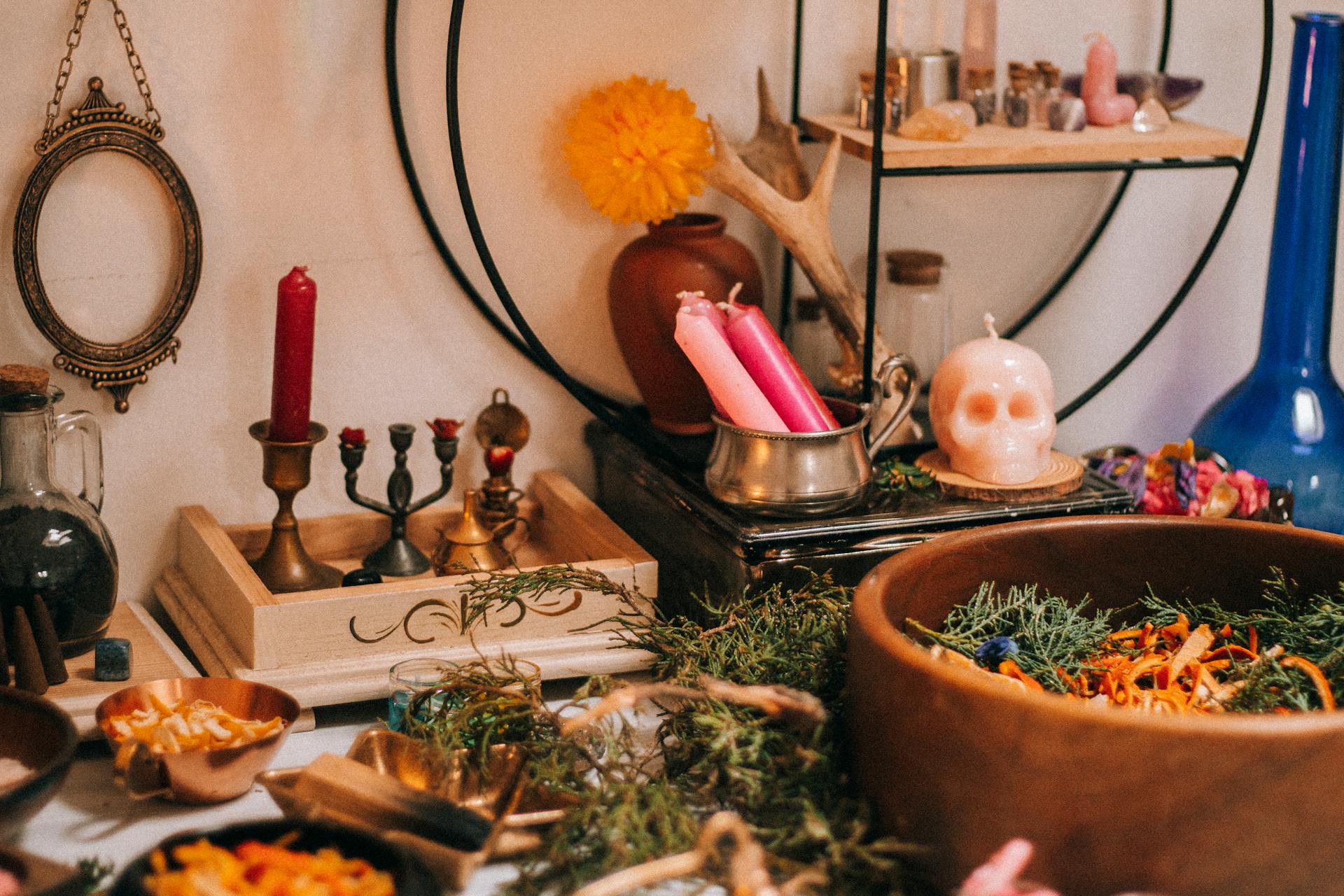
You don't need a coven, a robe, or any particular belief to mark the Wheel of the Year. At its simplest, observing the sabbats just means paying attention to the season you're actually in and doing something small to honor it. Many people build a seasonal altar, swapping the colors, plants, and objects to match each festival: evergreens and candles for Yule, eggs and spring flowers for Ostara, grain and bread for Lughnasadh, apples and fallen leaves for Mabon.
Common practices cut across all eight sabbats. Lighting candles, sharing a themed meal, spending time outdoors noticing what the natural world is doing, and setting intentions that fit the season are all easy ways in. Each sabbat has a natural focus you can lean into. Samhain invites reflection on what you want to release, Imbolc and Ostara favor fresh starts and plans, the summer sabbats are for celebration and gratitude, and the autumn festivals are for harvesting results and slowing down.
The sabbats also pair naturally with the lunar cycle, since the wheel tracks the Sun while the Moon runs its own faster rhythm underneath. Plenty of practitioners layer the two, marking the eight solar festivals across the year and the full and new Moons across each month. If you want to add that layer, the full moon rituals guide and the new moon manifestation guide cover how to work with lunar timing alongside the seasonal wheel.
The Wheel of the Year in the Southern Hemisphere
One important practical note: the dates above follow the Northern Hemisphere, where the Wheel of the Year was assembled. South of the equator the seasons are reversed, so the calendar dates don't match the actual seasons. A late-December solstice is the height of summer in Australia, not the depth of winter.
Most Southern Hemisphere practitioners solve this by shifting the wheel six months, celebrating each sabbat when its season actually arrives rather than on the traditional Northern date. So in the Southern Hemisphere, Samhain is observed around late April or early May, Yule lands near the June solstice, Beltane falls near the start of November, and so on. The logic is simple and worth remembering for anyone following the wheel: the festivals belong to the seasons, not to the calendar dates. Celebrate the season you're in, not the one a Northern almanac tells you it should be.
Frequently Asked Questions
What are the 8 sabbats of the Wheel of the Year?
The eight sabbats are Samhain, Yule, Imbolc, Ostara, Beltane, Litha, Lughnasadh, and Mabon. Four fall on the solstices and equinoxes, and four fall on the cross-quarter days between them. Spaced about six weeks apart, they form a continuous cycle marking the turning of the seasons across the whole year.
Is the Wheel of the Year Wiccan or Celtic?
It's both and neither, strictly speaking. The unified eight-festival calendar is modern, assembled in the mid-twentieth century mainly through Wicca and modern druidry. The pieces are older: the four cross-quarter festivals are Celtic, while the solstices, equinoxes, and several names come from Germanic and Anglo-Saxon sources. It's a blend of genuine ancient festivals inside a modern framework.
What is the most important sabbat?
Many traditions treat Samhain as the most significant sabbat, often calling it the witches' new year. It marks the end of the harvest, the start of winter, and the time when the veil between the living and the dead is considered thinnest. That said, importance varies by tradition, and some practitioners give equal weight to all eight festivals.
Do you have to be pagan to celebrate the sabbats?
No. While the Wheel of the Year is rooted in pagan and Wiccan practice, plenty of people observe the sabbats simply as a way to stay connected to the changing seasons. You can mark them with seasonal meals, time outdoors, candles, or intention-setting without holding any specific religious belief. The wheel works as a secular seasonal rhythm too.
The Wheel of the Year is, at heart, a reminder that time moves in cycles rather than a straight line, and that every season carries its own task and its own meaning. You can follow all eight sabbats in detail or simply let the wheel nudge you to notice what the light and the land are doing right now. Either way, it pairs naturally with the rest of a sky-watching practice. Run your natal chart to see how the seasons mapped onto the moment you were born, check your compatibility with the people you celebrate alongside, and pull a tarot reading when a turning point in your own year arrives. The wheel keeps turning. The only question is whether you're paying attention as it does.