
How to Make a Vision Board That Actually Works (Step by Step)
A vision board is a visual collage of the goals, feelings, and experiences you want to bring into your life, arranged somewhere you'll see it every day. To make one that actually works, you get clear on what you want, gather images and words that represent it, lay them out on a board, and put it where you'll look at it daily so it keeps your goals in front of you and nudges you to act on them.
That last part is where most vision boards quietly fail. Pinning up pretty pictures feels productive, but a board only changes anything when it changes what you notice and what you do. This guide walks through how to build one step by step, what to put on it, the best time to make one, and the honest psychology behind why some boards move people forward while others just collect dust.
What You'll Learn
What Is a Vision Board?
A vision board, sometimes called a dream board or manifestation board, is a collection of images, words, and symbols that represent what you want your life to look like. Think a beach if you're saving for a trip, a photo of a paid-off account if you're clearing debt, or a single word like "calm" if you want a steadier year. You arrange them on a corkboard, poster, or digital canvas and keep it somewhere visible.
The idea has roots in the New Thought movement of the late 1800s, which taught that focused thought shapes experience. It went mainstream when books and TV shows built around the law of attraction encouraged people to picture their goals in vivid detail. Today a vision board is one of the most popular manifestation tools because it's cheap, hands-on, and doesn't ask you to believe anything in particular to get value from it.
At its core, a board is a focusing device. It takes goals that live as vague wishes in your head and turns them into something concrete you see every morning. Whether you frame that spiritually or practically, the mechanism is the same: it keeps your attention pointed at what matters to you.
Do Vision Boards Actually Work?
Here's the honest answer. Vision boards can absolutely help, but not because a poster sends signals into the universe. They work through attention and behavior, and they can even backfire if you use them the wrong way.
Your brain has a filter called the reticular activating system that decides which of the thousands of things around you are worth noticing. When you spend time clarifying a goal and looking at it daily, you prime that filter to flag anything relevant. It's the same reason you suddenly see a specific car everywhere right after you decide you want it. The opportunities were always there. A vision board tunes you to spot them.
There's an important catch, though, and most vision board advice skips it. Psychologist Gabriele Oettingen has spent decades studying visualization, and her research found that simply fantasizing about a wonderful outcome can actually drain your motivation. The mind treats the daydream as a small taste of success, so you relax instead of getting to work. Her fix is called mental contrasting: picture the goal, then honestly picture the obstacle in your way, then make a specific if-then plan to handle it. In other words, a board of dreamy images is only half the tool. The other half is naming what stands between you and the goal and deciding what you'll do about it.
So do vision boards work? Yes, when they keep a goal salient and are paired with real action. They don't work as a substitute for effort. If you want the deeper mechanics, our guide to how the law of attraction actually works breaks down the difference between focused intention and wishful thinking.
What You Need to Make a Vision Board
You don't need anything fancy. A basic physical board comes together with items you probably already own:
If you'd rather go digital, all you need is a phone or computer. Free tools like Canva, Pinterest, or your device's photo app let you build a collage in minutes and set it as your lock screen. Both approaches work, and we'll compare them below.
The one thing that matters more than any supply is clarity. Before you cut out a single image, spend ten quiet minutes deciding what you actually want this year. A board built on vague wishes stays vague. A board built on specific, felt goals has something to focus your attention on.
How to Make a Vision Board Step by Step
Here's a simple process you can finish in an afternoon.
1. Get clear on your goals. Write down what you want across a few life areas: health, money, relationships, career, home, and personal growth. Be specific. "Run a 5K in the spring" beats "get fit."
2. Feel the why behind each one. Next to each goal, note how reaching it would feel. Emotion is what makes a board stick, so you want images that trigger that feeling, not just the object.
3. Gather your images and words. Flip through magazines or search online and collect anything that matches your goals and the feelings behind them. Pull more than you need.
4. Edit down. Lay everything out and keep only the pieces that genuinely move you. A cluttered board dilutes your focus. Aim for a handful of strong images per goal, not fifty weak ones.
5. Arrange before you stick. Play with the layout first. Some people group by life area, others put their single most important goal in the center. There's no wrong pattern.
6. Attach and add words. Glue, tape, or pin everything down, then layer in a few affirmations or a theme word so the meaning is clear at a glance.
7. Add a plan. This is the step that separates a working board from a pretty one. On the back or in a nearby journal, write one obstacle for each goal and one action you'll take this week. That's the mental contrasting piece that keeps the board honest.
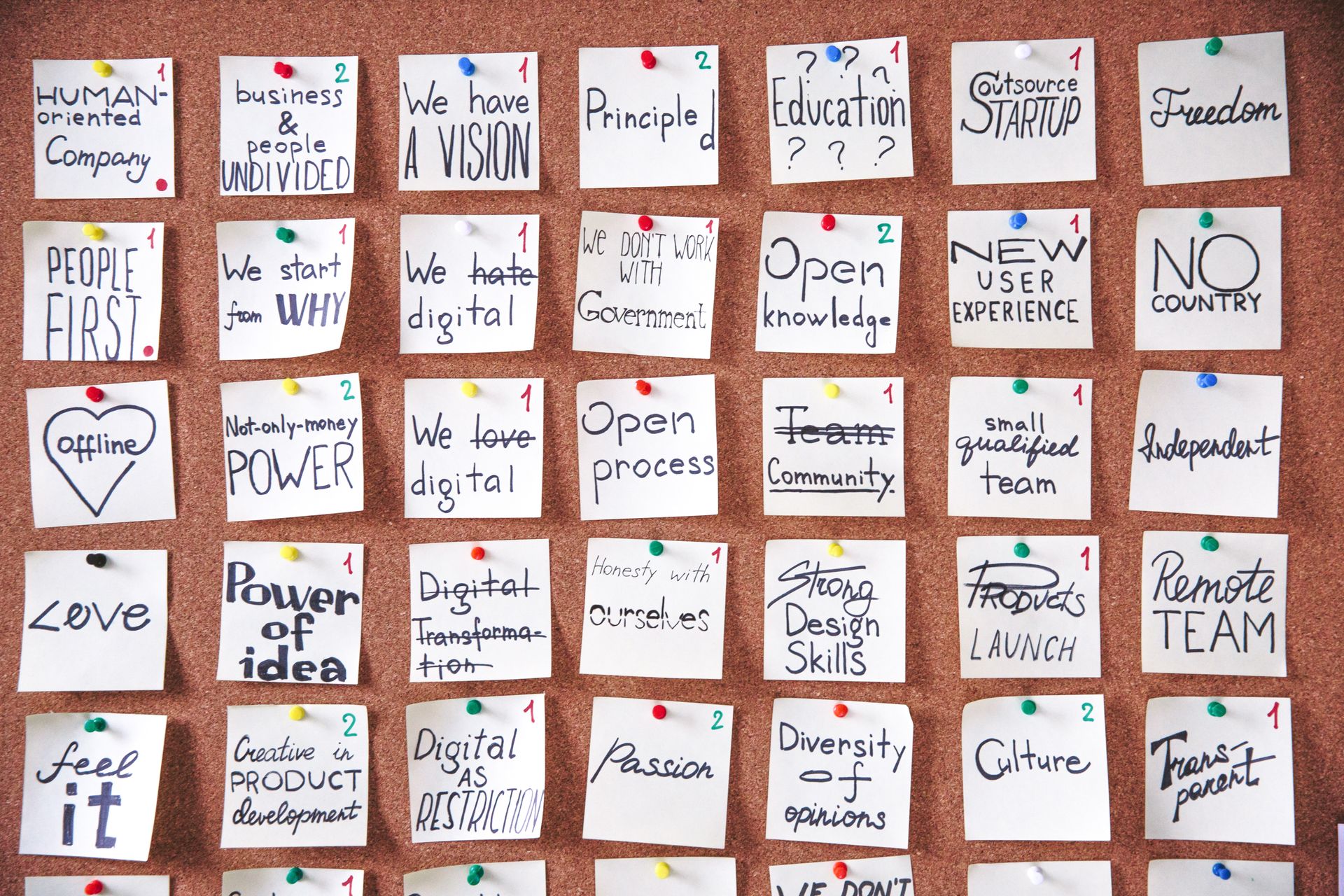
A corkboard covered with colorful sticky notes and planning materials, ready to become a vision board with pinned images and goals
Physical vs Digital Vision Boards
Neither is better. They fit different lives.
A physical board is tactile and unavoidable. Cutting and arranging by hand slows you down and makes the goals feel real, and a board on the wall is impossible to swipe past. The downside is that it stays in one room, so you only see it when you're home.
A digital board goes everywhere. Set it as your phone lock screen and you glance at your goals dozens of times a day without trying. It's also easy to update as goals shift, and you can build one in minutes with no scissors or glue. The tradeoff is that it can get buried among your other apps and lose its punch if you stop noticing it.
Plenty of people use both: a physical board at home for the ritual of making it, and a digital version on their phone for daily exposure. If you can only pick one, choose the format you'll actually look at. A gorgeous board you never see does nothing.
What to Put on a Vision Board
Anything that represents a goal or the feeling of reaching it belongs on your board. To make sure you cover the whole picture, pull ideas from each major life area:
Mix images with words. A few short affirmations or a single theme word for the year give the board direction. Some people love pairing their board with written practice, like scripting your reality in a journal, or using a rhythm like the 369 method to reinforce the same goals daily.
Be specific and be honest. A board full of borrowed images of someone else's dream life won't resonate. Choose things you genuinely want, in enough detail that you'd recognize the moment you got there.
An open planner page with handwritten goals and colorful decorative details, part of building a personal vision board
The Best Time to Make a Vision Board
You can make a vision board any day of the year, but a few moments carry natural momentum. The start of a new year is the obvious one, since you're already thinking about what's ahead. Birthdays work well too, marking your own personal new cycle.
If you like to align with the sky, the new moon is the traditional time to set intentions. It marks the start of the lunar cycle, a fresh dark-sky beginning, which many people treat as an invitation to plant seeds for what they want to grow. Building or refreshing your board on a new moon can add a sense of ceremony. Our new moon manifestation guide walks through a simple ritual you can pair with it, and the full moon two weeks later is a natural checkpoint to review your board and release what's no longer serving the goal.
Timing is a nice ritual, not a requirement. The best time to make a vision board is whenever you feel the pull to get clear about your direction. Momentum matters more than the calendar.

A softly lit scene of candles and moonlight for setting intentions, evoking the new moon as a time to make a vision board
Where to Put It and How to Use It Daily
A board only works if you see it, so placement is half the job. Put a physical board somewhere it lands in your line of sight during your normal routine: above your desk, next to your mirror, on the closet door, or across from your bed so it's the first thing you see in the morning. Keep a digital board as your phone or laptop background.
Seeing it isn't quite enough on its own, though. Spend a minute with it each day. Look at each image, let yourself feel what reaching that goal would feel like, and then, crucially, ask what one small thing you can do today to move toward it. That question is what turns passive looking into forward motion.
Refresh the board when your goals change. Some people rebuild it every season, others once a year. When a goal comes true, celebrate it and take that image down. An evolving board stays alive. A frozen one fades into the wallpaper.
Common Vision Board Mistakes to Avoid
A few habits quietly kill a board's usefulness:
Avoid those and you're ahead of most people who ever tape pictures to a poster.
Frequently Asked Questions
Do vision boards really work?
They can, when used as a focus tool paired with action. A board keeps your goals in front of you and trains your attention to notice relevant opportunities. It won't manifest anything on its own, though, and pure daydreaming without a plan can actually lower your motivation.
What should you not put on a vision board?
Skip vague concepts with no clear image, goals that are really someone else's dream, and anything that stirs pressure or shame instead of motivation. Avoid overcrowding it with so many images that nothing stands out. Keep it specific, positive, and genuinely yours.
How many goals should be on a vision board?
There's no fixed number, but aim for focus over volume. Covering a handful of life areas with a few strong images each tends to work better than cramming in dozens of goals. Too many competing images dilute the attention the board is meant to sharpen.
Where is the best place to put a vision board?
Anywhere you'll see it as part of your daily routine, such as above a desk, beside a mirror, on a closet door, or across from your bed. For a digital board, set it as your phone or laptop background so you glance at it throughout the day.
How often should I look at my vision board?
Ideally once a day, even for just a minute. Look at each image, connect with the feeling of reaching that goal, and identify one small action you can take. Daily contact is what keeps the board active instead of letting it fade into the background.
Bring Your Vision Into Focus
A vision board works when it's specific, visible, and backed by action. Get clear on what you want, choose images that make you feel it, name the obstacles in your way, and look at the board every day with a question about what you'll do next. That's the difference between a poster and a plan.
Ready to go deeper on your direction? Your free natal chart reveals the strengths and timing patterns woven into your birth chart, a tarot reading can offer perspective on the path ahead, and our compatibility tool helps you understand the relationships you're building toward. Use them alongside your board to turn intention into momentum.