
Human Design Chart: A Beginner's Guide to Your Type, Strategy, and Authority
Human Design is a self-knowledge system that combines your astrological birth data with the I Ching, the Kabbalistic Tree of Life, and the Hindu chakra system to produce a single map called the bodygraph. From your birth date, time, and place, it assigns you one of five energy types, a decision-making strategy, and an inner authority, then claims that following those three things puts you back in alignment with how you're built.
That's a big claim, and we'll be honest up front: Human Design isn't science. It's a synthesis of older symbolic systems, the same way tarot and astrology are. But as a framework for self-reflection it has exploded in popularity for a reason. People recognize themselves in their type description the same way they recognize themselves in their big three, and the system's practical advice (how to make decisions, when to act, when to wait) gives you something concrete to test in daily life. This guide covers everything you need to read your own chart for the first time.
What You'll Learn
What Is Human Design?
Human Design describes itself as a science of differentiation: a system for understanding how your energy works, how you're meant to make decisions, and where you're vulnerable to conditioning from other people. The chart it produces, the bodygraph, looks like a human silhouette filled with nine geometric shapes (the centers) connected by channels and gates.
The system runs two calculations from your birth data. The first, printed in black, is your personality: the conscious traits calculated from the moment of your birth, much like a standard natal chart. The second, printed in red, is your design: an unconscious layer calculated from roughly 88 days before your birth, when the Sun sat 88 degrees behind its birth position. Human Design teaches that the red side describes traits your body carries that your mind doesn't identify with, which is why friends sometimes describe you in ways that surprise you.
Where the two calculations activate gates and channels, parts of your bodygraph become defined (colored in). Defined areas represent consistent, reliable energy you broadcast to others. Undefined areas (left white) represent places where you absorb and amplify other people's energy instead of generating your own. That single idea, defined versus open, drives most of the practical advice in the system.
Where Does Human Design Come From?
Human Design was founded by Ra Uru Hu, born Alan Robert Krakower, a Canadian former advertising executive. By his own account, he experienced an eight-day mystical transmission on the island of Ibiza in January 1987, during which he received the system's mechanics. He spent the rest of his life teaching it until his death in 2011.
Whatever you make of the origin story, the components Ra synthesized are traceable. The 64 gates of the bodygraph map directly onto the 64 hexagrams of the I Ching. The channel structure echoes the Kabbalistic Tree of Life. The nine centers expand the seven-chakra model found in Hindu and yogic traditions. And the planetary activations come straight from Western astrology, using the same ephemeris data an astrologer would use to cast your natal chart. Human Design's novelty isn't any single ingredient. It's the claim that these systems describe one underlying mechanism and can be read together.
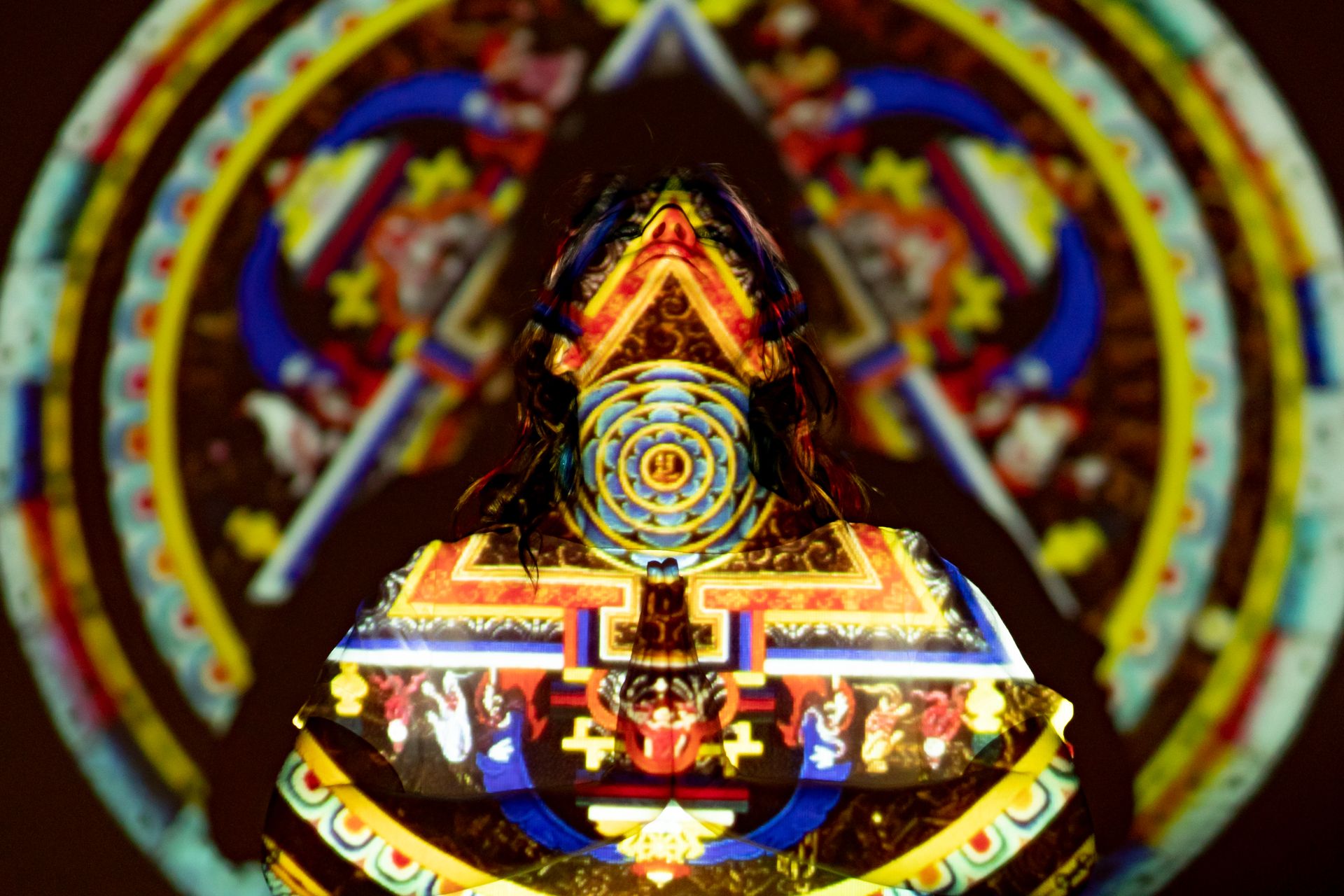
Colorful mandala light projection over a figure, evoking the layered symbolic systems behind human design
What Are the 5 Human Design Types?
Type is the headline of your chart, determined by which centers are defined and how they connect. Each type comes with a strategy (how to engage the world), a signature (the feeling of being on track), and a not-self theme (the feeling that you've drifted).
Generators make up roughly 37 percent of people in Human Design teaching. They have a defined sacral center, the system's battery, which gives them sustainable life-force energy for work they love. Their strategy is to respond: rather than chasing ideas cold, Generators are taught to wait for something in their environment to spark a gut response, then act on it. On track, they feel satisfaction. Off track, frustration.
Manifesting Generators, about 33 percent, are a hybrid: sacral beings with a motor connected to the throat. They respond like Generators but move faster, skip steps, and often juggle several passions at once. Their strategy adds a step: respond, then inform the people their actions will affect before acting. Their signature is satisfaction; their not-self theme is frustration, often mixed with anger.
Projectors, around 20 percent, have no defined sacral. They aren't built for long hours of output. Instead they're built to see other people's energy clearly, which makes them natural guides, managers, and advisors. Their strategy is to wait for the invitation: recognition has to come first, or their guidance lands as criticism. Success is their signature; bitterness is the warning sign.
Manifestors, roughly 9 percent, are the initiators. With a motor connected to the throat and no sacral, they're designed to start things and get them moving, then hand them off. Their strategy is to inform: telling people what they're about to do before they do it, which clears resistance. Peace is their signature; anger is their not-self theme.
Reflectors are the rarest type at about 1 percent. Every center in their chart is undefined, making them mirrors of their communities. Human Design teaches that Reflectors should wait a full lunar cycle, about 28 days, before major decisions, letting the Moon move through their chart and show them the question from every angle. Their signature is surprise and delight; their not-self theme is disappointment.
Those percentages come from Human Design's own teaching materials and population samples run through chart software, not from peer-reviewed research, so hold them loosely.
What Do the 9 Centers in the Bodygraph Mean?
The nine centers are where the bodygraph gets personal, because two people of the same type can have very different definition. Each center governs a theme:
Head governs inspiration and mental pressure, the pressure to answer questions. Ajna governs conceptualizing, how you process and hold ideas. Throat governs communication and manifestation, where energy becomes word and deed. G center (identity) governs direction, love, and sense of self. Heart (also called ego or will) governs willpower, worth, and promises. Sacral governs life-force and work capacity. Spleen governs intuition, instinct, and survival timing. Solar plexus governs emotions, which move in waves. Root governs adrenaline pressure, the drive to get things done.
The reading rule is consistent: where you're defined, you have reliable access and you influence others. Where you're open, you take in and amplify whatever's around you, and that's where conditioning happens. Someone with an open heart center, for example, tends to absorb other people's standards of worthiness and overcompensate by proving themselves. Someone with an open solar plexus absorbs the emotions in a room and can spend years thinking other people's feelings are theirs. The open centers aren't flaws. The system treats them as where your deepest wisdom develops, precisely because you experience those themes in so many flavors.

Person writing in a journal by candlelight surrounded by open books, studying their human design chart
What Is Inner Authority in Human Design?
If type tells you how to engage the world, authority tells you how to make decisions once an opportunity shows up. It's the part of the system people find most immediately useful, because it's testable.
Emotional authority applies to anyone with a defined solar plexus, about half of all people. The teaching: your emotions move in waves, so there's no truth in the now. Sleep on big decisions, ride the wave, and decide when you feel clear rather than high or low.
Sacral authority belongs to Generators and Manifesting Generators without a defined solar plexus. Decisions register in the gut as an immediate yes (energy rises) or no (energy drops). Yes or no questions work better than open-ended ones.
Splenic authority is an in-the-moment instinct, a quiet first hit that doesn't repeat itself. People with this authority are taught to act on the whisper before the mind talks them out of it.
Ego authority is rare and belongs to certain Manifestors and Projectors: the question is what do I want, and is my will actually behind this?
Self-projected authority belongs to some Projectors, who hear their truth by talking decisions out loud and listening to what they say.
Environmental (mental) authority applies to Projectors with no defined centers below the throat: they need trusted sounding boards and the right environment to reach clarity.
Lunar authority is the Reflector's 28-day cycle described above.
Notice what every authority has in common: none of them is the mind. Human Design consistently teaches that the mind is a brilliant tool for processing information and a terrible one for making personal decisions. Whether or not you buy the mechanics, that's the system's core practical wager, and it's one you can experiment with for free.
What Does Your Profile Number Mean?
Your profile is the pair of numbers written like a fraction, 1/3 or 4/6 or 5/1, derived from the line positions of your conscious and unconscious Sun. There are twelve profiles built from six lines, and each line is an archetype: line 1 is the Investigator who needs a solid foundation of knowledge, line 2 the Hermit with natural talent who needs to be called out, line 3 the Experimenter who learns by trial and error, line 4 the Opportunist whose path moves through their network, line 5 the Heretic who attracts projections and delivers practical solutions, and line 6 the Role Model who lives three distinct life phases.
A 1/3, for instance, researches deeply and then learns the rest by bumping into what doesn't work. A 4/6 builds influence through relationships while moving through the trial-and-error youth, the withdrawn observation phase, and the role-model maturity that line 6 describes. Profile reads like the costume your type wears on stage, and many readers find it the most instantly recognizable part of the chart.

Quiet forest path with a wooden direction signpost among fir trees, symbolizing strategy and decision making
Human Design vs Astrology: What's the Difference?
The two systems start from the same place, the planetary positions at your birth, and then diverge completely. Astrology reads those positions through signs, houses, and aspects, producing a symbolic portrait of your character and timing. Human Design feeds the same positions through the 64 hexagrams to activate gates in the bodygraph, producing a mechanical account of how your energy is supposed to operate.
Astrology is descriptive and interpretive: a skilled reader weighs an entire chart and there are many valid ways in. Human Design is prescriptive: it hands you a strategy and authority and tells you to run the experiment. Astrology has thousands of years of layered tradition behind it; Human Design has been around since 1987. They're not rivals so much as different instruments. Plenty of people use their natal chart for self-understanding and timing, and their bodygraph for the practical question of how to decide.
If you've never seen your actual planetary placements, generate your free natal chart first. Your Human Design chart is built from exactly the same birth data, so you'll need your birth time either way, and knowing your placements makes the bodygraph's astrological layer far less mysterious.
How to Read Your Human Design Chart
Here's a sane order of operations for your first pass, because the bodygraph throws a lot of information at you at once.
Start with type and strategy. This is the headline. Read your type description and notice whether the signature and not-self theme match your lived experience. Frustrated Generators and bitter Projectors tend to recognize themselves immediately.
Find your authority. Then test it on low-stakes decisions for a few weeks. If you have emotional authority, stop answering big asks on the spot. If you're sacral, have someone ask you yes or no questions and notice the gut response before your mind composes an answer.
Look at your centers. Note which are defined and which are open, and read about the conditioning themes of your open centers. This is usually where the uncomfortable accuracy lives.
Check your profile. The two-line archetype adds texture to everything above.
Leave gates and channels for later. There are 64 gates and 36 channels, and beginners drown there. They refine the picture; they don't change the fundamentals.
Treat the whole thing as an experiment rather than a verdict. Human Design's own teachers describe it that way: try living your strategy and authority for a while and keep what proves itself. That posture, test it against your life, is the same one we'd recommend for any symbolic system, from tarot to synastry.
Frequently Asked Questions
What do I need to calculate my Human Design chart?
Your birth date, exact birth time, and birth city. The birth time matters because several chart elements, including your rising gates and often your profile, shift within hours. If you don't know yours, check your birth certificate or read our guide on finding your birth time.
What is the rarest Human Design type?
Reflectors, at roughly 1 percent of the population by Human Design's own counts. They have no defined centers at all, which makes them sensitive mirrors of their environment. Manifestors are the second rarest at around 9 percent.
Is Human Design scientifically proven?
No. There are no peer-reviewed studies validating its mechanics, and its origin is a mystical experience, not research. Like astrology and tarot, it's best treated as a symbolic framework for self-reflection. Its practical advice about decision-making is testable in your own life, which is exactly how its teachers suggest you approach it.
Can your Human Design type change over time?
No. Type, authority, and profile are fixed at birth, calculated from your birth data and the 88-day prenatal design calculation. What changes is conditioning: the system teaches that living against your design accumulates not-self patterns, and the experiment is about shedding them, not becoming a new type.
Are some Human Design types more compatible than others?
Every type pairing can work, but the dynamics differ: Projectors often guide sacral types, Generators can sustain what Manifestors start, and open centers tend to be drawn to people who are defined where they're not. For the astrological side of relationship dynamics, run a compatibility reading with both birth charts.
Your bodygraph and your birth chart are two readings of the same moment: the sky when you arrived. Start with the data underneath both by generating your free natal chart, then run the Human Design experiment alongside it and see which lens tells you something true.