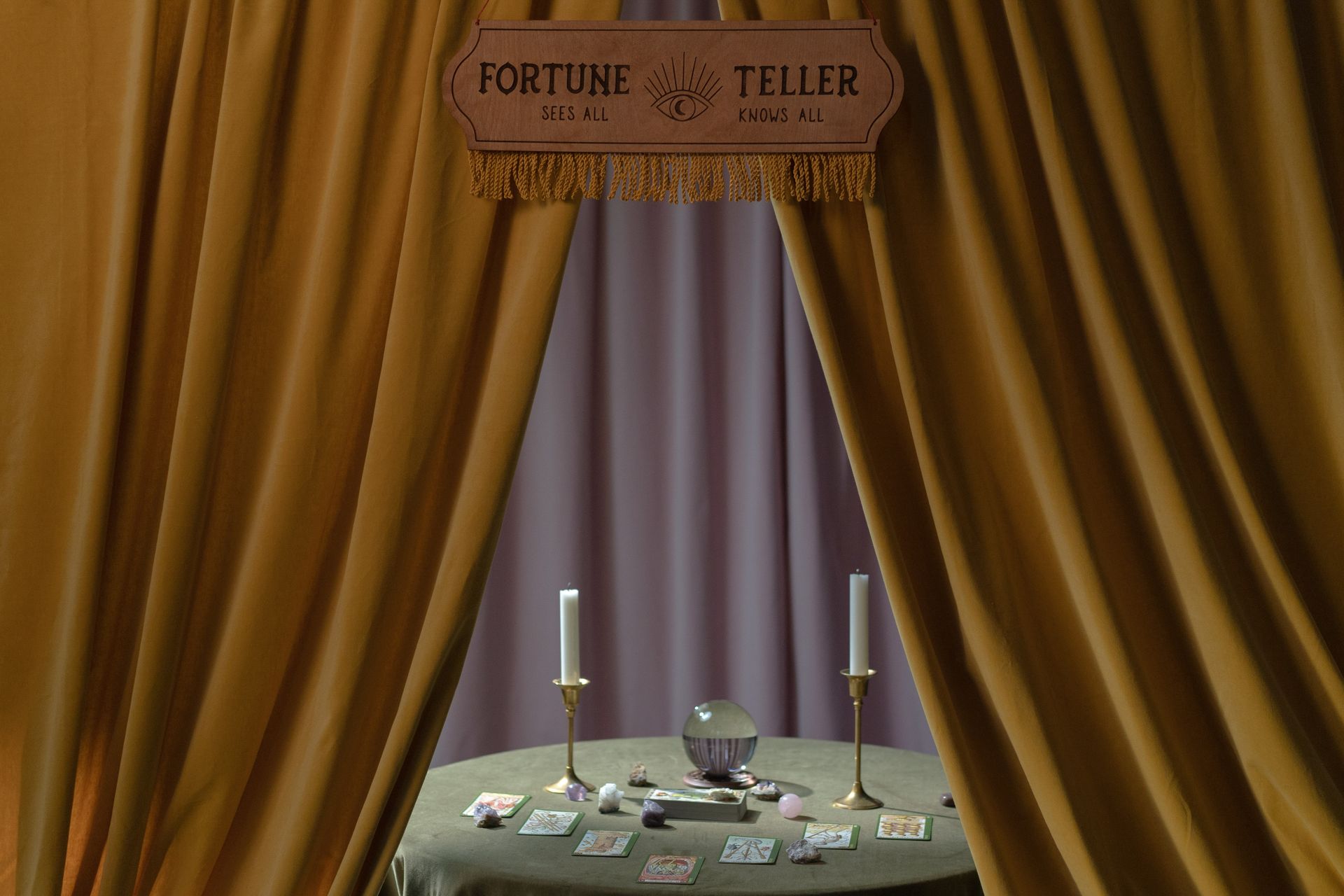
Scrying: How to Read Mirrors, Crystal Balls, and Water for Beginners
Scrying is the practice of gazing into a reflective or translucent surface, a crystal ball, a black mirror, a bowl of water, a candle flame, until images, symbols, or impressions rise up and tell you something. The surface itself holds no magic. It's a focusing tool, a blank screen your intuition can project onto once your busy, analytical mind finally quiets down. That's the whole secret. Scrying doesn't ask you to see the future in glass. It asks you to get still enough that your deeper knowing has room to speak.
People have scried for thousands of years across nearly every culture, from the polished obsidian mirrors of the ancient Aztecs to the famous crystal "shew stone" used by John Dee, advisor to Queen Elizabeth I. The tools changed, but the method stayed remarkably consistent: soft focus, patience, and a willingness to trust the images that surface. If you've ever lost yourself staring into a fire and felt your thoughts loosen, you've already brushed up against the state scrying lives in. This guide walks you through what scrying is, how to choose your tool, how to run your first session, and how to read what you see without forcing it.
What You'll Learn
What Is Scrying?
Scrying comes from the old English word "descry," meaning to perceive or reveal. At its core it's a form of divination where you stare into a surface until your mind produces images that carry meaning. Unlike tarot or the I Ching, which give you a fixed set of symbols to interpret, scrying is open-ended. There are no cards, no hexagrams, no preset answers. Whatever surfaces is unique to you and the moment.
That openness is both the appeal and the challenge. Tarot hands you a framework. Scrying hands you a blank surface and asks you to supply the framework from within. The visions can come as literal pictures, like a key or a door, or as vaguer impressions: a color, a sudden emotion, a word that drops into your head, a shape forming in mist. None of it appears physically in the glass for a bystander to photograph. It surfaces in your mind's eye, prompted by the soft, unfocused gaze the surface encourages.
How Does Scrying Work?
There's no need to dress this up in mystery. Scrying works by inducing a light trance, a relaxed, meditative state where your conscious mind stops chattering and your subconscious gets the floor. When you fix a soft gaze on a reflective surface for several minutes, a few things happen at once. Your eyes relax and the surface starts to look cloudy or shifting, which is a normal optical effect, not a vision yet. Your brainwaves slow toward the dreamy alpha and theta states. And your mind, freed from sharp focus, begins offering up images the same way it does just before you fall asleep.
Whether you read those images as messages from spirit, your higher self, or simply your own intuition surfacing what you already know, the mechanism is the same. Scrying bypasses the rational filter that usually drowns out subtle inner signals. It's closely related to the receptive, dreamlike state behind dream interpretation, and it draws on the same intuitive muscle you use with a pendulum. The skill isn't supernatural. It's the ability to relax, hold attention loosely, and trust what comes without immediately editing it.
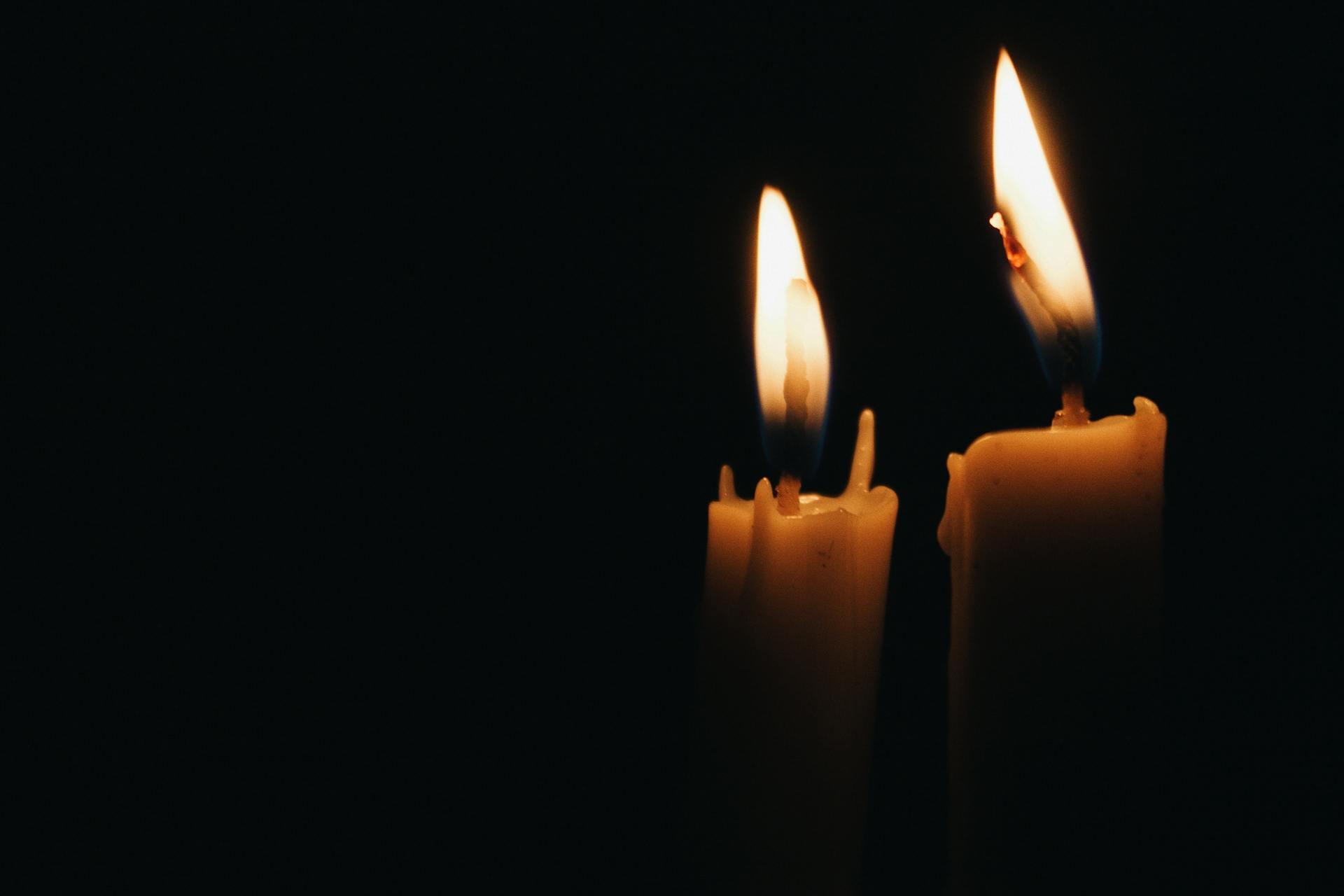
A lit candle flame burning against a dark background, one of the simplest surfaces for fire scrying
What Tools Can You Scry With?
The classic image is a crystal ball, but you can scry with almost any reflective or translucent surface. The best tool is the one you find easiest to sink into, so it's worth trying a few.
Crystal ball or sphere. The traditional choice. Clear quartz or even glass works. The depth and curve of a sphere make it easy for the gaze to get lost inside. Smoky quartz, obsidian, and beryl have all been used historically.
Black mirror. A mirror with a black backing instead of silver. The dark surface gives almost no clear reflection, which makes it ideal for projection. Many modern scryers consider it the easiest tool to start with, and you can make one yourself in a few minutes.
Water. The oldest and cheapest method. A dark bowl filled with water, ideally one with a black interior, gives you a reflective pool to gaze into. Some traditions add a drop of ink to deepen the surface or scry by moonlight on a full moon.
Candle flame and smoke. Fire scrying uses the flame's movement and the patterns in rising smoke. It's dynamic and engaging, which some beginners find easier than a still surface.
Other surfaces. Polished obsidian or crystal, a bowl of dark tea, even a still pond. The material matters far less than your ability to relax into it.
If you're brand new, start with a black mirror or a bowl of water. Both are nearly free, and the dark surface does a lot of the work for you.
How to Make a Black Mirror
You don't need to buy anything expensive. A homemade black mirror works just as well as a purchased one, and making it yourself adds a personal connection that many practitioners value.
Start with a clear glass surface. A cheap picture frame works perfectly, or any flat pane of glass. Remove the glass from the frame and clean it thoroughly so there are no smudges or dust. Then paint one side with flat black paint, matte rather than glossy, so it doesn't create distracting reflections. Two or three thin coats give the deepest, most even black. Let each coat dry fully before adding the next.
Once the paint is completely dry, set the glass back into the frame with the painted side facing the back. The unpainted side, the one you'll gaze into, stays smooth and clean. That's it. You now have a black mirror: a dark, near-reflectionless surface perfect for projection. Before your first session, many people like to cleanse it the same way you'd cleanse a new tarot deck, passing it through incense smoke or leaving it under the moon overnight to clear it and make it your own.
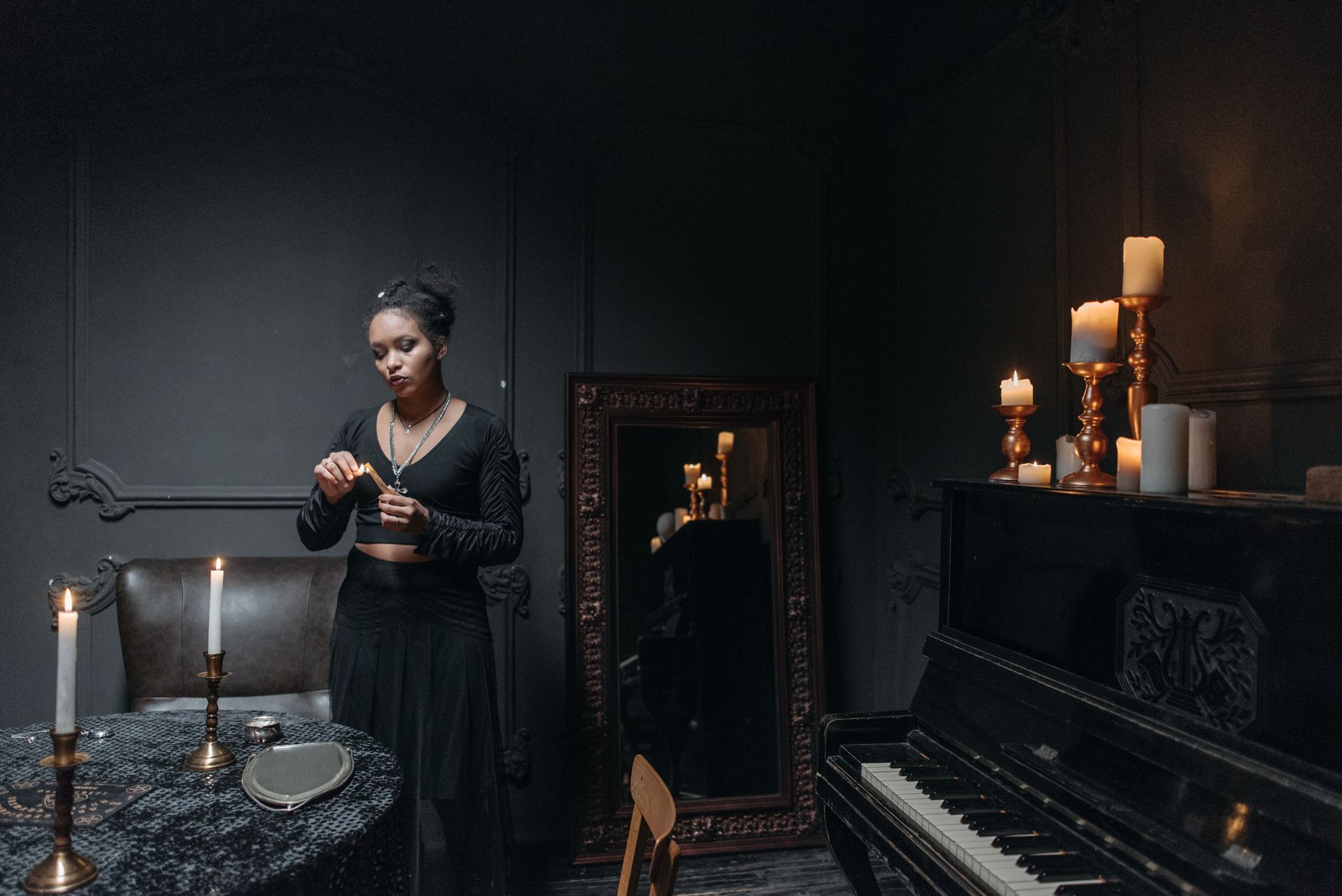
A dark mirror surface lit by candlelight, the kind of low reflection used in black mirror scrying
How to Scry: Step by Step
The setup matters more than any special technique. Get the conditions right and the rest tends to follow.
Set the scene. Choose a quiet, dark room where you won't be interrupted. Dim lighting is essential, since bright light creates hard reflections that pull you out of the soft gaze. A single candle placed to the side, never directly in front where it glares off the surface, is the traditional choice. Evening or night usually works best.
Settle yourself. Sit comfortably with your tool about a foot or two away, positioned so you can gaze down into it without straining your neck. Take several slow breaths and let your body relax. Spend a minute or two clearing your mind, the same way you'd start any meditation. If you have a question, state it silently and clearly, then let it go. Don't grip it.
Soften your gaze. This is the heart of scrying. Look into the surface but don't focus sharply on it. Let your eyes relax as if you're staring through the surface to a point behind it, the way you'd look at a 3D stereogram. Don't strain, don't search, and resist the urge to blink away the blur. Within a few minutes the surface may seem to cloud over, darken, or shift. That fogging is the doorway, the signal that your gaze has gone soft enough.
Let images come. Stay relaxed and receptive. Images, colors, symbols, or impressions may begin to form, sometimes in the surface, more often in your mind's eye. Don't chase them and don't judge them. Let them rise and pass like clouds. The moment you get excited and snap into sharp focus, the state usually breaks, so keep your attention loose. If nothing comes after fifteen or twenty minutes, that's fine. Stop without frustration and try again another day.
Record everything. The instant you finish, write down every image, feeling, color, and word in a journal, before the impressions fade the way dreams do. Note what you felt as much as what you saw. The meaning often clarifies later, when you read back over several sessions and patterns emerge.
What Do the Images Mean?
Here's the most important rule of interpretation: your personal associations come first. Scrying images are deeply individual, and a symbol that means one thing to you can mean the opposite to someone else. A spider might feel threatening to one person and creative to another who thinks of weaving and patience. Always start by asking what the image means to you, your memories, your gut reaction, before reaching for any general meaning.
That said, some symbols carry widely shared associations worth knowing as a starting point. A door or gate often points to an opportunity or a transition. A key suggests a solution or access to something hidden. Water tends to mirror emotion. A bird can signal news or a message coming. A path or road speaks to your direction in life. Colors carry tone too: red for passion or warning, blue for calm or communication, dark shades for the unknown or the subconscious. Use these as prompts, never as a fixed dictionary.
Pay just as much attention to non-visual impressions. A sudden feeling of peace, a name that pops into your head, a word you "hear," a wave of unease, all of these are valid scrying results. Many people receive more through feeling and knowing than through literal pictures. Connect whatever surfaces back to your original question and, crucially, to what's actually happening in your life right now. That link is almost always where the real meaning lives. If a recurring symbol shows up across sessions, that's your intuition being loud, much like a recurring dream refusing to be ignored.
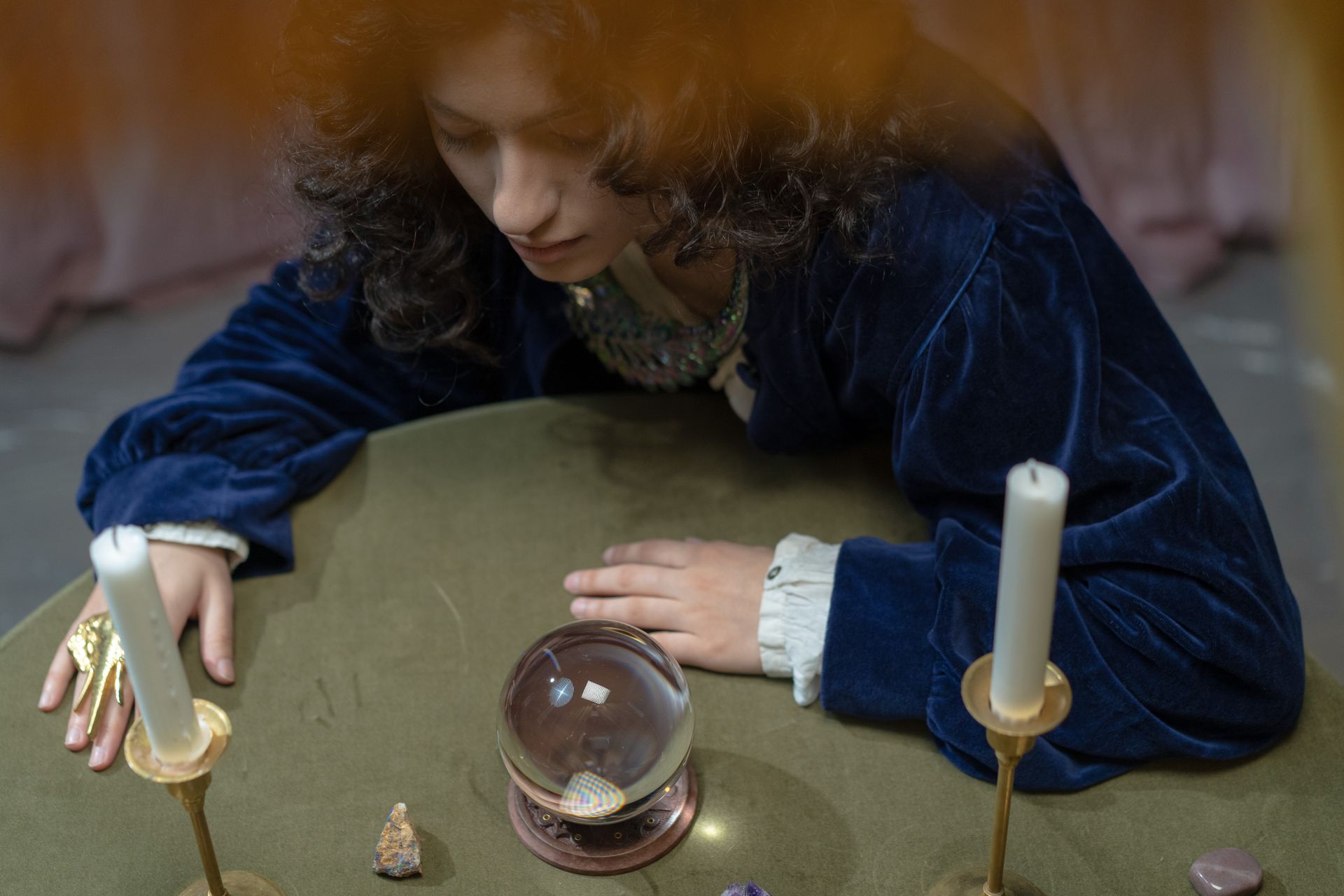
A pair of hands cradling a clear crystal ball, the receptive posture at the center of scrying practice
Common Mistakes and How to Fix Them
Most beginners hit the same handful of snags, and all of them are easy to correct.
Trying too hard. This is the big one. Scrying is receptive, not active. If you strain to see something or grip your question tightly, you stay locked in your analytical mind and nothing comes. The fix is counterintuitive: relax more, expect less, and treat each session as practice rather than a test.
Wrong lighting. Too much light creates hard reflections that keep snapping your focus sharp. A room that's too bright is the single most common reason a session won't work. Dim everything and keep your one candle off to the side.
Quitting too soon. The soft-gaze state can take ten or fifteen minutes to settle into, and the cloudy "doorway" effect often arrives only after you've held the gaze a while. Give each session real time before deciding it isn't working.
Editing the results. Beginners often dismiss the first impressions as "just imagination." But that first quiet image, the one you almost talked yourself out of, is usually the real signal. Record everything without judging it. You can interpret later.
Skipping practice. Scrying is a skill that builds with repetition, like any meditation. Short, regular sessions, even ten minutes a few times a week, train the state far faster than rare marathon attempts.
How to Cleanse and Care for Your Scrying Tool
A scrying tool is sensitive to environment and to your own energy, so keeping it clean, physically and energetically, helps the work. Physically, wipe a mirror or crystal with a soft cloth so the surface stays free of dust and fingerprints. Store it wrapped in dark cloth, away from sunlight, both to protect it and to keep stray light from charging it with distraction. Many practitioners keep their tool out of general view so it stays reserved for the practice.
Energetically, cleanse it the way you would any divination tool. Pass it through the smoke of incense or herbs, leave it overnight under the light of a full moon, or hold it with the clear intention of clearing whatever it's picked up. Doing this when you first acquire the tool, and periodically after intense sessions, keeps it feeling like a clean screen rather than a cluttered one. The ritual also marks a mental transition into the receptive state, which is part of why it helps. If scrying speaks to you, it pairs naturally with the wider intuitive toolkit, from the Moon card in tarot to a full natal chart reading that shows where your intuition runs strongest.

Moonlight reflecting on the still dark surface of water, the natural inspiration behind water scrying
Frequently Asked Questions
Is scrying hard to learn?
Scrying is simple to start but takes practice to do well. The basic technique, soft-focusing on a dark surface in dim light, can be learned in one session, but reaching a reliable trance state and trusting the images you receive develops over weeks of short, regular practice. Patience matters more than talent.
Do I really see images in the mirror?
Usually not literally. Most scryers receive images in the mind's eye rather than physically in the glass, prompted by the cloudy, shifting effect a soft gaze creates. Some people do report seeing shapes form in the surface, but feelings, impressions, and inner pictures are far more common and just as valid.
What's the best tool for a complete beginner?
A black mirror or a dark bowl of water is the easiest place to start. Both are nearly free, and their dark, low-reflection surfaces make the soft-gaze state much easier to reach than a clear crystal ball, which can throw distracting reflections until you're more practiced.
Is scrying safe?
Scrying is generally safe and is essentially a focused meditation. Set a clear intention before you begin, work in a calm space, and stop if you ever feel uneasy. As with any intuitive practice, treat what surfaces as insight to reflect on rather than fixed fact, and don't use it to replace medical, legal, or financial advice.
How long should a scrying session last?
Aim for fifteen to thirty minutes once you're settled. It often takes ten or more minutes just to reach the soft-gaze state, so give yourself time, but don't push past the point where you're straining. Shorter, consistent sessions build the skill faster than occasional long ones.
Scrying rewards patience more than any special gift. Dim the lights, soften your gaze, and let the images rise without grabbing at them, and over time you'll learn to read the quiet signals your intuition has been sending all along. When you're ready to pair that inner sight with a structured reading, pull a tarot spread or map where your intuition runs deepest with a natal chart reading.