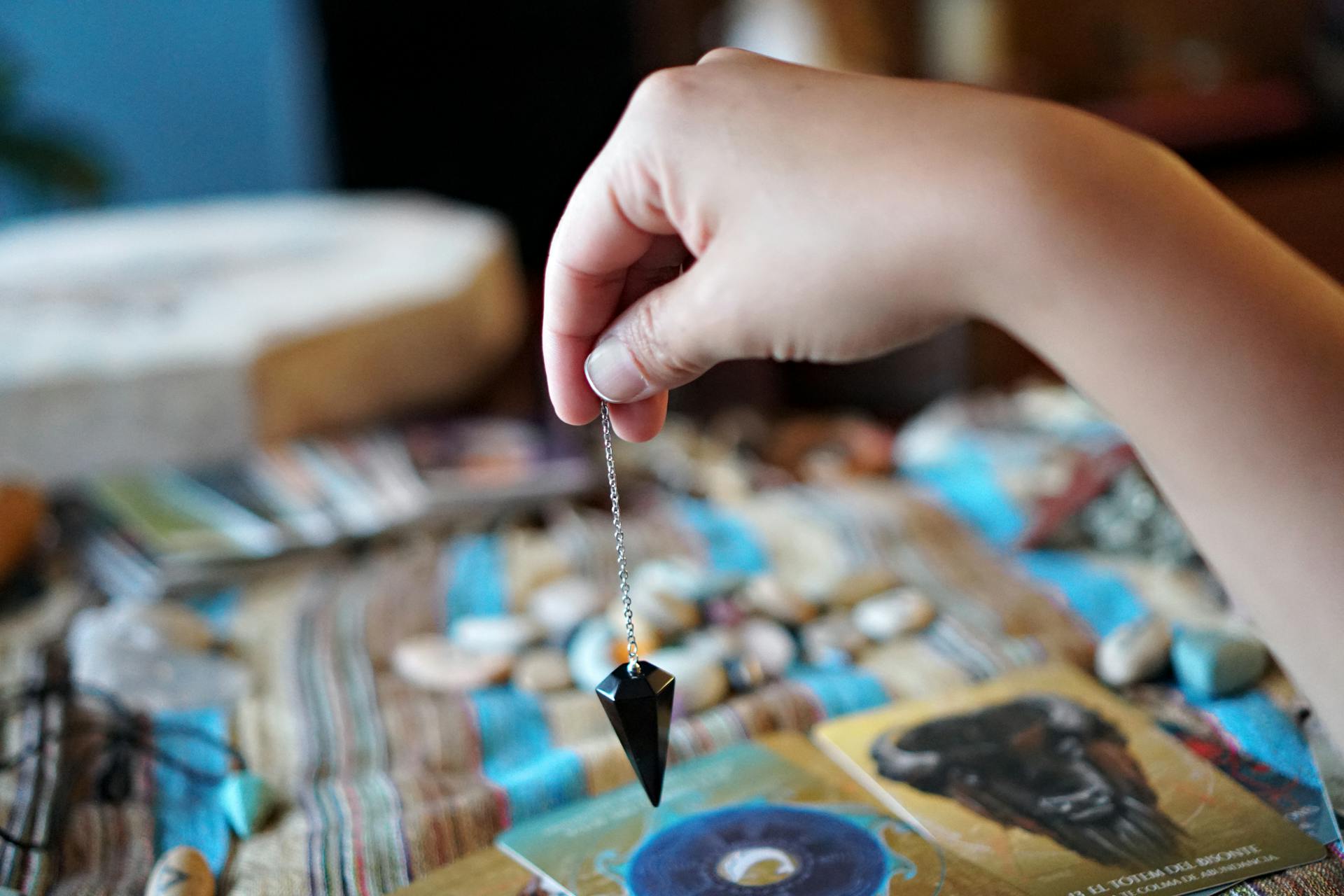
Pendulum Divination: A Beginner's Guide to Reading Pendulum Swings
A pendulum is one of the simplest divination tools you'll ever use, and that's exactly why it works so well. There's no complex spread to memorize like tarot, no alphabet to learn like runes, and no lines to interpret like palmistry. You hold a weighted object on a chain, ask a question, and watch which direction it moves. Yes, no, or unclear. That's the entire system.
But simplicity doesn't mean shallow. Pendulum divination, also called dowsing, has been used for thousands of years across cultures ranging from ancient Egypt to medieval Europe to modern spiritual practice. Water diviners used pendulums to locate underground wells. Healers used them to identify imbalances in the body's energy. Everyday people used them to make decisions when logic alone wasn't enough. The tool has survived this long because it consistently delivers results that feel meaningful to the people using it.
Whether you believe the pendulum taps into your subconscious mind, connects with spiritual guides, or channels some form of energy that science hasn't fully explained yet, the practical outcome is the same: you get clear answers to specific questions. This guide covers everything you need to start, from choosing your first pendulum to programming its responses and asking your first real questions.
What You'll Learn
What Is Pendulum Divination?
Pendulum divination is a practice where you suspend a weighted object, usually a crystal, metal, or wood point, from a chain or cord and interpret its movements to answer questions. The pendulum swings in specific directions to indicate yes, no, maybe, or rephrase the question. It's one of the oldest forms of divination still actively practiced today.
The word "dowsing" is often used interchangeably with pendulum divination, though dowsing traditionally refers to locating hidden things like water, minerals, or lost objects. Pendulum divination is broader: it covers any use of a pendulum for guidance, decision-making, or spiritual insight.
Historically, pendulum use shows up in records dating back to ancient Rome, where it was called "cleidomancy" when practiced with a suspended key. In the Middle Ages, miners throughout Europe used pendulums to locate ore deposits underground. By the 17th and 18th centuries, the practice had moved into the mainstream spiritual toolkit alongside tarot cards and astrology charts. Today, you'll find pendulums in crystal shops, energy healing practices, and the personal divination kits of people who use them alongside their daily tarot practice.
The reason pendulums remain popular is accessibility. You don't need to study for months before you get results. Most people can pick up a pendulum and get a clear response within their first session. That low barrier to entry makes it an ideal starting point for anyone curious about divination who isn't ready to commit to learning a more complex system.
How Does a Pendulum Work?
There are several frameworks for understanding why a pendulum moves the way it does, and which one you subscribe to doesn't change how you use it.
The subconscious mind theory is the most widely accepted explanation. Your subconscious processes information that your conscious mind overlooks or suppresses. When you hold a pendulum and ask a question, tiny involuntary muscle movements in your hand and fingers, called ideomotor responses, cause the pendulum to swing. You're not deliberately moving it. Your subconscious is communicating through your body, and the pendulum amplifies those micro-movements into visible signals.
This isn't a weakness of the system. It's the entire point. Your subconscious mind holds intuitive knowledge, pattern recognition, and emotional truths that your conscious mind filters out. The pendulum bypasses that filter.
The spiritual connection theory holds that the pendulum acts as an antenna or receiver for energy from spiritual guides, higher self, or universal consciousness. In this framework, the pendulum isn't reading your subconscious; it's channeling information from a source beyond your individual mind.
The energy field theory suggests that everything, including your body, your environment, and the objects around you, has an energy field. The pendulum responds to these fields, swinging in ways that reflect the energetic quality of whatever you're asking about.
In practice, most pendulum users don't pick just one theory. They use the tool, notice that it gives useful answers, and don't worry too much about the mechanism. The pragmatic approach works perfectly well.

A woman holding a pendulum with smoke creating a mystical atmosphere around the divination practice
How to Choose Your First Pendulum
Your first pendulum doesn't need to be expensive or elaborate. It needs to be weighted enough to swing freely and responsive enough to show clear directional movement. Here's what to consider.
Crystal pendulums are the most popular choice. Clear quartz is a classic starter because it's considered energetically neutral; it amplifies whatever intention you bring to it. Amethyst is another favorite, associated with intuition and spiritual insight. Rose quartz works well for questions about love and relationships. Each crystal carries its own energetic associations, but don't overthink it for your first pendulum. Pick the one that catches your attention.
Metal pendulums tend to be more precise in their movements because metal responds quickly to the micro-movements in your hand. Brass and copper are traditional choices. They're heavier than most crystals and produce crisp, defined swings.
Wood pendulums are lighter and more subtle in their movement. They work well for people who prefer a gentler, quieter form of communication. They're also a good choice if you want something that feels grounded and natural rather than crystalline.
The DIY option works in a pinch. A needle threaded through a cork, a ring on a string, or a small weight tied to dental floss will all function as a pendulum. The tool is secondary to your intention. If you want to try pendulum divination before investing in a dedicated tool, grab any small weighted object and a length of string.
When choosing a pendulum, pay attention to how it feels in your hand. Hold it by the chain and let it hang still. Does it feel natural? Does the weight feel right? Some practitioners describe feeling a subtle pull or warmth when they pick up the right pendulum. Others just choose the one that looks good. Both approaches are valid.
Chain or cord length matters. Most pendulums come with chains between 6 and 12 inches. Shorter chains produce faster, tighter swings. Longer chains produce slower, wider movements. For beginners, something around 8 inches tends to offer the best balance of responsiveness and readability.
How to Cleanse and Charge a Pendulum
Before using a new pendulum, or after a particularly heavy session, you'll want to clear any residual energy so you're starting fresh. This is the same principle behind cleansing tarot cards, and many of the same methods apply.
Smoke cleansing is the fastest method. Pass your pendulum through the smoke of dried sage, palo santo, or incense. Hold the intention that any stagnant or unwanted energy is being released. Thirty seconds is usually enough.
Moonlight charging works well for crystal pendulums. Place your pendulum on a windowsill or outside during a full moon and leave it overnight. The full moon's energy is considered purifying and recharging.
Salt burial is a deeper cleanse. Bury your pendulum in a bowl of sea salt for 24 hours. This method works for metal and most crystal pendulums, but avoid it with softer stones like selenite that can be damaged by salt.
Sound cleansing uses a singing bowl, tuning fork, or bell to reset the pendulum's energy through vibration. Strike the instrument near your pendulum and let the sound wash over it.
Running water is quick and effective: hold your pendulum under cool running water for a minute while visualizing any accumulated energy flowing away. Avoid this method with water-sensitive stones or metals that might tarnish.
After cleansing, hold the pendulum in your hands for a few minutes and set your intention. Tell it, silently or aloud, that it will serve as a tool for clear, truthful guidance. This step isn't ceremonial fluff. It's how you establish the relationship between your energy and the tool.
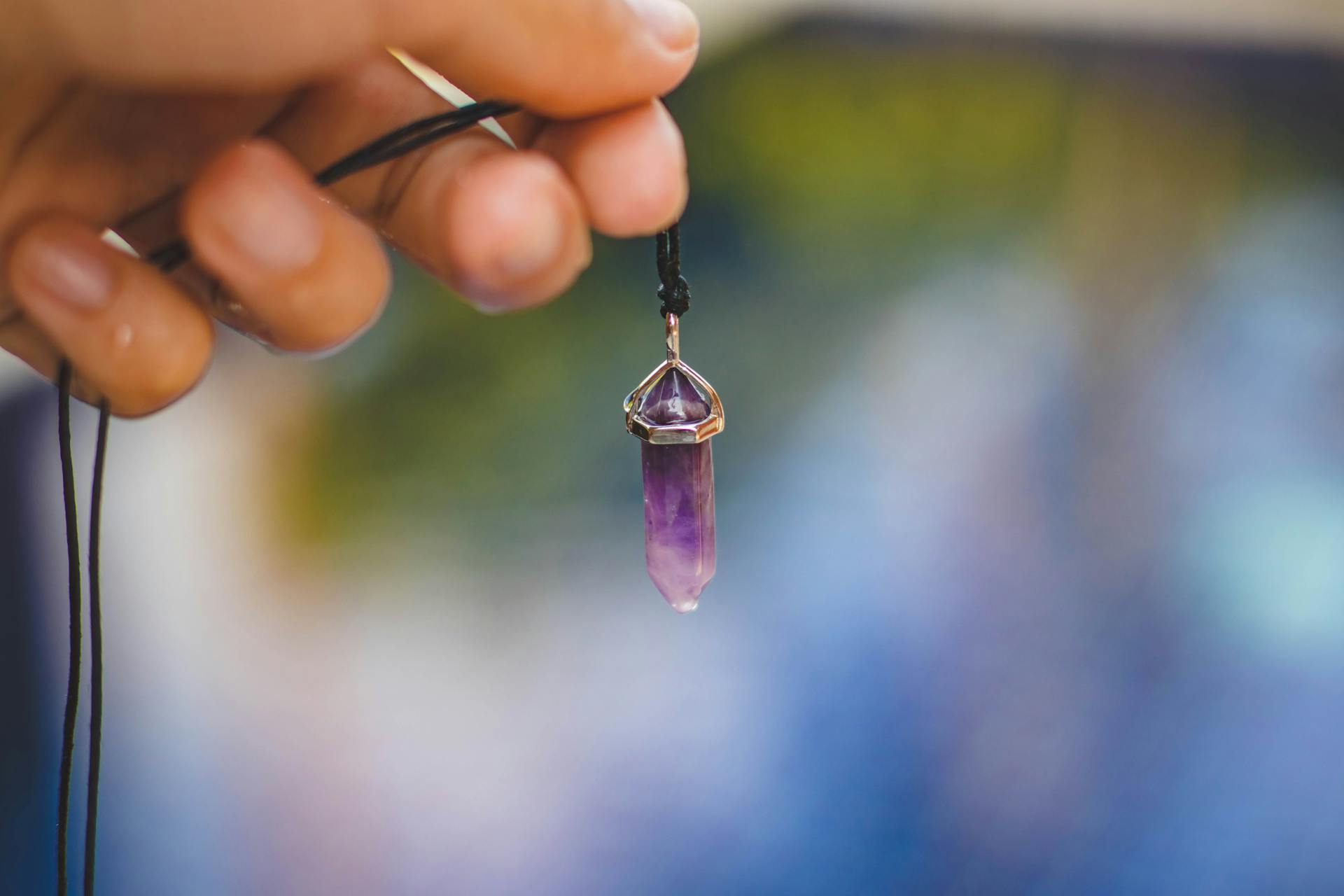
Close-up of a hand holding a purple amethyst crystal pendant on a chain against a natural outdoor background
How to Program Your Pendulum for Yes and No
Programming is the most important step in pendulum divination. Before you can ask real questions, you need to establish what each movement means. Here's the process.
Step 1: Find your neutral position. Sit comfortably at a table. Rest your elbow on the surface to stabilize your arm. Hold the pendulum chain between your thumb and index finger, letting the weight hang about an inch above the table. Wait for it to stop moving completely.
Step 2: Ask for your "yes" response. Say, out loud or internally, "Show me yes." Watch how the pendulum begins to move. Common yes responses include clockwise circles, front-to-back swings (toward and away from your body), or right-to-left swings. Don't try to influence it. Let the movement develop on its own. Once you see a clear, repeated pattern, that's your yes.
Step 3: Ask for your "no" response. Still the pendulum again, then say, "Show me no." The movement should be distinctly different from your yes. If yes was clockwise, no might be counterclockwise. If yes was front-to-back, no might be side-to-side.
Step 4: Ask for your "maybe" or "I don't know" response. This is the pendulum's way of telling you the question isn't clear enough, the timing isn't right, or the answer isn't available. It often looks like a wobbly, erratic, or very small movement.
Step 5: Verify. Ask a few questions you already know the answer to. "Is my name [your actual name]?" should give you a yes. "Am I 200 years old?" should give you a no. If the responses are consistent, you're calibrated and ready to go.
Some pendulums respond the same way for every user. Others adjust their responses based on who's holding them. Don't assume your yes will look the same as someone else's. Always calibrate a pendulum yourself, even if someone else already programmed it.
What Questions Can You Ask a Pendulum?
The pendulum excels at yes-or-no questions. It's not designed for open-ended queries like "What should I do with my life?" That's what tarot spreads and natal chart readings are for. The pendulum's strength is precision within a narrow scope.
Good pendulum questions:
Poor pendulum questions:
Tips for better questions:
How to Use a Pendulum Board
A pendulum board (sometimes called a divination mat or dowsing chart) expands what your pendulum can communicate beyond simple yes and no answers.
Basic pendulum boards feature a semicircle or full circle divided into sections labeled Yes, No, Maybe, and Rephrase. You hold the pendulum over the center point and watch which section it swings toward. This is essentially a visual version of the programming step, but it can help beginners who have trouble distinguishing between different swing patterns.
Letter boards arrange the alphabet around a circle, allowing the pendulum to spell out words or names. This works similarly to a spirit board and is used by practitioners who want more detailed communication with guides or their higher self.
Chakra boards map the seven main chakras and let you use the pendulum to identify which energy centers need attention. You hold the pendulum over each chakra label and interpret the strength and direction of the swing to assess whether that chakra is open, blocked, or overactive.
Number boards arrange digits 0 through 9 in a semicircle for questions that require numerical answers: dates, quantities, or percentages.
You can buy printed boards or make your own with paper and a marker. The board itself doesn't hold any special power. It's just a reference grid that makes the pendulum's movements easier to interpret. Some practitioners never use boards at all and rely entirely on the basic yes/no/maybe system for their entire practice.

Two hands using a rose quartz pendulum over tarot cards spread on a table for divination
Common Mistakes Beginners Make
Gripping the chain too tightly. A tense hand restricts the pendulum's movement and makes responses harder to read. Hold the chain lightly between your thumb and index finger. Your grip should be firm enough that the pendulum doesn't fall but loose enough that it can swing freely in any direction.
Asking questions while emotionally charged. If you just had a fight with your partner and immediately grab the pendulum to ask "Does my partner love me?", your emotional state will likely influence the ideomotor response. Wait until you're calm, or at minimum, acknowledge your emotional state and ask the pendulum to respond truthfully regardless of what you want to hear.
Moving your hand deliberately. This seems obvious, but it's surprisingly common in early sessions. You might not realize you're subtly guiding the pendulum toward the answer you want. Rest your elbow on a stable surface and keep your hand as still as possible. Let the movement come from below the level of conscious control.
Asking about other people's private matters. "Does my coworker have a crush on me?" or "Is my friend lying about something?" are questions that violate boundaries, and many practitioners find the pendulum gives unreliable answers when you're asking about someone else's inner experience without their knowledge or consent.
Skipping the calibration step. Every session should begin with a quick verification. Ask a few known-answer questions to confirm your yes and no are still consistent. Responses can shift over time or between sessions, and jumping straight into important questions without checking your baseline is like using a compass without knowing which end points north.
Over-relying on the pendulum for every decision. The pendulum is a tool for gaining insight, not a replacement for critical thinking, professional advice, or medical consultation. Use it as one input among many, not as an oracle that makes all your decisions for you.
Pendulum Divination and Astrology
If you already work with astrology, you can layer pendulum divination into your existing practice in several useful ways.
Identifying your dominant planet. If you're unsure which planet holds the most influence in your chart, hold the pendulum and ask about each planet individually. "Is Mars my dominant planet?" Work through all ten planets and note the strength of the response for each. This won't replace a proper chart analysis, but it can confirm what you're sensing intuitively.
Choosing the right timing. Astrology offers powerful timing tools like planetary hours, void-of-course moon periods, and lunar phases. If you're unsure whether the current astrological weather supports a particular action, the pendulum can help you cut through the noise: "Is today a good day to start this project?"
Crystal selection by transit. When a particular transit is hitting your chart, like Saturn return or Jupiter return, you might want to work with crystals that support that energy. Hold the pendulum over different crystals matched to your zodiac sign and let it tell you which one resonates with your current needs.
Checking compatibility. Before diving into a full synastry analysis, you can use the pendulum to get a quick initial read on energetic compatibility with another person. Ask, "Is this person's energy compatible with mine right now?" It's not a replacement for looking at the actual charts through a compatibility reading, but it adds an intuitive layer.
Moon phase practice. Many practitioners find their pendulum is more responsive during certain lunar phases. Try using it during the new moon for questions about new beginnings and during the full moon for questions about completion or release. Track your results across a full lunar cycle to see if you notice a pattern.
Frequently Asked Questions
Can anyone use a pendulum for divination?
Yes. Pendulum divination doesn't require any special psychic ability, initiation, or years of training. If you can hold a chain and ask a question, you can use a pendulum. Some people get clear responses immediately while others need a few practice sessions to develop sensitivity. Like any skill, it improves with regular use. Start with simple yes/no questions you already know the answers to and build from there.
How do I know the pendulum isn't just responding to my own hand movements?
It is responding to your hand movements, and that's how it works. The ideomotor effect causes tiny, unconscious muscle contractions that move the pendulum without your deliberate input. These micro-movements originate from your subconscious mind, which holds intuitive knowledge your conscious mind doesn't always access. The pendulum simply amplifies those signals into visible motion. This is the mechanism, not a flaw.
What's the best crystal for a beginner's pendulum?
Clear quartz is the standard recommendation because it's energetically versatile and amplifies intention without adding its own strong bias. Amethyst is a close second if you want to emphasize intuition and spiritual connection. If you're primarily asking about relationships, rose quartz is a natural fit. Honestly, the best crystal is the one you feel drawn to. Trust that pull; it's your intuition already working before you've even started.
Can I use a pendulum alongside tarot readings?
Absolutely. Many readers use the pendulum to clarify ambiguous tarot pulls. If you draw a card and aren't sure whether it applies to one area of life or another, the pendulum can narrow it down with targeted yes/no questions. You can also use it to confirm whether a tarot spread accurately reflects the situation before you interpret further. The two tools complement each other naturally since tarot provides narrative depth while the pendulum provides pointed clarity.
How often should I cleanse my pendulum?
Cleanse it when you first get it, after any session that felt heavy or emotionally draining, and whenever the responses start feeling sluggish or inconsistent. Some practitioners cleanse before every session as part of their setup ritual. Others only cleanse monthly or during full moons. There's no wrong frequency. If the pendulum feels "off" or your calibration test gives unreliable results, it's time for a cleanse.