
Kyanite Meaning: Healing Properties, Uses, and the Stone That Never Needs Cleansing
Kyanite is the crystal that breaks the usual rules. Its meaning centers on truth, communication, and clear alignment, and it's best known as the striking steel-blue stone that forms in long, flat blades streaked with silvery light. Most people meet it as blue kyanite, though it also shows up in black, green, and orange. People reach for it when they need to say what they actually mean, cut through mental fog, or bring a scattered energy back into line.
It also has a reputation no other popular stone can match: kyanite is one of the very few crystals said to never need cleansing. Where almost every other stone in this series comes with a whole ritual for clearing it, kyanite is supposed to clear itself. Here's what kyanite actually means, how people use it, how it links to the throat chakra and to Taurus and Libra in astrology, and why that no-cleansing claim is worth understanding honestly.
What You'll Learn
What Is Kyanite?
Kyanite is an aluminum silicate mineral, Al2SiO5. What makes it interesting geologically is that it's a polymorph: it shares its exact chemistry with two other minerals, andalusite and sillimanite, and the three differ only in how their atoms are arranged, which depends on the temperature and pressure where they formed. Kyanite is the high-pressure member, so finding it in a rock actually tells geologists something about the conditions deep underground.
Its name comes from the Greek word "kyanos," meaning deep blue, which is the color most people picture. It usually grows as long, bladed, almost knife-like crystals with a pearly or glassy sheen and fine striations running down their length. That flat, splintery blade shape is the fastest way to recognize it.
Major sources include Brazil, Nepal, and Switzerland, and the southern Appalachians in the United States are a significant supply, with Virginia home to one of the world's largest kyanite operations. Beyond jewelry and metaphysical use, kyanite is valued industrially for its heat resistance and goes into spark plugs, kiln furniture, and other high-temperature ceramics.
What Does Kyanite Mean?
At its core, kyanite means truthful communication and alignment. It's called a stone of self-expression, honesty, and cutting through, and the picture behind all of those is the blade itself: something clean that slices away confusion and lets the truth show. People turn to it when they need to speak up, when their thoughts feel tangled, or when they feel out of sync with themselves.
Because of its blue color and blade shape, it's tied to clear speech, calm reasoning, and mental clarity. It's often described as a bridge stone, one that connects the mind and the voice so that what you think and what you say line up. If lapis lazuli is the royal wisdom stone and amazonite is the gentle truth-teller, kyanite is the sharp, no-nonsense one that helps you get to the point.
Kyanite Healing Properties
In crystal-healing practice, kyanite sits among the communication and alignment stones. As always, it's worth being clear: these are traditional and folk associations, not medical claims, and there's no scientific evidence that any crystal treats a physical or mental condition. Here's how people describe working with it.
Mentally, kyanite is used to cut through confusion and mental clutter. Where you'd reach for a calming stone to slow down, this is the one people reach for to sharpen up. It's a popular choice before difficult conversations, public speaking, or any moment where you need your words to land, and students and writers keep it nearby for focus and clear thinking.
Emotionally, it's associated with honesty, both with others and with yourself, and with releasing the frustration that builds up when you've been holding your tongue. On the energetic side, its signature reputation is for alignment: practitioners say it brings the whole system back into balance, which is exactly why it shows up so often in chakra work.
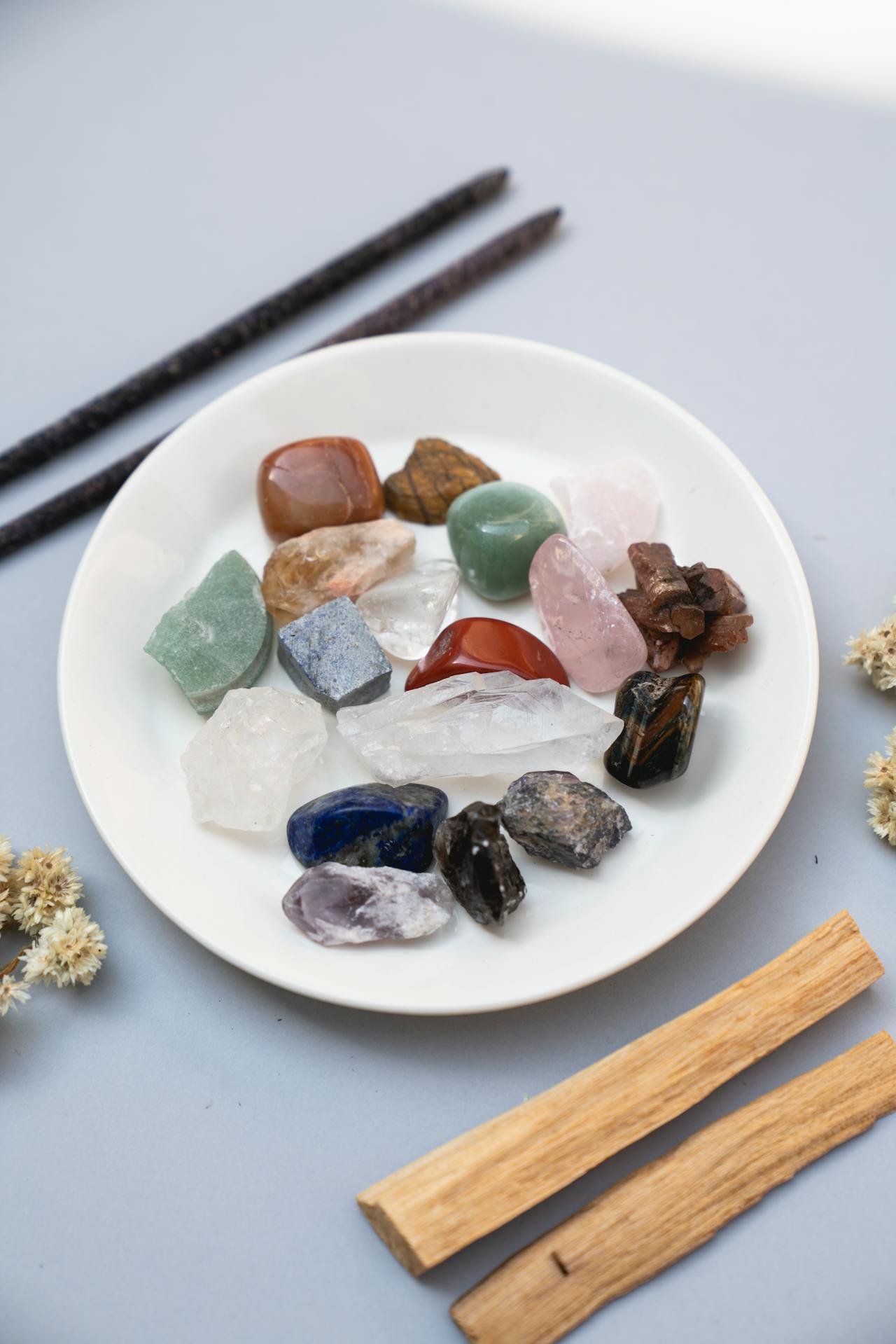
A calm collection of tumbled healing crystals, reflecting the clear, aligning energy at the heart of kyanite meaning
Kyanite and the Throat Chakra
Blue kyanite is one of the classic throat chakra stones. The throat chakra, Vishuddha, is the energy center at the base of the neck that governs communication, honest self-expression, and speaking your truth, so a blue stone that's all about clear speech is a natural match. People place kyanite at the throat during lying-down meditation, or wear it as a pendant that rests near the collarbone, to support saying what needs to be said.
But kyanite's bigger claim goes further than one center. It's one of the few stones said to align and open all seven chakras at once, clearing and balancing the whole column rather than working a single point. Black kyanite in particular gets used like a broom to sweep the aura and realign the energy body, and some practitioners run a blade of blue kyanite down the body from crown to root as an alignment pass before other crystal work.
Whether you use it for the throat alone or for the full system, it fits any practice built around clear energy flow. Our guide to the seven chakras walks through each center in order if you want the full map.

A peaceful blue-toned meditation scene, echoing kyanite's link to the throat chakra and honest self-expression
Kyanite Zodiac Signs and Astrology
Kyanite is most often tied to Taurus and Libra, and there's a neat piece of astrology behind the Taurus link. In traditional medical astrology, Taurus rules the throat and neck, the exact area the throat chakra sits over, so a blue throat-chakra stone lines up with the sign of the voice almost perfectly. Taurus can also be stubborn and slow to speak up, and kyanite's gift for honest expression is a useful counterweight.
Libra, the sign of balance, harmony, and fair communication, connects to kyanite's alignment and its knack for smoothing conversation. Some astrologers also link the stone to Aries for its cut-through directness and to Sagittarius for truth-telling. There's no single firm ruling planet in the older tradition, but its mental, communicative side gets tied to Mercury, and its Taurus and Libra links to Venus.
Kyanite is not a traditional birthstone. You can still match it to your chart the way you would any stone. Our crystal healing by zodiac sign guide lines up stones with all twelve signs, and the zodiac and chakras piece connects the signs to your energy centers.

The Taurus symbol, the earth sign that rules the throat and neck and links naturally to blue kyanite
Why Kyanite Never Needs Cleansing
This is the single most talked-about thing about kyanite. Along with citrine, it's one of the only two popular stones traditionally said to never need cleansing. The belief is that kyanite doesn't hold onto or accumulate negative energy the way other stones are thought to, so it never gets "full" and never needs clearing. Some go further and say it can cleanse other stones and even help recharge them.
Here's the honest framing this site always gives. There's no scientific evidence that any crystal stores, releases, or transmits energy at all, so from that angle no stone actually needs cleansing and none actually holds negativity. Within the metaphysical tradition, though, the no-cleansing reputation has a real practical upside: kyanite is genuinely low-maintenance. If cleansing rituals appeal to you, there's no harm in passing it through smoke or setting it in moonlight anyway. If they don't, kyanite is the stone the tradition itself says you can skip them with.
One caution: "never needs cleansing" is about energy, not dirt or damage. You still need to handle it carefully, because physically kyanite is more fragile than most stones, which brings us to its strangest property.
Blue, Black, Green, and Orange Kyanite
Blue is the classic and most common color, the steel-to-sky blue that gives the stone its name, and it's the one tied most closely to the throat chakra and clear communication. Within blue kyanite you'll see everything from pale, almost translucent blades to deep indigo, often with color that streaks and zones unevenly down the crystal.
Black kyanite is the other one you'll see everywhere, and it looks completely different: dark, opaque, and fanned out like a little broom or a folded feather. That fan shape is exactly why it's the go-to aura-sweeping and grounding stone, linked to the root chakra rather than the throat. Green kyanite is rarer and gets connected to the heart chakra and to living in truth from the heart. Orange kyanite, colored by manganese, is the least common of the bunch and is tied to the sacral chakra and creativity.
Whatever the color, the bladed habit and the streaky, striated look tend to carry across, so once you know the shape you can usually recognize kyanite even in an unfamiliar shade.
Why Kyanite Has Two Different Hardness Numbers
Here's kyanite's genuinely unusual scientific quirk, and it's real, measurable mineralogy rather than metaphysics. Kyanite has two very different hardness values depending on which direction you scratch it. Along the length of the blade it's soft, around 4.5 to 5 on the Mohs scale. Across the blade, it's much harder, around 6.5 to 7. Very few minerals show this much directional difference.
That property is so distinctive it earned the stone a second name: disthene, from Greek roots meaning "two strengths." It's a favorite demonstration in mineralogy classes for exactly that reason. Practically, it also explains why kyanite is tricky to cut and set as jewelry, and why the blades splinter and snap so easily along their length: that direction is both the soft one and a plane of easy cleavage.
For you as an owner, the takeaway is simple. Kyanite may not need energetic cleansing, but it does need gentle handling. Store it on its own, don't drop it, and don't tumble it around with harder stones, or you'll end up with splinters.
How to Tell Real Kyanite From Fakes and Look-Alikes
Kyanite is affordable enough that outright fakes are less common than with pricey stones, but there are look-alikes worth knowing. The blade shape, the lengthwise striations, and the streaky, uneven color are your best clues, since dyed or glass imitations tend to look too even and too perfectly colored.
The stone people most often confuse it with is blue sapphire. Both can be a similar blue, but sapphire is much harder, a 9 on the Mohs scale in every direction, far denser, and it forms as chunky crystals rather than thin blades. Blue kyanite is also sometimes mistaken for blue tourmaline or for pale aquamarine, though neither has kyanite's flat, splintery, striated blade. The directional-hardness check is almost a signature test: if a blade scratches easily along its length but resists across it, that behavior is very kyanite.
As always, buy from a seller who names the material clearly and prices it honestly. Genuine kyanite is not expensive, so a "kyanite" being sold at high gemstone prices, or one that looks suspiciously flawless, deserves a second look. For more on how blue stones line up with the calendar, our birthstones guide covers the traditional gems by month.
Does Kyanite Actually Work?
Here's the honest answer this site always gives. There's no scientific evidence that kyanite, or any crystal, emits a measurable energy, aligns your chakras, or improves how you communicate. If you're facing a hard conversation, a speaking fear, or ongoing frustration, kyanite is not a substitute for preparation, practice, or, where it's needed, a therapist.
What kyanite genuinely offers is a focus object and a cue. Holding a smooth blade before you speak, or wearing one at your throat during a nerve-wracking meeting, can act as a small, physical reminder to breathe, slow down, and say what you mean. That pause is real, and it's often exactly what clear communication needs. The alignment doesn't live in the mineral; it comes from the intention and the habit the stone helps you anchor. Used that way, as a prompt rather than a power, kyanite can be a genuinely useful part of a practice.
How to Use and Care for Kyanite
For communication, wear blue kyanite as a pendant near your throat, or hold a blade during meditation and set an intention to speak honestly. For clearing and alignment, some people sweep a piece of black kyanite through their aura, moving it around the body a few inches out from the skin, or run a blue blade down the chakra line from crown to root. It also works beautifully in a crystal grid aimed at clarity or truth.
Care is where kyanite asks for attention. Because the blades are soft and cleave easily along their length, store your kyanite separately from harder stones so it doesn't get scratched or splintered, and handle it gently. Brief contact with water is generally fine for solid blue kyanite, but the fragile, layered pieces are safest kept dry, and you should never tumble raw blades around.
As for cleansing, this is the one stone where the tradition says you can relax. If you like to cleanse anyway, dry methods such as smoke, sound, or moonlight are gentle and safe. Many people even use their kyanite to help cleanse and align their other crystals and their tarot deck instead.
Frequently Asked Questions
Does kyanite need to be cleansed?
Traditionally, no. Kyanite is one of the few stones, along with citrine, said not to hold negative energy, so the tradition says it never needs clearing. In honest terms, no crystal has been shown to hold energy at all, but this reputation makes kyanite genuinely low-maintenance.
What chakra is kyanite good for?
Blue kyanite is a classic throat chakra stone for honest communication. It's also one of the few crystals said to align all seven chakras at once. Black kyanite links to the root chakra for grounding, green to the heart, and orange to the sacral.
Can kyanite go in water?
Brief contact is usually fine for solid blue kyanite, but it's best kept dry. The blades are fragile and split easily along their length, so water and rough handling can damage delicate pieces. Since kyanite doesn't need energetic cleansing anyway, there's little reason to soak it.
Is kyanite the same as blue sapphire?
No. They can look similarly blue, but sapphire is far harder and denser and forms chunky crystals, while kyanite grows as thin, striated blades. Kyanite's telltale sign is its directional hardness: soft along the blade, harder across it.
What is black kyanite used for?
Black kyanite is the fan-shaped, opaque variety used mainly for grounding and for sweeping or clearing the aura. It's linked to the root chakra and is a popular tool for energy alignment, often kept alongside blue kyanite rather than instead of it.
Bringing It Together
Kyanite is the sharp, honest, low-maintenance stone, valued for clear communication and whole-system alignment, and tied to the throat chakra and to Taurus and Libra. Its two claims to fame set it apart: the tradition that it never needs cleansing, and the real mineralogy of a crystal with two different hardness numbers. Used honestly, as a cue to speak your truth rather than a magic fix, and handled with the care its fragile blades deserve, it earns a distinctive place in a crystal kit.
Want to see where your own voice and values sit? Build your free natal chart to find your Mercury and Venus placements, pull a tarot reading when you need clarity before you speak, or check your compatibility with someone you're working to communicate with better.