Celestite Meaning: Healing Properties, Uses, and the Sky-Blue Angel Stone
Celestite is the pale blue crystal that looks like a piece of the sky fell into a rock. Its meaning centers on peace, angelic connection, and clear communication with something higher than yourself, and people reach for it when they want to calm a racing mind, deepen their meditation, or feel closer to guidance they can't quite name. The soft sky-blue color is the whole story in a glance: a stone named for the heavens, used by people trying to reach them.
It's also a stone of quiet surprises. Celestite and celestine are the same mineral under two names, the gorgeous blue geodes almost all come from one stretch of coast in Madagascar, and the largest one on Earth is a cave in Ohio you can walk inside. Here's what celestite actually means, how people use it, how it links to the upper chakras and to Gemini and Libra in astrology, plus the honest facts about strontium safety, why it fades in the sun, and how to tell a real piece from a dyed fake.
What You'll Learn
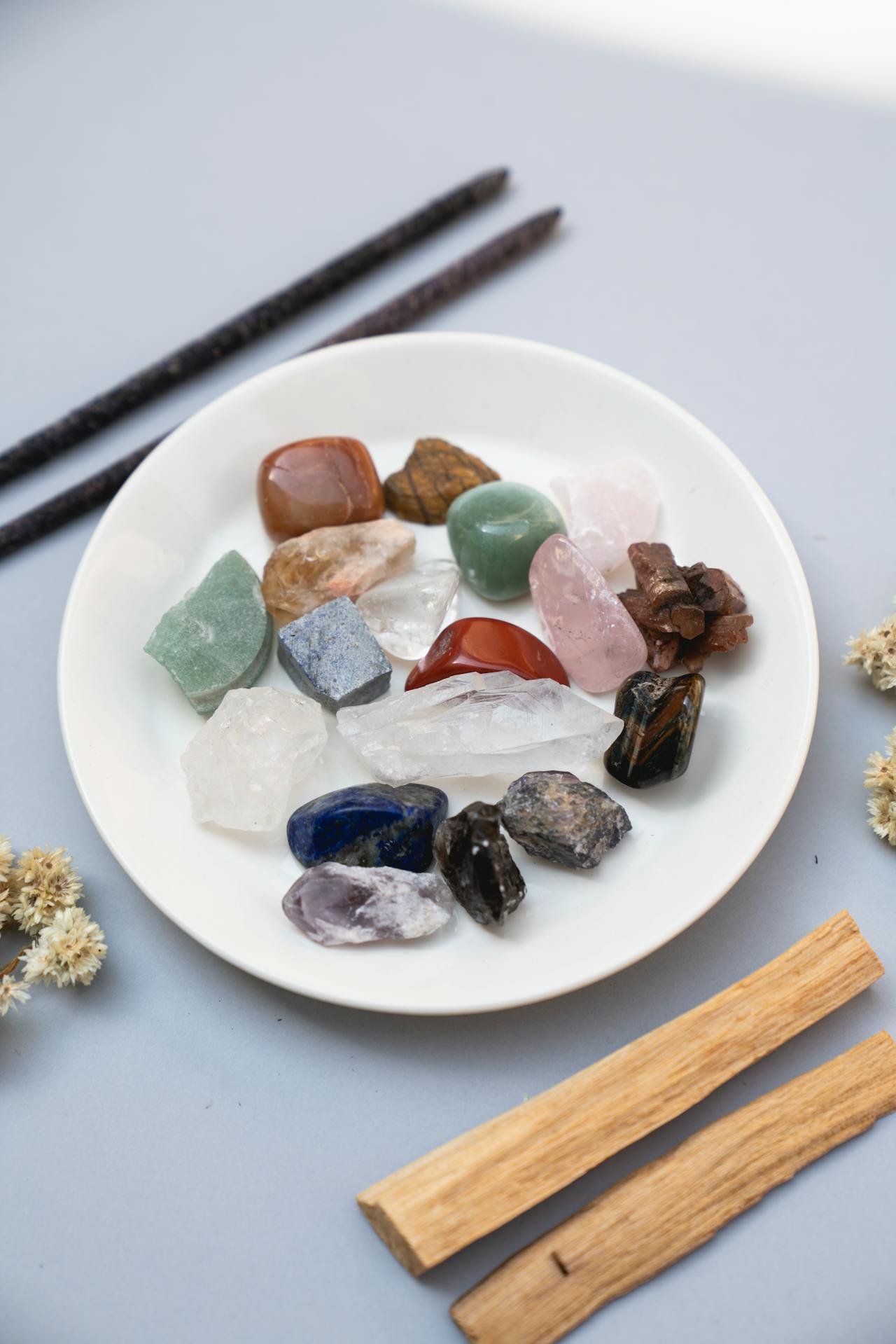
A collection of healing crystals arranged for quiet meditation, the kind of calm setting where celestite is often used
What Is Celestite?
Celestite is strontium sulfate, a mineral with the formula SrSO4, and it's the main natural source of the element strontium. It grows as soft, glassy crystals that range from colorless and white to the pale sky-blue the stone is famous for, with the occasional piece leaning faintly yellow or reddish depending on trace elements. The blue specimens are the ones the crystal world wants, and they usually arrive as clusters lining the inside of hollow geodes.
The name comes straight from the color. It traces to the Latin caelestis, meaning heavenly or of the sky, and the mineral was first described scientifically in 1791 by the German geologist A.G. Werner. Both spellings you'll see are correct: mineralogists tend to write celestine, while the crystal and metaphysical world usually says celestite. They're one and the same.
On the Mohs hardness scale, celestite is a soft 3 to 3.5, close to calcite and far below quartz. That softness matters more than it sounds, because it shapes almost everything about how you handle and store the stone. Celestite is also brittle and a little heavy for its size, and it dissolves very slightly in water, all of which puts it firmly in the display-it-don't-wear-it category.
What Does Celestite Mean?
At its core, celestite means heavenly peace. It's the calm-down stone of the crystal kit, associated with serenity, mental clarity, and a gentle lift out of everyday worry toward a wider, quieter perspective. People who work with it describe it as cooling rather than energizing, the kind of stone you want when your head is loud and you need the volume to drop.
Its second big theme is connection to the higher self and to guidance beyond the ordinary. That's where its most common nickname, the angel stone, comes from, and it's why celestite turns up so often on meditation altars and beside beds. The stone isn't doing anything dramatic. A pale blue crystal just makes a natural anchor for an intention around stillness, prayer, or listening inward.
There's a communication thread running through it too. Because of the blue color and the throat-chakra link, celestite is tied to honest, gentle self-expression, especially the kind that comes from a settled place rather than a reactive one. If angel numbers are part of your practice, celestite pairs naturally with that symbolism, and our complete guide to angel numbers maps the repeating sequences people treat as the same kind of higher nudge.
Celestite Healing Properties
In crystal-healing practice, celestite sits among the calming and spiritual stones rather than the grounding or protective ones. It's worth saying plainly before we go further: these are traditional and folk associations, not medical claims, and there's no scientific evidence that any crystal treats a physical or emotional condition. Here's how people describe working with it.
Emotionally, celestite is used to ease stress, quiet anxiety, and settle an overactive mind, which is why it's a favorite for meditation and for people who struggle to switch off at night. Some keep a piece on the nightstand hoping for calmer sleep and clearer dream recall, a use it shares with the stones in our crystals for sleep guide.
On the spiritual side, practitioners link it to meditation, intuition, and a sense of being supported by something larger. Folk tradition also credits it with easing tension headaches and general overwhelm, though those are comfort associations rather than treatments. If anxiety is your main reason for reaching for a stone, our crystals for anxiety guide covers the usual pairings, with the same honest caveat that the calm comes from the practice, not the mineral.

A serene blue-toned meditation scene, echoing the calm that celestite is reached for
Celestite and the Throat, Third Eye, and Crown Chakras
Celestite is an upper-chakra stone, and its pale blue-to-clear color is the reason. Its most direct link is the throat chakra, Vishuddha, the center of honest communication and self-expression. A soft blue stone known for calm, truthful speech is a natural fit there, and much of celestite's reputation for gentle honesty traces back to this center.
From the throat it reaches upward. Many practitioners place it with the third eye chakra, Ajna, the center of intuition and inner sight, where its quieting effect is said to help still the mind enough to notice what you already sense. Higher still, it's tied to the crown chakra, Sahasrara, the center of spiritual connection, which lines up with its angelic, reach-upward reputation.
That upward span is why celestite is so often described as a bridge to the higher self rather than a stone for the body or the material world. If you want the full map of the energy centers and how they stack, our guide to the seven chakras walks through each one in order, and the zodiac and chakras piece connects them to your birth chart.
A deep night sky scattered with stars, mirroring celestite's reach toward the higher, celestial chakras
Celestite Zodiac Signs and Astrology
Celestite is most often tied to Gemini, the communicator of the zodiac, and the match is easy to see. Gemini lives through words, ideas, and mental activity, and a calming stone linked to clear speech gives that fast, airy energy somewhere to settle. Where Gemini's mind can spin, celestite's reputation is for slowing the spin without dulling the thought.
It's also commonly paired with Libra, another air sign, for its themes of balance, harmony, and peaceful relating. Sources don't fully agree here. Some crystal guides list only Gemini, others add Libra, and a few stretch it to any air sign, so treat the pairing as a loose fit rather than a rule. Celestite is not a traditional birthstone tied to a calendar month.
For planetary associations, celestite's airy, mental, communicative streak leans toward Mercury, while its peaceful, intuitive side gets linked to the Moon in some traditions. You don't have to be a Gemini or a Libra to use it, though. Our crystal healing by zodiac sign guide lines up stones with all twelve signs so you can match one to your own chart.
Why Is Celestite Called the Angel Stone?
Celestite's best-known nickname is the angel stone, and the reasoning is mostly poetic. The sky-blue color, the heavenly name, and the gentle, upward-reaching feel of the crystal all point the same direction, so modern crystal writers settled on it as the go-to stone for angelic connection and divine peace. People who follow that tradition keep celestite in meditation spaces and use it as a focus when they want to feel close to guidance, whether they picture that as angels, a higher self, or simple inner stillness.
The practice usually described is quiet and internal. You hold or sit near the stone, let your mind settle, pose a question you've been carrying, and pay attention to the first calm thought or image that surfaces. In angel-focused traditions, that kind of guidance is understood to arrive as a gentle inner knowing rather than a voice, so the stone is treated as a prompt for listening, not a phone line.
None of this has scientific backing, and it's fair to be clear about that. What's real is the effect of sitting still with an intention and a calming object in your hands. For a lot of people that's genuinely steadying, and celestite is a pretty, blue reason to do it.

Soft blue light over clear water, echoing the sky-blue shade that gives celestite its heavenly name
Is Celestite the Same as Celestine?
Yes, celestite and celestine are two names for one mineral, and the split is mostly about who's talking. Celestine is the name the official mineralogy world uses, the one you'll find in geology references and museum labels. Celestite is the older-feeling name that stuck in the gem trade and the crystal-healing community. There's no difference in the stone itself, and no grade or quality implied by one word over the other.
Both names come from the same celestial root, so neither is wrong. If you're shopping, you'll see the two used interchangeably, sometimes even by the same seller on the same page. The thing to check isn't the spelling but the stone: whether it's natural, what color it really is, and where it came from.
A quick word on a different confusion. Celestite is not the same as angelite, even though both get called angel stones and both are pale blue. We'll sort those two out in a moment, because mixing them up is one of the most common mistakes new collectors make.
Celestite Geodes: Madagascar, Ohio, and How They Form
Most of the beautiful blue celestite you'll ever see comes from one place: the northwestern coast of Madagascar, near the village of Sakoany on the Betsiboka River. Miners dig shafts down to a celestite-bearing layer and pull out hollow geodes lined with clustered sky-blue crystals. The geodes can reach around 60 centimeters across, with individual crystals up to about 15 centimeters, and the deposit gives up only a modest amount each year, which is part of why good blue specimens aren't cheap.
The way these geodes form is worth knowing. They start as nodules of calcium sulfate, gypsum or anhydrite, buried in sediment. Strontium-rich water moves through, dissolves the calcium sulfate away, and drops the strontium back as celestite, which grows inward into the new cavity as a cluster of crystals. The hollow blue geode is the leftover shell of that slow swap.
The record-holder isn't in Madagascar, though. The largest known celestite geode is in Ohio, on South Bass Island in Lake Erie, near Put-in-Bay. It's about 35 feet across and big enough to walk inside, which is exactly what visitors do, since it's been turned into a tourist attraction called Crystal Cave. Industrial celestite, the kind mined for strontium rather than for looks, mostly comes from Mexico and China.
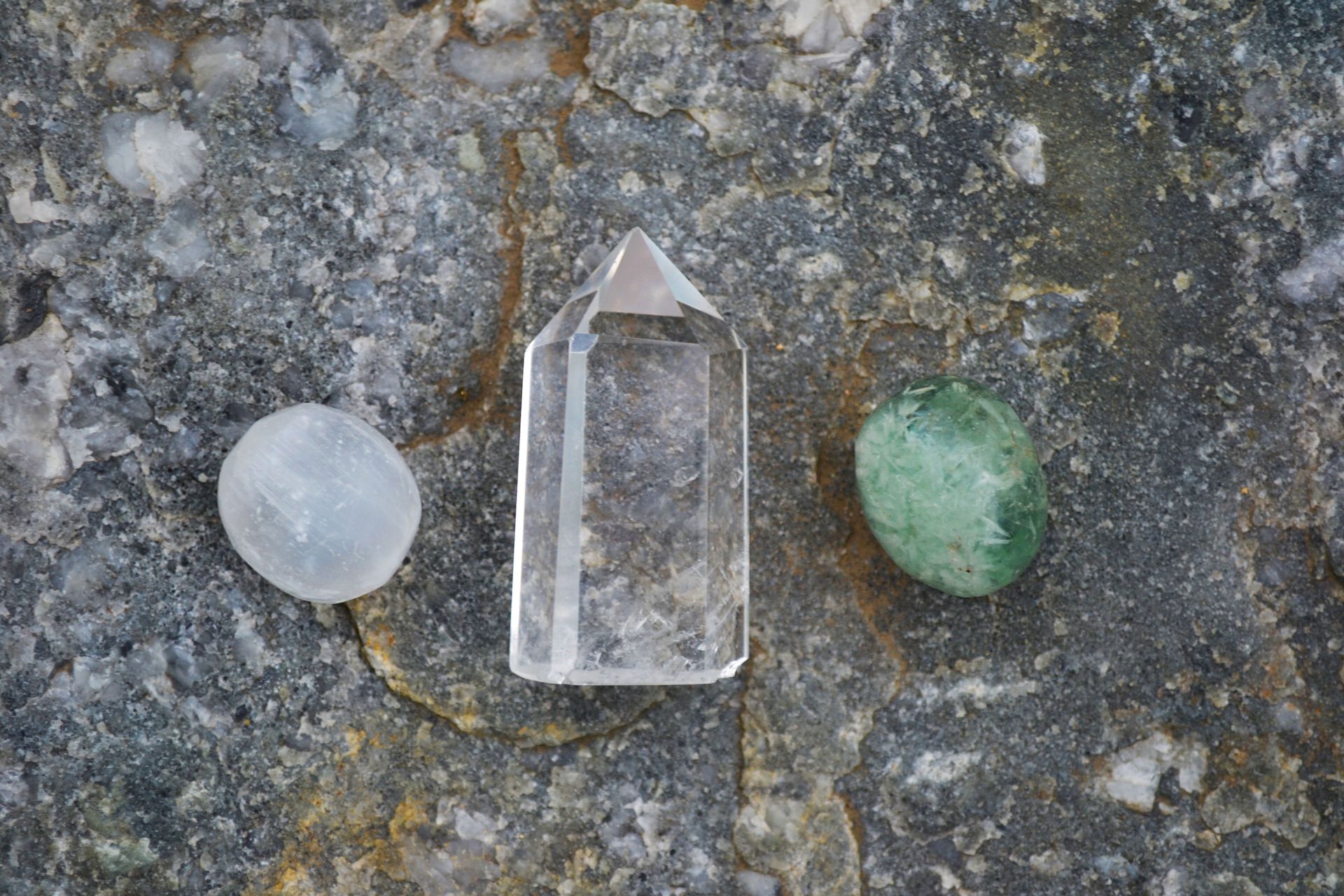
A cluster of pale, translucent selenite, close in look to the soft sky-blue crystals that line a celestite geode
Celestite vs Angelite vs Blue Lace Agate
Three pale blue calming stones get muddled together constantly, so here's how to keep them straight. Celestite is strontium sulfate, soft and glassy, usually sold as sparkling geode clusters, with the strongest reputation for angelic connection and meditation. It's the delicate one, the display piece.
Angelite is a different mineral entirely, anhydrite, which is calcium sulfate. Here's the twist that confuses everyone: angelite is actually compressed celestite that lost its water and hardened. It's more opaque, a flatter chalky blue, and tougher than celestite, so it holds up better as a tumbled stone or bead. Both carry the angel-stone reputation, which is why the names get swapped, but they look and feel different in the hand.
Blue lace agate is the third one, a banded form of chalcedony with soft blue and white stripes. It's harder than either of the others, safe to wear daily, and leans toward calm, gentle communication rather than the reach-upward, angelic angle. If you want a blue calming stone you can actually wear without babying it, blue lace agate or angelite will outlast celestite, which really does belong on a shelf.
Is Celestite Toxic? Strontium, Water, and Sunlight
Celestite is a strontium mineral, and that word sometimes sets off alarms, so let's be precise. The strontium in celestite is ordinary, stable strontium, not the radioactive strontium-90 people associate with fallout. A solid piece of celestite is safe to keep in your home and to handle. The sensible cautions are the same as for most soft minerals: don't make a crystal elixir by soaking it in water you plan to drink, and don't grind, cut, or sand it without protection, since no one should breathe mineral dust.
Water is the bigger everyday issue, and here celestite is needier than most stones. Strontium sulfate dissolves very slightly in water, and the stone is soft and often fragile, so soaking it can degrade the crystals and dull their shine over time. Keep it dry, and skip the water-cleansing methods that work for quartz.
Sunlight is the one that catches people out. Celestite's gentle blue fades in bright sun, and the fading is permanent, not something a shady shelf will bring back. A piece left on a sunny windowsill can go from sky-blue to near-white over months. Keep celestite out of direct sunlight if you want to keep its color, which, for a stone people buy almost entirely for that color, is the single most useful thing to know.
How to Tell Real Celestite From Fakes
Celestite is faked less often than big-name stones like turquoise, but a few things still trip up buyers. The most common problem isn't a fake mineral at all, it's dyed celestite, where pale or colorless natural crystals get a color boost to pass as premium blue. A suspiciously even, saturated blue, or color pooling in the gaps between crystals, is the tell. Natural celestite blue is soft and a little uneven.
Glass and resin copies of geodes exist too, aimed at the decor market. These tend to feel warm and light in the hand, show tiny trapped bubbles, and lack the glassy, slightly frosted crystal faces of the real thing. Real celestite is also noticeably soft, so a genuine crystal scratches more easily than quartz, though testing hardness on a pretty specimen isn't worth the risk of damage.
The most reliable move is the same one that protects you with any stone: buy from a seller who names the exact mineral and locality, usually Madagascar for blue geodes, and who doesn't lump everything blue together. If you're curious how blue stones line up with the calendar, our birthstones guide covers the traditional stones by month.
Does Celestite Actually Work?
Here's the honest answer this site always gives. There's no scientific evidence that celestite, or any crystal, emits a measurable energy, connects you to angels, or calms your nervous system on its own. If you're dealing with real anxiety, insomnia, or grief, a stone is not a substitute for the things that genuinely help, from good sleep habits and therapy to the support of people who care about you.
What celestite can honestly offer is a focus object and a cue. Sitting with a calm blue crystal before bed, or keeping one where you meditate, can anchor an intention you've already set around slowing down and listening inward. That anchor is real, and for a lot of people the small ritual of holding a stone and getting quiet is a genuine help. The peace doesn't live in the strontium. It comes from the stillness the stone invites you into.
Used that way, as a prompt rather than a power, celestite earns its place. It's a lovely, calming object with a heavenly color, and if it gets you to sit down and breathe for ten minutes, that's worth something real, no magic required.
How to Use and Care for Celestite
For calm and meditation, keep celestite where you'll actually sit with it: a bedside table, a meditation corner, or a quiet shelf you pass often. Many people hold a smaller piece during meditation or keep a geode in the bedroom for a settled, restful feel. It works nicely at the center of a crystal grid built around peace, sleep, or spiritual connection, and it pairs well with selenite and clear quartz. New to all this? Our healing crystals for beginners guide covers choosing and working with stones from scratch.
Care is where celestite asks more of you than most crystals, because it's soft, fragile, and sensitive to both water and light. Keep it out of direct sunlight to protect the blue, store it away from harder stones so it doesn't get scratched, and handle geodes gently, since the delicate crystal points chip easily. Keep it dry, and skip water entirely.
For cleansing and charging, stick to gentle, dry methods. Pass it through smoke, rest it on a selenite plate, use sound, or set it under the moon rather than the sun. The same careful approach is covered in our guide to cleansing and charging crystals, and it keeps a good piece looking its best for years.
Frequently Asked Questions
What is celestite good for?
Celestite is best known as a calming, spiritual stone, used for meditation, stress relief, and a sense of connection to the higher self or angelic guidance. It's linked to the throat, third eye, and crown chakras. These are traditional associations, not proven effects, so treat it as a focus for calm rather than a cure.
Is celestite the same as celestine?
Yes. Celestine is the name used in formal mineralogy, and celestite is the name common in the gem and crystal-healing world, but they're the same strontium sulfate mineral. Neither spelling signals a different quality or grade, so you can treat the two as interchangeable when you shop.
Can celestite go in water?
It's best kept dry. Celestite is strontium sulfate, which dissolves slightly in water, and the crystal is soft and fragile, so soaking it can damage the points and dull the shine. Never make a drinking elixir from it, and cleanse it with smoke, sound, or moonlight instead.
Does celestite fade in the sun?
Yes, and the fading is permanent. Celestite's soft blue washes out under prolonged direct sunlight, turning pale or near-white over time, and no amount of shade will bring the color back. Keep it on a shaded shelf or in a display case away from windows to protect its heavenly blue.
Is celestite toxic?
A solid natural or polished piece is safe to handle and keep at home, and the strontium in it is stable and ordinary, not radioactive. The only real cautions are not drinking water it has soaked in and not breathing dust if a piece is cut or ground, which is standard advice for any soft mineral.
Bringing It Together
Celestite is the sky-blue peacemaker of the crystal world, the soft strontium-sulfate stone valued for calm, meditation, and a reach toward the higher self, tied to the throat, third eye, and crown chakras and to airy Gemini and Libra. Its story is full of small surprises: a second name, celestine, that means the same thing, geodes that almost all come from one Madagascar riverbank, a walk-in cave of it in Ohio, and a color so delicate the sun can wash it away. Used honestly, as a cue to slow down and get quiet rather than a magic charm, and kept dry and out of the light its blue can't survive, it earns a lasting place on a shelf.
Curious how your own air and intuition sit in your chart? Build your free natal chart to find your Mercury, Moon, and rising placements, pull a tarot reading when your mind won't settle, or check your compatibility with someone you want to understand more clearly.