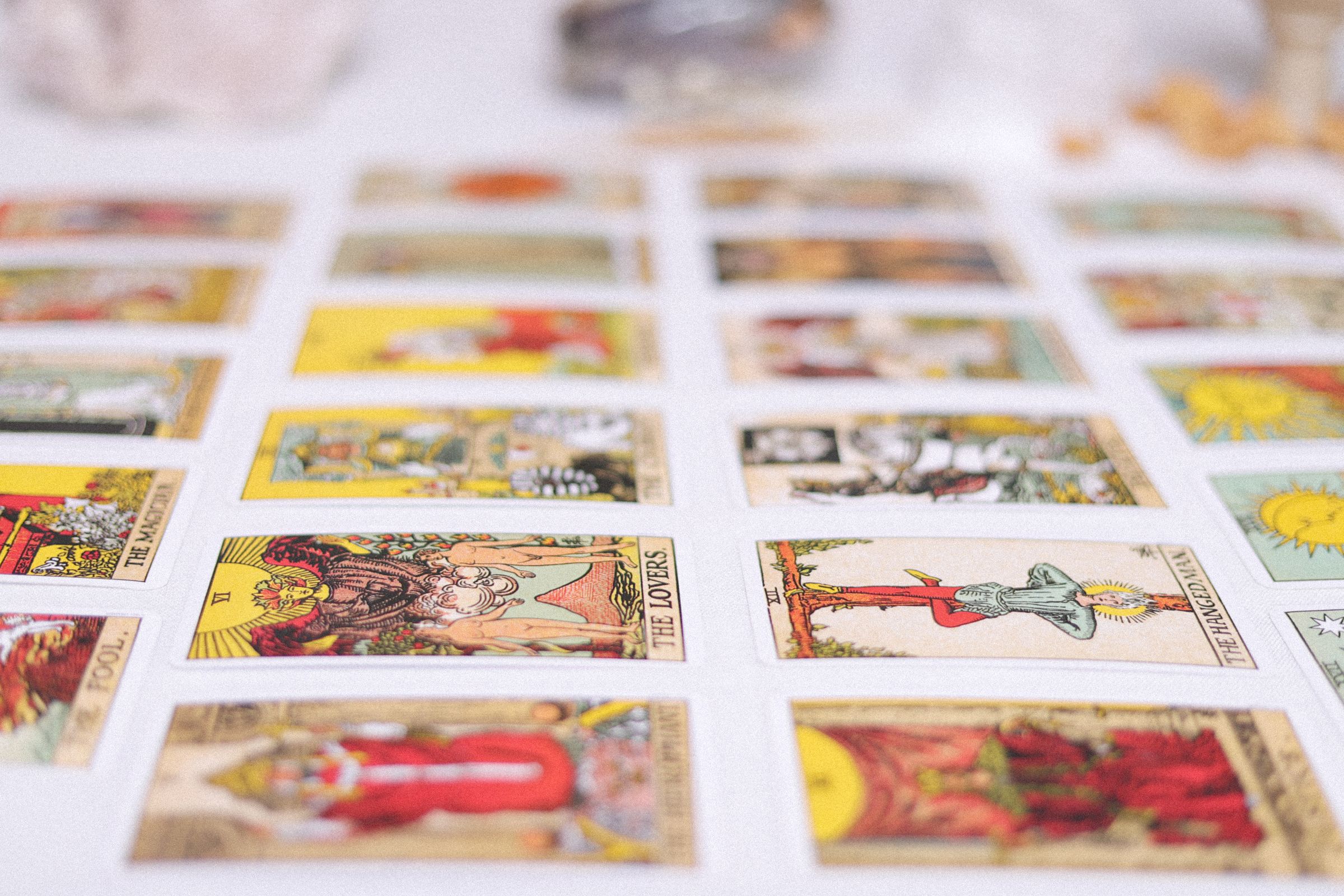
Tarot Birth Cards: How to Calculate Yours and What They Mean
Tarot birth cards are the Major Arcana cards encoded in your date of birth. Add up the digits of your birthday, reduce the total, and you land on a pair of cards (one rare combination gets three) that tarot readers treat as your lifelong archetypes. Unlike a daily draw that changes every morning, your birth cards never change. They work like a tarot version of a sun sign: a fixed pair of lenses that describe the core tension and the core gift you carry through life.
The system is simple enough to do on a napkin. Most people get two cards: a higher-numbered card that describes the soul-level lesson, and its single-digit reduction that describes how that lesson shows up in everyday personality. The Sun, the Wheel of Fortune, and the Magician form the only three-card combination. This guide walks through the calculation step by step, covers every birth card pair, and shows you how to actually use yours in readings instead of just knowing the trivia.
What You'll Learn
What Are Tarot Birth Cards?
Tarot birth cards (sometimes called personality and soul cards, or birth card constellations) come from the work of tarot scholar Mary K. Greer, who popularized the system in the 1980s building on earlier teachings from the Builders of the Adytum school. The premise: your birth date reduces to a number between 1 and 22, and each of those numbers corresponds to one of the Major Arcana, the 22 cards that carry the deck's big archetypal themes.
Because most birth dates reduce first to a two-digit number and then again to a single digit, most people end up with a pair. Greer reads the higher card as the soul card, the deeper pattern you're working out across a lifetime, and the lower card as the personality card, the way that pattern shows up in your day-to-day character. The two always share a numerological root, so they're two octaves of one note. Someone with the Moon and the Hermit, for example, carries the 9 vibration in both its inward, solitary form and its murky, intuitive form.
Birth cards aren't fortune-telling. They don't predict events the way a tarot spread addresses a question. They're closer to a natal placement: a fixed reference point you return to when readings, relationships, or life phases keep circling the same themes.
Hands of a reader at a candlelit table with tarot cards laid out for a birth card calculation
How Do You Calculate Your Tarot Birth Cards?
The calculation takes three steps. You need your full date of birth: month, day, and four-digit year.
Step 1: Add every digit of your birth date. Write the date out in numbers and sum each individual digit. For someone born December 5, 2001, that's 1 + 2 + 0 + 5 + 2 + 0 + 0 + 1 = 11.
Step 2: If the total is 23 or higher, add its digits together. The Major Arcana only runs to 22, so any total above that gets reduced once more. A birth date that sums to 27 becomes 2 + 7 = 9. A total of 22 or below stays as it is.
Step 3: Reduce the result to a single digit to find your second card. Take your number from step 2 and add its digits one more time. The two-digit number is your first birth card, and the single digit is your second. Our December 5, 2001 example gets 11, Justice, which reduces to 1 + 1 = 2, the High Priestess. That person's birth cards are Justice and the High Priestess.
One more worked example, start to finish. Born June 11, 1990: 6 + 1 + 1 + 1 + 9 + 9 + 0 = 27. That's over 22, so reduce: 2 + 7 = 9, the Hermit. Since 9 is already a single digit, the pair is completed by the two-digit Major Arcana card that reduces to 9, which is 18, the Moon. Birth cards: the Moon and the Hermit.
A quick note on numbering: this system uses the Rider-Waite-Smith order, where Strength is 8 and Justice is 11. Older Marseille-style decks swap those two cards, so if your deck numbers Justice as 8, go by the Rider-Waite convention for birth card work.
What If You Get a Single Digit or the Number 19?
Two situations trip people up, and both have clean answers.
If your sum reduces straight to a single digit, as in the June 11, 1990 example above, you still get two cards. Pair your single digit with the two-digit Major Arcana card that reduces to it: 2 pairs with 11 or 20, 3 with 12 or 21, 4 with 13 or 22. When two different higher cards reduce to your digit, tradition uses the card your actual math passed through; if your total never passed through either, most readers use the lower of the two. Don't agonize over the edge cases. Read both possible pairs and notice which one lands.
If your sum is exactly 19, you get three cards. Nineteen is the Sun, which reduces to 1 + 9 = 10, the Wheel of Fortune, which reduces again to 1 + 0 = 1, the Magician. It's the only chain in the system with two reductions, so Sun-Wheel-Magician people get a triple identity: radiant confidence, an instinct for life's turning points, and the will to direct them. If you summed directly to 10, you get the two-card version, the Wheel of Fortune and the Magician, without the Sun.
And no, you can't get the Fool alone. Zero never results from the math, but a sum of 22 counts as the Fool in this system (22 reduces to 4), giving the rare Fool and Emperor pair.
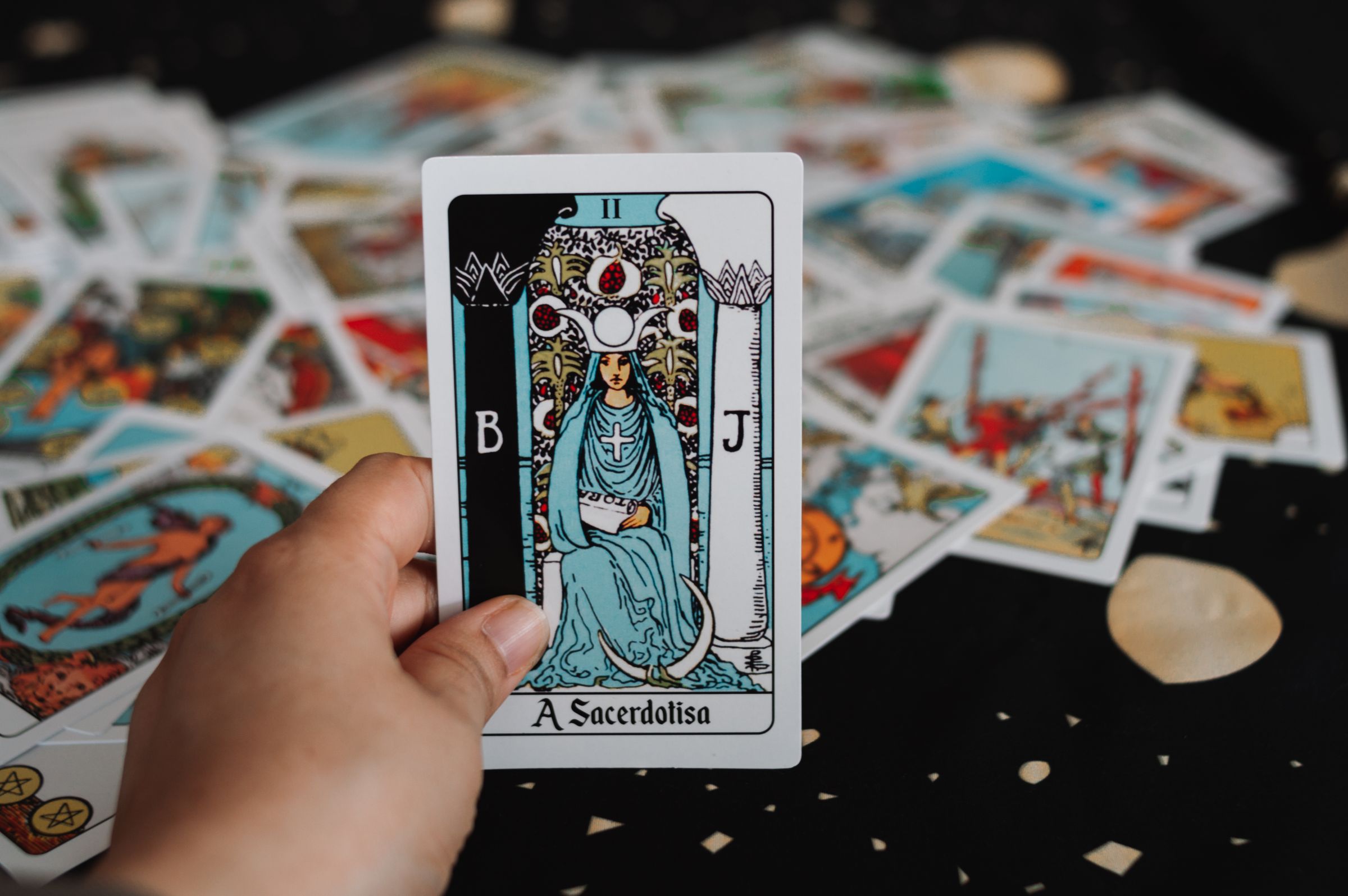
A hand holding the High Priestess card above a scattered tarot deck
All 12 Tarot Birth Card Pairs and Their Meanings
Here's every combination, from the most common totals to the rarest. Find yours and read it as a pair: the first card is the long arc, the second is the daily texture.
The Magician and the Sun (19/10/1). The three-card constellation. You're built to make things happen and be seen doing it. The lesson is learning the difference between willpower and force, and between healthy visibility and performing for approval. At your best you're the person who turns ideas into reality in broad daylight. Read more on the Sun.
The High Priestess and Justice (11/2). You run on inner knowing and outer fairness. Justice asks you to weigh, decide, and own consequences; the High Priestess asks you to trust what you know before you can prove it. The lifelong work is honoring both: decisions that are defensible and true to your gut.
The High Priestess and Judgement (20/2). The other 2 pair swaps Justice for Judgement: instead of weighing evidence, you're answering a call. People with this pair tend to live in chapters, with clear before-and-after moments of reinvention guided by an inner voice that won't be ignored.
The Empress and the Hanged Man (12/3). Creativity through surrender. The Empress wants to grow, nurture, and make things flourish; the Hanged Man insists that some seasons require waiting upside down while nothing visibly happens. You learn that fallow time is part of fertility, not the enemy of it.
The Empress and the World (21/3). The completion pair. Abundance here comes through finishing things: projects, degrees, eras. The trap is starting beautifully and drifting before the harvest. When you close loops, life pays out generously.
The Emperor and Death (13/4). Structure born from endings. You build solid things, and life periodically demolishes a structure so you can build a truer one. People with this pair often look stable from the outside while privately mastering reinvention. Transformation isn't a crisis for you; it's a method.
The Emperor and the Fool (22/4). The rarest two-card pair. Pure beginnings yoked to pure order: you leap, then you systematize the landing. The work is keeping the Fool's openness alive inside the Emperor's walls instead of letting the fortress win.
The Hierophant and Temperance (14/5). The teacher's pair. Temperance blends opposites into something workable; the Hierophant passes the recipe on. You're drawn to traditions, mentors, and systems of meaning, and eventually people start treating you as one.
The Lovers and the Devil (15/6). The most talked-about pair, for good reason. Both cards are about desire and bonds; one chooses freely, the other can't let go. Your lifelong study is attachment itself: what you choose, what has chosen you, and how to tell the difference.
The Chariot and the Tower (16/7). Drive meets demolition. You move fast and win ground, and occasionally life knocks down a tower you built on the run. The gift is resilience: Chariot people with Tower souls rebuild faster than anyone, and what they rebuild is honest.
Strength and the Star (17/8). Quiet power and durable hope. Strength tames the lion with patience rather than muscle; the Star keeps the long view lit after disaster. People seek you out in their worst weeks because you radiate the sense that things mend.
The Hermit and the Moon (18/9). The deep-water pair. The Moon gives you a porous, intuitive psyche; the Hermit gives you the need to withdraw and make sense of what you've absorbed. Your insight is real, but it needs solitude to develop, like film in a darkroom.
Tarot cards beside crystals and a crystal ball arranged on a reading table
Birth Cards vs Life Path Number: What's the Difference?
If this math feels familiar, it's because numerology's life path number uses the same raw material: the digits of your birth date. The difference is in the reduction rules and the symbols at the end.
Numerology reduces all the way to a single digit (keeping 11, 22, and 33 as master numbers), then interprets the number itself. Birth cards stop at 22 or below, keep the two-digit stage as its own card, and translate numbers into images. A person with life path 9 just has a 9; the same date in the tarot system might give the Moon and the Hermit, two distinct pictures that interact. The card version trades numerology's precision for tarot's texture, and the two systems read well side by side. If your life path and your birth cards repeat a theme, that's worth taking seriously. The same date also feeds your birthday number in numerology, so one birth date gives you several overlapping signals.
Birth cards also aren't the same as a significator, the card a reader picks to represent you in a spread. A significator is chosen, often by appearance or court card temperament. Birth cards are calculated, and most readers treat them as the deeper signature.
How to Work with Your Birth Cards
Knowing your pair is step one. Here's what readers actually do with them.
Watch for them in spreads. When your own birth card shows up in a reading, many readers treat it as the deck pointing directly at you: this situation touches your core pattern, not just the question on the table. It's one of the few cards whose meaning shifts based on who's sitting in the chair.
Use them as a meditation and journaling anchor. Pull your two cards out of the deck and study them together. What does the higher card demand that the lower card resists? A daily tarot practice gets noticeably richer when you read each day's draw against your fixed pair: today's card is the weather, your birth cards are the climate.
Track your year card alongside them. The same math applied to your birthday plus the current year gives a year card that changes annually and cycles through themes. Your birth cards stay constant underneath, which is exactly why the moving card is readable against them.
Compare pairs with people close to you. Birth card pairs interact the way sun signs do. A Lovers-Devil person and a Hermit-Moon person will negotiate intimacy very differently, and seeing that on the table can defuse years of friction. It's a natural companion to a compatibility reading.
Your birth cards are one fixed signature drawn from your birth date, and your natal chart is another. They describe the same person through different symbol systems, and reading them together is where things get interesting. Generate your free natal chart to see the astrological side, explore the tarot tools for daily draws and spreads, or go deeper into the number side with the numerology calculator. For the bridge between the two systems, see how tarot and astrology correspond, where each Major Arcana card maps to a sign or planet.
Frequently Asked Questions
Can your tarot birth cards change?
No. Birth cards are calculated from your date of birth, so they're fixed for life, like a sun sign. What changes is your year card, which is recalculated from your birthday and the current year, and your relationship to the pair as you grow into different facets of it.
Can you have only one tarot birth card?
In Mary K. Greer's system, everyone has at least two cards. If your birth date reduces directly to a single digit, you pair it with the two-digit Major Arcana card that reduces to the same digit. The only larger group is the Sun, Wheel of Fortune, and Magician triple, which comes from a sum of exactly 19.
Are tarot birth cards the same as a zodiac sign?
They're parallel ideas from different systems. Both are fixed identifiers calculated from your birth data, but a zodiac sign comes from the Sun's position in the sky while birth cards come from numerology applied to your birth date. Many readers use both, since each Major Arcana card also has a traditional astrological correspondence.
What's the rarest tarot birth card pair?
The Fool and Emperor pair, which requires the birth date digits to sum to exactly 22, is generally the rarest. Sums cluster in the high 20s and low 30s for most modern birth dates, so totals at the extreme low end (under 23 before reduction) are less common.
Is the Death birth card bad?
No. As a birth card, Death pairs with the Emperor and describes someone who builds lasting structures through repeated reinvention. In birth card work, Death reads the way it usually does in tarot: transformation and necessary endings, not literal loss.
Your birth cards give you a fixed pair of archetypes to read every other card against, and the calculation takes under a minute. Work out your pair, pull those cards from your deck, and then see how the rest of your symbolic fingerprint lines up by generating your free natal chart.