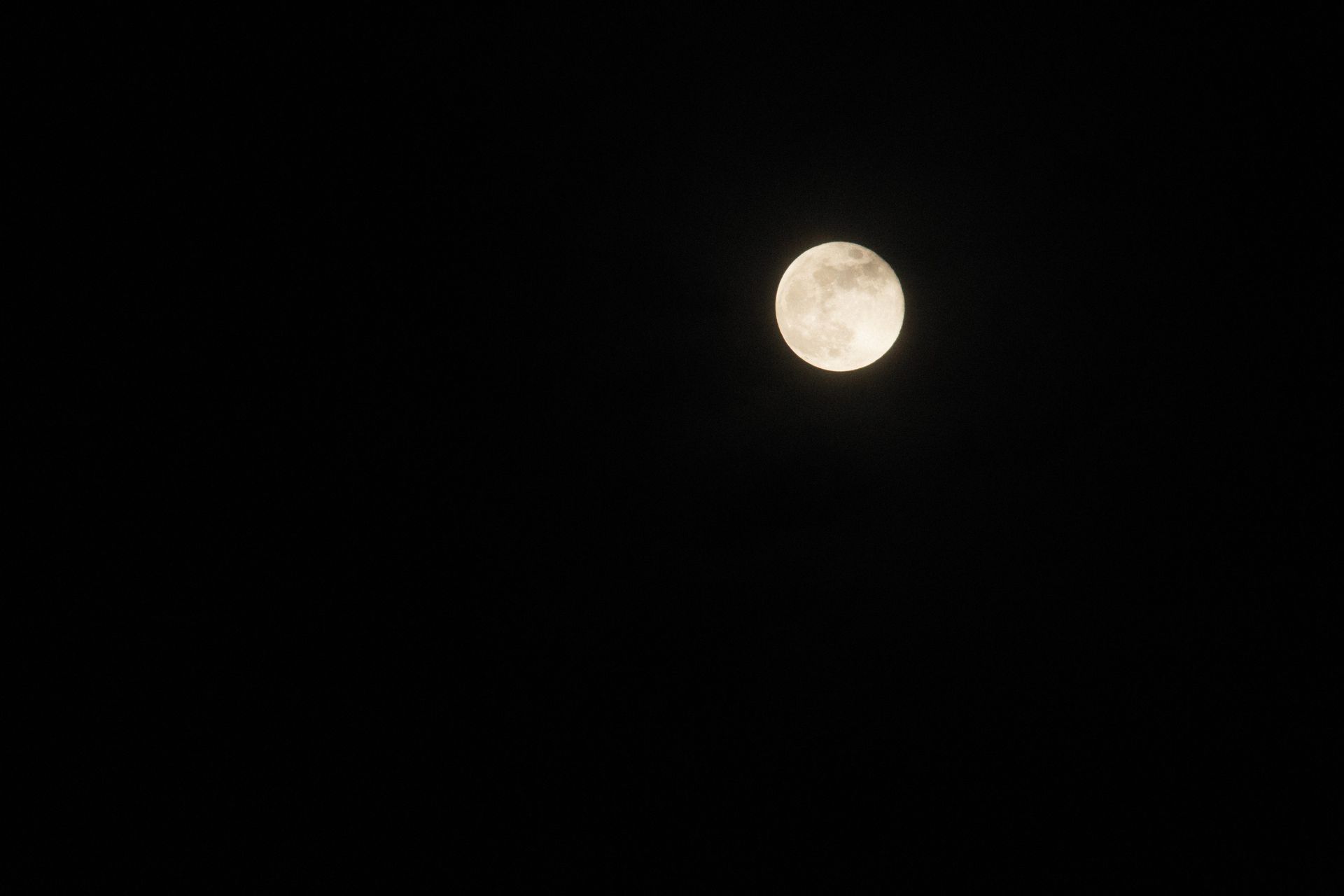
Full Moon Names by Month: Wolf Moon to Cold Moon Meanings
Every full moon of the year carries a traditional name, and the names follow the seasons: the Wolf Moon in January, the Snow Moon in February, all the way to the Cold Moon in December. These names come mostly from Native American, Colonial American, and old European farming traditions, and each one marks what was happening in nature that month, like wolves howling in deep winter or strawberries ripening in early summer. You can name tonight's moon just by knowing what month it is.
The names aren't astrology in the chart-reading sense, but they sit right at the heart of moon work. Knowing that June's full moon is the Strawberry Moon, or that the Harvest Moon hangs low and orange near the autumn equinox, gives every full moon ritual a theme to anchor to. Instead of "the full moon," you're working with a moon that has a story, a season, and a mood already attached.
This guide runs through all 12 monthly full moon names, what each one means, and where the names came from. Then it covers the special moons that don't fit the calendar neatly, the Blue Moon, the Blood Moon, the Harvest Moon, and the Supermoon, so you'll know exactly what you're looking at the next time the sky lights up.
What You'll Learn
Why Do Full Moons Have Names?
Before printed calendars were common, people tracked the year by moons. A full moon happens roughly every 29.5 days, which gives you about 12 full moons across a year, one in most months. Naming each one was a practical way to keep time and remember what to do: plant now, hunt now, brace for cold now.
Most of the names we use in English come from a blend of sources. Many trace to Native American peoples of the northeastern United States, recorded and spread by the Old Farmer's Almanac. Others come from Colonial settlers and old European traditions. Because different cultures watched different things, a single month often has several names, and they all describe the same sky from different angles.
The names matter for spiritual practice because they hand you a built-in intention. A full moon is already the peak of the lunar cycle, the moment for release, gratitude, and seeing things clearly. The seasonal name tells you which flavor of that energy is strongest. If you keep a full moon ritual practice, the name is a gift: it tells you what the season itself is asking you to honor.
The 12 Full Moon Names Month by Month
Here's the standard list of monthly full moon names, the ones you'll see most often, along with what each one points to.
January: Wolf Moon. Named for wolves howling through the cold, hungry depths of winter. The Wolf Moon is about survival, instinct, and the parts of you that go quiet but never disappear. It's a strong moon for protection work and for honoring what keeps you going.
February: Snow Moon. February tends to bring the heaviest snowfall, hence the name. Some traditions call it the Hunger Moon because food ran low this time of year. It's a moon for endurance, patience, and trusting that scarcity is a season, not a sentence.
March: Worm Moon. As the ground thaws, earthworms return and birds follow. The Worm Moon marks the first stirrings of spring and the slow turn from dormancy to new life. Think emergence, thawing, and the first signs that something is about to grow.
April: Pink Moon. Named not for the moon's color but for pink wildflowers, the moss phlox, that bloom in early spring. The Pink Moon is about renewal, fresh growth, and gentle new beginnings.
May: Flower Moon. May explodes with blooms across the Northern Hemisphere, so this moon celebrates abundance and fertility. It's one of the most joyful full moons, ideal for gratitude, beauty, and letting good things flourish.
June: Strawberry Moon. The Strawberry Moon marks the short season when wild strawberries ripen. It hangs low and can look golden or amber near the horizon. This is a moon of sweetness, harvest beginnings, and savoring what's ripe in your life right now.
July: Buck Moon. Male deer regrow their antlers in July, and the Buck Moon honors that surge of growth and strength. It's also called the Thunder Moon for summer storms. Work with it for vitality, expansion, and stepping into your power.
August: Sturgeon Moon. Named for the large sturgeon fish that were easiest to catch in late summer. The Sturgeon Moon is about depth, reaping rewards, and pulling up what's been developing under the surface.
September: Corn Moon. This moon marks the corn harvest. In years when it falls closest to the autumn equinox, it becomes the Harvest Moon instead. The Corn Moon is about gathering in, taking stock, and gratitude for what you've grown.
October: Hunter's Moon. With the harvest gathered, attention turned to hunting and stocking up for winter. The Hunter's Moon is about preparation, focus, and gathering resources before the lean season.
November: Beaver Moon. Named for the time beavers finish their dams and settle in, and for when trappers set beaver traps. The Beaver Moon is about building, securing your home, and getting ready to turn inward.
December: Cold Moon. The longest, darkest nights belong to the Cold Moon. It's a moon of stillness, rest, and deep reflection as the year closes. Use it to release the old year and sit quietly with what you've learned.
What Is a Blue Moon?
A Blue Moon is a "bonus" full moon that doesn't fit the usual one-per-month pattern. There are two definitions, and both are correct depending on who you ask. The monthly Blue Moon is the second full moon in a single calendar month, which happens because 12 full moons don't divide evenly into 12 months. The seasonal Blue Moon, the older definition, is the third full moon in a season that has four instead of the usual three.
Either way, a Blue Moon is rare, which is where the phrase "once in a blue moon" comes from. It happens roughly every two to three years. The moon doesn't actually turn blue, though smoke or volcanic ash in the atmosphere can occasionally tint it.
Spiritually, a Blue Moon is treated as an amplifier. It's an extra dose of full moon energy in a short window, so it's a powerful time for big intentions, rare opportunities, and anything you only get one shot at. If a Blue Moon lands in a month, many people save their most important moon water and intention work for that night.
What Is a Harvest Moon?
The Harvest Moon is the full moon that falls closest to the autumn equinox, usually in September but sometimes in early October. Unlike the other named moons, the Harvest Moon isn't tied to a fixed month, it follows the equinox.
It earned its name because of a real and useful trick of timing. Around the equinox, the moon rises only a short while later each night instead of the usual longer delay, so there's bright moonlight in the early evening for several nights running. That extra light let farmers keep harvesting after sunset, hence "Harvest Moon."
As a spiritual marker, the Harvest Moon is the great moon of gratitude and reaping. It sits at the turn from summer's growth to autumn's gathering, making it ideal for taking stock of what you've built all year and giving thanks before the wheel turns toward winter. It pairs naturally with the seasonal energy of the pagan sabbats around the equinox.
What Is a Blood Moon?
A Blood Moon is a full moon during a total lunar eclipse, when the Earth passes directly between the sun and the moon. The moon doesn't go dark. Instead it turns a deep coppery red because the only sunlight reaching it bends through Earth's atmosphere, the same effect that paints sunsets red.
Astrologically, eclipses are heavyweight events. A Blood Moon is a lunar eclipse, which acts like a full moon turned up to maximum, often bringing sudden endings, revelations, and turning points. Many astrologers advise against starting brand new projects on an eclipse and suggest letting things unfold instead. If you want to understand how these moments hit your own chart, it helps to know your natal moon phase and where eclipses fall relative to your placements.
A note on names: "Blood Moon" sometimes also gets used loosely for any low, reddish harvest-season moon, but the precise meaning is the eclipse moon.
What Is a Supermoon?
A Supermoon happens when a full moon occurs at or near perigee, the point in the moon's orbit closest to Earth. Because the moon's orbit is slightly oval rather than a perfect circle, its distance from us changes. A Supermoon looks up to about 14 percent larger and noticeably brighter than a full moon at its farthest point.
You can stack names: a Strawberry Supermoon is June's full moon at perigee, and a Harvest Supermoon is the equinox moon at its closest. Supermoons happen a few times a year when the timing lines up.
Energetically, a Supermoon is read as an intensified full moon. The pull is stronger, emotions can run higher, and the sense of culmination feels bigger. It's a favorite night for release rituals, charging crystals, and any practice where you want the moon's presence at full volume. If full moons usually leave you restless or wired, a Supermoon is the night you'll feel it most.
How to Use Full Moon Names in Your Practice
The names turn a generic full moon into a themed one, and that theme is the easiest on-ramp to meaningful ritual. Start by matching your intention to the moon's name. Under a Wolf Moon, lean into protection and instinct. Under a Flower Moon, focus on gratitude and abundance. Under a Cold Moon, go quiet and reflective.
You can build a simple year-long rhythm around the 12 moons, letting each one set the tone for that month's intention setting. Journal under each named moon, note the season's theme, and you'll have a personal almanac by year's end. Pair the work with moon water charged under that specific moon, and the seasonal energy carries forward into the weeks after.
To know exactly which named moon is coming and when it peaks for your location, check a live moon phase tracker. And if you're curious how the full moon you were born under shaped you, your natal chart reveals the lunar phase and sign you arrived with, which colors how every one of these moons lands for you personally.
Frequently Asked Questions
What are the 12 full moon names in order?
Starting in January: Wolf Moon, Snow Moon, Worm Moon, Pink Moon, Flower Moon, Strawberry Moon, Buck Moon, Sturgeon Moon, Corn Moon (or Harvest Moon), Hunter's Moon, Beaver Moon, and Cold Moon. The names follow the seasons and come mostly from Native American and Colonial American traditions.
Why is it called a Strawberry Moon?
June's full moon is called the Strawberry Moon because it marks the short season when wild strawberries ripen and are ready to gather. The name describes the harvest, not the moon's color, though it often does look golden or amber low on the horizon.
What is the difference between a Blue Moon and a Blood Moon?
A Blue Moon is a second full moon in one calendar month, a calendar quirk that happens every few years. A Blood Moon is a full moon during a total lunar eclipse that turns the moon red. One is about timing, the other is about an eclipse.
Is a Supermoon spiritually significant?
Many practitioners treat a Supermoon as an intensified full moon since the moon is closest to Earth and appears larger and brighter. It's considered a powerful night for release rituals, charging crystals, and emotional culmination, though the underlying full moon meaning stays the same.
Do full moon names change by region?
Yes. The names here are the common English-language list from the Old Farmer's Almanac, blending Native American, Colonial, and European sources. Other cultures and regions track different seasonal events, so the same moon can carry several names at once.
Every full moon already carries a name and a season's worth of meaning, which makes each one an easy invitation to pause and work with the sky on purpose. Next time the moon is full, name it, find its theme, and let that be your starting point. To see exactly which moon is rising and plan your ritual around it, open the live moon phase guide or look up the moon you were born under in your free natal chart.