Larimar Meaning: Healing Properties, Uses, and the Blue Atlantis Stone
Larimar is the sea-blue stone that looks like a tropical lagoon caught in rock. Its meaning centers on calm, clear communication, and a cooling of hot emotions, and people reach for it when they want to settle a stirred-up mind, speak from a steadier place, or feel closer to the soothing pull of water. The color tells you most of what the stone is about before you read a word: white sand, turquoise shallows, and open sky folded into one piece.
It's also one of the rarest stones in the crystal world, found in exactly one place on Earth. Larimar is a blue variety of the mineral pectolite, it comes from a single small area of the Dominican Republic, and its famous Atlantis nickname is a twentieth-century story rather than an ancient one. Here's what larimar actually means, how people use it, how it links to the throat and heart chakras and to signs like Leo and Pisces, plus the honest facts about why it fades in the sun, how to spot a dyed fake, and where the one true deposit sits.
What You'll Learn
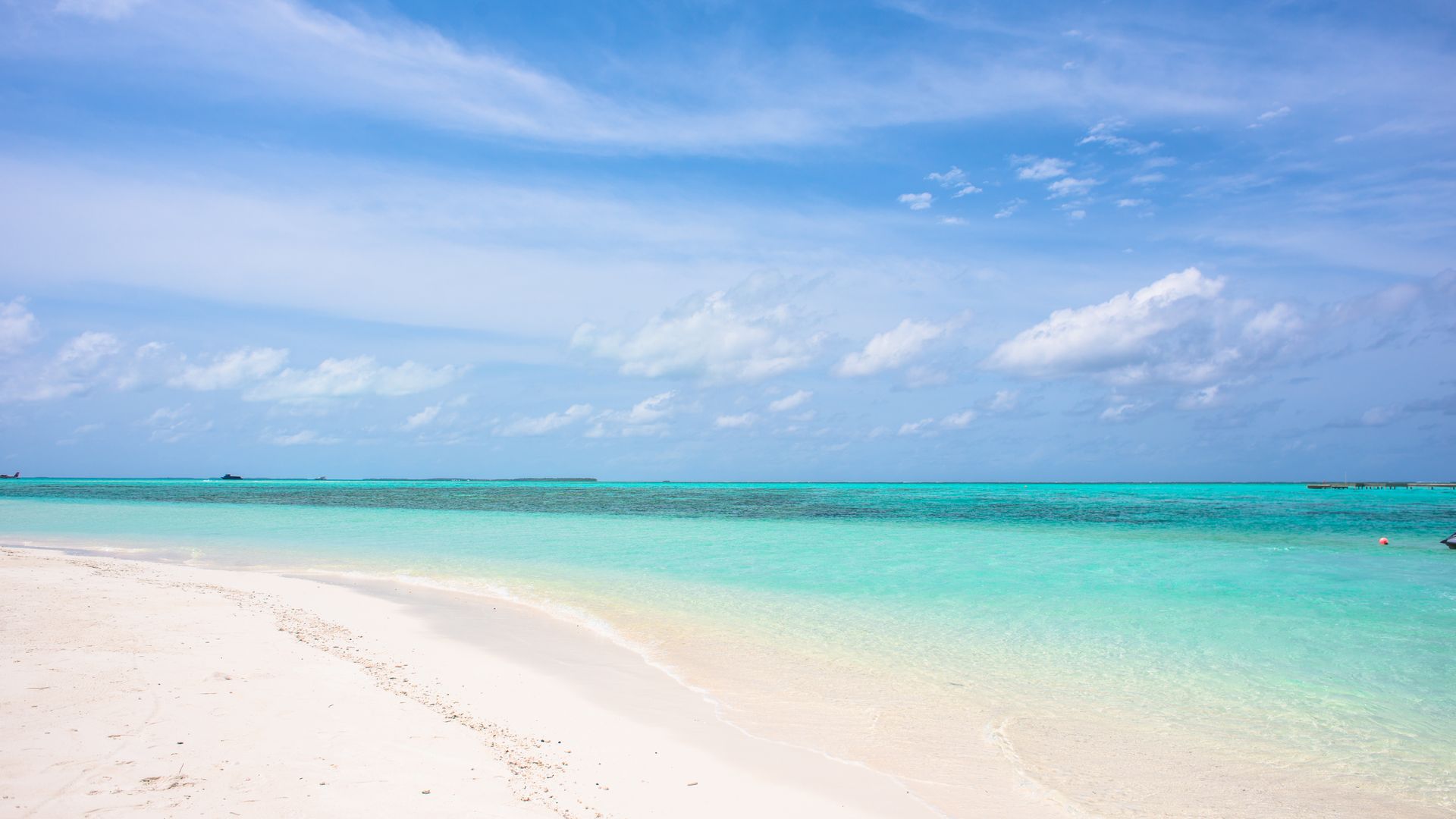
A tropical shoreline where white sand meets turquoise shallows under a pale blue sky, the sea-and-sky blue that gives larimar its color and name
What Is Larimar?
Larimar is the blue variety of pectolite, a sodium calcium silicate with a long chemical name and a short description: a usually white or gray mineral that, in one rare case, grows in shades of blue. The blue comes from copper quietly taking the place of some of the calcium in the crystal structure, not from cobalt, which is a common myth you'll still see repeated by sellers. The result ranges from a pale, milky sky-blue to a deep volcanic blue-green, almost always marbled with white in a pattern collectors call turtleback or sea foam.
It formed the hard way. The blue pectolite grew inside gas pockets in ancient volcanic rock, filling cavities that lava left behind millions of years ago. Erosion later broke that rock down and washed the larimar into streams and out toward the sea, which is how the first pieces were found as water-worn pebbles on a beach rather than dug straight from a mine.
On the Mohs hardness scale, larimar sits around 4.5 to 5. That's harder than soft stones like selenite or celestite but well below quartz, so it lands in a middle zone: wearable as a pendant or earrings with a bit of care, but not something you want to knock around on a daily ring. Keep that number in mind, because it shapes how you should treat a good piece.
What Does Larimar Mean?
At its core, larimar means calm. It's the stone people pick up when they want to cool down, whether that's a racing mind, a short temper, or the kind of anxious energy that won't sit still. Where some blue stones lean toward the sky and the spiritual, larimar leans toward water: soothing, fluid, and a little forgiving. Its reputation is for taking the heat out of a moment, which is why it often turns up alongside the stones in our crystals for anxiety guide.
Its second theme is honest, gentle communication. Because of the blue color and the throat-chakra link, larimar is tied to saying what you mean from a settled place instead of a reactive one. People reach for it before a hard conversation, hoping to speak clearly without the sharp edges.
There's a feminine, oceanic thread running through it too. Larimar is often linked to the sea, to dolphins, and to a soft, receptive energy that people describe as nurturing rather than driving. That watery, yielding quality is a big part of why it feels different in the hand from a bright, energizing stone like citrine or carnelian.
Larimar Healing Properties
In crystal-healing practice, larimar sits with the calming and emotional stones rather than the grounding or protective ones. It's worth saying plainly up front: these are traditional and folk associations, not medical claims, and there's no scientific evidence that any crystal treats a physical or emotional condition. Here's how people describe using it.
Emotionally, larimar is used to ease stress, cool anger, and quiet the kind of anxiety that comes with feeling overwhelmed. Because its energy gets described as watery and soft, people often reach for it during grief or burnout, when a harder, brighter stone feels like too much. Some keep a piece nearby at night for calmer sleep, a use it shares with the stones in our crystals for sleep guide.
On the relationship side, larimar's link to honest speech and heart-centered calm gives it a reputation for cooling conflict between people, especially the sort of argument that heats up faster than either person wants. It turns up in our crystals for love guide for that reason, usually for soothing and clear communication rather than attraction. Folk tradition also credits it with easing tension people carry in the chest and throat, though those are comfort associations, not treatments.
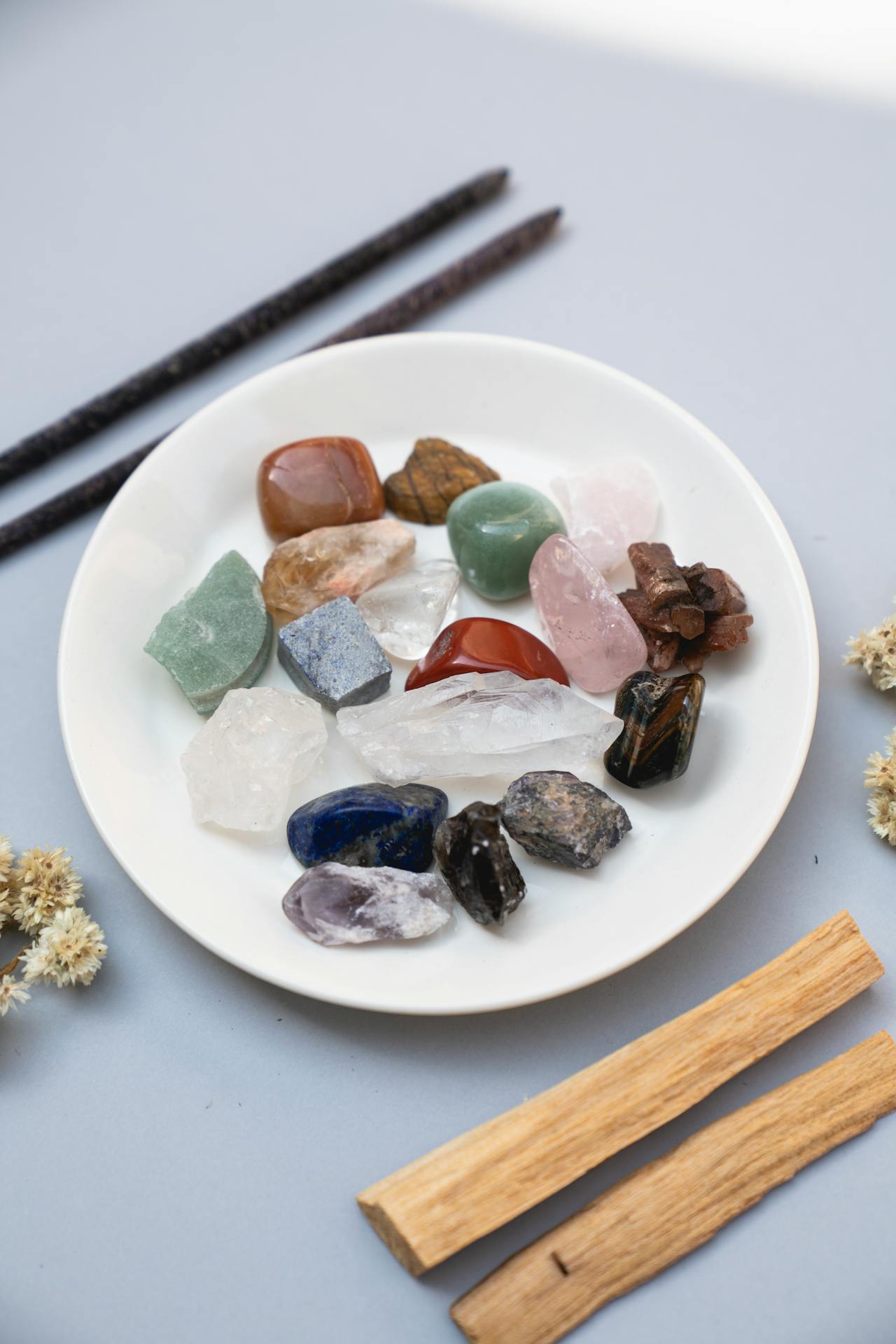
An assortment of polished healing crystals laid out for a quiet meditation practice, the kind of calm setting larimar is reached for
Larimar and the Throat and Heart Chakras
Larimar is mainly a throat and heart stone, and its blue-to-blue-green color is the reason. Its clearest link is the throat chakra, Vishuddha, the center of honest communication and self-expression. A soft blue stone known for calm, truthful speech is a natural fit there, and a lot of larimar's reputation for easy, unforced honesty traces back to this center.
From the throat it reaches down to the heart chakra, Anahata, the center of love and emotional balance. That's where the greener, more turquoise pieces get placed, and it's why larimar is so often described as a bridge between what you feel and what you can actually say. The stone's whole appeal, for a lot of people, is that pairing: a heart settled enough to speak and a throat that can speak without heat.
Some practitioners stretch it upward to the third eye and crown as well, though those links are looser and the sources don't fully agree. If you want the full map of the energy centers and how they stack, our guide to the seven chakras walks through each one in order, and the zodiac and chakras piece connects them to your birth chart.

Crystals arranged for chakra work, the throat and heart centers larimar is most often tied to
Larimar Zodiac Signs and Astrology
Larimar is most often tied to Leo, which surprises people, since Leo is a fire sign and larimar is all cool water. That's the point of the pairing. The stone is said to temper Leo's heat, softening the pride and the quick temper without dimming the warmth, so a fiery sign borrows a little of the sea's patience. It's a loose, modern association rather than an ancient rule.
It's also commonly linked to Pisces and the other water signs, which makes more obvious sense. Pisces lives in feeling, intuition, and the tides of emotion, and a soothing sea-stone fits that current cleanly. Sources diverge here, as they do with most stones: some crystal guides list only Leo, others add Pisces, and a few open it to any water sign, so treat the pairing as a soft fit, not a law. Larimar is not a traditional birthstone tied to a calendar month.
For planetary associations, larimar's oceanic, dreamy side gets linked to Neptune, the planet of the sea and the imagination, while its communicative streak leans toward Mercury. You don't have to be a Leo or a Pisces to use it, though. Our crystal healing by zodiac sign guide lines up stones with all twelve signs so you can match one to your own chart.
Why Is Larimar Called the Atlantis Stone?
Larimar's best-known nickname is the Atlantis Stone, and the story behind it is newer than it sounds. It traces to Edgar Cayce, an American psychic active in the early twentieth century, who is said to have predicted that a blue stone with healing powers would be found on a Caribbean island that was once part of Atlantis. When larimar surfaced in the Dominican Republic in the 1970s, not long after divers found an underwater rock formation near Bimini that some tied to the Atlantis legend, crystal writers connected the two and the nickname stuck.
It's a good story, and it sells stones. It's also worth being clear that it's a story. There's no archaeological or geological evidence linking larimar to a lost continent, and the Cayce prophecy gets passed around mostly in metaphysical and sales writing rather than anywhere you could check it. The stone doesn't need the myth. A rare blue gem that grows in only one spot on the planet is striking enough on its own.
People who follow the Atlantis framing use larimar for meditation on peace, old memory, and a sense of connection to something larger than this one lifetime. Whether you take that literally or just as a nice focus for stillness, the practice is the same: sit with the stone, quiet down, and listen.
Clear blue ocean water meeting the horizon, echoing the Caribbean sea that larimar comes from
Where Does Larimar Come From?
Here's the fact that makes larimar genuinely unusual: it comes from one place on Earth. The only commercial deposit sits in a mountainous stretch of the Barahona Province in the southwest of the Dominican Republic, where miners dig vertical shafts into a hillside near the village of Los Chupaderos to reach the blue pectolite. When that single area runs dry, the world's supply of real larimar runs dry with it, which is a big part of why good stones aren't cheap.
The discovery history is a little tangled. One account has a local priest, Father Miguel Domingo Fuertes Loren, asking permission to mine a blue rock in the area as far back as 1916, a request that was turned down. The stone most people know today was popularized in 1974, when a Dominican man named Miguel Mendez and a US Peace Corps volunteer, Norman Rilling, came across larimar pebbles washed up on a beach at the foot of the mountains. Mendez gave it the name, combining his daughter Larissa's name with mar, the Spanish word for sea. Larissa plus the sea: Larimar.
That one-deposit reality is why the stone is so tied to the Caribbean and why the fakes are worth watching for. When a material can only come from a single hillside, anything cheap and plentiful labeled larimar deserves a second look.
Larimar vs Turquoise vs Aquamarine
Three blue stones get compared to larimar constantly, so here's how to keep them straight. Turquoise is an opaque blue-to-green copper-and-aluminum mineral, often with dark veining, and it carries a long history as a protection and travel stone across many cultures. Larimar is softer, more translucent in places, and patterned with white rather than veined with brown or black, and its reputation leans toward calm and communication rather than protection.
Aquamarine is the blue member of the beryl family, the same mineral group as emerald. It's harder than larimar, usually clearer and more see-through, and its blue is cooler and more even, without larimar's marbled turtleback look. Aquamarine is a traditional March birthstone with its own sea associations, while larimar has no birthstone month at all.
If you're choosing between them, it often comes down to look and durability. Aquamarine is the tougher, glassier blue you can wear hard. Turquoise is the earthy, protective blue with deep cultural roots. Larimar is the rare, painterly sea-and-sky blue you buy for its pattern and its calm, and the one you have to treat the most gently of the three.
Does Larimar Fade? Sunlight, Heat, and Water
Yes, larimar can fade, and this is the single most useful thing to know before you buy a nice piece. Prolonged direct sunlight and heat can wash the blue out over time, leaving it paler and grayer, and the change doesn't reverse in the shade. A larimar pendant worn every sunny day, or a stone left on a bright windowsill, can slowly lose the color you paid for. Keep it out of long sun exposure and away from heat sources.
Water is less of a crisis than it is for celestite, but larimar still shouldn't soak. It's reasonably stable, yet it's porous enough that long baths and harsh cleaners can dull the surface, and anything acidic should be kept well away. Wipe it with a soft damp cloth and dry it, and skip the water-cleansing rituals that suit quartz.
The hardness matters here too. At 4.5 to 5 on the Mohs scale, larimar scratches more easily than most stones people wear, so store it on its own, keep it off hard surfaces, and take rings or bracelets off before anything rough. Treated gently, a good piece holds its sea-blue for years. Treated like a quartz, it won't.
How to Tell Real Larimar From Fakes
Because real larimar comes from one small deposit and sells at a premium, fakes are common, and most of them are dyed look-alikes. The usual stand-in is dyed howlite or magnesite, both naturally white stones that take blue dye easily and get sold as larimar to buyers who don't know the pattern. The tell is the pattern itself: real larimar has that irregular turtleback marbling of blue and white, sometimes with faint red or brown flecks, while dyed stones show color pooling in cracks or a flat, too-even blue with no depth.
Pressed and reconstituted pieces exist too, made from larimar powder or chips bonded with resin, along with straight plastic and glass copies aimed at the cheap jewelry market. Resin and glass tend to feel warm and light in the hand, may show tiny trapped bubbles, and lack the cool, slightly waxy feel of the real stone. A suspiciously low price is its own warning, since genuine larimar is never cheap to begin with.
The most reliable move is the same one that protects you with any stone: buy from a seller who names the mineral as blue pectolite and the source as the Dominican Republic, and who can speak to the pattern and grade. If you like matching stones to the calendar, our birthstones guide covers the traditional options by month, though larimar isn't one of them.
Does Larimar Actually Work?
Here's the honest answer this site always gives. There's no scientific evidence that larimar, or any crystal, gives off a measurable energy, cools your emotions on its own, or connects you to a lost continent. If you're dealing with real anxiety, anger you can't manage, or grief, a stone is not a substitute for the things that genuinely help, from therapy and good sleep to the people who care about you.
What larimar can honestly offer is a focus object and a cue. Holding a cool, sea-colored stone before a hard conversation, or keeping one where you meditate, can anchor an intention you've already set around staying calm and speaking clearly. That anchor is real. For a lot of people, the small ritual of picking up a stone and taking a slow breath does help them settle, and the color nudges the mind toward water and ease.
Used that way, as a prompt rather than a power, larimar earns its place. It's a rare, lovely stone the color of a Caribbean afternoon, and if it gets you to pause and cool down before you speak, that's worth something real, no magic required.
How to Use and Care for Larimar
For calm and communication, keep larimar where you'll reach for it: worn as a pendant near the throat and heart, tucked in a pocket for a stressful day, or held during meditation when you want to cool off. It works well at the center of a crystal grid built around peace, honest speech, or emotional healing, and it pairs naturally with other soothing stones like aquamarine and amazonite. New to all this? Our healing crystals for beginners guide covers choosing and working with stones from scratch.
Care is where larimar asks a little more of you, because of the sun, heat, and softness issues above. Keep it out of prolonged sunlight to protect the blue, store it apart from harder stones so it doesn't get scratched, and take jewelry off before anything rough or chemical. Clean it with a soft, barely damp cloth, and skip ultrasonic cleaners entirely.
For cleansing and charging, stick to gentle, dry methods. Pass it through smoke, rest it on a selenite plate, use sound, or set it under the moon rather than the sun. The same careful approach is covered in our guide to cleansing and charging crystals, and it keeps a good piece looking its best for years.
Frequently Asked Questions
What is larimar good for?
Larimar is best known as a calming stone for stress, anger, and anxious energy, and as a throat-and-heart stone for honest, gentle communication. People use it in meditation and before hard conversations. These are traditional associations, not proven effects, so treat it as a focus for calm rather than a cure.
Where does larimar come from?
Larimar comes from a single deposit in the Barahona Province of the Dominican Republic, and nowhere else on Earth. It's a blue variety of the mineral pectolite that formed in volcanic rock and was first found as water-worn pebbles on a nearby beach. That one-source rarity is why genuine larimar is never cheap.
Can larimar go in water and sunlight?
Keep it out of both when you can. Larimar can fade permanently in prolonged sunlight and heat, so it's not an everyday-in-the-sun stone, and while it tolerates water better than celestite, long soaking and harsh cleaners can dull it. Wipe it with a soft damp cloth and cleanse it with smoke, sound, or moonlight.
Why is larimar called the Atlantis Stone?
The nickname comes from the psychic Edgar Cayce, who is said to have predicted a blue healing stone would be found on a Caribbean island once tied to Atlantis. When larimar surfaced in the Dominican Republic in the 1970s, writers connected it to that prophecy. It's a modern metaphysical story, not a historical or scientific fact.
Is larimar expensive?
Good larimar isn't cheap, and the reason is simple supply. It comes from one small mining area, so prices rise with the strength and evenness of the blue, with deep volcanic-blue pieces costing the most and pale, heavily white-marbled stones costing less. If a larimar piece looks like a bargain, check carefully that it isn't dyed howlite.
Bringing It Together
Larimar is the rare sea-and-sky stone of the crystal world, a blue variety of pectolite valued for calm, honest speech, and the cooling of hot emotions, tied to the throat and heart chakras and to signs like fiery Leo and watery Pisces. Its story rests on one unusual fact: it comes from a single hillside in the Dominican Republic and nowhere else, which makes its Atlantis legend almost beside the point. Used honestly, as a cue to cool down and speak from a settled place rather than a magic charm, and kept out of the sun and heat its blue can't survive, it earns a lasting place in a collection.
Curious how your own water and air sit in your chart? Build your free natal chart to find your Moon, Mercury, and Neptune placements, pull a tarot reading when your emotions won't settle, or check your compatibility with someone you want to speak to more clearly.