Prehnite Meaning: Healing Properties, Uses, and the Stone That Heals the Healer
Prehnite is the soft green stone that looks like a cluster of frosted grapes, and its meaning centers on calm, letting go, and the quiet renewal of someone who gives a lot and runs low. People reach for it when they feel stretched thin, when they're holding too much for other people, or when they want to clear out the clutter in a drawer or a crowded mind. It carries a gentle, forgiving kind of energy rather than a bright or forceful one.
It's also a stone with a long reputation for healing the healer, which is where a lot of its following comes from. Prehnite is a calcium aluminum silicate that grows in rounded, bubbly clusters, often alongside dark needles of a second mineral called epidote, and its best-known nickname ties it to intuition and prophecy. Here's what prehnite actually means, how people use it, how it links to the heart and solar plexus chakras and to signs like Libra and Virgo, plus the honest facts about where it comes from, how to tell it apart from jade, and whether it does anything at all.
What You'll Learn
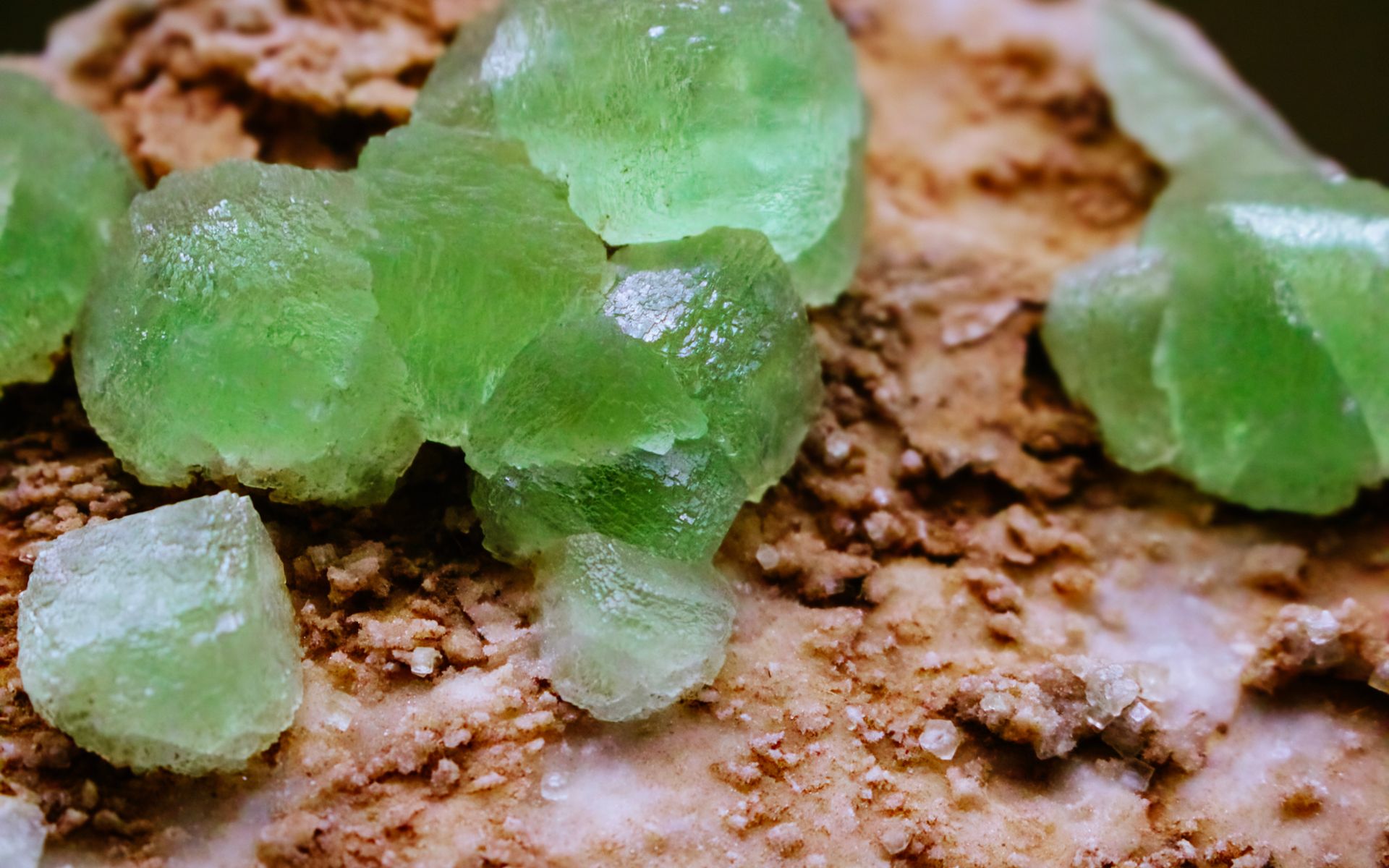
Rounded, translucent green mineral crystals clustered on a tan rock matrix, the bubbly botryoidal habit and pale green color typical of prehnite
What Is Prehnite?
Prehnite is a calcium aluminum silicate, a pale green to yellow-green mineral that's usually translucent and often grows in rounded, lumpy masses that collectors call botryoidal, from the Greek word for a bunch of grapes. That bubbly, grape-cluster habit is one of the easiest ways to recognize it. The color runs from a milky sea-green to a warm yellow-green, sometimes nearly colorless, with an inner glow that makes a good piece look lit from within.
Its name has an unusually specific origin. Prehnite was named after Colonel Hendrik von Prehn, a Dutch military officer who carried samples from South Africa back to Europe in the late 1700s, and the mineralogist Abraham Gottlob Werner described it in 1788. It's widely cited as the first mineral ever named after a person, a small distinction that made it a bit of a landmark in how minerals got their names. Even if you set that claim aside, naming a green stone after a soldier who shipped it across an ocean is a memorable start.
On the Mohs hardness scale, prehnite sits around 6 to 6.5. That's roughly the hardness of a steel file and firmer than softer stones like selenite or larimar, so it holds up reasonably well as a tumbled stone or a cabochon pendant. It isn't as tough as jade, though, and it can chip on a sharp knock, so it still wants a little care.
What Does Prehnite Mean?
At its core, prehnite means letting go. It's the stone people associate with release, decluttering, and trusting that you'll have enough once you stop clinging to the extra. That theme shows up both literally, as a stone some keep near a desk or closet while they clear it out, and emotionally, as a cue to put down worry you've been carrying past its usefulness.
Its second theme is unconditional love, aimed as much at yourself as at anyone else. Prehnite gets called the stone of unconditional love in a lot of crystal guides, and the meaning there leans toward compassion without strings, the kind you extend to a friend having a hard week. Because of that, people often reach for it alongside the gentler stones in our crystals for anxiety guide when they want to soften how they talk to themselves.
There's a forward-looking thread too. Prehnite is sometimes called the stone of prophecy or the stone of vision, tied to intuition, inner knowing, and a calm sense that things will work out. Taken together, those three strands, release, gentle love, and quiet trust, give prehnite a settled, unhurried feel in the hand that sets it apart from a bright, driving stone like citrine or carnelian.
Prehnite Healing Properties
In crystal-healing practice, prehnite sits with the calming and heart-centered stones rather than the grounding or protective ones. It's worth saying plainly up front that these are traditional and folk associations, not medical claims, and there's no scientific evidence that any crystal treats a physical or emotional condition. Here's how people describe using it.
Emotionally, prehnite is used to ease anxiety, quiet an overactive mind, and soften the restless feeling of having too much to hold. Because its energy gets described as calming and renewing, people reach for it during burnout or caregiver fatigue, when a harder or flashier stone feels like the wrong fit. Some keep a piece nearby at night for steadier rest, a use it shares with the stones in our crystals for sleep guide.
On the relationship side, prehnite's link to compassion and heart-centered calm gives it a reputation for easing tension and helping people give without resentment. It turns up in our crystals for love guide for that reason, usually for self-compassion and gentle connection rather than attraction. Folk tradition also credits it with helping the body's own healing and with calming nervous energy, though those are comfort associations, not treatments, and a stone is never a substitute for care from a doctor.
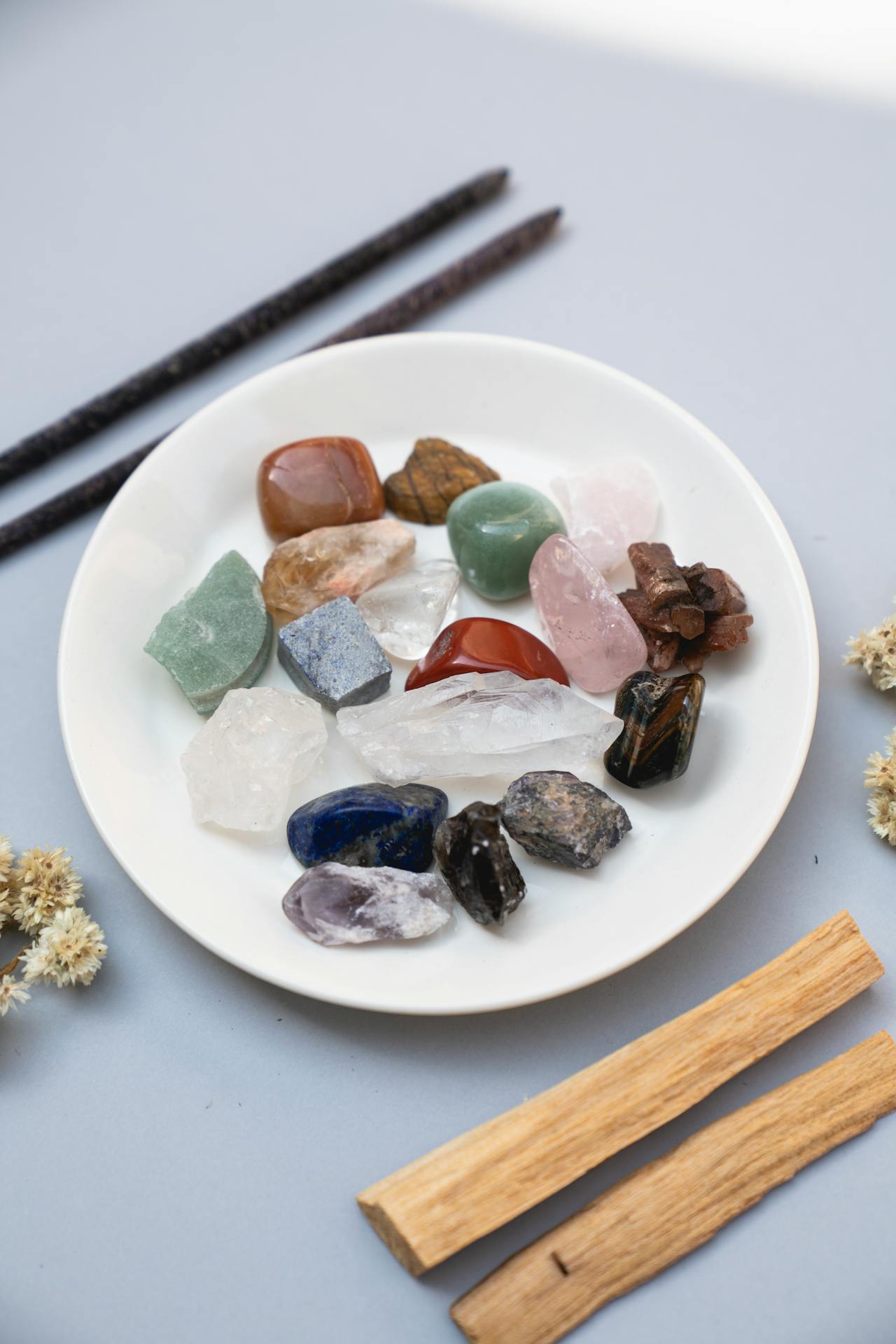
An assortment of polished healing crystals laid out for a quiet meditation practice, the kind of calm setting prehnite is reached for
The Stone That Heals the Healer
If prehnite has one signature, this is it. It's long been called the stone that heals the healer, and the idea is specific: it's for the person who pours out for everyone else and forgets to refill their own cup. Nurses, therapists, teachers, caregivers, and anyone who absorbs other people's stress for a living are the classic audience for it.
The reasoning behind the nickname is simple once you lay it out. A healer who gives all day ends up depleted, a little resentful, and prone to burnout, and prehnite's cluster of meanings, release what you're holding, soften how you treat yourself, trust that you'll be okay, lines up almost exactly with what a drained caregiver needs to hear. Whether or not a stone can deliver any of that, the message it stands for is a good one, and holding a reminder of it isn't a bad habit.
Some crystal writers extend this into the idea of an Archangel Raphael connection, Raphael being the healing angel in several traditions, and link prehnite to professional and energy healers like Reiki practitioners. Treat that as modern metaphysical lore rather than old or verifiable history. The practical takeaway survives the skepticism: if you spend your days taking care of other people, a cue to take care of yourself has real value.
Prehnite and the Heart and Solar Plexus Chakras
Prehnite is mainly a heart and solar plexus stone, and its green-to-yellow color is the reason. Its clearest link is the heart chakra, Anahata, the center of love, compassion, and emotional balance. A soft green stone tied to unconditional love and self-kindness fits that center cleanly, and much of prehnite's reputation for gentleness traces back to it.
The yellow-green pieces reach down to the solar plexus chakra, Manipura, the center of personal power, confidence, and will. That pairing is part of why prehnite is described as a bridge between the heart and the gut, between caring for others and keeping something back for yourself. The stone's whole appeal, for a lot of people, is that balance: an open heart that doesn't empty itself out.
Some practitioners stretch it upward to the third eye as well, leaning on the stone of vision nickname, though that link is looser and the sources don't fully agree. If you want the full map of the energy centers and how they stack, our guide to the seven chakras walks through each one in order, and the zodiac and chakras piece connects them to your birth chart.
A green forest path in soft light, the heart-chakra green that prehnite is most often tied to
Prehnite Zodiac Signs and Astrology
Prehnite is most often tied to Libra, the sign of balance, fairness, and relationships. The fit makes sense. Libra's whole project is keeping the scales even, between self and other, giving and receiving, and prehnite's theme of loving without emptying yourself lands right in that space. It's a loose, modern association rather than an ancient rule.
It's also commonly linked to Virgo, and that pairing speaks to a different side of the stone. Virgo tends toward helping, worrying, and carrying other people's problems, which is exactly the overextended pattern prehnite is said to soothe. A few guides add Scorpio or Capricorn, and as with most stones, the sources diverge, so treat the pairing as a soft fit rather than a law. Prehnite is not a traditional birthstone tied to a calendar month.
If you'd like to see where the gentler, more relational planets sit in your own chart, our piece on finding your Venus sign is a good place to start, since Venus governs how you love and what you value. You can also browse crystal healing by zodiac sign for stones matched to your whole chart, and the birthstones and zodiac guide for the traditional calendar links.
What Is Prehnite With Epidote?
One of the most common forms you'll see for sale is prehnite with epidote, and it's worth understanding what you're looking at. Epidote is a separate dark green to black mineral that often grows right inside or across prehnite, showing up as sharp needles, streaks, or tufts against the soft green. The two form together in the same volcanic cavities, so the pairing is natural, not a manufactured combination.
Visually it's a striking stone, with the pale cloudy green of prehnite shot through with dark, almost grassy lines of epidote. Collectors prize the contrast, and some pieces look like a tiny green landscape caught in rock. If you see fine black needles in a green cabochon labeled prehnite, epidote is almost always what they are.
Metaphysically, people treat the combination as prehnite's calm and release paired with epidote's reputation for clearing out stuck or negative patterns, so the blend gets described as good for letting go of old habits. Those are folk associations rather than tested effects, but the visual appeal alone is a solid reason the epidote form stays popular.
Where Does Prehnite Come From?
Prehnite forms in the gas pockets and cracks of volcanic rock, usually alongside minerals like epidote, quartz, and various zeolites, which is why you so often find it on a matrix rather than as a loose crystal. It's a fairly widespread mineral, found on several continents, so unlike the single-deposit rarity of a stone like larimar, prehnite comes from many places.
The classic source is South Africa, near the Cape of Good Hope, where von Prehn's original samples came from. Today, some of the most prized material comes from Australia, especially gem-quality yellow-green pieces, and from Mali in West Africa, which produces a sunny, almost lemon-colored prehnite that cutters love. Other notable deposits turn up in China, Scotland, India, and the United States.
Because it's not rare, prehnite stays affordable, which is part of its appeal for people building a collection. Price tracks the quality of the color and the clarity, with clean, evenly colored pieces and good epidote specimens costing more than cloudy, pale ones, but you won't pay anything close to what a fine jade or emerald commands.
Prehnite vs Jade, Green Aventurine, and Fakes
Prehnite's soft green gets it confused with a few other stones, and knowing the differences helps you buy with confidence. Jade is the usual mix-up, but jade is far tougher, tends toward a denser and more opaque look, and lacks prehnite's translucent, lit-from-within glow and grape-cluster habit. Prehnite is usually a little more see-through and a little softer underfoot, so to speak.
Green aventurine is the other common comparison. Aventurine is an opaque quartz with a sparkly shimmer called aventurescence from tiny mica flecks, while prehnite is cloudy and glowing rather than sparkly. If it glitters, it isn't prehnite. Some sellers also confuse it with green opal, chrysoprase, or grossular garnet, each of which has its own look once you compare them side by side.
As for outright fakes, the usual tricks are dyed green quartz, green glass, and treated or color-enhanced material sold without disclosure. Glass often gives itself away with trapped round bubbles and a too-even color, while natural prehnite has the slightly uneven, foggy green and the botryoidal shape no mold reproduces well. When in doubt, buy from a seller who names the source and is clear about any treatment.
Does Prehnite Actually Work?
Here's the honest answer this site always gives. There's no scientific evidence that prehnite, or any crystal, gives off a measurable energy, heals a healer, or sharpens your intuition on its own. If you're dealing with real burnout, anxiety, or the kind of depletion that comes from caring for others, a stone is not a substitute for rest, boundaries, therapy, and the people who support you.
What prehnite can honestly offer is a focus object and a cue. Holding a calm green stone while you clear a cluttered space, or keeping one where you work, can anchor an intention you've already set about letting go and taking care of yourself. That anchor is real. For a lot of people, the small ritual of picking up a stone and taking a slow breath genuinely helps them settle, and the stone's meaning nudges the mind toward release and self-kindness.
Used that way, as a prompt rather than a power, prehnite earns its place. It's a gentle, glowing green stone with a message worth remembering, and if it gets a tired caregiver to pause and refill their own cup, that's worth something real, no magic required.
How to Use and Care for Prehnite
For calm and release, keep prehnite where you'll reach for it: worn as a pendant near the heart, tucked in a pocket on a draining day, or held during meditation when you want to put something down. It works well at the center of a crystal grid built around self-care, letting go, or emotional healing, and it pairs naturally with other heart stones like rose quartz and green aventurine. New to all this? Our healing crystals for beginners guide covers choosing and working with stones from scratch.
Care is simple, with two cautions. Prehnite tolerates brief contact with water thanks to its middling hardness, but it isn't a stone to soak for hours, and prolonged sunlight can dull its soft green over time, so skip sunbathing it. Store it apart from harder stones so it doesn't get scratched, take jewelry off before anything rough, and clean it with a soft, barely damp cloth.
For cleansing and charging, gentle methods suit it best. Pass it through smoke, rest it on a selenite plate, use sound, or set it under the moon rather than the sun. The same approach is covered in our guide to cleansing and charging crystals, and it keeps a good piece glowing for years.
Frequently Asked Questions
What is prehnite good for?
Prehnite is best known as a calming stone for letting go, decluttering, and self-compassion, and as a heart-and-solar-plexus stone for people who give a lot and run low. It's often used in meditation and kept near a workspace. These are traditional associations, not proven effects, so treat it as a focus for calm rather than a cure.
Why is prehnite called the stone that heals the healer?
The nickname points to its reputation among caregivers, therapists, and energy healers, the people who spend their days tending to others and end up depleted. Prehnite's themes of release, gentle self-love, and trust line up with what a drained giver needs, so it's framed as a reminder to refill your own cup. That's folklore, not medicine.
Can prehnite go in water and sunlight?
Brief water contact is fine because prehnite is reasonably hard, but don't soak it for long or use harsh cleaners. Keep it out of prolonged sunlight, which can slowly fade its soft green. Wipe it with a soft damp cloth and cleanse it with smoke, sound, or moonlight instead of a sunny windowsill.
What is the difference between prehnite and jade?
Jade is far tougher and usually denser and more opaque, while prehnite is softer, more translucent, and glows from within rather than looking solid. Prehnite also tends to grow in rounded, grape-like clusters that jade doesn't. If a green stone is see-through with a cloudy inner light, it's more likely prehnite than jade.
Is prehnite expensive?
Prehnite is affordable compared with stones like jade or emerald because it's found in many places rather than one rare deposit. Price depends on color and clarity, so clean, evenly colored pieces and attractive prehnite-with-epidote specimens cost more than pale, cloudy ones, but good material stays within easy reach for most collections.
Bringing It Together
Prehnite is the soft green stone of release and renewal, a calcium aluminum silicate valued for letting go, gentle self-love, and quiet trust, tied to the heart and solar plexus chakras and to signs like balanced Libra and helpful Virgo. Its story rests on one memorable idea: it's the stone that heals the healer, the reminder for anyone who gives all day to save a little for themselves. Used honestly, as a cue to put something down and refill your own cup rather than a magic charm, and kept out of long sun and hard knocks, it earns a lasting place in a collection.
Curious how your own giving and receiving sit in your chart? Build your free natal chart to find your Venus, Moon, and Libra placements, pull a tarot reading when you feel stretched too thin, or check your compatibility with someone you keep pouring energy into.